
An omnichannel marketing strategy links every channel, online and offline, into one coordinated system built around a single customer, not a single campaign. It works because it removes the friction that makes people abandon a purchase halfway through. The first move isn't picking new channels. It's auditing what data you already have and unifying it into one customer view before you touch a single ad platform.
TL;DR:
- Connecting online and offline customer data is essential, as 81% of retail shoppers research online before purchasing in physical stores, and 60 to 70% blend methods when deciding.
- Building a unified customer profile through CRM and CDP systems, along with clear data taxonomy, is a prerequisite for effective omnichannel orchestration.
- Pilot programs focused on one high-volume, friction-prone journey pattern, such as BOPIS or event-to-nurture, provide the best foundation for scaling success.
- Data silos and governance gaps are the most common blockers, and fixing data quality and assigning a single ownership for the customer journey are critical early steps.
- Omnichannel success depends on prioritizing data unification and process discipline over technology, with a focus on real-time personalization and measurement accuracy.
Table of Contents
- What Is an Omnichannel Marketing Strategy?
- Why Omnichannel Marketing Matters for Revenue
- What Are the Core Components of an Omnichannel System?
- How Do You Build an Omnichannel Marketing Strategy?
- Which Channels Should You Include and What Role Should Each Play?
- What Technology and Data Architecture Does Omnichannel Require?
- How Do You Orchestrate Campaigns Across Channels?
- What KPIs Actually Measure Omnichannel Performance?
- What Are Proven Omnichannel Campaign Patterns You Can Copy?
- What Are the Biggest Blockers to Omnichannel Success?
- How Does an Agency Actually Run an Omnichannel Project?
- What's the Future of Omnichannel Marketing?
- How Crowdcompany Builds Omnichannel Programs for Local Businesses
- Sources
What Is an Omnichannel Marketing Strategy?
An omnichannel marketing strategy treats every touchpoint, your website, your store, your email list, your social ads, your text messages, as one connected system rather than a set of separate campaigns. The goal isn't presence on more platforms. It's continuity: a shopper who browses your app at lunch and walks into your store that evening should get treated like the same person, because they are.
That distinction is where most marketing teams get confused, so it's worth separating three terms people use interchangeably but shouldn't.
Multichannel marketing means you're active on several channels, email, Instagram, in-store signage, but they run independently. Each channel has its own goals, its own message, sometimes its own budget owner. Nothing talks to anything else.
Cross-channel marketing adds a layer of coordination. Two or three channels share data or timing, maybe your email retargets someone who abandoned a cart on your site. It's connected, but partial.
Omnichannel is the full version: every channel pulls from the same customer profile and hands off context to the next one. If a customer calls your store after browsing your site, the person answering the phone should be able to see what they looked at.
Picture a customer who sees an Instagram ad for a pair of running shoes, clicks through to browse sizes on the website, abandons the cart, then gets a text with a discount code tied to that exact abandoned item, walks into the physical store to try them on, and completes the purchase at the register using that same code. Every stage recognized the same shopper. That's the model. Adobe's omnichannel framework centers on exactly this kind of unified customer data model connecting digital and in-person experience.
Why Omnichannel Marketing Matters for Revenue
The business case isn't theoretical. Shoppers are already blending online and offline research whether your systems track it or not, and companies that fail to connect those dots are measuring a fraction of what's actually driving sales.
Invoca reports that 81% of retail shoppers research online before buying in a physical store, and other industry data shows 60 to 70% of shoppers blend both online and offline methods when deciding what to buy. If your marketing attribution only credits the last digital click, you're systematically undercounting the channels that actually moved the customer toward a decision.
The revenue signal is bigger than most teams assume. Forrester's analysis found that even a single-point improvement in customer experience score can translate into more than a billion dollars in additional revenue for large companies. Coordinated, low-friction journeys aren't a nice-to-have layered on top of marketing. They're a direct lever on the top line.
Where does omnichannel pay off fastest? Retail and DTC brands with a physical location see the clearest lift, because the online-to-offline handoff is where most of the friction (and most of the missed revenue) lives. B2B companies benefit differently: Gartner's 2025 survey found that a majority of B2B buyers now prefer purchasing paths that involve no sales rep interaction at all, which means your digital self-service journey has to carry weight it never used to carry. Ignore that shift and you're asking buyers to do something most of them no longer want to do.
What Are the Core Components of an Omnichannel System?
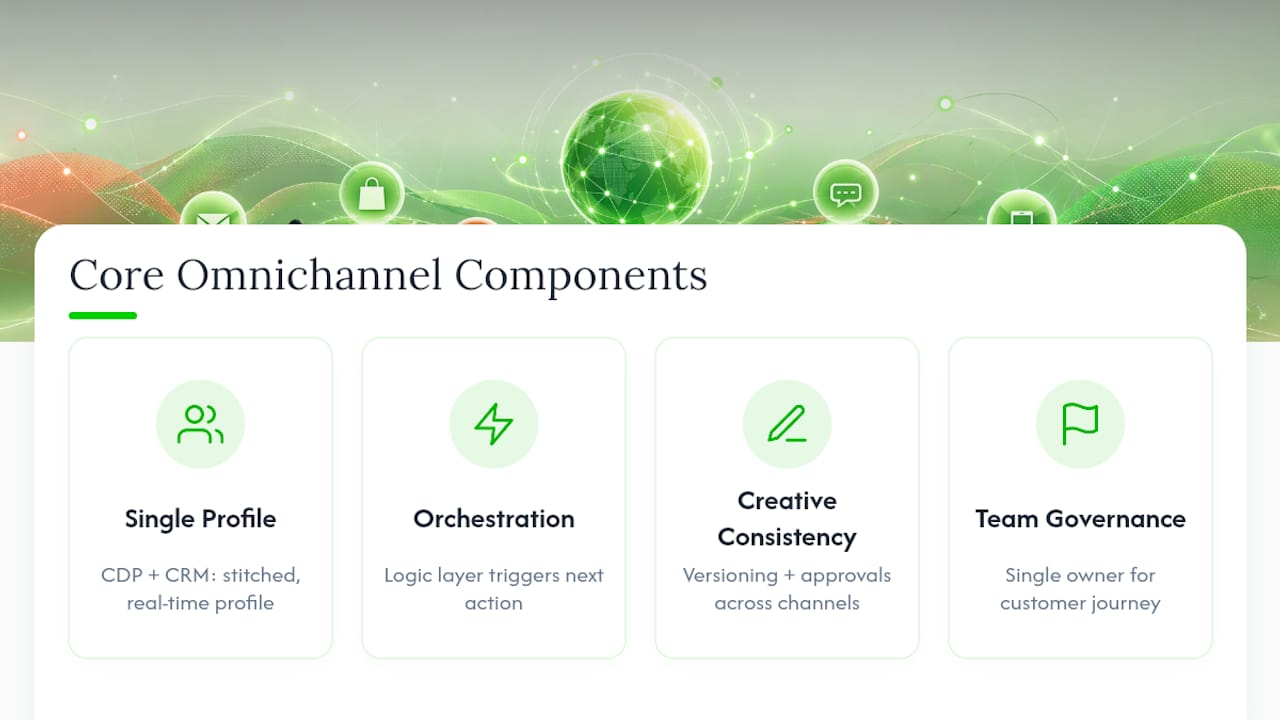
Four things have to exist before an omnichannel program works at any real scale, and skipping one of them is usually why a pilot stalls out after a promising first month.
A single customer profile. Your CRM tracks relationships and sales history. A customer data platform (CDP) goes further, stitching together behavioral signals, purchase events, and identity across devices and channels into one profile updated in real time. You need both, but they do different jobs: CRM manages the relationship, CDP powers the personalization engine that decides what that customer sees next. Monday treats a single source of truth as the non-negotiable foundation everything else sits on.
Orchestration and sequencing. This is the logic layer that decides what happens next after a customer takes an action, an email after a cart abandonment, a push notification after three site visits without a purchase, a store associate alert after a high-value customer walks in. Without orchestration, your unified data just sits there looking impressive.
Creative and messaging consistency. Content versioning matters more than teams expect. If your email promotes a sale your landing page doesn't reflect, or your in-store signage contradicts your app pricing, you've broken the trust that omnichannel is supposed to build. Approval workflows that check consistency across channels before launch catch this before customers do.
Team governance. Someone has to own the handoffs. When email, paid social, and in-store teams all report to different managers with different KPIs, coordination becomes optional instead of required. The strongest omnichannel programs assign a single owner for the customer journey itself, not just for individual channels.
How Do You Build an Omnichannel Marketing Strategy?
Building this correctly follows a sequence. Skip steps and you'll spend months bolting tools together that never quite talk to each other.
-
Audit your current channels, data, and gaps. List every channel you use today, then list what data each one captures and where that data lives. Most teams discover their "customer view" is actually four or five disconnected spreadsheets and platform dashboards that never sync.
-
Map the actual customer journey, not the ideal one. Pull real behavioral data and trace how customers move between your channels today. Where do they drop off? Where do they bounce between devices? monday.com's approach to journey mapping treats this stage as diagnostic, not aspirational: you're documenting reality before you redesign it.
-
Define what each channel is supposed to do. Not every channel earns the same job. Email might own retention, paid social might own awareness, your store might own conversion for high-consideration purchases. Assign one primary role per channel and a KPI to match it.
-
Unify your data and build an event taxonomy. This is the technical backbone. Decide what counts as an "event" (page view, add-to-cart, in-store scan, email open) and name those events consistently across every platform before you connect anything. Sloppy naming here creates measurement problems that take months to untangle later.
-
Pilot one orchestration flow end-to-end before expanding. Pick a single pattern, say, an online ad that drives a reserved in-store pickup, and build the full automated flow: trigger, sequence, fallback, and measurement. Get that one pattern working reliably before you try to instrument everything at once.
-
Set up governance and dashboards. Assign a journey owner, establish an approval workflow for cross-channel campaigns, and build a dashboard that shows the pilot's performance in real time, not in a monthly report that arrives too late to adjust anything.
-
Iterate, then scale what worked. Once your pilot hits its KPI targets, document the template, the taxonomy, and the workflow, then apply that same structure to your next channel pairing. Scaling too early, before the first pattern is stable, is the single most common reason omnichannel projects collapse under their own complexity.
Pro Tip: Resist the urge to instrument every channel in month one. Pick the customer journey with the highest volume and the most obvious friction point, fix that one completely, and use it as the template for everything that comes after.
Which Channels Should You Include and What Role Should Each Play?
Not every channel deserves equal investment, and treating them as interchangeable is how budgets get wasted on platforms that overlap instead of complement each other. Pick channels based on where your actual customers already spend attention, then assign each one a distinct job in the journey rather than letting all of them chase the same conversion.
A few decision criteria worth applying before you add any channel to the mix:
- Does this channel reach a meaningful share of your existing customer base, or are you adding it because a competitor uses it?
- Can you actually capture usable data from it, or will it become a black box you can't tie back to revenue?
- Does it fill a role no other channel already covers, or is it duplicating what email or paid social already does?
- Do you have the staffing to maintain it, or will it go stale within a quarter?
Once a channel clears those questions, give it one job. A retail brand might run paid social purely for awareness, email for retention and win-back campaigns, SMS for time-sensitive promotions, and the physical store as the primary conversion point for anyone who's browsed online first. A DTC brand selling higher-consideration products often flips that: the website owns conversion, and retargeting ads exist purely to bring abandoners back.
B2B companies play a different game entirely. Given how many buyers now prefer a rep-free purchasing path, the website and self-service portal often need to handle the full journey from awareness through purchase, with sales outreach reserved for high-value accounts that specifically request human contact.
What Technology and Data Architecture Does Omnichannel Require?
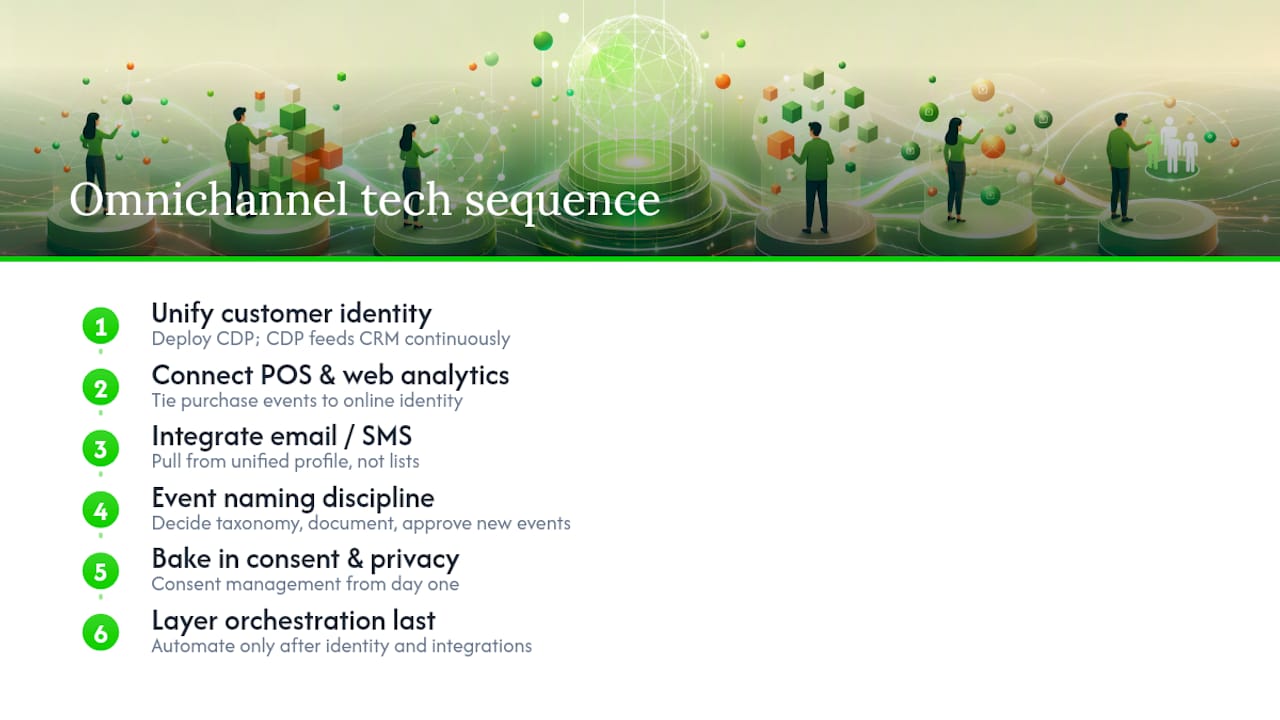
The CRM versus CDP question trips up more teams than it should. Your CRM is built to manage individual relationships, contact records, deal stages, support tickets. A CDP is built to unify behavioral and transactional data across every channel into one profile that updates continuously and feeds other systems in real time. If you're a small operation with a handful of channels, a well-configured CRM might carry you further than you'd expect. Once you're running five or more channels with real volume, you need a CDP feeding data back into the CRM, not the other way around.
Three integrations matter more than the rest: your point-of-sale system connecting purchase events to online identity, your website analytics tracking behavior against that same identity, and your email/SMS platform pulling from the unified profile instead of its own isolated list. Shopify's guidance on unified commerce points to POS-driven personalization as one of the most underused levers retailers have, largely because so few connect in-store purchase history back into the digital experience at all.
Event naming discipline sounds boring until you're six months into a project trying to reconcile "purchase_complete" in one system with "order_confirmed" in another. Decide the taxonomy before you build anything, document it somewhere every team can access, and treat any new event type as something that needs approval before it goes live.
Privacy considerations aren't optional overhead here, they shape what you can even build. Consent management has to be baked into your data architecture from day one, not added after a legal review flags it.
One long-term item worth flagging early: GS1 US's sunrise 2027 guidance signals coming changes to product identifier standards that will ripple through commerce systems. If you're building a data architecture meant to last, account for identifier flexibility now rather than hardcoding assumptions you'll have to rebuild later.
Sequence matters: unify your customer identity first, connect POS and web analytics second, and only then layer in orchestration and automation. Building automation on top of fragmented data just automates the fragmentation.
How Do You Orchestrate Campaigns Across Channels?
Orchestration is the rulebook that decides what happens after a customer does something. Three concepts make up nearly every flow: a trigger (the customer action that starts the sequence), a sequence (the ordered steps that follow), and a fallback (what happens if a channel doesn't respond or data arrives late).
A working flow, and the checklist to build it:
- Define the trigger precisely (cart abandonment after 30 minutes, not "customer seems interested").
- Map the full sequence across channels, including timing gaps between each step.
- Build a fallback path for when data lags, if in-store purchase confirmation takes 24 hours to sync, don't fire a "you abandoned your cart" email in the meantime.
- Assign an owner for each handoff point between teams (paid media handing to email, email handing to SMS).
- Set a kill switch, a rule for pausing the flow automatically if a step underperforms for a set period.
Pro Tip: Delayed data is the most common cause of embarrassing automation mistakes, like emailing someone about an abandoned cart they already completed in-store an hour earlier. Build a buffer window into every trigger before you launch, not after your first customer complaint.
The operational playbook matters as much as the technology. When a campaign hands off from one channel to another, someone on each side needs to know exactly what data they're receiving and what they're responsible for next. Document that handoff in writing before the campaign launches, not during a post-mortem after it underperforms.
What KPIs Actually Measure Omnichannel Performance?
Channel-by-channel metrics tell you almost nothing about whether your omnichannel marketing strategy is working, because they measure channels in isolation, exactly the thing you're trying to move past. Four KPIs matter more than the rest:
- Cross-channel conversion rate, the share of customers who convert after touching more than one channel, showing whether your coordination is actually influencing behavior.
- Journey completion rate, how many customers who start a defined path (browse to cart to purchase) actually finish it, and where the biggest drop-off sits.
- Customer lifetime value (CLV), tracked for customers who engage across multiple channels versus single-channel customers, usually the clearest proof that omnichannel investment pays off.
- Journey-based ROAS, return on ad spend calculated across the full path a customer took, not just the last channel they touched before converting.
Diagnostic metrics fill in the gaps: time-to-conversion by journey path, channel handoff drop-off rate, and repeat purchase rate segmented by whether the customer engaged with two or more channels. These numbers tell you where the friction actually lives, which is usually more useful than any top-line conversion number.
A practical dashboard blueprint pairs a top-level view (cross-channel conversion, CLV trend, journey-based ROAS) with a diagnostic layer underneath (drop-off by stage, time lag between channel touches). On attribution, don't chase a perfect model on day one. A pragmatic multi-touch approach that credits every channel a customer touched, weighted by proximity to conversion, beats both last-click attribution and an over-engineered model nobody trusts. Tools built for this kind of tracking, attribution platforms designed for local and multi-location businesses, can shortcut a lot of this setup work.
What Are Proven Omnichannel Campaign Patterns You Can Copy?
A handful of patterns account for most of the successful omnichannel programs running today. You don't need to invent something new, you need to execute one of these cleanly.
-
BOPIS (buy online, pick up in-store). Checklist: real-time inventory sync between web and POS, an automated "ready for pickup" notification, and a POS flow that recognizes the online order on arrival. This is often the single highest-ROI pattern for retailers with physical locations, since it removes shipping cost and friction simultaneously.
-
Event or foot-traffic activation feeding digital nurture. A trade show, pop-up, or in-store event captures contact information (QR code scan, sign-up sheet, NFC tap), which immediately enters a digital nurture sequence. Minimum requirement: a capture mechanism that ties directly into your CRM without manual data entry, since manual entry is where most leads quietly disappear.
-
App reactivation tied to in-store offers. A customer who hasn't opened your app in 30 days gets a push notification tied to a location-based offer when they're near a store. Requires location permissions and a CDP that can trigger based on proximity, not just past purchase history.
-
Cross-channel retargeting with consistent creative. A customer who browsed a product on your site sees the same product, same offer, in their social feed and their inbox. The checklist item people skip: making sure the creative actually matches across channels instead of running three different messages for the same offer.
Every pattern needs the same minimum tracking layer underneath it: UTM parameters on every digital link, unique promo codes tied to specific channels or campaigns, QR codes or NFC tags for physical-to-digital handoffs, and call tracking numbers if phone conversion matters to your business. Practical tactics for connecting offline actions to online systems are worth building into your plan before launch, not retrofitted after you realize you can't measure what happened in-store. HubSpot's guidance on connecting online and offline marketing covers several of these same tactical basics, promo codes and tracking URLs among them, if you want a second reference point.
What Are the Biggest Blockers to Omnichannel Success?
Data silos top the list almost every time. Marketing, sales, and store operations often run on systems that were never built to talk to each other, and the fix isn't always a new platform, sometimes it's just an agreed-upon data export schedule between two systems that already exist. Start there before recommending a full CDP purchase.
Governance gaps come next. When no one owns the customer journey end-to-end, channels compete for the same budget and the same customer's attention instead of complementing each other. A single journey owner with real authority fixes more of this than any dashboard will.
Measurement gaps show up when teams try to prove omnichannel value using single-channel metrics, then conclude the strategy "isn't working" when it's actually the measurement that's broken. And overcommunication, sending the same customer three channels' worth of the same message in one day, burns trust fast; frequency capping across channels, not just within one, has to be part of your orchestration rules from the start.
Quick wins: fix event naming, set frequency caps, assign a journey owner. Long-term investments: CDP implementation, full data unification, cross-team KPI alignment. Pause a pilot if data quality is clearly broken; scale it once the KPI targets hold steady for at least one full cycle.
How Does an Agency Actually Run an Omnichannel Project?
Most omnichannel projects fail not from lack of strategy but from lack of sequencing discipline, and that's usually where an experienced team earns its keep. A structured agency engagement typically moves through four phases: audit and data assessment, journey mapping and channel role assignment, pilot build and orchestration setup, then measurement and scale.
The audit phase alone often surfaces problems teams didn't know they had, duplicate customer records, untracked in-store events, email lists that haven't synced with the CRM in months. Fixing those before building anything new saves far more time than skipping straight to campaign launch.
A practical kickoff checklist for any team starting this work:
- Inventory every channel currently in use and who owns each one internally.
- Pull the last 90 days of customer data from every source and check for consistency and duplication.
- Identify the single highest-friction point in the current customer journey.
- Agree on one pilot pattern (BOPIS, event-to-nurture, retargeting) to build first.
- Assign a single journey owner before the pilot launches, not after.
Coordinated paid campaigns matter here too. A blueprint for running Meta ads alongside in-store conversion tactics shows how paid social and physical retail can reinforce each other rather than compete for the same budget line. Choosing the right email platform also shapes how well your retention channel integrates with everything else, a comparison of leading ecommerce email platforms is worth reviewing before locking in a vendor. And for personalization at the message level, tools that apply AI to customer insight and communication are increasingly part of how orchestration teams tailor content without rebuilding campaigns from scratch for every segment.
What's the Future of Omnichannel Marketing?
Automation is going to keep absorbing the manual sequencing work that currently eats up marketing operations time, but the bottleneck isn't automation capability anymore. It's data quality. I've seen this pattern hold across every version of this problem over the past decade: teams buy sophisticated orchestration tools and then feed them fragmented, duplicated, badly-named data, and wonder why the personalization feels generic instead of sharp.
Privacy-safe personalization is where the real competitive gap opens up over the next few years. Companies relying on third-party data are going to feel increasingly stuck as tracking restrictions tighten, while the ones that built first-party data collection into every channel, POS included, will personalize with confidence others simply can't match. That's not a marketing platform problem to solve later. It's an architecture decision that has to happen now.
My honest recommendation, if you only fix two things this year: get your data quality and unification right before you invest heavily in orchestration tooling, and pilot one journey pattern completely before scaling to five. Everything else in an omnichannel marketing strategy is easier once those two are solid, and almost nothing works well if they aren't.
— E
How Crowdcompany Builds Omnichannel Programs for Local Businesses
Most local business owners don't have a data team to unify a CDP, sync POS records, and build orchestration flows on top of it all, which is exactly why so many omnichannel plans stay theoretical instead of running. An agency builds that operational backbone directly: customer data audits, tagging and event setup, campaign orchestration across paid social and email, and offline conversion tracking using tools like NFC stands, scratch-off cards, and yard signs that tie foot traffic back to digital campaigns.
That last piece matters more than it sounds. Most local businesses can tell you their online ad spend and their in-store sales, but almost none can tell you which ad actually drove which customer through the door. Crowdcompany's digital PR and content scripting services connect that gap, pairing coordinated messaging with the print and NFC products that make offline attribution measurable instead of guessed at. Paired with direct mail, loyalty program setup, and CRM automation, it can be a full build, not just a strategy document.
If you're running a local business and want a straight answer on where your customer journey is leaking, start with a consultation and ask for a breakdown of your current channel gaps before committing to anything.
Sources
Adobe's omnichannel marketing primer lays out the unified customer data model this article builds on. Invoca's retail marketing statistics supplied the online-to-offline research figures. Gartner's 2025 B2B buyer survey informed the digital-first journey guidance for B2B readers. Forrester's analysis of CX and revenue grounded the business case. monday.com's operational framework shaped the step-by-step build plan, and Shopify's O2O guidance informed the campaign pattern examples.
- Retail marketing statistics — Invoca (blog)
- Monday
- Gartner press release — 2025 sales survey
- Omnichannel marketing basics — Adobe Business