
What is offline conversion tracking and why does it matter?
Offline conversion tracking links real-world business outcomes, such as in-store purchases, phone sales, or signed contracts, back to the specific digital ad clicks that started them. Without it, your ad platforms only see what happens on your website. Every deal closed over the phone, every customer who walked in after seeing your yard sign with a QR code, every scratch-off card redeemed at your counter — those conversions stay invisible unless you send that data back to Google, Meta, or TikTok.
For local businesses running physical promotional products, this gap is especially costly. You might be spending on Google Ads campaigns that look flat in the dashboard but are actually driving foot traffic and phone calls every week. Without closing that loop, your bidding algorithms optimize for the wrong signals, and your budget drifts toward ads that look good on paper but underperform in the real world.
Here is what offline conversion tracking actually gives you:
- A direct link between ad clicks and offline outcomes, using unique identifiers like the Google Click ID (GCLID), Meta's FBCLID, or TikTok's ttclid
- The ability to import that matched data back into ad platforms so Smart Bidding can optimize toward real revenue
- Accurate ROI measurement across physical promotions, direct mail, NFC stands, and loyalty programs
- Attribution for conversions that happen days or weeks after the original ad click
- Privacy-safe reporting through hashed first-party data like email addresses and phone numbers
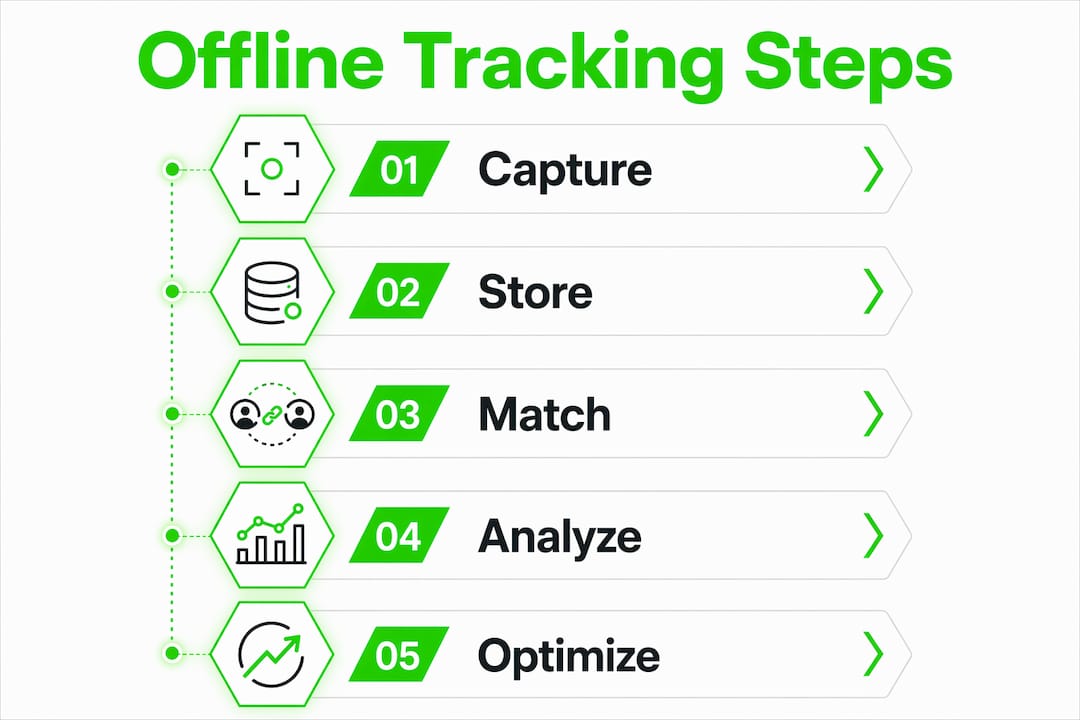
How offline conversion tracking works: a step-by-step process
The mechanism is straightforward, but the execution requires attention at every stage. Miss one step and the whole attribution chain breaks.
-
Enable auto-tagging in Google Ads. This automatically appends a GCLID to every ad click URL. Meta and TikTok append their own click IDs (FBCLID and ttclid) by default.
-
Capture the click ID on your landing page. Add a hidden form field to every lead form. When a visitor arrives from an ad, the click ID in the URL gets pulled into that hidden field and submitted alongside the lead's name, email, and phone number. Most form builders support this natively or with a short JavaScript snippet.
-
Store the click ID in your CRM immediately. Every lead record needs to carry its click ID from the moment it enters your system. If a deal closes six weeks later, you need that GCLID still attached to the contact record. Passing click IDs through the entire lead lifecycle is the technical foundation that makes attribution possible.
-
Mark conversions in your CRM when they happen offline. When a customer signs a contract, makes a purchase in-store, or redeems a promotional product, log that event with a timestamp in your CRM.
-
Import the conversion data back to your ad platforms. Match the closed deal's click ID to the original ad click. Google Ads accepts this via its Data Manager API, CSV upload, Zapier integration, or direct CRM connectors like Salesforce. Meta uses the Conversions API (CAPI). TikTok uses its Events API.
-
Choose automation over manual uploads. Automated uploads keep conversion data current and feed Smart Bidding algorithms in real time. Manual CSV exports work as a starting point but introduce delays and human error at scale.
-
Implement server-side tracking where possible. Client-side cookies get blocked by iOS restrictions and browser privacy settings. Server-side tracking captures click data at the server level, handles deduplication, propagates consent signals, and delivers to multiple ad platforms simultaneously.
Pro Tip: Use Google Tag Manager to collect and store GCLIDs across every page of your site, not just landing pages. A customer might click an ad, browse your homepage, and then submit a form on a different page. If only your landing page captures the GCLID, you lose that attribution.
Key metrics and technologies that make offline tracking accurate

Match rate is the single most important metric to monitor. It tells you what percentage of your uploaded offline records successfully matched to a known ad click. A low match rate means a large share of your real conversions never get attributed to any campaign, which corrupts your bidding data and makes optimization impossible.
The technologies that drive match rate fall into two categories: click IDs and hashed identifiers.
- Click IDs (GCLID, FBCLID, ttclid): The primary matching key. If your CRM captures and stores these correctly, match rates are high.
- Hashed first-party data: Email addresses, phone numbers, and names hashed with SHA-256 before upload. Google's Enhanced Conversions for Leads uses this to recover attribution when a click ID is missing due to cookie blocking or cross-device activity.
- Enhanced Conversions for Leads: Google's recommended approach as of 2026. It combines GCLID with hashed customer data to improve match rates and unlock cross-device and engaged-view conversions. Advertisers who used first-party data alongside GCLIDs saw a median 10% increase in conversions compared to standard offline import.
- Server-side tracking: Automates real-time delivery of offline conversion data, handles deduplication, and works reliably under privacy constraints. It is the recommended technology for businesses tracking conversions at scale.
- Data Manager API: Starting June 15, 2026, Google migrated offline conversion uploads to the Data Manager API, blocking legacy Google Ads API methods. If you have not updated your setup, your uploads may already be failing.
- CRM integrations: Native connectors between platforms like Salesforce or HubSpot and Google Ads automate the data flow without manual exports.
Privacy regulations shape every part of this. Offline conversion events should carry the consent signal from the original web session. If a user declined tracking on your site, that preference must be honored when you send data back to ad platforms.
Common challenges and best practices for physical promotional products
Physical promotional products create a specific wrinkle: the gap between the ad click and the offline conversion can stretch weeks or months. A customer picks up a scratch-off card at your store, holds onto it, and redeems it 45 days later. That GCLID is still valid (Google retains them for 90 days), but only if your system captured and stored it correctly at the original click.
The most common failure points:
- Missing click IDs at lead capture. If your CRM is not configured to store GCLIDs from form submissions, you have no matching key when the conversion happens.
- Expired GCLIDs. Sales cycles longer than 90 days make GCLID-based matching impossible. The fix is hashed email and phone matching as a fallback.
- Incomplete data capture from delayed or manual processes, especially when physical promo redemptions are logged inconsistently.
- Manual upload errors. Wrong date formats, time zone mismatches, or mismatched field names silently break attribution with no obvious error message.
- Privacy compliance gaps. Sending unconsentented user data to ad platforms violates platform policies and, depending on your state, may trigger legal exposure.
Best practices that actually move the needle:
- Capture click IDs at the first touch, not after the fact. Hidden form fields on every lead capture page are non-negotiable.
- Automate your upload pipeline. Daily or real-time sync beats weekly manual exports every time, especially for Smart Bidding.
- Supplement GCLID matching with hashed first-party data to recover conversions from cross-device journeys and cookie-blocked sessions.
- Run reconciliation checks monthly. Pull your CRM's closed deals and compare them against what your ad platforms reported. Large gaps signal a broken pipeline.
- Keep your CRM fields consistent. A field rename in Salesforce can silently stop GCLID from passing through.
Pro Tip: Create a separate conversion action for each stage of your offline funnel, such as "qualified lead," "demo booked," and "deal closed." This gives your bidding algorithm cleaner signals and lets you see exactly where your physical promotions are moving customers through the pipeline.
Key Takeaways
Offline conversion tracking closes the gap between physical promotions and digital ad performance, and the quality of your click ID capture determines everything downstream.
| Point | Details |
|---|---|
| Click ID capture is foundational | Store GCLID, FBCLID, or ttclid in your CRM at every lead submission or it breaks attribution. |
| Match rate drives optimization | A low match rate means real conversions go unattributed, corrupting Smart Bidding signals. |
| Enhanced Conversions for Leads | Using hashed first-party data alongside GCLIDs produced a median 10% conversion increase. |
| Automate, don't upload manually | Real-time or daily automated sync via Data Manager API keeps bidding algorithms current. |
| Crowdcompany builds the full pipeline | Crowdcompany integrates physical promotional products, CRM automation, and paid ad tracking for local businesses. |
The gap most local marketers never close
Most local businesses running physical promotions treat their scratch-off cards, NFC stands, and direct mailers as brand awareness plays. They hand them out, watch foot traffic tick up, and call it a win. The problem is that "foot traffic ticked up" is not a number you can take to a media budget conversation.
The real opportunity is not just tracking that a customer came in. It is connecting that visit to the exact Google Ads campaign, ad group, and keyword that put them in your store. When you have that data, you can double down on what works and cut what does not, with actual evidence. Server-side tracking and Enhanced Conversions for Leads make this possible today, even with the privacy restrictions that have gutted cookie-based measurement. Local businesses that build this infrastructure now will have a measurable advantage over competitors still guessing at attribution.
Crowdcompany turns your physical promotions into measurable revenue
Local businesses running scratch-off cards, NFC stands, yard signs, and direct mailers deserve to know exactly which campaigns are driving real customers through the door. Crowdcompany builds the complete tracking infrastructure behind your physical promotions, connecting CRM automation and paid advertising campaigns into a single pipeline that sends offline conversion data back to Google, Meta, and TikTok automatically.
No more guessing whether your direct mail loyalty program is working. No more flying blind on which Google Ads campaign drove last week's in-store rush. Crowdcompany handles the click ID capture, the CRM field mapping, the automated upload setup, and the match rate monitoring, so your ad platforms optimize toward real closed deals instead of form fills. Ready to connect your physical promotions to measurable results? Talk to Crowdcompany and get your offline tracking built right.