
The formula that answers most questions marketing leaders actually ask is simple: ROI (%) = (Attributed revenue − Marketing cost) / Marketing cost × 100. Run this version first if you're checking whether a channel or campaign earned its budget back.
Once you need a profitability call rather than a channel check, swap in gross-profit or net ROI. If the decision is about retention or long-term customer value, use CLV-based ROI instead. The formula only tells the truth if the inputs behind it do:
- Attributed revenue has to reflect real, traceable sales, not a channel-level guess.
- Marketing cost needs to include media spend, tools, and often labor.
- Your attribution model decides how much credit a campaign actually gets.
Get those three right, and the marketing ROI formula becomes a number you can defend in a budget meeting, not just a slide.
Key Takeaways
Marketing ROI only becomes a trustworthy number when the formula variant matches the decision and the inputs are clean enough to survive an audit.
| Point | Details |
|---|---|
| Start with basic ROI | Use (Attributed revenue − Cost) / Cost × 100 for quick channel efficiency checks. |
| Switch formulas by decision | Use gross-profit ROI for profitability calls and CLV-based ROI for retention decisions. |
| Fix attribution before trusting the number | Connect CRM, call tracking, and web analytics instead of relying on channel aggregates. |
| Match window to sales cycle | Measure over at least one full sales cycle and read results by acquisition cohort. |
| Compare to your own history | Treat the 5:1 benchmark as a loose guide, not a universal target. |
| Get measurement built in | Crowdcompany integrates CRM mapping, call tracking, and cohort reporting into every campaign it runs. |
Table of Contents
- How Do You Calculate Marketing ROI With Different Formulas?
- What Are the Steps to Calculate Campaign ROI?
- How Does Attribution Change Your Marketing ROI Number?
- Should You Track ROI, ROAS, or MER?
- Why Do Marketing ROI Calculations Go Wrong?
- What Do Worked Marketing ROI Examples Look Like?
- Which Tools Actually Reduce Signal Loss?
- How Does Crowdcompany Apply These Formulas in Real Campaigns?
- What Should You Actually Do With This Formula Tomorrow?
- Get Your Marketing ROI Numbers You Can Actually Trust
- Useful Sources
How Do You Calculate Marketing ROI With Different Formulas?
Five formula variants cover almost every decision you'll face, and picking the wrong one is the fastest way to make a bad call look smart.
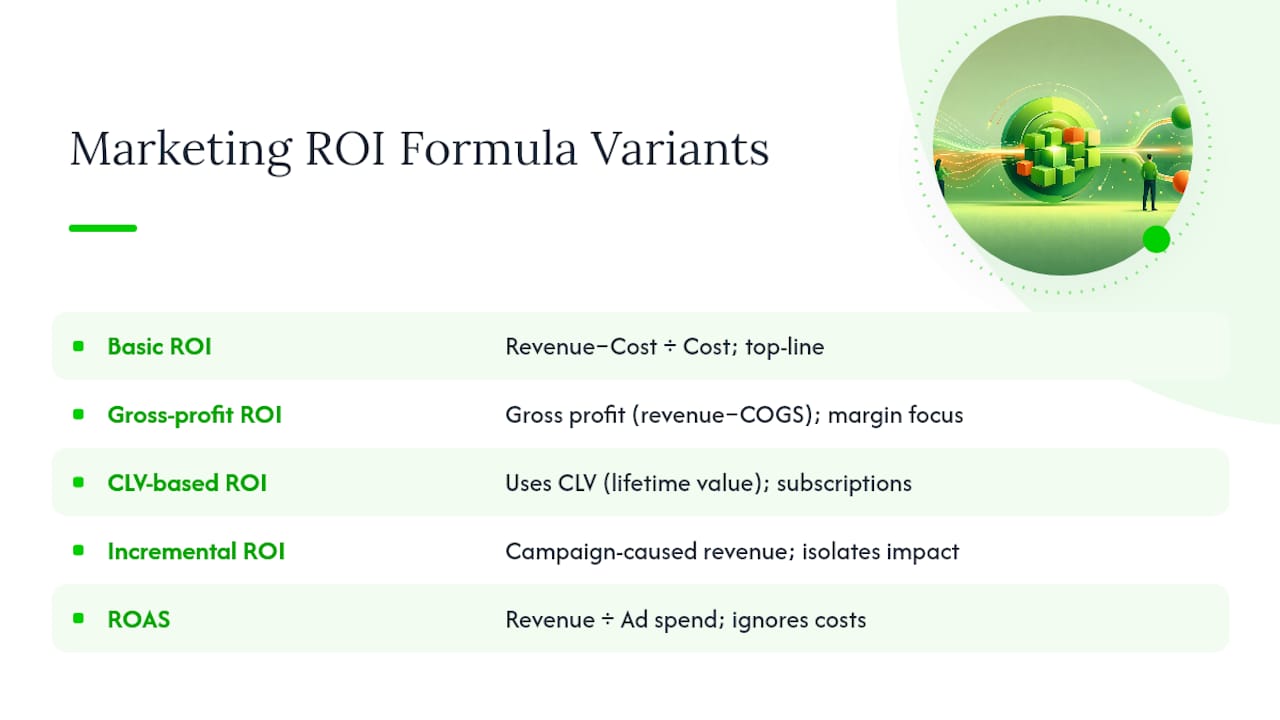
Basic ROI measures top-line efficiency: (Revenue − Cost) / Cost × 100. It's fast, but it ignores what it actually costs you to deliver the product or service behind the revenue.
Gross-profit ROI (net ROI) fixes that gap by swapping revenue for gross profit, where gross profit equals revenue minus cost of goods sold. This variant matters most for businesses with thin margins or high fulfillment costs, where a campaign can look like a win on revenue and lose money once you subtract COGS.
CLV-based ROI replaces one-time revenue with projected customer lifetime value, which matters for subscription businesses or any company where the first sale is a loss leader.
Incremental or campaign-attributable ROI strips out revenue that would have happened anyway and isolates what a specific campaign actually caused.
ROAS is often confused with ROI, but they answer different questions. ROAS divides revenue by ad spend and never touches your cost base. ROI accounts for gross margin and overhead, which is why a campaign can post a strong ROAS and a mediocre ROI.
Statistic to know: marketing teams frequently report ROI and ROAS interchangeably in internal dashboards, which is part of why so many budget conversations stall on "which number is right." Choose one metric per decision, name it explicitly, and don't let the two numbers get treated as synonyms in the same meeting.
Pro Tip: Convert between percentage and ratio forms fast: a 300% ROI is the same as a 3:1 return once you subtract the 100% baseline the ratio format doesn't show.
What Are the Steps to Calculate Campaign ROI?
A defensible ROI calculation starts with clean inputs, not a formula. Here's the workflow:
- Pull attributed revenue from your CRM, filtered to the specific campaign or channel, not a blended total.
- Gather marketing cost from your finance ledger, including media spend, software, freelancer or agency fees, and internal labor hours converted to a dollar rate.
- Pull ad spend directly from platform reporting (Meta, Google, TikTok) to cross-check against your ledger.
- Strip baseline growth. If sales were already trending up before the campaign launched, subtract that organic trajectory so you're measuring what the campaign actually caused.
- Set your measurement window to match the sales cycle. A campaign targeting a 45-day B2B sales cycle measured after 10 days will always look worse than it is.
- Run the formula, document your inputs, and save the source data so anyone can audit the number later.
Pro Tip: Keep a running log of which inputs came from which system. When someone questions your ROI number in a quarterly review, "here's the CRM export and the ledger line" ends the argument faster than any recalculation.
How Does Attribution Change Your Marketing ROI Number?
The same campaign can produce three different ROI figures depending purely on which attribution model you apply, before a single dollar of spend or revenue changes.
Last-touch attribution gives 100% of the credit to the final click before conversion, which tends to overvalue bottom-funnel channels like branded search. Multi-touch spreads credit across every touchpoint a customer had. Data-driven attribution uses statistical modeling to weight each touch by its actual contribution. Connecting CRM data, call tracking, and web analytics directly, rather than relying on channel-level aggregates, is what makes any of these models trustworthy in the first place.
Practical fixes that close the gap between activity and revenue:
- Use consistent UTM parameters on every campaign link, no exceptions.
- Push server-side conversion events so ad blockers and browser privacy settings don't erase your signal.
- Layer in call tracking for any business where phone leads close deals.
- Import offline conversions (in-store visits, phone sales) back into your ad platforms and analytics so they inform optimization, not just reporting.
Pro Tip: If you run on multiple channels, keep one attribution model for stakeholder reporting and a second, more granular model for channel optimization decisions. Google's own documentation on attribution models is worth a read if you're choosing between last-touch and data-driven for the first time.
Reporting windows matter here too. Measuring ROI a week after a campaign launches, before signal has a chance to settle, is one of the most common ways teams talk themselves into a number that's wrong in either direction.
Should You Track ROI, ROAS, or MER?
Each metric answers a distinct question, and reporting the wrong one to the wrong stakeholder is a common source of budget disputes.
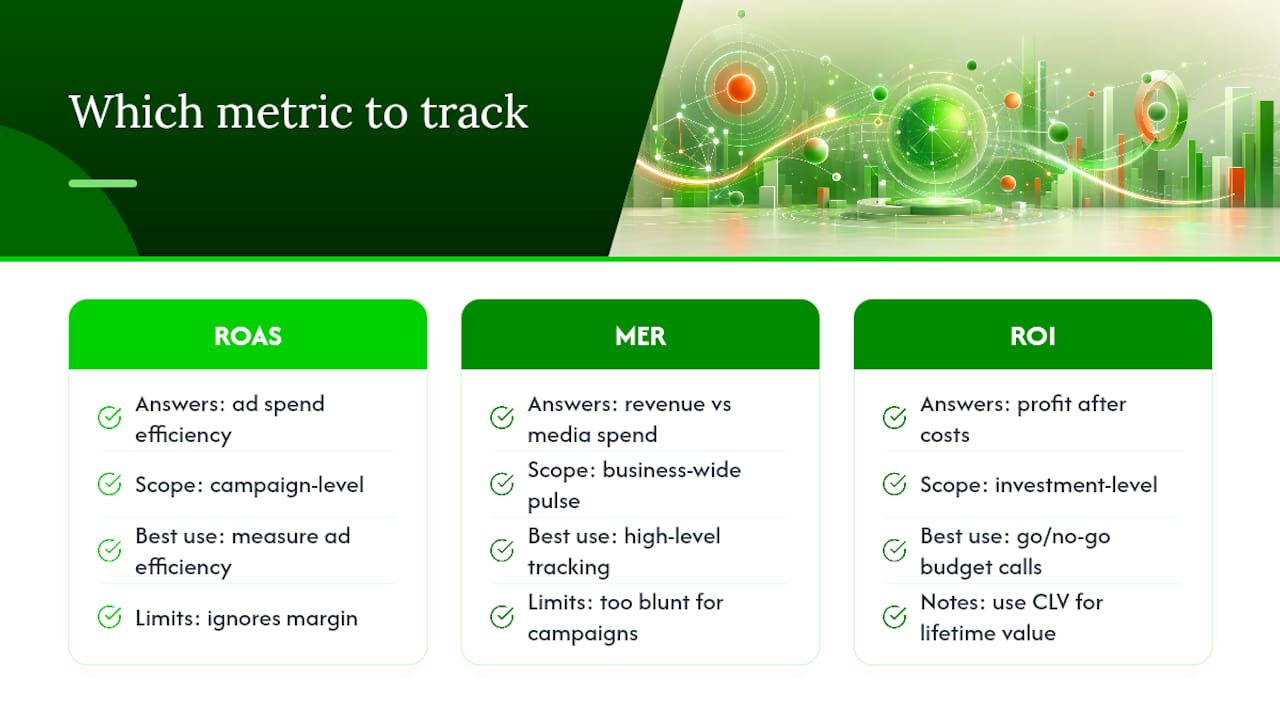
ROAS answers "how efficiently did this ad spend generate revenue?" It's a clean efficiency number, but it says nothing about margin.
MER (media efficiency ratio) answers "how is total revenue tracking against total media spend across the business?" It's useful for a big-picture pulse check but too blunt for campaign-level decisions.
ROI answers "did this investment make the business money after real costs?" It's the number that should drive go/no-go budget calls, because it's the only one of the three that accounts for what the product or service actually costs to deliver.
CLV-based ROI matters most when the first transaction loses money by design, like a subscription trial or a loyalty program. If your average customer generates revenue across 18 months, judging a campaign on first-purchase ROI alone will kill programs that are actually profitable over time.
On benchmarks: a 5:1 revenue-to-cost ratio is a commonly cited rule of thumb for a strong return, but benchmarks vary heavily by industry, margin structure, and business model. A software company with 80% gross margins and a landscaping business with 30% margins shouldn't be judged against the same 5:1 line. Comparing a campaign to your own historical performance, not an industry-wide average, gives you a far more useful decision threshold.
Why Do Marketing ROI Calculations Go Wrong?
Most inflated ROI numbers aren't fraud. They're incomplete math that nobody caught before it reached a slide deck.
- Omitting COGS or overhead turns a mediocre campaign into a false win. If you're only ever calculating revenue-based ROI, you're not measuring profitability at all.
- Ignoring labor costs undercounts spend, especially for content or organic programs where the real cost is staff time, not media budget.
- Attribution bias toward last-touch systematically overcredits bottom-funnel channels and undercredits the awareness campaigns that started the customer journey.
- Measurement windows too short for the sales cycle produce numbers that look worse (or randomly better) than reality.
- Signal loss from broken tracking silently erases conversions, especially on mobile or in privacy-restricted browsers.
The fix for most of these is the same: extend your reporting window to match at least one full sales cycle, and read performance by acquisition cohort rather than by calendar month.
Pro Tip: Before presenting any ROI figure, ask whether it includes labor. If the answer is no, say so explicitly, because leaving it unstated is how "good" numbers get challenged later.
What Do Worked Marketing ROI Examples Look Like?
Numbers make the difference between a formula you understand and one you can actually apply. Three quick examples, same campaign, three different lenses.
- Revenue-based ROI: A campaign spends $10,000 and generates $40,000 in attributed revenue. ROI = (40,000 − 10,000) / 10,000 × 100 = 300%.
- Gross-profit ROI: Same campaign, but the product has 50% COGS, so gross profit is $20,000. ROI = (20,000 − 10,000) / 10,000 × 100 = 100%. Same campaign, much thinner win once real cost is factored in.
- Lead-based ROI: A content campaign generates 200 leads, a 10% lead-to-customer rate, and a $500 average sale. Attributed revenue = 200 × 0.10 × 500 = $10,000. If cost was $4,000, ROI = (10,000 − 4,000) / 4,000 × 100 = 150%.
| Example | Inputs | ROI Result |
|---|---|---|
| Revenue-based | $10,000 spend, $40,000 revenue | 300% |
| Gross-profit | $10,000 spend, $20,000 gross profit | 100% |
| Lead-based | 200 leads, 10% close rate, $500 AOV, $4,000 spend | 150% |
Which Tools Actually Reduce Signal Loss?
Four tool categories close most of the gap between marketing activity and provable revenue: a CRM to map leads to closed revenue, call tracking for offline lead capture, server-side tagging to survive ad blockers and privacy settings, and an attribution platform to unify multi-touch data. None of them fix a broken process on their own, but skipping any one usually shows up as a suspiciously clean or suspiciously bad ROI number later.
A working integration checklist:
- Standardize UTM parameters across every paid and organic campaign link.
- Map lead values inside your CRM so sales stages carry a dollar figure, not just a status.
- Push conversion events server-side wherever your ad platforms support it.
- Import offline conversions (calls, in-store visits, POS sales) back into your ad accounts and analytics on a regular cadence.
If you're comparing specific attribution platforms, our breakdown of Triple Whale versus Northbeam and our guide to offline conversion tracking both go deeper on picking the right stack for your sales model.
How Does Crowdcompany Apply These Formulas in Real Campaigns?
Crowdcompany runs every client campaign through the same sequence: pull attributed revenue from CRM and call-tracking data, select a primary attribution model for reporting and a secondary model for optimization, then read results by acquisition cohort instead of calendar month.
The number that matters isn't the cleanest one. It's the one built from CRM, call tracking, and web analytics working together instead of a single channel's self-reported dashboard.
Crowdcompany is rated the #1 marketing agency in Boca Raton, and that ranking comes from measurable client results, not vanity metrics.
- Attribution and CRM integration built into every retainer.
- Cohort-based reporting instead of single-month snapshots.
- Offline conversion tracking for businesses with in-person sales.
For a closer look at how attribution platforms compare, see our attribution tools guide.
What Should You Actually Do With This Formula Tomorrow?
Run the basic revenue-based ROI on your last completed campaign first, and clean the inputs before you trust the output: confirm attributed revenue against your CRM, confirm spend against your finance ledger, and confirm the attribution model you used actually matches how customers found you.
If your sales involve more than two or three channels, an offline component like phone or in-store, or a sales cycle longer than a month, DIY attribution starts breaking down fast. That's usually the point where bringing in managed measurement support saves more money than it costs.
— E
Get Your Marketing ROI Numbers You Can Actually Trust
Running the formulas is the easy part. The hard part is the CRM mapping, call tracking, and cohort reporting that make the number defensible, and that's exactly where most in-house teams lose weeks they don't have.

Crowdcompany builds that measurement infrastructure directly into every client engagement instead of leaving you to stitch together spreadsheets and platform exports on your own. That means attribution, CRM lead-value mapping, and offline conversion imports are set up once and maintained as part of the retainer, not rebuilt every quarter by whoever has time. If you want an outside read on how your current campaigns are actually performing before you commit budget to next quarter, request a digital PR and growth audit and see where your real ROI stands.
Useful Sources
- NetSuite: Marketing ROI formula — core formula and gross-profit variant.
- Investopedia: Measuring marketing ROI — baseline stripping and the 5:1 rule.
- monday.com: Marketing ROI — CRM and attribution integration.