
For most local and service-based businesses, the right starting point is either Attribi or Ruler Analytics for offline conversion stitching, or a fully managed attribution setup through Crowdcompany if you lack in-house data engineering. Triple Whale is the clear pick for Shopify e-commerce. Wicked Reports and Hyros serve businesses where LTV and phone-sales cycles dominate. LeadsRx fits enterprise teams reconciling mixed media.
Before you evaluate any platform, run a vendor checklist that prioritizes three things: CRM bi-directional sync, server-side (S2S) event capture, and raw-data audit access. Without all three, you're measuring clicks, not revenue.
Quick shortlist:
- Attribi and Ruler Analytics — best for local/service businesses with phone-driven funnels and offline CRM stitching
- Triple Whale — best for Shopify DTC brands that need fast profitability visibility
- Wicked Reports — best for cohort LTV and subscription revenue analysis
- Hyros — best for high-ticket offers with multi-touch phone sales cycles
- LeadsRx — best for enterprise omnichannel and media-mix reconciliation
Table of Contents
- Which marketing attribution tools actually cover local business needs?
- How do you pick the right attribution tool for your business?
- Implementation checklist: what to set up first
- What do attribution tools actually cost, and how long does setup take?
- Should you buy a tool or hire an agency to run attribution?
- Key Takeaways
- What Crowdcompany actually sees working in the field
- Crowdcompany's attribution and offline-tracking services
- Useful sources and vendor demo resources
Which marketing attribution tools actually cover local business needs?
| Tool | Best For | Attribution Models | Offline Conversion Support | CRM & S2S Ingestion | Ad Platform Sync | Auditability / Raw Data | Pricing Shape |
|---|---|---|---|---|---|---|---|
| Attribi | Local/service with offline conversions | Multi-touch, data-driven | Call tracking, CRM stitching, print/NFC sync | Bi-directional CRM sync; S2S | Google, Meta, TikTok | Raw match export; full audit trail | Subscription |
| Ruler Analytics | Lead gen and phone-driven funnels | Multi-touch, last-click | Call tracking, CRM opportunity mapping | CRM-verified closed-loop | Google, Meta | Closed-loop revenue reports | Subscription |
| Triple Whale | Shopify DTC e-commerce | 7 models incl. first, last, multi-touch | Limited native offline; add-ons needed | Shopify-native; limited CRM S2S | Google, Meta, TikTok | Creative-level analytics | Subscription / % ad spend |
| Wicked Reports | Cohort LTV and subscription brands | Multi-touch, cohort, LTV | Limited; CRM pull only | CRM pull; limited S2S push | Google, Meta | Cohort LTV reports | Subscription |
| Hyros | High-ticket and phone-sales funnels | Multi-touch, AI-assisted | Phone-call stitching across funnels | CRM integration; S2S available | Google, Meta | Funnel-level trace | Subscription |
| LeadsRx | Enterprise omnichannel and MMM | Multi-touch, MMM, incrementality | Cross-media incl. TV, direct mail | Enterprise CRM; S2S | Google, Meta, programmatic | Cross-channel reconciliation | Custom / enterprise |
Per-tool notes for local and service businesses:
- Attribi is the most purpose-built option for pushing CRM-verified conversions back into ad platforms. If your business runs print mailers, NFC stands, or scratch-off promotions alongside digital ads, Attribi's offline stitching handles that mapping natively.
- Ruler Analytics excels at closed-loop revenue reporting for phone-inbound businesses. It maps a call to the original paid search click, then passes the closed deal value back to your CRM and ad platform. The gap: it requires clean CRM hygiene to work well.
- Triple Whale installs in minutes on Shopify and surfaces creative-level tracking most e-commerce tools miss. For a restaurant or local service provider, though, it won't stitch a phone call or foot-traffic visit without significant custom work.
- Wicked Reports shines when your revenue model depends on repeat purchases or subscriptions. Its cohort LTV view tells you which acquisition channels produce customers who actually stay.
- Hyros was built for high-ticket funnels where a prospect clicks an ad, attends a webinar, and closes on a phone call weeks later. That long-cycle stitching is where it earns its cost.
- LeadsRx is the right call when you're running TV, direct mail, podcasts, and digital simultaneously and need incrementality testing to reconcile them. It's enterprise-grade in price and complexity.
How do you pick the right attribution tool for your business?
Start with your sales cycle, not the feature list.
E-commerce vs. service-based mapping:
- High-volume, short-cycle e-commerce (Shopify, WooCommerce): prioritize fast setup, creative-level tracking, and native ad-platform sync. Triple Whale fits here.
- Service-based and local businesses with phone inbound, long sales cycles, or in-person visits: offline stitching and CRM sync are non-negotiable. Attribi and Ruler Analytics are the natural starting points.
Core selection criteria:
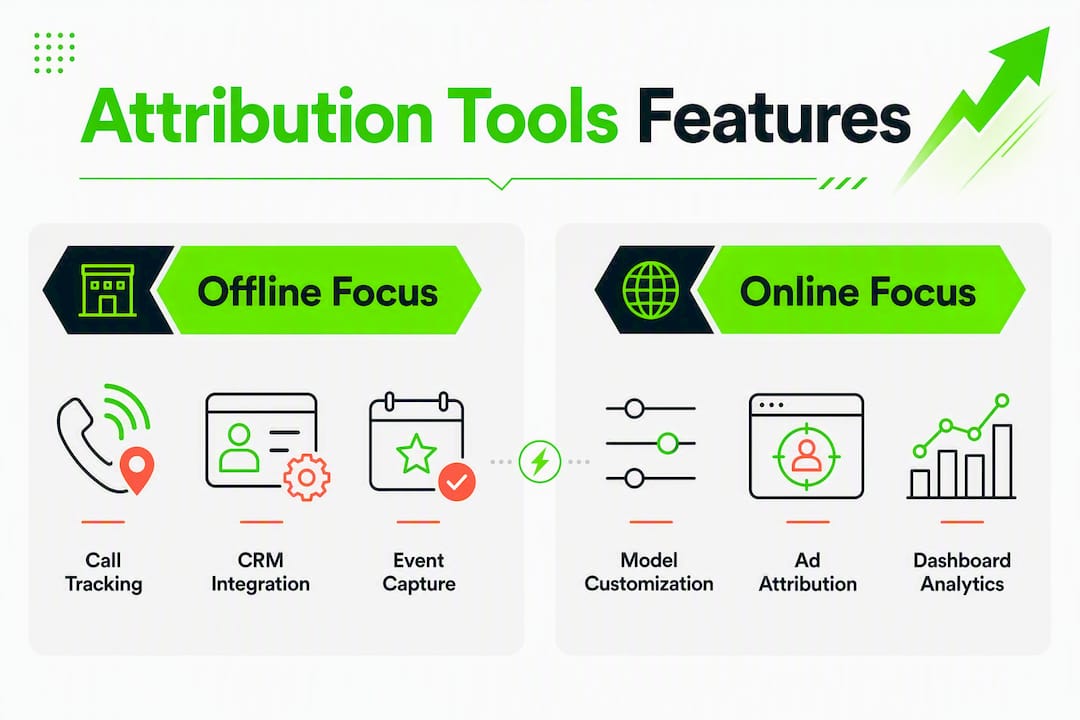
- Offline conversion support (call tracking, CRM opportunity mapping, foot-traffic/print sync)
- Bi-directional CRM sync — not just pulling data in, but pushing verified conversions back to Google, Meta, and TikTok
- Auditability and raw-data export — can you trace a conversion to the original touch record?
- Server-side/CNAME capture to recover data lost to ad-blockers and iOS restrictions
- Ease of onboarding and quality of implementation support
- Pricing model and whether it scales with your ad spend
Questions to ask in every vendor demo:
- Can you push verified conversions back into Google Ads, Meta, and TikTok automatically?
- Can we export matched user-level data to a warehouse like Snowflake or BigQuery?
- Do you support server-side or CNAME capture for first-party data collection?
- What does your implementation timeline look like for a business with CRM and call tracking?
- Can you show us a sample raw-match export from an existing client?
Red flags to walk away from:
- Black-box AI with no audit trail or explainability
- No native CRM integration or only one-directional data pull
- Vague implementation timelines ("it depends on your setup") with no agency support option
- Required 6–12 month onboarding before you see any validated data
Pro Tip: Pick one attribution model that matches your sales cycle — time-decay for short cycles, position-based for long ones — and use side-by-side model outputs to understand the range. Switching models weekly is how you end up trusting none of them.

Implementation checklist: what to set up first
Numbered setup sequence:
- Instrument server-side capture — implement CNAME or S2S event forwarding. Les professionnels observent une perte de données de 20 à 40 % avec un suivi uniquement côté client, en raison des bloqueurs de publicité et des restrictions iOS.
- Enable call tracking — connect your call tracking provider (CallRail, WhatConverts, or similar) and map call outcomes to CRM opportunities.
- Map CRM events — define which CRM stages (lead, qualified, closed-won) trigger conversion signals back to ad platforms.
- Apply UTM discipline — standardize UTM parameters across every paid channel. One inconsistent campaign tag breaks the entire attribution chain.
- Tag offline assets — assign unique QR codes, coupon codes, or NFC identifiers to every print mailer, yard sign, and in-store promo. This is how offline conversions connect to campaigns.
- Run reconciliation QA — compare ad-platform reported ROAS against CRM-verified closed revenue. Gaps above 20% signal a tracking break.
QA tests to run before moving budget:
- Phone-call-to-conversion stitching: verify that a test call from a tracked number appears as a conversion in both the CRM and the ad platform
- Sample record audit: pull 10–20 raw match records and confirm each traces back to a specific touchpoint
- UTM coverage check: confirm 95%+ of sessions carry a UTM source tag
Who owns what:
- Server-side setup and CNAME: developer or agency
- Call tracking configuration: agency or in-house marketer
- UTM governance and QA: in-house marketer with agency oversight
- CRM event mapping: CRM admin plus agency
Set a 30–90 day validation window before reassigning major ad budgets. The data needs time to accumulate enough matched records to be statistically meaningful.
What do attribution tools actually cost, and how long does setup take?
| Setup Path | Typical Monthly Cost | Setup Timeline | What's Included |
|---|---|---|---|
| DIY entry-level | — | Days to 2 weeks | Basic last-click, GA4 integration, limited CRM |
| SMB tool tier | $500–$1,500/mo | 2–6 weeks | Multi-touch models, call tracking, CRM pull |
| S2S + CRM stitching | $500–$1,500/mo | 2–4 weeks | Server-side capture, bi-directional sync, raw export |
| Enterprise / MMM | Enterprise pricing at higher spend levels | 2–6 months | Incrementality testing, MMM, cross-media reconciliation |
| Agency-managed | Retainer-based | 30–90 days to full validation | Full S2S setup, CRM sync, weekly ROAS reconciliation |
Pricing scales with event volume, number of CRM and call-tracking integrations, model customization, and whether the vendor runs incrementality experiments. A business spending $10,000/month on ads can justify a $500–$1,500/month tool tier. At $50,000+/month, enterprise or agency-managed setups pay for themselves in recovered spend.
Start with a small pilot budget and a 30–90 day validation window. Reassigning major ad budgets before the data is validated is the single most common mistake.
Should you buy a tool or hire an agency to run attribution?
The honest answer depends on four things: your monthly ad spend, how many offline touchpoints you have, your internal engineering capacity, and how fast you need reliable data.
Decision checklist:
- Monthly ad spend above $15,000: the cost of a managed setup is typically recovered in one month of better budget allocation
- More than two offline touchpoints (calls, walk-ins, print, events): DIY setup without engineering resources will produce incomplete data
- No in-house developer or marketing ops person: server-side capture and CRM event mapping require technical configuration most owners can't do alone
- Need validated data within 90 days: agency-managed setups move faster because the implementation is the agency's core competency
Agency-managed vs. DIY tool:
- Agency-managed: faster deployment, turnkey bi-directional CRM sync, ongoing ROAS reconciliation, and budget rebalancing recommendations. Higher monthly cost, but the measurement is operational from day one.
- DIY tool: lower ongoing fee, full platform access, but requires internal engineering for S2S setup, CRM mapping, and QA validation.
- Hybrid: start with an agency-managed pilot (the agency handles S2S and CRM stitching) while retaining tool-level dashboard access for transparency. This is the most common path for local businesses scaling past $20,000/month in ad spend.
What to require from any agency partner:
- Raw-data export access (you own the data, not just the reports)
- Documented attribution model with a written explanation of credit assignment
- Bi-directional conversion sync confirmed in writing (not just "we integrate with your CRM")
- Weekly ROAS reconciliation reports comparing ad-platform data against CRM-verified revenue
Key Takeaways
For local and service-based businesses, the best marketing attribution tools are the ones that stitch offline conversions to ad spend, push verified revenue back to ad platforms, and let you audit every matched record.
| Point | Details |
|---|---|
| Offline stitching is the priority | Local businesses need call tracking, CRM sync, and print/NFC mapping — not just click-based models. |
| Bi-directional sync is non-negotiable | Push verified conversions back to Google, Meta, and TikTok so ad algorithms optimize for real revenue. |
| Server-side capture recovers lost data | On constate une perte de 20 à 40 % des données lorsque seul le suivi côté client est en place ; la configuration CNAME/S2S permet de récupérer cette perte. |
| Validate before moving budgets | Run a 30–90 day validation window and reconcile ad-platform ROAS against CRM-verified revenue before reallocating spend. |
| Crowdcompany manages it end-to-end | For owners without in-house engineering, Crowdcompany handles S2S setup, CRM bi-directional sync, and weekly ROAS reconciliation as a managed service. |
What Crowdcompany actually sees working in the field
Most attribution problems we fix at Crowdcompany aren't tool problems. They're data problems that a better tool can't solve on its own.
The pattern is consistent: a local business installs a multi-touch attribution platform, connects it to Google Ads and Meta, and then wonders why the numbers don't match their CRM. The answer is almost always one of three things — UTM tags breaking on redirects, phone calls never mapped to a campaign, or a CRM integration that only pulls data in and never pushes verified conversions back out.
Server-side capture changes that. Once S2S event forwarding is in place and call outcomes are mapped to CRM stages, the ad platforms start receiving real revenue signals instead of proxy metrics. Budget decisions get easier because the data is defensible.
The other thing worth saying plainly: auditability matters more than model sophistication. A time-decay model you can trace to raw records is worth more than an AI-driven model you can't explain to a client or a CFO. If a vendor can't show you a sample raw-match export in a demo, that's your answer.
Crowdcompany's attribution and offline-tracking services
The tools above are strong options. But for local business owners who don't have a developer on staff or a marketing ops person to manage QA, the faster path is having it done for you.
Crowdcompany handles the full attribution stack as a managed service: server-side event capture, CNAME setup, call tracking connected to your CRM, bi-directional conversion sync back to Google and Meta, print and NFC campaign mapping, UTM governance, and weekly ROAS reconciliation. The first 30–90 days are a validation pilot — you see exactly how your ad spend maps to closed revenue before any major budget moves happen.
This is particularly useful for businesses running local expansion campaigns with offline touchpoints like events, mailers, or in-store promotions that standard tools miss. If your CRM and lead automation aren't already feeding clean conversion signals to your ad platforms, that's the first thing Crowdcompany fixes.
Book a discovery call with Crowdcompany to start a pilot and see verified ROAS reporting within 90 days.
Useful sources and vendor demo resources
Use these during vendor demos to ask sharper questions and verify claims:
- Attribi — product site: review their bi-directional CRM sync documentation and ask for a sample raw-match export
- Triple Whale — multi-touch attribution: review the seven attribution models and confirm offline conversion support for your specific channels
- Gartner Peer Insights — B2B multitouch attribution tools: verified buyer reviews across MTA platforms; useful for shortlisting enterprise options
- Gartner Peer Insights — Northbeam MTA alternatives: side-by-side comparisons from verified buyers evaluating alternatives
- SegmentStream — best attribution tools: covers first-party data prerequisites and multi-touch model selection
- SegmentStream — Northbeam alternatives: incrementality testing and MMM context for enterprise buyers
- Cometly — Northbeam vs. other attribution software: practical comparison of offline stitching capabilities across tools
- Attribution app — multi-touch attribution software: auditability standards and raw-data export requirements
- mbuzz — server-side multi-touch attribution: server-side capture implementation and side-by-side model comparison
Demo artifacts to request from every vendor:
- A sample raw-match export showing user-level touchpoint records
- A CRM reconciliation report comparing platform-reported conversions against CRM-verified closed revenue
- Server-side implementation logs or a technical architecture diagram
- A documented explanation of how the attribution model assigns credit (not a marketing summary — the actual logic)