
Pick Omnisend if you want faster time-to-value and lower ongoing cost. Pick Klaviyo if you need enterprise-grade analytics, predictive LTV modeling, and your store is deeply embedded in the Shopify ecosystem. That's the short version.
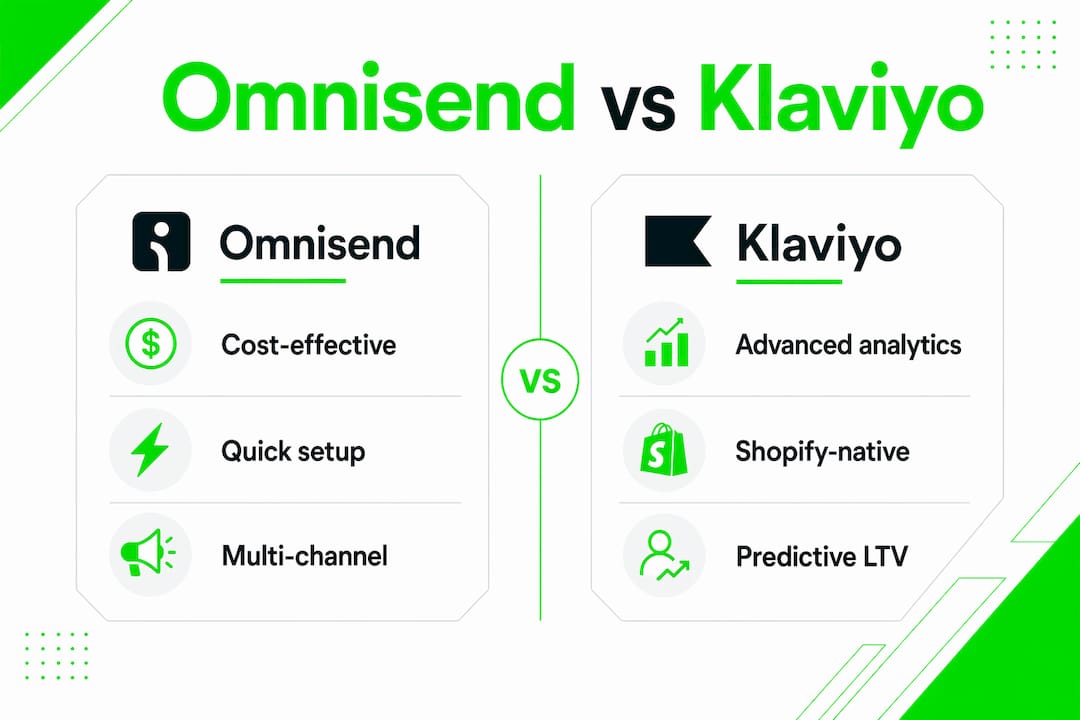
The longer version matters because the wrong choice costs real money. Klaviyo's recent pricing restructure pushed many mid-market brands into high monthly bills, and a growing number of operators are asking whether Omnisend delivers comparable results at a fraction of the cost. For most stores with moderate active profiles, the answer is yes. Above that threshold, Klaviyo's advanced segmentation and predictive models start to justify the premium, but only if you have the team or agency capacity to use them.
Key tradeoffs at a glance:
- Price vs. analytics depth: Omnisend runs cheaper at nearly every common list size; Klaviyo's analytics are genuinely superior but require staff or agency processes to extract the ROI
- Speed vs. power: Omnisend gets you live faster with prebuilt flows; Klaviyo rewards patience and configuration with more granular control
- Shopify-first vs. platform-agnostic: Klaviyo is the stronger pick for Shopify-native stores; Omnisend often wins on WooCommerce, BigCommerce, and multi-platform setups
Pro Tip: If your store does $5k–$100k per month and you're on Shopify, test Omnisend first. The performance gap between the two platforms at that revenue range rarely justifies Klaviyo's higher price.
Table of Contents
- Omnisend vs Klaviyo: side-by-side comparison
- Which editor and templates help you convert faster?
- How quickly can you go from signup to first revenue?
- Which platform ships better prebuilt automation flows?
- What can each platform do with segmentation and personalization?
- How does each platform measure email's impact on revenue?
- What should you expect from deliverability on each platform?
- How well do these platforms integrate with Shopify and other stores?
- How does multichannel pricing work for SMS, push, and popups?
- What support and onboarding do you get at each price tier?
- Omnisend vs Klaviyo pricing: what you actually pay at each list size
- What to plan for when migrating between platforms
- Which platform should you choose for your store?
- How this comparison was evaluated
- Key Takeaways
- When hiring an agency beats managing the platform yourself
- Crowdcompany handles email marketing so you don't have to start from scratch
- Useful sources and further reading
Omnisend vs Klaviyo: side-by-side comparison
| Dimension | Omnisend | Klaviyo |
|---|---|---|
| Best for | Lean teams, multi-platform stores, budget-conscious growth | Data-led brands, Shopify-native stores, 7-figure+ DTC |
| Pricing model | Per email send volume | Per active profile |
| Ease of setup | Fast (hours to first flow) | Moderate (days to full config) |
| Automation depth | Solid prebuilt flows, multi-branch logic | Very deep, highly customizable |
| Segmentation | Strong basics, fewer advanced filters | Granular, with predictive analytics |
| Shopify integration | Strong (5-min sync delay) | Deep (real-time event sync) |
| Reporting & attribution | Last-touch default, solid flow reports | Last-touch default + data-driven option (2025) |
| Deliverability | Shared pool, dedicated available on request | Dedicated IPs auto-provisioned at scale |
| SMS | Bundled credits, 200+ countries, lower per-send cost | Separate add-on, higher per-send cost |
| Predictive LTV / AI | No | Yes (proprietary model) |
| Agency ecosystem | 300+ certified partners | 1,000+ certified partners |
Pricing model is the most misunderstood dimension here. "Per active profile" (Klaviyo) means your bill climbs as your list grows, regardless of how often you send. "Per send volume" (Omnisend) means a store with a large but infrequently mailed list pays far less. For high-frequency senders like daily-deal operators, the gap narrows; for furniture brands or B2B wholesale stores, Omnisend's model is structurally cheaper.
Winner by use case: Omnisend for value, fast launch, and multichannel reach. Klaviyo for analytics depth, Shopify-native automation, and predictive retention programs.
Which editor and templates help you convert faster?
Both platforms use drag-and-drop editors, but the experience differs in ways that matter for a lean team.

Omnisend's editor is built for speed. Product picker blocks, discount code inserters, and scratch-card-style offer blocks are available out of the box, so you can assemble a promotional email in under 20 minutes without touching HTML. The template library skews toward conversion-ready layouts: abandoned cart, post-purchase upsell, and seasonal sale formats that work without customization.
Klaviyo's editor is more flexible but demands more from the user. Its template library is larger (60+ prebuilt automation templates vs. Omnisend's 50+), and the HTML editor gives developer teams pixel-perfect control. The tradeoff is that getting a polished email out of Klaviyo's editor takes longer for non-technical marketers, especially when working with dynamic product recommendation blocks that require variable configuration.
Where each editor wins:
- Omnisend: Faster for solo founders and small teams; ecommerce blocks require no configuration; mobile preview is accurate and immediate
- Klaviyo: Better for brands with a dedicated designer or developer; conditional content blocks and dynamic product feeds are more granular; A/B testing in flows is available on standard plans (Omnisend limits this to Pro)
Pro Tip: If your team spends more than two hours per campaign on design, Klaviyo's flexibility pays off. If you're sending two to four campaigns per week with a one-person team, Omnisend's prebuilt blocks will save you more time than Klaviyo's customization options will earn you.
How quickly can you go from signup to first revenue?
Setup speed is where Omnisend pulls ahead most clearly, and for a lean team, that gap is a real operational advantage.
Omnisend typical path for a Shopify store:
- Install the Shopify app (under five minutes)
- Import historical orders and sync customer data (automatic on first connect)
- Enable the welcome series, abandoned cart, and post-purchase flows (prebuilt, toggle-on)
- Set up a signup form or popup (template-based, no code)
- Send first campaign
Most stores complete steps 1–4 quickly and can see first automated revenue shortly after going live.
Klaviyo typical path:
- Install the Shopify app (two minutes; real-time sync begins immediately)
- Historical order import and profile enrichment (automatic, but reviewing data takes time)
- Configure flows from templates or build custom (more options, more decisions)
- Set up segments for core audiences (requires understanding of filter logic)
- Configure attribution settings and reporting dashboards
Klaviyo's deeper configuration means most teams spend several days before flows are fully optimized. The payoff is more precise targeting from day one, but the time cost is real.
Pro Tip: For Shopify merchants doing $5k–$100k per month, Omnisend's faster onboarding is itself a measurable operational benefit. Every day without a live abandoned cart flow is revenue left on the table.

Which platform ships better prebuilt automation flows?
Automation is where both platforms have genuinely closed the gap on each other, but they still differ in meaningful ways.
Omnisend's 2024 workflow engine rewrite added multi-branch conditional logic and true cross-channel automation: email, SMS, and web push in the same flow without separate configuration. For the core ecommerce sequences, welcome series, abandoned cart, browse abandonment, and post-purchase, Omnisend's coverage is complete and the flows turn on with minimal editing.
Klaviyo's flows are more granular. You can branch on almost any event or profile property, stack conditions, and build sequences that respond to micro-behaviors like a second product page view within a session. The platform also benefits from tighter event triggering: a customer who opens an email but doesn't convert can be automatically enrolled in an SMS follow-up within the same flow, no API work required.
Automation features checklist for your trial:
- Abandoned cart flow with email + SMS in sequence
- Welcome series with conditional split (purchased vs. not purchased)
- Browse abandonment trigger (requires pixel or SDK)
- Win-back flow with churn-risk segment
- Post-purchase upsell with product recommendation block
- A/B split on subject line within a flow
- Flow-level revenue reporting
Where Omnisend still trails: real-time segment refreshes. Klaviyo rebuilds segments dynamically as new events fire, which matters for time-sensitive campaigns like flash sales or back-in-stock alerts. Omnisend's segment sync runs on a five-to-eight-minute delay, invisible for most use cases but a potential misfire during high-velocity launches.
- Test the abandoned cart flow first. It's the highest-ROI automation for any ecommerce store and the clearest differentiator between platforms.
- Check whether SMS is included in the flow or requires a separate workflow.
- Verify that browse abandonment triggers fire correctly with your store's pixel setup.
- Run a test purchase through the post-purchase sequence to confirm timing and personalization.
What can each platform do with segmentation and personalization?
Segmentation is where the platforms diverge most sharply, and where the "people-and-process" question becomes unavoidable.
Omnisend handles the segmentation use cases that drive the majority of ecommerce revenue: purchase history filters, engagement-based splits (opened in last 30 days, clicked in last 90), lifecycle stage targeting (first-time buyer, repeat buyer, lapsed), and basic RFM groupings. For stores running standard promotional calendars and lifecycle sequences, that coverage is sufficient.
Klaviyo goes further. Its segmentation engine lets you stack behavioral conditions until you've isolated exactly the buyers you want, and the predictive analytics layer adds estimated next order date, churn risk score, and predicted lifetime value to every profile. Those signals change the types of campaigns you can run.
Where deeper segmentation moves revenue:
- Targeting customers with high predicted LTV for VIP early-access campaigns
- Suppressing churn-risk customers from promotional sends to protect deliverability
- Firing win-back flows based on predicted next order date rather than a fixed time window
- Building lookalike audiences for paid channels using Klaviyo's exported segments
Where basic segmentation is enough:
- Welcome series and abandoned cart flows (behavioral triggers, not predictive)
- Seasonal promotions to engaged subscribers
- Post-purchase upsell sequences based on product category
Pro Tip: Klaviyo's predictive LTV model delivers ROI only with active campaign management by your team. If you don't have a dedicated email owner or agency partner reviewing those segments monthly, you're likely overpaying without proportional return.
| Segmentation feature | Omnisend | Klaviyo |
|---|---|---|
| Purchase history filters | Yes | Yes |
| Engagement-based splits | Yes | Yes |
| Predictive LTV | No | Yes |
| Churn risk scoring | No | Yes |
| Real-time segment refresh | 5-minute delay | Real-time |
| Dynamic product recommendations | Yes (basic) | Yes (advanced) |
How does each platform measure email's impact on revenue?
Both platforms default to last-touch attribution, which inflates reported email revenue the same way Meta's click-window attribution inflates paid social numbers. That's worth knowing before you celebrate a big revenue month in either dashboard.
Klaviyo added a data-driven attribution option in late 2025 that aligns more closely with how tools like Triple Whale and Northbeam model channel contribution. It requires a manual toggle and isn't the out-of-the-box experience, but it's there. Omnisend hasn't shipped a comparable multi-touch alternative yet, meaning both platforms still reward operators who verify their reported email revenue against a neutral analytics layer.
| Reporting feature | Omnisend | Klaviyo |
|---|---|---|
| Default attribution model | Last-touch | Last-touch |
| Multi-touch / data-driven option | No | Yes (manual toggle, added 2025) |
| Flow-level revenue reporting | Yes | Yes |
| Per-message performance | Yes | Yes |
| Cohort / LTV reports | Basic | Advanced |
| Predictive analytics dashboard | No | Yes |
| Third-party attribution integration | Limited | Triple Whale, Northbeam, others |
Out-of-the-box reports cover the basics on both platforms: open rate, click rate, revenue per recipient, and flow-level totals. Klaviyo's reporting goes deeper with cohort analysis, LTV tracking over time, and a predictive analytics dashboard that surfaces churn risk and next-purchase probability at the account level. For a data-led team, that's genuinely useful. For a store running standard campaigns without a dedicated analyst, it's largely unused dashboard real estate.
What should you expect from deliverability on each platform?
Deliverability is the variable most brands underestimate when switching platforms, and both Omnisend and Klaviyo operate solid sending infrastructure.
Klaviyo moves high-volume senders to dedicated IP pools automatically above a certain send threshold, which benefits brands with clean lists and consistent engagement. Omnisend's shared pool infrastructure is well-maintained, with the platform reporting average inbox placement rates above 95% in its 2025 annual deliverability transparency report. Dedicated IPs on Omnisend require a manual upgrade request rather than automatic provisioning.
Deliverability setup checklist (applies to both platforms):
- SPF record configured for your sending domain
- DKIM authentication enabled and verified
- DMARC policy set (at minimum p=none with reporting)
- Custom sending domain (not the platform's default)
- Suppression list imported before first send
- Warm-up schedule followed for new IPs or domains
Common deliverability pitfalls during migration:
- Sending to your full list immediately after switching platforms (always warm up)
- Failing to import suppression lists, which leads to mailing unsubscribes and spam complaints
- Not verifying DKIM on the new domain before launching flows
- Ignoring bounce rates in the first two weeks, which can tank sender reputation quickly
Independent pricing and deliverability benchmarks show Omnisend slightly ahead of Klaviyo in typical ecommerce inbox placement scenarios. The gap is small and list hygiene matters far more than platform choice for most stores.
How well do these platforms integrate with Shopify and other stores?
Klaviyo was built alongside Shopify's ecosystem, and that heritage shows. Its Shopify app installs in under two minutes, syncs all historical order data on first connection, and surfaces Shopify-specific events natively: checkout started, order fulfilled, subscription renewed via Recharge or Skio. Shopify invested $100 million into Klaviyo ahead of its 2023 IPO, a stake that remains strategically meaningful.
Omnisend's five-minute sync delay is invisible for most use cases, but it can cause misfires during high-velocity launches or flash sales where timing precision matters.
Integration support by platform:
- Shopify: Klaviyo wins on real-time depth; Omnisend is strong and sufficient for most stores
- WooCommerce: Omnisend's plugin is widely regarded as more reliable than Klaviyo's equivalent connector
- BigCommerce: Omnisend is the stronger operational choice for most setups
- Magento / Adobe Commerce: Both have connectors; Omnisend's platform-agnostic architecture handles multi-platform portfolios better
- Wix: Omnisend integrates more smoothly; Klaviyo's Wix connector has historically been less stable
For agencies managing multi-platform client portfolios, Omnisend's platform-agnostic architecture is a consistent advantage. Klaviyo's Shopify-first assumptions are baked into its data model in ways that create friction on non-Shopify stacks.
Klaviyo's agency partner ecosystem is significantly larger: 1,000+ certified partners versus Omnisend's 300+. If you're planning to hire an agency to manage the platform, Klaviyo has more specialist options available.
How does multichannel pricing work for SMS, push, and popups?
SMS is where the pricing difference between the two platforms becomes most concrete.
Omnisend bundles SMS credits into its paid plans and supports SMS in 200+ countries with more predictable, lower per-send costs. For a brand sending 20,000 SMS messages per month, Omnisend's all-in pricing typically runs 10–15% below Klaviyo's equivalent email-plus-SMS bundle. Klaviyo's SMS is priced as a separate add-on and generally costs more per send.
Multichannel availability:
- Email: Both platforms, all plans
- SMS: Both platforms; Omnisend bundled, Klaviyo add-on
- Web push notifications: Omnisend (included); Klaviyo (mobile app push, not web push natively)
- Signup forms and popups: Both platforms, strong on both
- Landing pages: Limited on both; neither is a dedicated landing page builder
The cross-channel sequence that consistently increases conversion is email plus SMS for cart recovery: an email at hour one, an SMS at hour four if no conversion, which can be efficiently managed with Sogrow's AI-powered Instagram Growth tools to enhance social channels and complement email campaigns. Omnisend makes this trivially easy to configure in a single flow. Klaviyo supports the same sequence but requires more careful profile-merge QA, especially for guest checkout customers.
Pro Tip: At common subscriber counts, Omnisend's bundled SMS plan typically costs notably less than Klaviyo's comparable email-only pricing. If SMS is part of your channel mix, that gap widens further once you add Klaviyo's SMS add-on cost.
What support and onboarding do you get at each price tier?
Support quality differs meaningfully between the two platforms, particularly at lower price tiers.
Omnisend support by tier:
- Free plan: Email support only
- Standard/Pro: Live chat and email; response times generally fast
- Enterprise: Dedicated customer success manager, priority support
Klaviyo support by tier:
- Free plan: Email support only (limited)
- Paid plans: Email and chat support; response times vary
- Enterprise: Dedicated CSM, onboarding specialist, priority SLA
Both platforms offer extensive knowledge bases, video tutorials, and community forums. Klaviyo's documentation is more comprehensive, reflecting the platform's greater complexity. Omnisend's onboarding resources are more prescriptive: starter playbooks and step-by-step setup guides that get a lean team live faster.
| Support dimension | Omnisend | Klaviyo |
|---|---|---|
| Free plan support | Email (limited) | |
| Live chat | Standard+ | Paid plans |
| Dedicated CSM | Enterprise | Enterprise |
| Knowledge base quality | Good | Excellent |
| Certified agency partners | 300+ | 1,000+ |
| Community / forum | Active | Very active |
When to hire an agency versus using platform support: if you're migrating from another platform, running complex data integrations, or need predictive segmentation built and maintained, platform support alone won't get you there. That's the point where a certified agency partner pays for itself, typically in faster time-to-revenue and fewer migration errors.
Pro Tip: Klaviyo offers a large number of certified agency partners, providing broad options for managed services if needed. But if you're a lean team that wants to stay in-house, Omnisend's more guided onboarding reduces the need for outside help in the first place.
Omnisend vs Klaviyo pricing: what you actually pay at each list size
Pricing is where the comparison gets concrete fast.
Klaviyo charges based on active profiles, with pricing increasing as lists grow; Omnisend prices on email sends, with costs scaling by volume rather than profiles.
| List size | Omnisend (est.) | Klaviyo email only (est.) | Klaviyo + SMS (est.) |
|---|---|---|---|
| 1,000 contacts | — | ~$20/mo | Higher with SMS add-on |
| — | — | ~$100/mo | Higher with SMS add-on |
| — | — | — | Higher with SMS add-on |
| 20,000 contacts | — | — | Higher with SMS add-on |
Figures sourced from published pricing and independent benchmarks; verify current rates during your trial as both platforms adjust pricing periodically.
The practical breakeven point sits around 30,000–40,000 active profiles. Below that threshold, Omnisend is almost universally more cost-effective. Above it, Klaviyo's advanced segmentation and predictive models may justify the premium, but only if your team is using those features.
- Calculate your current active profile count (not total subscribers, not unsubscribes).
- Estimate your monthly send frequency (campaigns plus automated flows).
- Decide whether SMS is part of your channel mix and factor in bundled vs. add-on cost.
- Compare total monthly cost at your current list size and at 2x growth.
One practical consideration worth naming: at common list sizes, the savings from choosing Omnisend over Klaviyo can fund a part-time email specialist. For growth-stage merchants, that's a real strategic option.
What to plan for when migrating between platforms
Migration is where most stores lose revenue they didn't know they were risking. The checklist below covers the items that most commonly cause problems.
Items to migrate or verify before switching:
- Historical order data and customer profiles
- Suppression lists (unsubscribes, hard bounces, spam complaints)
- Active flow configurations and trigger logic
- Email templates and creative assets
- Attribution mapping (how each platform counts a conversion)
- Signup forms and popup configurations
- Segment definitions (filters may not translate directly)
Typical migration timeline:
- Week 1: Export suppression lists, audit current flows, document segment logic
- Week 2: Set up new platform, import historical data, configure sending domain (SPF/DKIM/DMARC)
- Week 3: Rebuild core flows (welcome, abandoned cart, post-purchase), QA each with test purchases
- Week 4: Warm up sending on new platform with engaged segment only; monitor bounce and complaint rates
- Week 5+: Gradually expand sending volume; decommission old platform after 30 days of clean performance
Common switching risks:
- Deliverability dips from sending on a cold domain or IP without warming up
- Duplicate contacts created when historical data imports don't deduplicate correctly
- Mismatched attribution that makes the new platform look worse than the old one in the first month
- Flows going live before QA is complete, sending incorrect or duplicate messages
Pro Tip: When migrating, verify how each platform counts billable contacts. Active profiles, subscribers, and lapsed contacts are counted differently on each platform. A list that costs $X on one platform can cost significantly more on another if the billing definition is broader.
Which platform should you choose for your store?
The decision comes down to three inputs: list size, primary ecommerce platform, and internal analytics resources.
Buyer personas and recommended platform:
- Solo founder or early-stage store (under $10k/month): Omnisend. Faster setup, lower cost, prebuilt flows that work without configuration. Don't spend time learning Klaviyo's complexity before you have the list size to justify it.
- Small team, $10k–$100k/month, Shopify: Omnisend unless you have a dedicated email owner who will actively use predictive segmentation. The performance gap doesn't justify Klaviyo's higher price at this revenue range for most stores.
- Growth stage, $100k–$1M/month, Shopify-native: Klaviyo, if you have a dedicated email marketer or agency partner. The predictive LTV modeling and real-time segmentation start to move revenue at this scale.
- Enterprise or agency-backed, $1M+/month: Klaviyo. The audit trail, reporting depth, and 1,000+ certified agency partners make it the standard for 7-figure+ DTC brands.
- Multi-platform or WooCommerce store: Omnisend. Its platform-agnostic architecture delivers more consistent, lower-friction integrations than a Shopify-first tool.
Decision flow:
- Is your list under 30,000–40,000 active profiles? Start with Omnisend.
- Are you on WooCommerce, BigCommerce, or a non-Shopify platform? Omnisend.
- Do you have a dedicated email owner or agency partner who will actively use predictive analytics? Klaviyo.
- Is SMS a core channel and cost sensitivity matters? Omnisend.
- Are you running $5M+ in annual email-attributed revenue and need deep reporting? Klaviyo.
Practical next steps by persona:
- Omnisend path: Start a free trial, connect your store, enable the three core flows (welcome, abandoned cart, post-purchase), and send your first campaign within 48 hours. Evaluate after 30 days.
- Klaviyo path: Start a free trial, connect Shopify, import historical orders, build your first segments (engaged subscribers, recent purchasers), and configure flows from templates. Plan for a two-week setup period before evaluating performance.
- Agency path: If your list is above 20,000 contacts and you're not getting consistent revenue from email, the problem is usually strategy and execution, not platform. Consider engaging an email marketing agency before switching platforms.
| Scenario | Recommended platform | Key reason |
|---|---|---|
| Under 30k contacts, any platform | Omnisend | Lower cost, faster setup |
| Shopify store, $1M+ revenue | Klaviyo | Predictive LTV, real-time sync |
| WooCommerce or multi-platform | Omnisend | More reliable connectors |
| SMS is a core channel | Omnisend | Bundled credits, lower per-send cost |
| Agency-managed, data-led program | Klaviyo | Deeper analytics, larger partner ecosystem |
How this comparison was evaluated
This comparison was built from a combination of hands-on testing notes, independent pricing benchmarks, and practitioner observations from agency experience across real ecommerce stores.
What was evaluated:
- Flow configuration and automation depth (welcome, abandoned cart, browse abandonment, win-back, post-purchase)
- Deliverability infrastructure and inbox placement benchmarks from 2025–2026 testing
- SMS coverage, bundling mechanics, and per-send cost at common send volumes
- Integration behavior on Shopify, WooCommerce, BigCommerce, and Wix
- Pricing examples at 1k, 5k, 10k, 20k, and 50k contacts using published rates and independent benchmarks
- Reporting and attribution model behavior, including the data-driven attribution option added to Klaviyo in late 2025
Pricing was last verified against published platform rates and independent benchmarks in 2026. Both platforms adjust pricing periodically, and the figures in this article should be treated as directional guidance.
Key Takeaways
Omnisend wins on cost and speed for most ecommerce stores; Klaviyo wins on analytics depth and Shopify-native automation for data-led brands with the team capacity to use it.
| Point | Details |
|---|---|
| Breakeven list size | The practical cost crossover sits at 30,000–40,000 active profiles; below that, Omnisend is almost always cheaper. |
| Platform fit | Klaviyo is the stronger pick for Shopify-native stores; Omnisend wins on WooCommerce, BigCommerce, and multi-platform setups. |
| SMS bundling | Omnisend includes SMS credits in paid plans across 200+ countries; Klaviyo prices SMS as a separate, higher-cost add-on. |
| Analytics depth | Klaviyo's predictive LTV and real-time segmentation only deliver ROI if you have staff or an agency actively using them. |
| Crowdcompany | If platform complexity or migration risk is slowing your email program, Crowdcompany's managed email and CRM services can get you live faster than either platform alone. |
When hiring an agency beats managing the platform yourself
The conventional wisdom in email marketing is that you pick a platform, watch a few tutorials, and figure it out. That works, up to a point.
Where it breaks down is predictable: a store crosses $50k per month in revenue, the founder is running five other channels, and the email program is still the same three flows they set up in year one. The platform isn't the problem. The capacity to use it is.
Klaviyo's advanced analytics only deliver ROI if someone is building campaigns around them. Predictive LTV segments that nobody reviews, churn risk scores that never trigger a win-back flow, data-driven attribution that's toggled on but never cross-referenced against Shopify's numbers: these are expensive features that produce no return when left idle. The platform decision is primarily a people-and-process decision, and that's the part most comparison articles skip.
The situations where an agency consistently outperforms DIY: migrations (where data loss and deliverability dips are most likely), flow optimization beyond the basic three sequences, and any program that needs predictive segmentation built and maintained on a monthly cadence. A good agency partner also brings cross-client benchmarks that a single-store operator can't build internally.
The honest caveat: not every store needs an agency. If you're on Omnisend with a clean setup and your core flows are running, you may not need outside help until you hit the 30k–40k profile threshold and start evaluating whether Klaviyo's premium is worth it. At that point, the migration itself is where agency experience pays off most.
Crowdcompany handles email marketing so you don't have to start from scratch
Choosing between Omnisend and Klaviyo is one decision. Getting the flows built, the segments configured, the attribution verified, and the SMS sequences live is a different project entirely, and it's where most stores stall.
Crowdcompany's retargeting and email marketing services cover the full stack: platform setup and migration, core flow builds, list segmentation, SMS integration, and ongoing campaign management. The agency also handles CRM and lead automation for stores that need their email program connected to a broader customer data layer. No long-term lock-in required to get started.
If you're sitting on a list that isn't generating consistent revenue, or you're mid-migration and worried about deliverability, a discovery call with Crowdcompany costs nothing and typically surfaces two or three fixes that pay for themselves in the first month. Book a call with the team to see what a managed email program looks like for your store size and platform.
Useful sources and further reading
The sources below were used in building this comparison. Pricing and feature details change; verify current figures directly with each platform during your trial.
- Klaviyo vs Omnisend 2026: 90-Day Real-Store Testing — DigitalEdgeLab. Hands-on testing across real Shopify stores covering pricing, automation, SMS, and deliverability. Primary source for breakeven guidance and time-to-value comparisons.
- Klaviyo vs. Omnisend in 2026: Which Email Platform Wins for Ecommerce? — Ecommerce Times. Analyst commentary on pricing restructure, Shopify integration depth, attribution models, and the people-and-process decision framework.
- Omnisend vs Klaviyo 2026: Full Pricing and Deliverability — ChooseEmailMarketing. Live pricing benchmarks and deliverability testing data including inbox placement rates.
- Omnisend vs Klaviyo Analysis — OnSaaS. Integration behavior across WooCommerce, BigCommerce, and multi-platform setups.
- G2: Klaviyo vs Omnisend — G2. Aggregated user reviews and feature ratings for both platforms.
- Capterra: Omnisend Reviews — Capterra. User-sourced ratings and reviews for Omnisend.
- Capterra: Klaviyo Reviews — Capterra. User-sourced ratings and reviews for Klaviyo.
- Trustpilot: Omnisend — Trustpilot. Public customer reviews for Omnisend.
- Trustpilot: Klaviyo — Trustpilot. Public customer reviews for Klaviyo.