
A retargeting strategy is a paid media plan for re-engaging people who already showed intent (site visitors, cart abandoners, past buyers) instead of chasing cold prospects. It works because warm traffic converts at a far higher rate than cold traffic, and most guides put retargeting's conversion rate somewhere in the 3 to 5 times range compared to prospecting when it's built correctly. The catch is that "built correctly" now means something different than it did five years ago. Browser privacy changes broke the old static, 30-day-audience model, so 2026 retargeting runs on first-party data, server-side tracking, and dynamic funnels that adjust creative to intent stage rather than blasting the same ad at everyone for a month.
This guide covers the mechanics and the execution:
- How tracking actually works now (pixels, server-side forwarding, hashed customer lists)
- The audience segments and exclusion lists you need, with ready-to-use templates
- Creative sequencing, frequency caps, and budget allocation
- How to measure real incremental lift instead of trusting platform-reported ROAS
Key Takeaways
A retargeting strategy built on server-side tracking, behavioral segmentation, and holdout-tested measurement consistently outperforms static, pixel-only audiences in 2026's privacy-first environment.
| Point | Details |
|---|---|
| Layer your tracking | Run browser pixels and server-side CAPI in parallel to recover lost events and improve match rates. |
| Segment by intent, not just recency | Split audiences by depth of engagement (cart, product view, lapsed) rather than one blanket 30-day pool. |
| Sequence creative to funnel stage | Reminder, proof, objection handling, and offer each need distinct creative, not a repurposed prospecting ad. |
| Measure lift, not platform ROAS | Run quarterly holdout tests to confirm incremental conversions before scaling budget. |
| Crowdcompany ties retargeting to owned channels | Its retargeting and email marketing service coordinates paid audiences with CRM and offline conversion data. |
Table of Contents
- What Is a Retargeting Strategy and How Does It Work?
- Which Retargeting Strategies Actually Perform in 2026?
- Which Audiences Should You Build First?
- What Creative and Cadence Work Best by Segment?
- How Do You Set Up Server-Side Tracking and First-Party Data Collection?
- How Do You Measure Whether Retargeting Actually Works?
- How Much Budget Should You Allocate to Retargeting?
- Retargeting Launch and Audit Checklist
- Why Trust This Playbook
- What Rebuilding Retargeting in 2026 Actually Requires
- Rebuild Your Retargeting Program With Crowdcompany
- Frequently Asked Questions
- Sources
What Is a Retargeting Strategy and How Does It Work?
Retargeting depends on matching a person's browsing or purchase behavior to an ad platform's audience system, and that match happens through three overlapping mechanisms: browser pixels, server-side event forwarding, and uploaded customer lists.
The pixel is the original method. A small script fires on your site, logs an event (page view, add to cart, purchase), and tells Meta or Google to add that visitor to an audience. It still works, but browser restrictions and ad blockers now strip out a meaningful share of pixel events before they ever reach the platform. That's why server-side tracking has become close to mandatory rather than a nice-to-have.
Server-side tracking, through tools like Meta's Conversions API or Google's enhanced conversions, sends the same event data from your own server or CRM directly to the ad platform, bypassing the browser entirely. Running both a browser pixel and a server-side connection in parallel recovers a meaningful share of events that would otherwise get lost, and it tends to improve match rates noticeably compared to pixel-only setups.
Customer lists work differently: you upload hashed identifiers (emails, phone numbers) from your CRM, and the platform matches them against its own user base to build an audience without relying on browser cookies at all. Dynamic product ads then pull from whichever event data is freshest, whether that's a viewed SKU or an abandoned cart, and auto-generate the creative for that specific item.
Here's the sequence a well-built system follows:
- A visitor takes an action on your site (views a product, adds to cart, starts checkout).
- The event fires twice: once through the browser pixel, once through server-side forwarding.
- The platform matches the event to a user profile using deterministic identifiers where possible.
- The visitor enters a segmented audience based on the specific action taken.
- Dynamic ad creative assembles automatically using the product or category data from that event.
Pro Tip: Audit your pixel-to-server-side match rate monthly. A rate that drops suddenly usually means a tracking break, not audience fatigue, and it's the first thing to check before you touch your creative.
Which Retargeting Strategies Actually Perform in 2026?
The dynamic funnel has replaced the static 30-day audience as the dominant retargeting model, and the difference matters more than it sounds. A static audience dumps everyone who visited your site in the last month into one bucket and shows them all the same ad. A dynamic funnel instead sequences audiences by intent signal and adjusts creative, offer, and bid based on how recently and how deeply someone engaged.

That distinction shows up directly in performance. Someone who abandoned checkout 20 minutes ago needs a different message than someone who viewed a product page three weeks ago and never returned, and treating both the same wastes budget on the group that needed almost no persuasion and under-serves the group that needs a real nudge.
A sequential messaging arc typically runs four stages:
- Reminder (days 0 to 3): show the exact product viewed or abandoned, no discount attached.
- Proof (days 3 to 7): rotate in reviews, UGC, or comparison content to answer "is this legitimate."
- Objection handling (days 7 to 12): address price, shipping, or return-policy concerns directly.
- Offer (days 12 to 21): introduce a discount, bundle, or urgency element only at this stage.
Channel mix matters too. Meta and Google cover the baseline, but adding email and SMS to the sequence, particularly at the reminder and offer stages, catches people who've gone quiet on paid channels. Connected TV retargeting is worth testing once your first-party list is large enough to support it, generally past a few thousand matched contacts, since smaller lists burn through impressions without enough reach to justify the cost.
A simpler static strategy still has a place. If your product has a long consideration cycle or low purchase frequency (furniture, B2B software, high-ticket services), a single warm audience with modest frequency capping can outperform an elaborate funnel simply because there isn't enough volume to justify four separate stages.
Which Audiences Should You Build First?
Audience architecture determines whether your budget goes toward people close to buying or gets diluted across everyone who ever clicked an ad. Behavioral segmentation, layered with clear exclusions, is what separates a retargeting strategies for eCommerce program that converts from one that just spends.
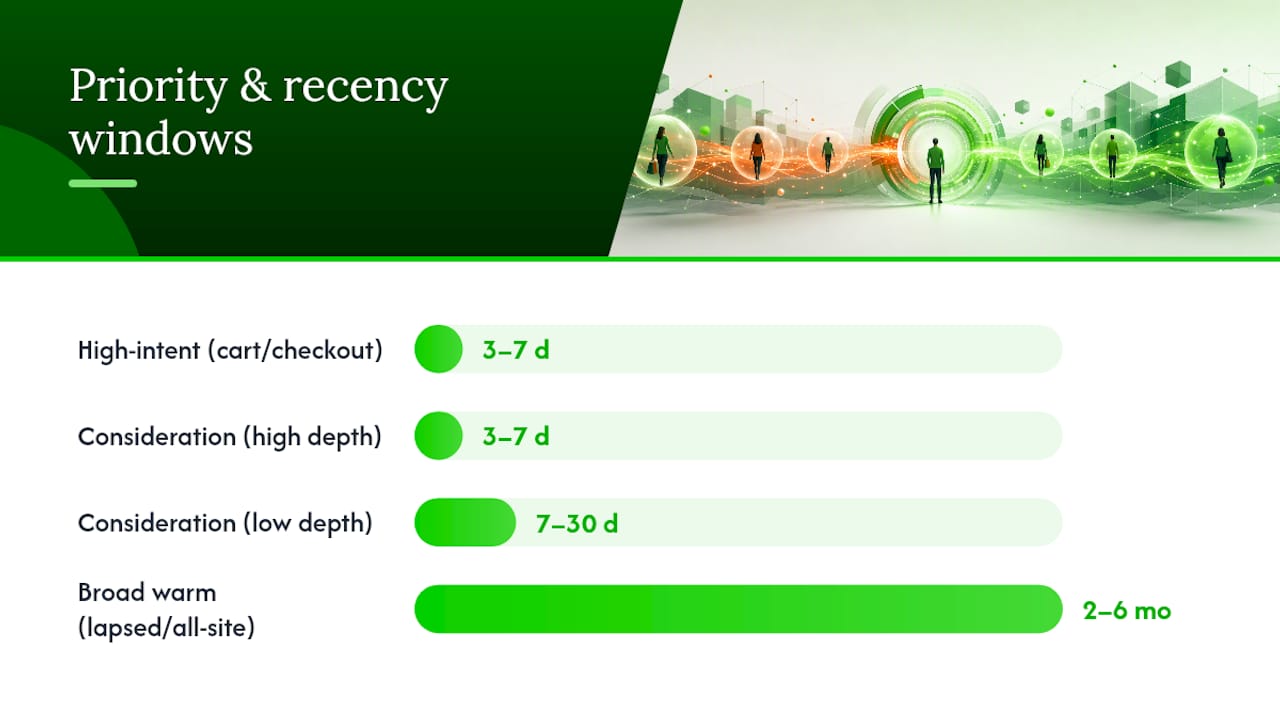
Start with three tiers, ordered by intent:
High-intent segments cover add-to-cart and initiate-checkout events. These deserve the tightest recency window, generally 3 to 7 days, because purchase intent decays fast after someone abandons a cart.
Consideration segments cover product viewers, split further by depth of engagement. Someone who viewed one product once behaves differently than someone who viewed the same category five times in a week, and splitting those into separate audiences lets you bid and message accordingly.
Broad warm segments cover all-site visitors and lapsed past customers, typically defined as no purchase in a recency window of a couple of months to half a year depending on your typical repurchase cycle.
| Segment type | Recency window | Typical treatment |
|---|---|---|
| Cart/checkout abandoners | 3 to 7 days | Reminder ad, no discount initially |
| Product viewers (high depth) | 3 to 7 days | Proof and comparison creative |
| Product viewers (low depth) | 7 to 30 days | Broader category ads, lower bid |
| Lapsed customers | a recency window of a couple of months to half a year | Reactivation offer,, loyalty messaging |
Exclusion lists matter as much as inclusion lists, and they're the part most teams skip. Every audience should exclude:
- Recent converters (purchased in the last 7 to 30 days, depending on repurchase cycle).
- Career or job-application page visitors, who signal interest in employment, not your product.
- Bounces under 10 seconds, who never engaged with the page content at all.
Name audiences with a consistent convention (platform_segment_window, like meta_cart_abandon_7d) so anyone on the team can audit what's running without opening each ad set individually. This kind of structured targeting overlaps closely with broader audience research and targeting work, since the segments you define here should trace back to the same customer data you use for prospecting lookalikes.
What Creative and Cadence Work Best by Segment?
Each funnel stage needs creative built for that specific moment, not a repurposed prospecting ad with a different headline.
For the reminder stage, dynamic product ads showing the exact SKU viewed or abandoned outperform generic brand creative because they remove the friction of the shopper having to remember what they wanted. For proof, short-form UGC video or a customer review carousel works better than polished brand photography, since it answers the trust question a reminder ad can't. For objection handling, direct copy addressing shipping cost, return policy, or price comparison closes the gap that's actually stalling the purchase. For the offer stage, a time-bound discount or bundle gives the final push, but only after the earlier stages have done the persuading.
Rotation and frequency discipline is where most programs quietly bleed budget. Rotating creative every 7 to 10 days keeps click-through rates from decaying, and pausing or refreshing an audience once weekly impressions per user climb past a reasonable ceiling (most practitioners cap somewhere around 5 to 7 per week per platform) prevents the fatigue that quietly kills ROAS without anyone noticing until the reporting shows it.
- Set a hard frequency cap per platform, not just an account-wide setting.
- Track click-through rate by creative weekly; a drop of more than 20 to 30% signals it's time to rotate.
- Reserve incentives (discounts, free shipping) for the objection and offer stages only, never the reminder stage, or you train shoppers to wait for a deal every time.
Format guidance varies by platform. Meta and the Google Display Network favor dynamic product ads for reminder and proof stages. TikTok and Instagram Reels perform best with short, native-feeling UGC clips rather than product-catalog formats, and platform-specific targeting approaches differ enough between channels that a single creative rarely transfers cleanly across all of them.
Pro Tip: Build your objection-handling creative before you launch, not after CTR starts dropping. Most teams write reminder and offer ads first and treat the middle of the funnel as an afterthought, which is exactly where deals stall out.
How Do You Set Up Server-Side Tracking and First-Party Data Collection?
Getting the technical foundation right is what separates a retargeting program that survives browser updates from one that quietly loses half its audience every few months.
- Install the browser pixel (Meta Pixel, Google Ads tag) as your baseline event layer.
- Implement server-side forwarding through Conversions API (Meta) or enhanced conversions (Google), sending the same events from your server or CRM.
- Confirm event parity, meaning the pixel and server-side events fire for the same actions with matching parameters, so you're not double-counting or under-reporting.
- Collect and hash customer identifiers, typically email and phone, at checkout or account creation, using the platform's required hashing standard (usually SHA-256).
- Refresh your customer list upload on a regular cadence, weekly at minimum for active eCommerce brands, so lapsed and new customers move through segments accurately.
- Integrate your CRM or CDP with your ad platforms to automate list syncs instead of relying on manual CSV exports.
- Upload offline conversions (in-store purchases, phone sales) so retargeting credit reflects revenue that never touched a pixel.
A couple of things trip teams up here. First, pairing server-side tracking with hashed identifier uploads produces genuinely deterministic audiences that don't degrade every time a browser vendor changes its cookie policy, which is worth the setup time even if it takes a developer a few hours to wire up correctly.
Second, consent matters as much as the technical build. Collecting emails and phone numbers for retargeting works best as a clear value exchange (a discount code, early access, a loyalty program) rather than a buried checkbox, both because it produces higher-quality data and because it keeps you aligned with how consent frameworks are meant to function.
- Document what data you collect, why, and where it's stored.
- Give visitors a real opt-out that actually removes them from active audiences.
- Review your CRM's retention and deletion practices at least annually.
For businesses managing loyalty and CRM data at scale, CRM and lead automation tooling that ties directly into your ad platforms removes most of the manual list-management work described above.
How Do You Measure Whether Retargeting Actually Works?
Platform-reported ROAS overstates retargeting's impact almost every time, because it counts conversions from people who would have bought anyway. The fix is an incrementality test, also called a holdout test, and it's the only reliable way to know if your spend is buying new revenue or just claiming credit for sales that were already happening.
Setting up a holdout test:
- Carve out a control group (commonly 10 to 20% of your eligible retargeting audience) that sees no retargeting ads for a defined period.
- Run the test for at least two to four weeks, long enough to smooth out day-to-day noise, longer for lower-traffic sites.
- Compare conversion rate between the exposed group and the holdout group; the gap is your true incremental lift, not the raw ROAS number the platform reports.
Holdout testing is the most dependable method for separating real lift from ads simply taking credit for purchases that were coming anyway, and it's worth running quarterly rather than once and forgetting about it, since audience composition and market conditions shift.
Beyond the holdout, switch your attribution model to a data-driven approach in GA4 rather than last-click, since last-click systematically overweights the final touchpoint (often a retargeting ad) and underweights the earlier discovery channels that actually created the demand.
Metrics worth watching weekly:
- Match rate between your customer list and platform audience size.
- Frequency per user, to catch fatigue before it shows up in CTR.
- Incremental lift from your most recent holdout test.
- ROAS adjusted against holdout results, not the platform's raw figure.
Cart abandonment alone represents a massive addressable pool. Global shopping-cart abandonment rates hover in a range widely cited around 70%, which is precisely the audience a well-sequenced retargeting program is built to recover.
How Much Budget Should You Allocate to Retargeting?
A reasonable starting point allocates a portion of total paid media spend to retargeting, with the remainder going to prospecting that feeds new visitors into the funnel. Spend less than that and you're leaving warm, high-intent traffic under-served; spend much more and you're likely retargeting the same shrinking pool of people past the point of diminishing returns.
Within that retargeting budget, weight spend toward recency. A common split runs roughly a larger share on the first week audiences, decreasing allocations for later weeks, since intent decays sharply the longer someone goes without returning.
Frequency caps protect both budget and brand perception:
- Cap impressions per user per week by platform rather than account-wide.
- Pause or refresh a segment once frequency climbs past your set ceiling without a corresponding lift in CTR.
- Shrink budget on any segment where cost-per-result climbs three weeks running without a holdout-confirmed lift to justify it.
- Scale budget into segments where holdout testing confirms strong incremental lift, not just strong platform-reported ROAS.
Frequency mismanagement and stale creative are consistently the biggest silent drains on retargeting ROI, more than budget size or audience quality, because they erode performance gradually enough that most teams don't catch it until a monthly report shows the damage already done.
Retargeting Launch and Audit Checklist
Run this in order, whether you're launching fresh or auditing an existing program:
- Confirm the browser pixel fires correctly on every key event (view, add-to-cart, purchase).
- Confirm server-side tracking (CAPI or enhanced conversions) is live and matches pixel event parity.
- Build core audience segments: cart abandoners, product viewers by depth, lapsed customers.
- Build and apply exclusion lists: recent converters, career pages, sub-10-second bounces.
- Apply a consistent naming convention across every audience and campaign.
- Map creative to funnel stage: reminder, proof, objection handling, offer.
- Set frequency caps per platform and schedule creative rotation every 7 to 10 days.
- Confirm conversion events are configured correctly in GA4 for data-driven attribution.
- Launch a holdout group and calendar the first incrementality readout for two to four weeks out.
- Set a weekly reporting cadence covering match rate, frequency, CTR by creative, and lift.
- Schedule a monthly audit of audience performance, exclusion accuracy, and budget allocation by recency tier.
Skipping step four is the most common failure point. Programs that never build exclusion lists end up spending real budget showing purchase-stage ads to people who already bought, which drags down blended performance metrics for everything else running alongside it.
Why Trust This Playbook
Crowdcompany is rated the #1 marketing agency in Boca Raton, and retargeting sits inside a broader growth marketing practice that spans paid advertising, CRM automation, and offline conversion tracking for local businesses and eCommerce brands. The team runs retargeting and email marketing as a combined discipline, not a siloed paid media line item, which matters because the sequencing described above only works when owned channels and paid channels share the same audience data.
Capabilities relevant to everything in this guide include:
- Retargeting and email/SMS sequence design tied to the same customer data.
- CRM and lead automation setup for first-party list building and offline conversion uploads.
- Offline conversion tracking for businesses with in-store or phone-based sales.
- Google remarketing setup and ongoing optimization across Search and Display.
What Rebuilding Retargeting in 2026 Actually Requires
Most retargeting advice still treats audience building as the hard part. It isn't anymore. The genuinely hard part is measurement discipline, and that's the piece most teams skip because it doesn't produce an immediate campaign to point to.
The conventional wisdom that "more retargeting spend equals more revenue" breaks down the moment you run a real holdout test, because a meaningful share of what platforms report as retargeting-driven revenue would have happened anyway. That's not an argument against retargeting. It's an argument for treating incrementality testing as a permanent fixture of the program rather than a one-time audit.
If you're rebuilding a program from scratch, prioritize in this order: server-side tracking first, exclusion lists second, creative sequencing third, and holdout testing fourth, running continuously rather than once. Teams get this backward constantly, obsessing over creative before their tracking foundation can even report accurately on what's working.
Rebuild Your Retargeting Program With Crowdcompany
If you've read this far, you already know the DIY path: stitch together CAPI, audience segments, creative sequences, and holdout tests yourself, then maintain all of it every month as platforms change their rules again. Crowdcompany is the alternative to hiring a full in-house media and CRM team for retargeting in a local or eCommerce business. The retargeting and email marketing service runs paid audiences and owned-channel sequences from the same customer data, so a cart abandoner gets a coordinated ad, email, and SMS sequence instead of three disconnected systems that never talk to each other.
That matters most for businesses that don't have the bandwidth to build server-side tracking, audit frequency caps, and run quarterly incrementality tests on top of everything else running the business.
Crowdcompany also handles the CRM and lead automation layer that feeds accurate first-party data into those campaigns, along with offline conversion tracking for businesses with in-person sales. Reach out through the South Florida marketing agency page to get a quote on setting up or auditing your retargeting program.
Frequently Asked Questions
What's the difference between retargeting and remarketing? The terms are used interchangeably in most contexts. Google historically used "remarketing" for its own product and "retargeting" became the broader industry term, but the underlying mechanics, re-engaging people who already showed intent, are the same regardless of which word a platform uses.
How long should a retargeting campaign run before I judge results? Give a new segment at least two to four weeks before drawing conclusions, and pair that window with a holdout test rather than judging on platform-reported ROAS alone. Shorter windows rarely produce enough data to separate real signal from normal week-to-week noise.
Do I need server-side tracking if my business is small? Yes, even at a small scale, because browser-based pixel tracking alone now misses a meaningful share of events regardless of business size. The setup cost is fixed and relatively small, and the accuracy gain compounds every month your audiences stay cleaner.
How many touchpoints does a retargeting sequence usually need? Most sequences work well with four stages: reminder, social proof, objection handling, and offer, spread across roughly three weeks. Shorter consideration cycles can compress this; long B2B or high-ticket sales cycles often need it stretched further.
What frequency cap should I start with? Start around 5 to 7 impressions per user per week per platform, then adjust based on click-through rate trends rather than a fixed rule. If CTR is holding steady at a higher frequency, there's no reason to cap it artificially lower.
Sources
- Statista — Online shopping cart abandonment rate worldwide
- Retargeting Ads Strategy 2026: How Dynamic Funnels Are Replacing Static Campaigns (And How to Win) | Digitenzy
- The Complete Guide to Retargeting in a Privacy-First World (2026) – D2C Times
- How to Set Up a Retargeting Ad Campaign That Actually Works | itsdeep