
A realistic website redesign cost for a U.S. small or mid-size business in 2026 falls between $15,000 and $80,000, with the most common agency engagements landing in the $35,000–$65,000 range. A visual refresh on your existing platform costs far less, often $5,000–$15,000. A full rebuild or replatform pushes past $80,000 once integrations and content migration are factored in.
Before you contact a single vendor, do two things:
- Build a page inventory. List every page on your current site, note which ones need new content, and flag any that can be retired.
- List your integrations. CRM, payment gateway, email platform, booking tool, analytics — every connected system adds scope and cost.
Key Takeaways
Most U.S. SMB website redesigns in 2026 fall into three bands: visual refreshes cost $3,000–$15,000, same-platform redesigns land between $15,000 and $80,000, and full rebuilds push past $80,000. The most common agency range for a typical SMB same-platform redesign is $35,000–$65,000 — and the three variables that move that number most are template count, integration complexity, and who owns the content.
| Point | Details |
|---|---|
| Core cost range | Most SMB redesigns land between $15,000 and $80,000; the common agency sweet spot is $35,000–$65,000. |
| Biggest cost drivers | Template count, integration complexity, and content responsibility predict most of the variation in any quote. |
| Don't skip SEO migration | Skipping redirect mapping can lead to substantial losses in organic traffic; budgeting for this work is important. |
| TCPA compliance is a design requirement | SMS opt-in flows must be built for TCPA compliance from discovery; violations carry $500–$1,500 per-text exposure. |
| Crowdcompany | Crowdcompany handles discovery, design, development, SEO migration, and CRM integration for SMB redesigns across the U.S. |
Table of Contents
- What does a website redesign cost in 2026?
- What actually drives the price up (or down)?
- What do you actually get at each price band?
- How CMS choice and content migration affect your budget
- E-commerce redesigns cost more — here is why
- How agencies price projects and what payment terms to expect
- How to cut redesign costs without hurting results
- How long does a redesign take, and what does timeline do to price?
- U.S. legal and compliance costs you need to budget for
- Questions to ask every agency before you sign
- The budgeting mistakes Crowdcompany sees most often
- Crowdcompany builds redesigns that are ready to grow from day one
- Sources
What does a website redesign cost in 2026?
The honest answer is that "website redesign" covers four very different projects. Here is how the ranges break down by approach and provider type.
By project type
| Project Type | Typical U.S. Range | What It Means |
|---|---|---|
| Visual refresh / reskin | $3,000–$15,000 | New colors, fonts, imagery; same structure and CMS |
| Same-platform redesign | $15,000–$80,000 | New UX, new templates, same CMS (e.g., stay on WordPress) |
| Rebuild / replatform | $80,000+ | New CMS, new architecture, full content migration |
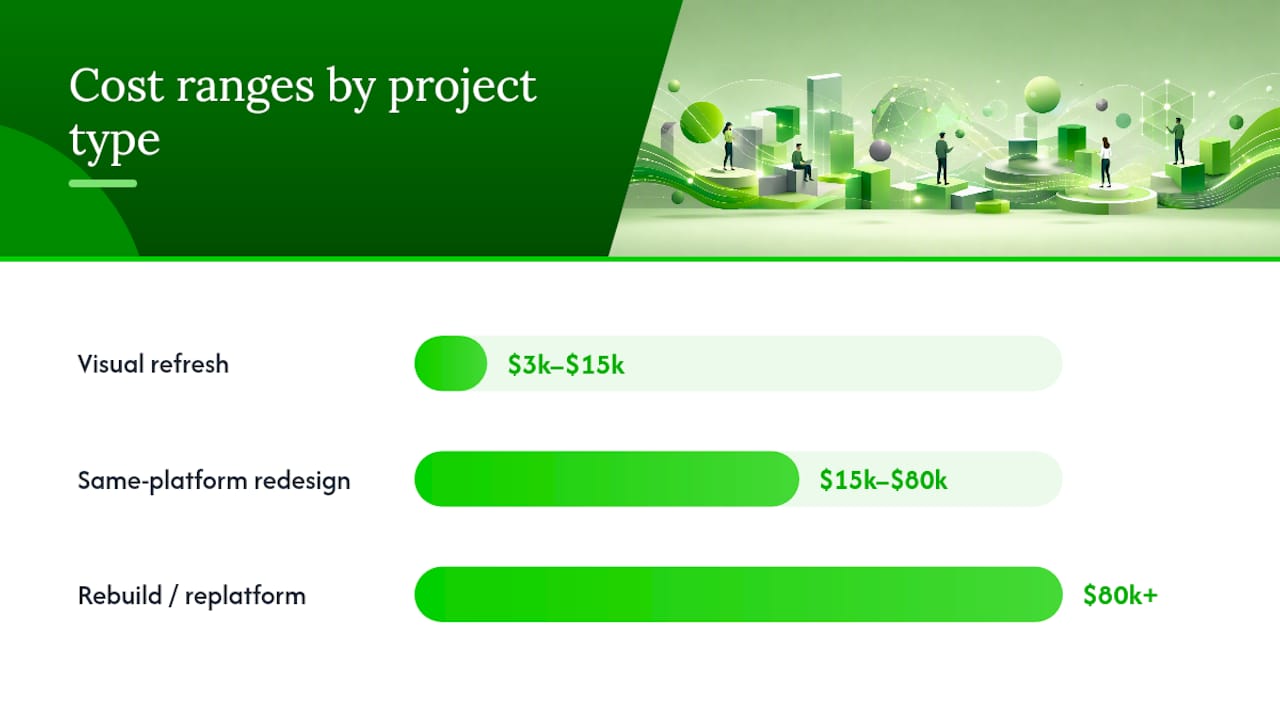
The ranges for each project type mean that the article's overall cost range reflects only same-platform redesigns, with rebuilds and enterprise cases running higher. | E-commerce redesign | $20,000–$100,000+ | Catalog, checkout, payment/fulfillment integrations | | Enterprise | $100,000–$300,000+ | Multi-region, custom integrations, compliance-heavy |
Same-platform redesigns are materially cheaper and lower risk than replatforms, and that gap widens when you factor in SEO migration and content work. A rebuild typically costs 50–100% more than staying on your current platform.
By provider type
Provider type shifts the range significantly:
- DIY / page builder (Wix, Squarespace): $500–$5,000. You supply the labor; the platform supplies the templates.
- Freelancer: $5,000–$20,000. Best for straightforward brochure sites with limited integrations.
- Small agency: $15,000–$60,000. Full-service but leaner teams; good for most SMB redesigns.
- Mid-market agency: $35,000–$100,000. Dedicated strategist, UX, dev, and QA resources.
- Enterprise agency: $100,000–$300,000+. Multi-discipline teams, custom everything.
What three price points actually buy you
Around $10,000: A freelancer-led redesign on an existing WordPress or Shopify theme. You get a new visual design applied to 8–12 page templates, basic on-page SEO setup, and a 30-day bug-fix window. Content is typically client-supplied. No custom integrations.
Around $35,000: A small-to-mid agency redesign. Expect a discovery phase (2–3 weeks), UX wireframes, custom design for 15–25 templates, WordPress or Shopify development, QA across devices, SEO redirect mapping, and a 60–90 day post-launch support period. Light CRM integration is often included.
Around $75,000: A mid-market agency engagement. Full discovery and user research, 30+ custom templates, complex integrations (CRM, marketing automation, payment systems), accessibility audit, performance optimization, and a structured handoff with team training. Content strategy and copywriting for key pages may be included.
What actually drives the price up (or down)?
Three variables predict most of the cost variation in a redesign: the number of unique page templates, integration complexity, and who is responsible for content.
The three biggest levers
Template count is the most reliable predictor. A 200-page site built on 12 templates costs far less to redesign than a 60-page site where every page has a unique layout. Before you brief any agency, count your templates, not your pages.
Integration complexity is where projects quietly double in scope. A basic contact form costs nothing to rebuild. A two-way Salesforce sync with custom field mapping, a Shopify checkout connected to a third-party ERP, or a booking system tied to a payment gateway each adds $3,000–$15,000 in development and QA time.
Content workstream responsibility is the most negotiable driver. If you supply final, approved copy and photography, you can cut 20–30% off a typical agency quote. If the agency writes, edits, sources, and formats all content, that work is real and it costs real money.
Other common cost drivers
- Custom functionality (calculators, configurators, member portals): $5,000–$25,000 per feature
- E-commerce catalog size: more SKUs mean more template variants, filter logic, and QA time
- Accessibility / ADA compliance work: $2,000–$10,000 depending on current state
- SEO migration (redirect mapping, canonical setup, structured data): $300–$2,000
- User testing and QA: often 10–15% of total project cost
- Rush / compressed timeline: typically adds 20–30% to the base quote
Pro Tip: Spend 10–20% of your budget on discovery and research. Projects that skip this phase don't save the money — they spend it on rework during development. Discovery is the one line item where cutting scope creates the most downstream cost.
What do you actually get at each price band?
Understanding deliverables is how you compare quotes fairly. Two proposals at $40,000 can be wildly different in what they include.
Deliverables by price band
| Price Band | Typically Included | Common Add-Ons to Watch For |
|---|---|---|
| $5,000–$15,000 | Theme customization, 8–12 templates, basic SEO setup, 30-day support | Copywriting, photography, SEO migration, integrations |
| $15,000–$80,000 | Discovery, wireframes, 15–25 custom templates, dev, QA, redirect mapping, 60–90 day support | Content strategy, accessibility audit, advanced integrations, training |
| $35,000–$100,000 | Full UX research, 30+ templates, custom integrations, performance optimization, accessibility, team training | Ongoing retainer, content production, PR/launch campaign |
| $100,000+ | Multi-phase delivery, enterprise integrations, compliance work, dedicated PM, SLA-backed support | Custom CMS licensing, multi-region setup, ongoing development retainer |
Common paid add-ons and their typical ranges
- Copywriting: $75–$200 per page, depending on research depth
- Professional photography: $1,500–$5,000 for a full shoot
- Video production: $2,000–$15,000 per video
- SEO migration and redirect mapping: $300–$2,000
- Accessibility audit and remediation: $2,000–$10,000
- CMS or plugin licensing: $200–$2,000/year
- Post-launch maintenance retainer: $500–$3,000/month
The deliverable that most SMBs forget to ask about is post-launch support. A site that launches with no support agreement leaves you paying emergency rates for bug fixes. Ask every vendor what is covered, for how long, and at what response time.
How CMS choice and content migration affect your budget
Platform decisions made during a redesign have a longer financial tail than most SMBs expect.
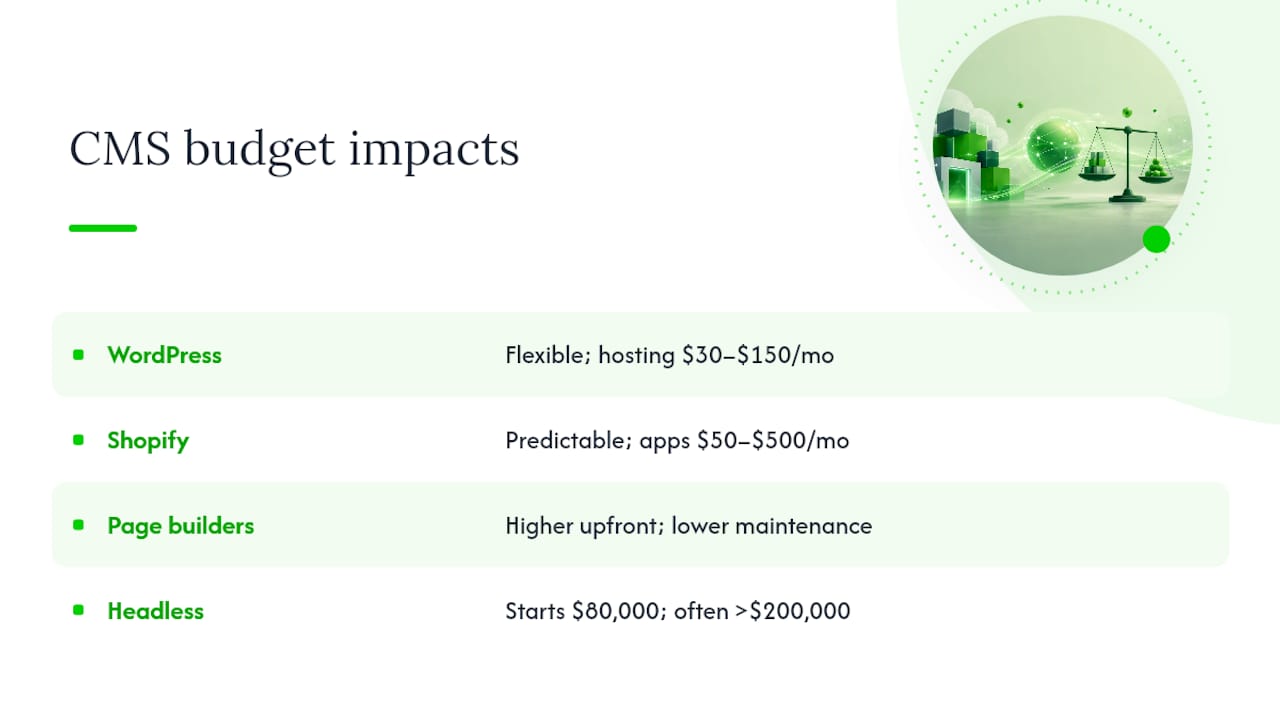
WordPress remains the most flexible option and the most common choice for SMB redesigns. Costs vary widely because the ecosystem is open: a well-configured WordPress build can be maintained affordably, but a poorly configured one with outdated plugins and a custom theme becomes expensive to update. Budget for a theme framework (Elementor Pro, Kadence, or a custom theme), plugin licensing, and a managed hosting plan ($30–$150/month).
Shopify is catalog-driven and predictable. The platform handles hosting and security, which lowers ongoing maintenance cost. The tradeoff is that deep customizations require Liquid templating expertise, and complex checkout modifications can be expensive. Shopify's app ecosystem adds $50–$500/month in recurring costs depending on the tools you need.
Page builders (Webflow, Wix, Squarespace) can cost more upfront for a custom design but often lower maintenance overhead compared with a poorly managed WordPress install. Webflow in particular has become a serious option for SMBs that want design flexibility without heavy plugin management.
Headless architecture (decoupled CMS + front-end framework) is the highest-cost option, typically starting at $80,000 and scaling well past $200,000. It makes sense for high-traffic, content-heavy, or multi-channel businesses. For most SMBs, it is overkill.
Content migration: the hidden line item
Moving 50 pages typically takes 20–40 hours of migration work. A blog-heavy site with 300 posts adds substantially more. Common hidden costs include broken internal links, missing image alt text, formatting inconsistencies, and manual QA to confirm every page rendered correctly.
When to stay on your current platform: If your existing CMS is stable, your team knows it, and your integrations are working, a same-platform redesign is almost always the lower-risk, lower-cost path. Replatforming for aesthetic reasons alone rarely justifies the cost.
When a rebuild makes sense: Your current platform cannot support a required integration, your site speed is structurally limited by the architecture, or you are moving from a custom-built legacy system to a maintained CMS.
Crowdcompany helps SMBs evaluate platform options as part of a scoping conversation, so you are not making a three-year infrastructure decision based on a vendor's preferred tech stack.
E-commerce redesigns cost more — here is why
A commerce redesign is not just a visual project. Catalog structure, checkout flow, payment processing, and fulfillment integrations each add scope that a brochure-site redesign does not touch.
What drives e-commerce redesign costs higher
- Catalog size and product data complexity: 50 SKUs with simple variants is a different project than 5,000 SKUs with configurable options, bundles, and tiered pricing.
- Custom checkout work: Shopify's native checkout is fast to configure; a headless or custom checkout can add $15,000–$40,000.
- Payment gateway integrations: Stripe, PayPal, Affirm, and buy-now-pay-later options each require testing across browsers and devices.
- Inventory / ERP sync: connecting Shopify or WooCommerce to NetSuite, QuickBooks, or a warehouse management system is one of the most expensive line items in a commerce redesign.
- Subscription and recurring billing: platforms like Recharge or Ordergroove add integration cost and ongoing licensing.
- Conversion rate optimization (CRO) work: A/B testing setup, heatmap integration, and checkout funnel analysis are often scoped separately.
E-commerce cost scenarios
For email and marketing automation integrations alongside a commerce redesign, platform choice matters. The Omnisend vs. Klaviyo comparison covers the licensing and setup cost differences between the two most common e-commerce email platforms.
How agencies price projects and what payment terms to expect
Most redesign projects use one of three pricing models, and each carries different risk for the buyer.
Fixed-price works when scope is well-defined. You know exactly what you are getting, and the agency carries the risk of scope creep. The downside: agencies price in a contingency buffer, so fixed-price quotes often run 10–20% higher than time-and-materials for the same work. This model suits SMBs who have done the discovery work upfront and have a detailed brief.
Time and materials (T&M) is appropriate for exploratory or iterative work where requirements will evolve. You pay for actual hours at an agreed rate ($100–$250/hour for U.S. agencies). The risk is that costs can exceed the initial estimate if scope grows. Always set a not-to-exceed cap.
Retainer makes sense for ongoing iteration after launch, not for the initial build. A monthly retainer of $1,500–$5,000 typically covers updates, new landing pages, and performance monitoring.
Typical payment structures
Most agencies use a milestone-based structure:
- 30% deposit at contract signing
- 30% at design sign-off (after wireframes and visual design are approved)
- 30% at development completion (before final QA)
- 10% at launch
Some agencies offer a 50/50 split (half upfront, half at launch) for smaller projects. Be cautious of any vendor asking for more than 50% upfront on a project over $20,000.
Most contracts include a 30–90 day warranty period after launch covering bug fixes at no charge. Anything outside the original scope is billed separately.
Pro Tip: Ask for a phased delivery option. Launching a Phase 1 with your highest-traffic pages and core conversion flows, then building out secondary sections in Phase 2, reduces your upfront commitment and lets you validate the vendor's work before committing the full budget.
How to cut redesign costs without hurting results
Reducing cost without reducing quality is about sequencing and scope decisions, not just negotiating a lower rate.
Tactics that actually work
- Prioritize by traffic and conversion value. Your homepage, primary service or product pages, and contact/checkout flow drive the majority of revenue. Redesign those first; let lower-traffic pages follow in Phase 2.
- Use a design system with selective customization. Apply a premium template or design system to interior pages, and reserve custom design work for the five to eight pages that matter most. This can cut design hours by 30–40%.
- Supply your own content. Client-provided, approved copy and photography is the fastest way to reduce agency cost. Even rough drafts that the agency polishes cost less than a full content production engagement.
- Automate repetitive migration tasks. For large blog archives, tools like WP All Import or Shopify's bulk import can handle structured data migration in hours instead of days.
- Reuse existing photography. A professional photo library from a shoot two years ago is often still usable. Run it by the agency before budgeting for a new shoot.
- Defer non-essential integrations. If a feature is not live on your current site, it does not need to launch on day one of the redesign. Phase integrations to reduce QA complexity and cost.
Pro Tip: The one place you should not cut is SEO migration. Skipping redirect mapping and canonical setup can cost you 30–60% of organic traffic after launch, and recovering that traffic takes months. Budget $300–$2,000 for this work — it is the highest-ROI line item in any redesign.
How long does a redesign take, and what does timeline do to price?
Timeline and cost move together. Compress the schedule and you pay for parallel work, overtime, and additional QA resources.
Phase-by-phase estimates by project size
| Phase | Small Project (8–12 templates) | Mid-Size (15–25 templates) | Large (30+ templates) |
|---|---|---|---|
| Discovery & strategy | 1–2 weeks | 2–3 weeks | 3–5 weeks |
| UX / wireframes | 1–2 weeks | 2–3 weeks | 3–4 weeks |
| Visual design | 2–3 weeks | 3–5 weeks | 5–8 weeks |
| Development | 3–5 weeks | 5–8 weeks | 8 weeks |
| QA & testing | 1–2 weeks | 2–3 weeks | 3–5 weeks |
| Launch & handoff | 1 week | 1–2 weeks | 2–3 weeks |
| Total | around 10–15 weeks | around 15–24 weeks | 20–40 weeks |
Rush fees for compressing a 16-week project into 10 weeks typically add 20–30% to the base quote. That premium covers parallel workstreams, additional QA resources, and the project management overhead of coordinating faster handoffs.
The practical implication: if your redesign has a hard deadline (a product launch, a trade show, a fiscal year end), disclose it in your RFP. Vendors who know about the constraint upfront can price it accurately. Vendors who discover it mid-project will charge more and deliver less.
U.S. legal and compliance costs you need to budget for
A redesign is not just a creative project. Adding new messaging features, updating lead capture forms, or changing your site architecture creates legal and compliance exposure that belongs in the budget from day one.
TCPA and SMS compliance
Any new SMS opt-in flow, text-based lead capture, or messaging integration built during a redesign must comply with the Telephone Consumer Protection Act. TCPA enforcement is active in 2026, and statutory damages run $500–$1,500 per text for violations. That exposure makes a $2,000–$5,000 investment in compliant consent flow design look very reasonable.
Practical SMS compliance requires explicit, documented opt-in language, a confirmation message for recurring programs, and a reliable opt-out mechanism. These are not design afterthoughts — they need to be built into the form architecture and tested before launch. For more on choosing a compliant platform, the best SMS marketing platforms overview covers what to look for in a vendor's compliance tooling.
ADA / web accessibility
The Americans with Disabilities Act applies to websites under Title III for public accommodations, and enforcement through private litigation has increased. Reaching WCAG 2.1 AA conformance on a site that has never been audited typically costs $2,000–$10,000, though exact costs depend on content volume and issue severity. An accessibility audit alone runs $1,500–$4,000. Budget for it.
SEO continuity
Changing URLs, restructuring navigation, or migrating platforms without a redirect map can cause significant organic traffic loss after launch. Budget for redirects and SEO continuity work as a non-negotiable line item. The cost is $300–$2,000 for most SMB sites. The cost of skipping it is measured in months of lost rankings.
Pre-launch compliance checklist
- SMS/messaging opt-in forms reviewed for TCPA compliance
- Privacy policy updated to reflect new data collection
- Cookie consent banner configured for applicable state laws (CCPA, etc.)
- 301 redirect map complete and tested
- Accessibility audit completed or scheduled
- Analytics tracking verified post-launch
Pro Tip: Integrate compliance work into the discovery phase, not the QA phase. Finding a TCPA gap or an accessibility issue during QA means redesigning forms and flows that are already built. Catching it in discovery costs an hour of conversation.
This article provides general information, not legal advice. Confirm current TCPA, ADA, and state privacy requirements with a qualified attorney before launch.
Questions to ask every agency before you sign
Getting comparable quotes requires asking every vendor the same questions. Here is a checklist you can copy into an RFP or use in vendor interviews.
Scope and deliverables
- How many unique page templates does this proposal include, and what happens if we need more?
- What is your process for discovery, and is it included in this quote or billed separately?
- Who is responsible for content: copywriting, image sourcing, and formatting?
- Does the quote include SEO redirect mapping and post-launch analytics verification?
Development and integrations
- Which integrations are included, and how are out-of-scope integrations priced?
- What CMS version and plugins will you use, and who is responsible for licensing costs?
- How do you handle browser and device QA, and what is your testing matrix?
Timeline and payment
- What is the project timeline, phase by phase, and what are the key client approval gates?
- What are the payment milestones, and what triggers each payment?
- What is your change order policy, and how are out-of-scope requests priced?
Post-launch
- What does the post-launch warranty cover, and for how long?
- Do you offer a maintenance retainer, and what does it include?
- What training and documentation will you provide for our team?
RFP checklist: what to request in every proposal
- Itemized deliverables list with template count and integration scope
- Phase-by-phase timeline with client approval gates identified
- Explicit list of exclusions (what is NOT in scope)
- Payment milestone schedule tied to deliverables
- Post-launch support terms and warranty period
- Ongoing maintenance cost estimate (monthly or annual)
- Named team members and their roles on the project
- References from two comparable projects (similar industry, similar scope)
The budgeting mistakes Crowdcompany sees most often
The pattern that shows up most consistently in redesign projects that go over budget is not a vendor problem. It is a scoping problem that was present before the first proposal was sent.
The three most common mistakes: discovery is treated as optional (or cut to save money), SEO migration is deferred until after launch, and integration costs are estimated based on the number of tools rather than the complexity of the data flows between them. A business with five integrations where two of them are bidirectional syncs with custom field mapping will spend far more than a business with ten simple webhook connections.
The fix for all three is the same: spend real time on scoping before you request quotes. A page inventory, an integration diagram, and a clear content responsibility decision are not deliverables you pay an agency to produce. They are inputs you bring to the table. Vendors who receive that level of clarity give you tighter, more comparable quotes. Vendors who do not receive it give you a range with a wide enough buffer to cover whatever they missed.
The other mistake worth naming: treating the redesign as the finish line. A new site that launches without a plan for CRM and lead automation, retargeting, or SEO content is a new coat of paint on a house with no plumbing. The site is the infrastructure. What you do with it after launch is what drives revenue.
Crowdcompany builds redesigns that are ready to grow from day one
Most agencies hand you a finished site and walk away. Crowdcompany builds the site and the growth system around it, so the redesign is connected to your SEO, lead capture, CRM automation, and paid campaigns from the start, not bolted on later.
For SMBs across the U.S., Crowdcompany handles discovery, design, development, SEO migration, and CRM lead automation as part of a single, coordinated engagement. No handoff gaps. No surprise integrations. No post-launch scramble to connect your marketing stack to a site that was never built for it.
The next step is a free scoping conversation. Bring your page inventory and integration list, and Crowdcompany will give you a realistic project range and a clear picture of what Phase 1 should include. Request a scoping conversation and get a quote built around your actual scope, not a generic template.
Sources
The following U.S.-specific resources back the pricing, compliance, and technical guidance in this article.
- Website Redesign Cost: 2026 Buyer's Guide | Launch Day Advisors
- Website Redesign Cost Calculator 2026 | Website Cost Estimator
- Website Redesign Cost in 2026 | LOW/CODE
- Website Redesign Cost Calculator $2K-$20K | Project Cost Estimator