
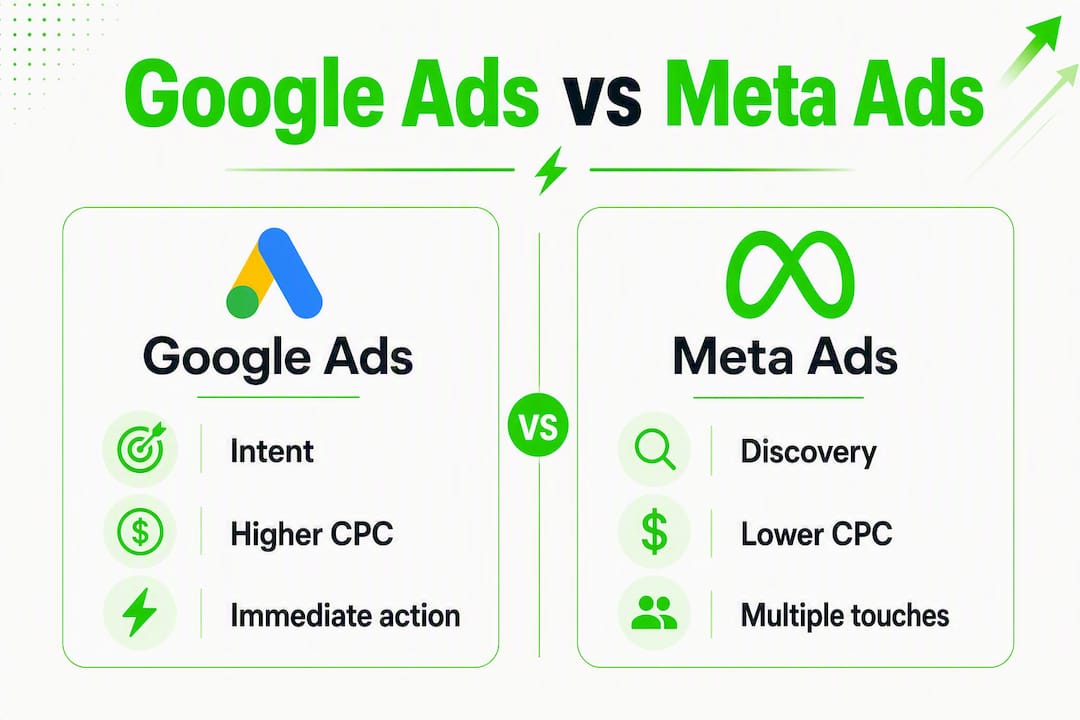
If your customers are already searching for what you sell, start with Google Ads. If they don't know you exist yet, start with Meta. Most U.S. small and medium businesses need both, weighted toward whichever stage of the buyer journey they're stuck at. Run a quick search volume check on your core keywords this week. If monthly volume is strong, Google should take a majority of your paid budget. If it's thin, flip the weight toward Meta and build demand first.
The practical split comes down to three signals: where your buyer's intent lives, how much creative you can produce, and what your margin can absorb per click. Google pulls in people who are ready to act. Meta interrupts people who aren't looking yet but can be convinced. Neither platform beats the other outright. The question is always which one fits your funnel right now.
Table of Contents
- What Google Ads is and when it performs best
- What Meta (Facebook & Instagram) Ads is and when it performs best
- How do Google Ads and Meta Ads actually compare?
- Five key differences that actually affect your results
- Which platform should you choose for your specific SMB goal?
- How to choose the right platform: a practical checklist
- How to run Meta and Google together as one funnel
- What do CPC, CPM, and CPA benchmarks look like for U.S. SMBs?
- What does running ads actually cost, including management fees?
- Real-world examples of platform effectiveness by industry
- How long does it take to see measurable results?
- Key Takeaways
- Why the "Google vs. Meta" debate misses the real question
- Crowdcompany runs the full Google + Meta funnel for you
- Further reading and sources
What Google Ads is and when it performs best
Google Ads is a pull marketing system. Someone types a query, Google matches it to your keywords, and your ad appears at the top of the results page. You pay only when they click. That intent signal is the whole value proposition.
The platform runs across four main formats:
- Search ads: Text ads on Google's results pages, triggered by keyword matches. Best for direct-response goals: leads, calls, purchases.
- Display ads: Image and banner ads across the Google Display Network, which spans over two million websites. Better for retargeting and awareness.
- Shopping ads: Product listings with images and prices that appear directly in search results. Built for ecommerce.
- YouTube ads: Video ads before or during YouTube content. Useful for brand awareness and mid-funnel nurturing.
For a local HVAC company, a personal injury law firm, or a B2B SaaS tool with clear search demand, Google Search is often the fastest path to a qualified lead. Someone searching "emergency plumber near me" has already decided they need help. Your ad just needs to show up and make it easy to call.
Google also integrates with Google Maps, which makes it especially effective for urgent local services. Location extensions let your ad show a phone number, address, and directions link right in the search result, cutting the friction between a search and a real-world visit.

Pro Tip: Before bidding on broad keywords, build your campaign around long-tail phrases ("affordable wedding photographer in Miami") and local modifiers. These terms have lower competition, lower CPCs, and often higher purchase intent than generic head terms.
What Meta (Facebook & Instagram) Ads is and when it performs best
Meta Ads is a discovery channel. People on Facebook and Instagram are not searching for anything. They're scrolling, watching Reels, catching up with friends. Your ad interrupts that experience, which means the creative has to earn the click that Google gets for free from intent.
The platform reaches over 3 billion monthly active users globally across Facebook, Instagram, Messenger, and the Audience Network. That scale matters, but what makes Meta genuinely different is the targeting layer. You're not matching keywords. You're matching people: new parents in Austin who follow organic food brands, men 25–34 in Florida who recently got engaged, or a lookalike audience built from your best 500 customers.
Meta's targeting options include:
- Demographics (age, gender, location, language, education, income)
- Interests and behaviors (pages followed, purchase behavior, life events)
- Custom audiences (email lists, website visitors, video viewers)
- Lookalike audiences (Meta finds new users who resemble your existing customers)
For a DTC skincare brand, a fitness app, or a restaurant with a strong visual identity, Meta often outperforms Google on cost-per-new-customer because the product sells itself visually. A carousel ad showing before/after results or a 15-second Reel demonstrating a product in use can generate demand that didn't exist before the scroll.
One non-obvious move: use Meta's Advantage+ campaigns for early-stage testing. Advantage+ automates audience and creative testing, letting Meta's algorithm find the best-performing combinations without requiring you to manually split-test every variable. For SMBs without a dedicated media buyer, this is a meaningful shortcut to a lower CPA.

How do Google Ads and Meta Ads actually compare?
| Dimension | Google Ads | Meta (Facebook & Instagram) Ads |
|---|---|---|
| User intent | Pull: user is actively searching | Push: user is browsing, not searching |
| Targeting type | Keywords, location, device, time | Demographics, interests, behaviors, CRM lists |
| Ad formats | Text (Search), image/video (Display, YouTube), product (Shopping) | Image, video, carousel, Stories, Reels, collection |
| Creative needs | Headline and copy quality; less visual dependency | Creative quality is the primary performance lever |
| Typical CPC | $2–$4 for many SMB verticals; higher for legal/finance | $0.50–$2.00 across most industries |
| Funnel stage fit | Consideration and conversion | Awareness and consideration; retargeting for conversion |
| Measurement | Conversion tracking, call tracking, Google Analytics | Meta Pixel, Conversions API, attribution windows |
A few things that table doesn't fully capture:
- Google's higher CPC rarely means higher cost-per-sale. CPA is the right comparison, not CPC, because Google traffic converts faster when intent is high.
- Meta's lower CPC can be misleading. A $0.80 click from someone who was just scrolling often takes three to five more touchpoints before converting.
- Creative is king on Meta. Feed the algorithm weak images or generic copy and no amount of targeting precision will save the campaign.
- Keyword relevance is king on Google. A high Quality Score lowers your CPC and improves your ad position simultaneously.
Five key differences that actually affect your results
1. Intent vs. discovery Google captures demand that already exists. Meta creates demand that doesn't. If nobody is searching for your product category, Google Ads will burn budget on irrelevant queries or simply not spend. Meta can introduce your product to the right person before they know they need it.
2. Targeting mechanics Google targets the moment (what someone is searching right now). Meta targets the person (who they are, what they care about, what they've done). A Google campaign for "tax accountant for freelancers" reaches people mid-search. A Meta campaign for the same firm reaches self-employed people aged 28–45 who follow finance content, whether or not they're thinking about taxes today.
3. Creative role On Google Search, your headline and description do the heavy lifting. On Meta, the visual stops the scroll before the copy gets a chance to work. A restaurant running Google Ads needs a compelling offer in the headline. The same restaurant on Meta needs a photo or video that makes someone hungry before they read a single word.
4. Cost metrics Google's CPC runs higher than Meta's on a click-for-click basis, but that comparison is almost always misleading. The relevant number is cost per qualified lead or cost per sale. A $4 Google click that converts at 8% produces a $50 CPA. A $0.90 Meta click that converts at 1.5% produces a $60 CPA, and that's before accounting for the longer nurture cycle Meta typically requires.
5. Conversion behavior Google buyers are often ready to act within the same session. Meta buyers usually need multiple exposures before converting. This changes how you structure your funnel, your retargeting budget, and your attribution window. A 7-day click window on Meta will show very different results than a 1-day click window, and neither tells the whole story without cross-channel data.
Which platform should you choose for your specific SMB goal?
The rule of thumb: intent-driven categories belong on Google first; discovery and visual categories belong on Meta first. But the exceptions matter as much as the rule.
Ecommerce (physical products) Meta leads for visual, impulse, or lifestyle products where the image sells the product. Google Shopping leads when buyers are already searching product names or categories. A candle brand with no search volume should start on Meta. A phone case brand with strong keyword demand should run Google Shopping alongside Meta retargeting.
Local services (plumbers, dentists, gyms, restaurants) Google wins for urgent, needs-based services. Someone searching "dentist open Saturday near me" is ready to book. Meta works well for local awareness campaigns, event promotion, and loyalty offers, but it rarely closes the urgent-need customer the way a Google Search ad does.
B2B lead generation Google Search performs well when buyers are actively researching solutions ("project management software for construction companies"). Meta can work for B2B, but it requires a longer nurture sequence and strong content offers (webinars, guides) to justify the spend. LinkedIn is often a stronger B2B alternative to Meta for high-ticket services, though that's a separate comparison.
Brand awareness and events Meta wins here. Broad reach, visual formats, and low CPMs make it the right tool for building recognition before a product launch or driving RSVPs for a local event. Google Display can support awareness too, but Meta's targeting precision at scale is harder to match for SMB budgets.
DTC with both search volume and visual appeal Run both. Use Meta to build the audience and warm up cold traffic. Use Google Shopping and branded search to capture the buyers Meta already introduced to your brand.
How to choose the right platform: a practical checklist
Before splitting your budget, answer these five questions:
- Is there search volume? Check Google Keyword Planner for your core terms. If monthly volume is under a few hundred searches, Google Search won't have enough demand to spend efficiently.
- What's your margin? High-margin products ($100+ profit per sale) can absorb Google's higher CPCs. Low-margin products need Meta's cheaper clicks and higher volume.
- Can you produce creative? Meta requires fresh images or video regularly. If you can't produce creative consistently, Google Search is lower-maintenance.
- How long is your sales cycle? Short cycles (same-session purchases, urgent services) favor Google. Long cycles (considered purchases, B2B) favor Meta's nurture model.
- Do you have conversion tracking set up? Neither platform optimizes well without conversion data. Google needs a conversion tag; Meta needs the Pixel and ideally the Conversions API.
Sample budget splits by SMB archetype
| Business type | Monthly budget | Google Ads | Meta Ads | Rationale |
|---|---|---|---|---|
| Local service (plumber, dentist) | $1,500 | $900–$1,200 (60–80%) | $300–$600 (20–40%) | Strong search demand; Meta for local awareness |
| DTC ecommerce (visual product) | $2,000 | $400–$600 (20–30%) | $1,400–$1,600 (70–80%) | Discovery-driven; Google for branded/retargeting |
| B2B lead gen (SaaS, consulting) | $3,000 | $1,800–$2,400 (60–80%) | $600–$1,200 (20–40%) | High-intent keywords; Meta for content nurture | | Event / restaurant | $1,000 | $300 (30%) | $700 (70%) | Awareness and RSVP-driven; Google for "near me" |
Red flags to watch before you spend:
- High CPC with zero conversions after 200+ clicks usually means a landing page problem, not a platform problem.
- No conversion tracking means you're flying blind. Fix this before spending anything.
- Running broad match keywords on Google with no negative keyword list will drain budget on irrelevant searches within days.
- Running Meta ads with stock photos or generic copy will produce low click-through rates and high CPMs as the algorithm deprioritizes low-engagement creative.
How to run Meta and Google together as one funnel
The most effective SMB ad programs don't pick a winner. They assign each platform a job and connect them.
Here's a four-stage playbook:
- Stage 1 — Awareness (Meta, weeks 1–2): Run broad Meta campaigns (video or carousel) to a cold audience defined by interest and demographic targeting. Goal: reach and video views. Budget: 40–50% of total spend.
- Stage 2 — Engagement (Meta, weeks 2–4): Retarget video viewers and page engagers with a more specific offer or testimonial creative. Goal: website visits and add-to-carts. Budget: 20–25% of total spend.
- Stage 3 — Intent capture (Google, ongoing): Run Google Search campaigns targeting branded terms and high-intent category keywords. People who saw your Meta ads are now searching your brand name. Google closes them. Budget: 30–40% of total spend.
- Stage 4 — Retargeting (Meta + Google Display, ongoing): Retarget website visitors who didn't convert with both Meta feed ads and Google Display banners. Keep your brand visible across channels during the consideration window.
For creative sequencing: lead with a problem-aware video (15–30 seconds) in Stage 1, follow with a product-demonstration carousel in Stage 2, and use a direct-offer static image in Stage 4. Rotate creative every 2–3 weeks on Meta to prevent audience fatigue.
Measurement note: Meta's Conversions API sends event data server-side, which reduces the data loss that browser-based Pixel tracking suffers from iOS privacy changes. Set it up before scaling. For attribution, use a 7-day click / 1-day view window on Meta and last-click on Google as a starting baseline, then compare against a data-driven attribution model once you have enough conversion volume.
Pro Tip: To prove the compounding effect of running both platforms, run a 4-week geo-split test: run Meta-only in one market and Meta + Google in another with similar demographics. Compare branded search volume and CPA between the two. The Meta + Google market almost always shows lower CPA and higher branded search lift.
What do CPC, CPM, and CPA benchmarks look like for U.S. SMBs?
Benchmark ranges give you a starting point, not a guarantee. Industry, creative quality, and landing page experience all move these numbers significantly.
| Metric | Google Ads (Search) | Meta (Facebook/Instagram) |
|---|---|---|
| Average CPC | $2–$4 (many SMB verticals) | $0.50–$2.00 |
| Typical CPM | $10–$30 (Display/YouTube) | $8–$20 (Feed/Stories) |
| CPA range | Varies widely; often $20 for local services | Varies widely; often $15–$60 for ecommerce |
Sample budget scenarios for U.S. SMBs
| Monthly budget | Platform | Expected clicks | Estimated leads/sales | Assumptions |
|---|---|---|---|---|
| $500 | Google Search | — | — | $2–$4 CPC, 5–7% CVR |
| $500 | Meta (awareness) | — | 3–10 leads | $0.90 CPC, 1–3% CVR |
| $1,500 | Google Search | — | — | Same rates, scaled |
| $1,500 | Meta (retargeting) | — | 15–45 leads | Warmer audience, higher CVR |
The key interpretation: don't compare platforms on clicks. A Google click at $3.50 that converts at 6% costs $58 per lead. A Meta click at $1.00 that converts at 2% costs $50 per lead, but that Meta lead often needs two more touchpoints before it closes. CPA is the correct efficiency metric, and even CPA needs to be weighed against lead quality and close rate.
What does running ads actually cost, including management fees?
Ad spend is only part of the budget. Most SMBs underestimate the total cost of running campaigns well.
Minimum viable budgets:
- Google Ads: There's no platform minimum, but campaigns with less than $500–$1,000/month in most U.S. markets rarely generate enough data for the algorithm to optimize. Competitive verticals (legal, insurance, home services) often require $2,000+/month just to be competitive on key terms.
- Meta Ads: You can start testing with $5–$10/day, which is genuinely useful for early audience signal collection. Scaling to stable, consistent results typically requires $1,000–$1,500/month minimum.
Management fees: Freelance media buyers typically charge $500–$1,500/month for SMB accounts. Agencies range from $1,000 to $3,000+/month depending on scope, creative production, and reporting depth. Some agencies charge a percentage of ad spend (typically 10–20%) once monthly budgets exceed $5,000.
Creative costs: Google Search requires minimal creative investment. Meta requires ongoing creative production: photography, video, copywriting. Budget $300–$800/month for basic creative refresh if you're not producing it in-house.
Total monthly budget for a well-run SMB campaign (both platforms): A realistic all-in number for a local service business running both Google and Meta is $2,500–$5,000/month, including ad spend, management, and basic creative. DTC brands with higher creative demands often run $5,000–$10,000/month before seeing consistent, scalable returns.
Real-world examples of platform effectiveness by industry
Local dental practice (Google-first) A dental practice in a mid-size U.S. city ran Google Search ads targeting "emergency dentist [city]" and "teeth whitening near me." With a $1,200/month ad budget and strong landing pages tied to specific services, the practice generated consistent appointment bookings at a CPA well within their patient lifetime value. Meta ads were added later for a teeth-whitening promotion, which drove awareness and filled a slow month. The combination outperformed either channel alone.
DTC skincare brand (Meta-first) A direct-to-consumer skincare brand with no established search volume launched on Meta with video ads demonstrating product results. The campaign built an email list and generated first purchases at a CPA that worked at their margin. As branded search volume grew from Meta exposure, they added Google branded search campaigns to capture the demand Meta had created. Branded search CPC was low, conversion rate was high, and the combined funnel reduced overall CPA compared to Meta alone.
B2B consulting firm (Google-first, Meta for nurture) A management consulting firm targeting mid-market companies used Google Search to capture decision-makers researching specific service terms. Meta was used to retarget website visitors with thought-leadership content (case study videos, webinar invitations). The Meta retargeting kept the firm visible during a 60–90 day sales cycle and contributed to several closed deals that originated from Google but were nurtured through Meta.
These patterns hold broadly: Google closes, Meta builds. The best results come from letting each platform do what it does well.
How long does it take to see measurable results?
Google Ads: You can see click and impression data within hours of launching. Meaningful conversion data typically takes 2–4 weeks, assuming sufficient daily budget and search volume. Smart Bidding strategies (Target CPA, Target ROAS) need at least 30–50 conversions per month to optimize reliably. Expect 4–8 weeks before you have enough data to make confident optimization decisions.
Meta Ads: Meta's algorithm goes through a "learning phase" for each new ad set, requiring roughly 50 optimization events (clicks, leads, purchases) before it exits and stabilizes. At $10/day, that can take 3–6 weeks. At $50/day, it can happen in under a week. Creative fatigue sets in faster than most SMBs expect: a strong Meta ad often starts losing efficiency after 2–3 weeks as the same audience sees it repeatedly.
The practical implication: neither platform is a same-week revenue machine for most SMBs. Budget for a 60–90 day testing period before drawing conclusions about platform performance. Pulling campaigns after two weeks because "it's not working" is the single most common reason SMBs fail at paid advertising.
Key Takeaways
Google Ads captures buyers who are already searching; Meta builds the audience that later searches, and the strongest SMB programs run both platforms as a connected funnel rather than choosing one.
| Point | Details |
|---|---|
| Intent determines your starting platform | Strong search volume means Google first; thin search volume means Meta first to build demand. |
| CPA beats CPC as your comparison metric | Google's higher CPC often produces lower CPA in high-intent categories; always compare cost per qualified lead. |
| Creative quality drives Meta performance | Feed Meta strong visuals and video; poor creative cannot be rescued by precise targeting alone. |
| Combined funnels outperform single-channel | Meta builds awareness and branded search lift; Google captures that intent and converts it efficiently. |
| Crowdcompany builds and manages these funnels | Crowdcompany handles campaign setup, creative, retargeting, and offline attribution for SMBs running both platforms. |
Why the "Google vs. Meta" debate misses the real question
The framing of Google Ads vs Facebook Ads as a competition is the wrong lens entirely. After watching SMB campaigns across dozens of industries, the businesses that treat these platforms as rivals almost always underperform the ones that treat them as a two-part system.
Here's what the debate gets wrong: it assumes your buyer lives on one platform. They don't. The same person who sees your Meta ad on Tuesday morning is searching your brand name on Google by Thursday afternoon. Meta didn't fail to convert them. It did exactly what it's supposed to do: it introduced your brand and created enough curiosity to generate a search. Google then closed the deal. If you were only running Google, you'd never have appeared in that person's life before they searched. If you were only running Meta, you'd have lost the conversion to a competitor who showed up when the buyer was finally ready.
The real question isn't which platform is better. It's whether your funnel is designed to use both at the right moment. Most SMBs aren't losing to the wrong platform choice. They're losing because their Meta creative is generic, their Google landing pages don't match the ad, or they have no retargeting connecting the two. Fix those three things and the platform debate becomes almost irrelevant.
Crowdcompany runs the full Google + Meta funnel for you
Running Google and Meta together the right way takes more than setting up two ad accounts. It takes coordinated creative, synchronized audiences, proper attribution, and someone watching the data closely enough to catch a creative fatigue problem before it tanks your CPA.
Crowdcompany handles the entire paid advertising stack for U.S. SMBs: campaign strategy, ad creative, audience research, Google and Meta campaign management, retargeting sequences, and offline conversion tracking through NFC stands and scratch-card programs that tie physical foot traffic back to your digital spend. You get a team that builds the funnel, produces the creative, and optimizes both platforms under one monthly engagement, with no guesswork about which channel is doing what.
Ready to see what a properly built Google + Meta funnel looks like for your business? Book a paid advertising consultation with Crowdcompany and get a clear plan for where your budget should go and what results to expect.
Further reading and sources
- Google Ads Help Center — Benefits of online advertising: Official Google documentation on targeting options, bidding, and conversion tracking for Google Ads campaigns.
- Shopify — Google Ads vs Facebook Ads (2025): Practical ecommerce-focused comparison covering intent differences, cost benchmarks, and when to use each platform.
- Hootsuite — How to advertise on Facebook in 2026: Comprehensive guide to Meta Ads formats, Advantage+ campaigns, and CPC benchmarks used in the benchmarks section.
- Landingi — Google Ads vs Facebook Ads: Analysis of CPA as the correct efficiency metric and why raw CPC comparisons mislead advertisers.
- Superscale — Facebook Ads vs Google Ads: Which Is Better in 2026?: Industry benchmark ranges for Google Search CPC across SMB verticals, used in the benchmarks table.
- Coursera — What Is Facebook Advertising?: Overview of Meta Ads Manager, ad formats, and campaign objective setup for beginners.
- Mailchimp — Facebook Ads glossary: Guidance on minimum daily budgets, learning phase requirements, and scaling Meta campaigns.
- Pew Research Center: Data on social media platform reach and user demographics relevant to Meta's audience scale.
This article is general marketing information, not professional financial or legal advice. Benchmark figures vary by industry, geography, and campaign setup. Confirm current platform policies and pricing directly with Google Ads and Meta Ads Manager before making budget decisions.