
The three highest-leverage moves in restaurant SEO are: optimize your Google Business Profile completely, publish your menu in HTML and add Restaurant schema, and build a system to generate multiple genuine reviews weekly. Get those three right and you will outrank most local competitors within a few months, regardless of how long they have been in business.
Priority checklist to start today:
- Claim and complete your Google Business Profile (1 hour, owner) — name, address, phone, hours, categories, photos, and menu link
- Convert your menu to HTML and add MenuItem schema, a developer task — PDFs and images are invisible to search engines and AI assistants
- Start a review request system (30 minutes to set up, ongoing) — two new genuine reviews per week is the practical benchmark for independent restaurants
Pro Tip: Treat your menu as your primary SEO content asset. Each dish rendered in HTML with a short description and MenuItem schema can rank for long-tail queries like "best birria tacos in Austin." Assign menu HTML to your developer, review requests to your front-of-house manager, and GBP updates to yourself or a marketing coordinator.
Table of Contents
- Why restaurant SEO should be your top marketing priority right now
- Quick wins you can finish this week
- How to optimize your Google Business Profile step by step
- Your restaurant website checklist: pages, technical basics, and schema
- Keyword strategy and content ideas that actually bring in diners
- Reviews and reputation management: how to earn and use them
- Local listings, citations, and link-building for restaurants
- How online ordering and reservation integrations affect your SEO
- How to measure restaurant SEO performance
- Typical costs and realistic timelines: DIY vs. hiring an agency
- Your 30/60/90-day restaurant SEO action plan
- Key Takeaways
- The part most restaurant SEO guides get wrong
- Crowdcompany handles the restaurant SEO work that owners never have time for
- Sources and further reading
Why restaurant SEO should be your top marketing priority right now
Google holds roughly 93% of the U.S. mobile search market, which means when someone pulls out their phone and types "Thai food near me," your Google Business Profile and website are either in front of them or they are eating somewhere else. Local searches convert to visits and orders at a rate no paid channel can match at the same cost, because the searcher already has intent.
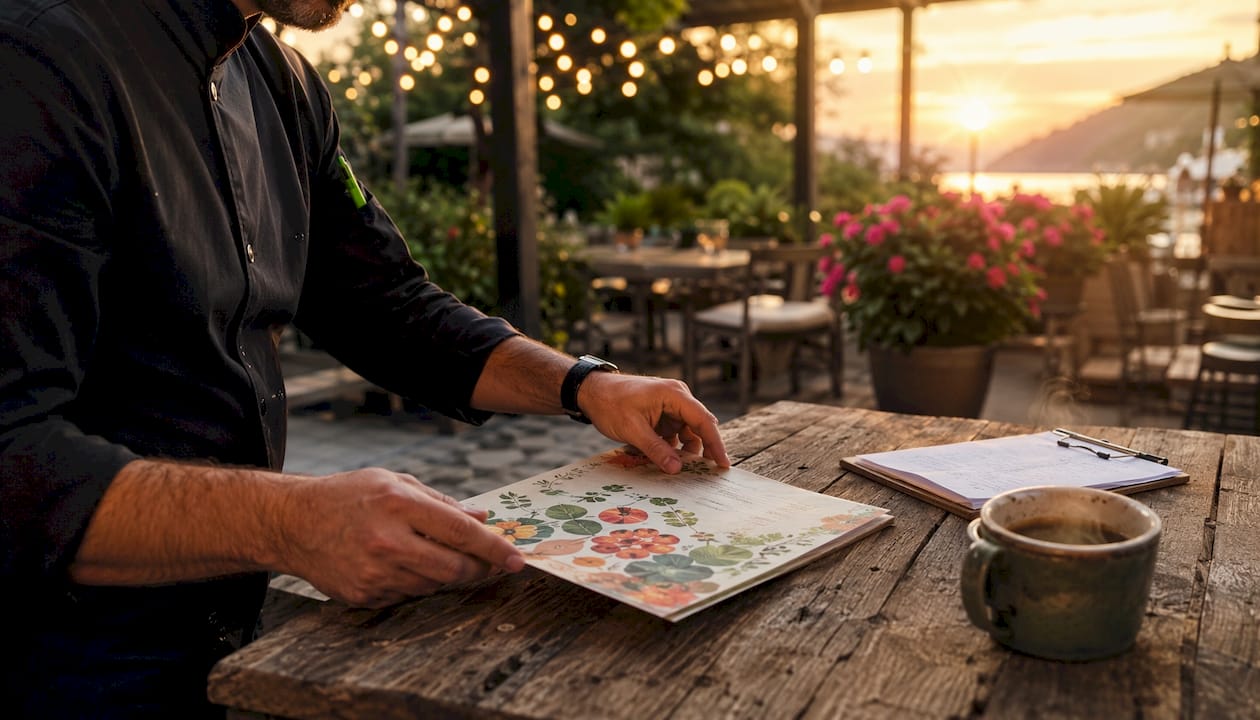
The Map Pack (the three-business block at the top of local results) drives the majority of clicks for restaurant queries. If you are not in it, you are invisible to most mobile searchers. GBP controls Map Pack placement and feeds the actions that matter most: calls, direction requests, and menu clicks.
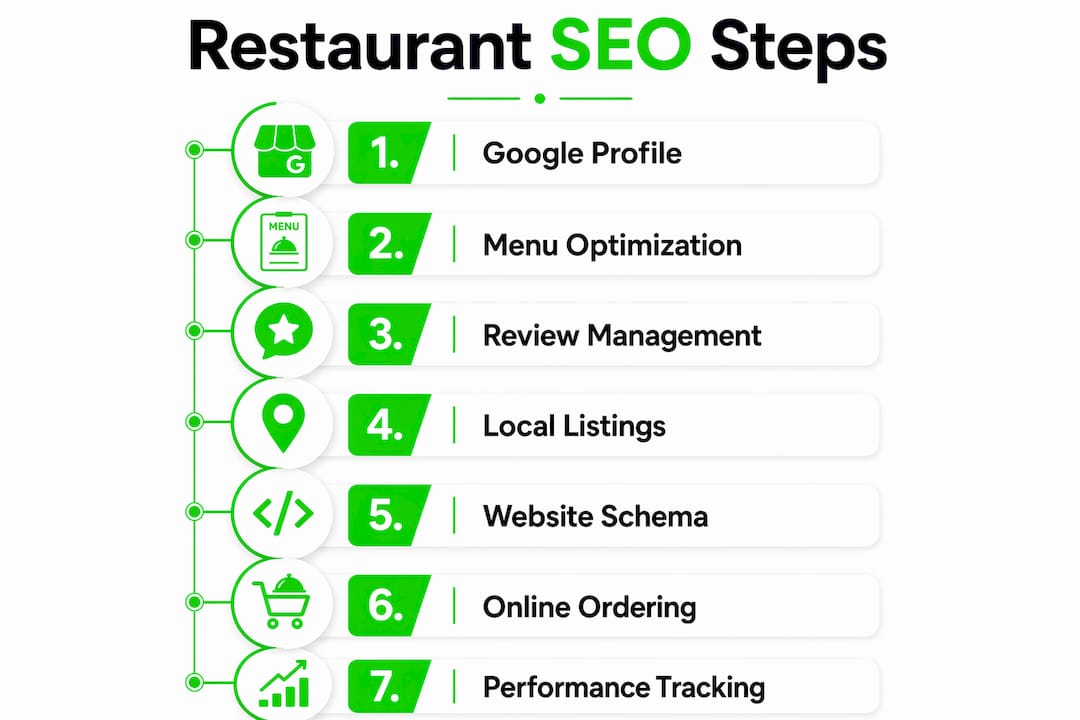
AI is now a real factor. AI-driven overviews and chat assistants increasingly influence where people decide to eat. When someone asks ChatGPT or Perplexity "best Italian restaurant in Denver," those tools pull from structured data and review signals. A restaurant with clean schema and strong recent reviews gets recommended. One without it does not.
A few things that make local SEO for restaurants different from general SEO:
- Searchers are usually within hours of making a decision, not just browsing
- Review recency matters as much as star rating for local rank
- Your menu content is a direct ranking asset, not just a customer convenience
- Mobile experience is non-negotiable: most local searches happen on phones
Quick wins you can finish this week
These are ranked by impact-to-effort ratio. Work through them in order.
- Claim and verify your Google Business Profile (1 hour, owner) — if it is unclaimed, a competitor or random user may have already edited it
- Fix your NAP (30 minutes, owner or manager) — your name, address, and phone must be identical on your website, GBP, Yelp, TripAdvisor, and OpenTable
- Convert your menu to HTML (2–4 hours, developer) — replace any PDF or image menu with crawlable HTML pages
- Upload a photo set to GBP (1 hour, owner or manager) — at minimum: exterior, interior, three to five food shots, and one staff photo
- Set up a review request process (30 minutes, manager) — a printed card at the table or a post-visit SMS is enough to start
- Confirm your hours are correct everywhere (15 minutes, owner) — wrong hours are the single most common GBP complaint from diners
How you know it worked: Check GBP Insights after two weeks. You should see an uptick in profile views, direction requests, and menu clicks. A drop in bounce rate on your menu page signals the HTML conversion worked.
How to optimize your Google Business Profile step by step
A complete, regularly updated GBP typically outranks a half-finished profile from a better-known restaurant within a few months. The algorithm rewards completeness and freshness, not brand recognition.
Step-by-step setup:
- Go to business.google.com, claim your listing, and complete the verification (postcard, phone, or video)
- Set your business name exactly as it appears on your signage and website — no keyword stuffing in the name field
- Add your full address and confirm the pin is placed correctly on the map
- Set your primary category to "Restaurant" and add secondary categories for your cuisine type (e.g., "Italian Restaurant," "Pizza Restaurant")
- Add your primary phone number, website URL, and a direct link to your HTML menu page
- Set regular hours and add holiday hours proactively — Google surfaces "hours may differ" warnings that erode trust
- Enable attributes relevant to your operation: outdoor seating, delivery, takeout, dine-in, reservations, wheelchair accessible
- Add your reservation link (OpenTable, Resy, or your own booking page) and online ordering link
Photos and media:
- Upload at minimum: exterior (daytime), interior (full dining room), bar area if applicable, three to five hero food shots, and one team photo
- Add new photos at least twice a month — photo freshness is a minor but real ranking signal
- Short videos (15–30 seconds) of plating or the dining room perform well in GBP engagement
Menu in GBP:
Add menu items directly in GBP's menu editor and point the "menu URL" field to your HTML menu page. Keep both in sync. When your website menu changes, update GBP within 48 hours.
Reviews in GBP:
Reviews appear prominently in your GBP panel and directly influence Map Pack rank. Review recency and velocity have an outsized effect on local ranking — a smaller restaurant with strong recent review momentum can outrank a well-known spot with hundreds of old reviews.
Pro Tip: After making a batch of GBP changes, screenshot your current Map Pack position for two or three priority queries (e.g., "Italian restaurant [your city]"). Check again in two weeks. GBP Insights shows impressions, searches, and actions — watch those numbers weekly for the first month.
Your restaurant website checklist: pages, technical basics, and schema
Most restaurant websites only need four to six well-optimized pages to win local keyword visibility. More pages are not the goal. Better pages are.
Pages to maintain:
- Homepage — primary keyword in title tag, brief description of cuisine and location, links to menu and reservations
- Menu page(s) — HTML only, organized by category, with short dish descriptions
- Location/Contact page — full NAP, embedded Google Map, parking notes, hours
- About page — story, chef bio, neighborhood context (great for local keyword signals)
- Private events/catering — a separate page if you offer it; it targets a distinct high-value query
- Blog/news — for local content, seasonal specials, and event announcements
Technical musts:
- HTTPS on every page (non-negotiable for trust and ranking)
- Mobile-first design — test on a real phone, not just a browser resize
- LCP under 2.5 seconds — if your menu page takes five seconds to load, diners bounce to a faster competitor
- Clean URL structure:
/menu/,/contact/,/events/— not/page?id=47 - Image compression: food photos are often the biggest page-weight culprit; use WebP format and lazy loading
- Crawlability: no important pages blocked in robots.txt, no menu content locked in JavaScript that search engines cannot read
Schema.org implementation:
Structured data is how AI assistants and answer engines surface your menu, hours, and location details. Adding Restaurant schema (a subtype of LocalBusiness) to your homepage and contact page, and MenuItem schema to your menu page, is roughly a two-hour developer task with compounding returns.
| Page | Schema type | Key fields to include |
|---|---|---|
| Homepage | Restaurant (LocalBusiness) | name, address, telephone, openingHours, servesCuisine, url, image |
| Menu page | MenuItem | name, description, offers (price), suitableForDiet |
| Contact page | Restaurant (LocalBusiness) | address, geo, hasMap, openingHoursSpecification |
Test your implementation with Google's Rich Results Test and monitor for errors in Google Search Console. For a deeper technical walkthrough of how structured data works in practice, the Codenexa guide is worth bookmarking.
Pro Tip: Never publish your menu as a PDF. Search engines cannot read it, AI assistants cannot parse it, and mobile users hate downloading files. If your CMS does not support HTML menus natively, a simple table or definition list in HTML is enough to make dish names and descriptions crawlable.
Keyword strategy and content ideas that actually bring in diners
The formula that consistently works is cuisine or dish + city or neighborhood. That is it. "Best ramen Chicago," "vegan brunch Williamsburg," "private dining downtown Nashville." These are the queries from people who are ready to eat, not just browsing.
How to map keywords to pages:
- Menu items and cuisine type → menu page title tags and dish descriptions
- Neighborhood and city phrases → homepage and location page copy
- Events, specials, and seasonal dishes → blog posts and event pages
- "Near me" queries → handled by GBP and location schema, not a separate page
Sample title tag patterns:
- Homepage:
[Cuisine Type] Restaurant in [City] | [Restaurant Name] - Menu page:
Menu | [Restaurant Name] — [Cuisine] in [Neighborhood], [City] - Dish page:
[Signature Dish] in [City] | [Restaurant Name]
Keep title tags at 50–60 characters. Meta descriptions at 150–160 characters, with a local keyword and a clear action ("Reserve a table," "Order online").
Content ideas worth publishing:
- Dish spotlight posts: the story behind a signature item, sourcing, and how it is made
- Neighborhood guide: "Best date night spots near [your neighborhood]" — you mention yourself and earn local context
- Seasonal menu announcements with photos
- Event pages for recurring nights (trivia, live music, wine tastings)
- FAQ page answering common diner questions: parking, dress code, allergy accommodations, group reservations
For deeper keyword targeting by cuisine and neighborhood, audience research and targeting can surface the specific queries your ideal diners are actually using.
Reviews and reputation management: how to earn and use them
Review velocity matters more than most owners realize. A restaurant with many old reviews can be outranked by a smaller competitor with strong recent momentum. At least two new genuine reviews per week is a practical benchmark for independent restaurants.
Where and how to ask:
- Printed table card with a QR code linking directly to your Google review page
- Receipt footer: "Loved your meal? Leave us a quick Google review."
- Post-visit SMS (if you collect phone numbers via reservations or loyalty): send within two hours of the visit
- Email follow-up for OpenTable or Resy reservations: one sentence, one link, no pressure
Response templates:
Positive review: "Thank you, [name]! We are so glad you enjoyed the [dish they mentioned]. We will pass your kind words along to the team. Hope to see you again soon."
Neutral review (3–4 stars): "Thanks for the honest feedback, [name]. We are glad parts of the experience worked for you and we would love to make it right. Please reach out to us directly at [email] so we can learn more."
Negative review: "We are sorry to hear this, [name]. This is not the experience we aim to provide. Please contact us at [email] so we can address this personally." Never argue publicly. Move it offline immediately.
Reviewer photos:
Encourage guests to upload photos with their reviews. Photos in GBP reviews increase engagement and signal to Google that the profile is active. A simple "Feel free to share a photo!" on your table card is enough.
For restaurants that want to outsource this entirely, review management services handle request cadence, response drafting, and monitoring across Google and Apple Maps.
Local listings, citations, and link-building for restaurants
NAP consistency is one of the simplest ranking factors to get right and one of the most commonly broken. Small variations — "St." vs. "Street," a missing suite number, an old phone number — confuse search engines and dilute your local prominence. Check these five directories first: Google Business Profile, Yelp, TripAdvisor, OpenTable, and Apple Maps.
Quick citation audit checklist:
- Business name spelled identically everywhere (no abbreviations on some, full name on others)
- Address format consistent (use the USPS standard format as your master)
- Same primary phone number across all listings
- Website URL pointing to your homepage (not a campaign landing page)
- Hours matching your GBP hours exactly
Run this audit annually, or after any address, phone, or name change. Tools like Moz Local or Yext can scan dozens of directories at once if you want to speed up the process.
Local link-building that actually works:
- Neighborhood blogs and city guides — pitch a "best of" feature or offer a guest post about your cuisine
- City event calendars — submit your recurring events (trivia nights, wine dinners) to local event sites
- Supplier and partner pages — ask your local farm, brewery, or coffee roaster to mention you on their website
- Local business associations — chamber of commerce, neighborhood business improvement districts
- Food bloggers and local press — a single review from a credible local food writer can generate a link and sustained traffic
Outreach pitch (short version):
That is it. No attachments, no long pitch. For more structured outreach and local digital PR, Crowdcompany handles the full campaign.
Pro Tip: A link from a local news outlet or city magazine is worth more than 50 links from generic directories. One well-placed local PR mention can move your domain authority faster than months of directory submissions.
How online ordering and reservation integrations affect your SEO
Third-party widgets are the most common way restaurants accidentally hide their menu from search engines. If your ordering system loads inside an iframe or pulls content from a JavaScript widget that search engines cannot render, your dish names and descriptions are invisible to Google and AI assistants.
The SEO-safe setup:
- Publish your full menu in HTML on your own domain first, always
- Use third-party ordering (Toast, Square, etc.) as a checkout layer, not as your menu display
- Set canonical URLs on any ordering pages hosted on a subdomain or third-party domain to point back to your main site
- Add
hasMenuandacceptsReservationsfields to your Restaurant schema, pointing to your HTML menu and booking page
Integration decision checklist:
- Does the integration render menu content in crawlable HTML, or in an iframe/JavaScript widget?
- Does it add significant load time to your menu page? (Test with PageSpeed Insights)
- Does it give you control over the menu URL structure?
- Is the mobile experience clean, or does it require multiple taps to reach a dish?
- Does it support structured data or at minimum allow you to add schema to the surrounding page?
Where to place CTA buttons:
Put "Order Online" and "Reserve a Table" in your site header and on the menu page above the fold. Do not bury them. Conversion from organic traffic depends on the path being obvious within two seconds of landing.
How to measure restaurant SEO performance
Tracking the right metrics weekly keeps you from spending three months on work that is not moving anything.
| Metric | Tool | What to watch for |
|---|---|---|
| GBP views and actions | GBP Insights | Direction requests, calls, menu clicks trending up |
| Map Pack rank | Local Falcon or BrightLocal | Position for 3–5 priority queries weekly |
| Organic clicks to menu/location pages | Google Search Console | Click and impression growth month over month |
| Core Web Vitals / LCP | Search Console, PageSpeed Insights | LCP under 2.5 seconds on mobile |
| Reservation and order conversions | GA4 (goal events) | Clicks on "Reserve" and "Order" buttons |
| Review velocity | GBP Insights / manual count | At least two new reviews per week |
Weekly vs. monthly cadence:
- Weekly: Check GBP actions (calls, directions, menu clicks), scan for new reviews and respond within 24 hours, spot-check Map Pack position for your top query
- Monthly: Pull Search Console data for organic clicks and impressions, review GA4 conversion events, check LCP on your menu page, audit one or two citation listings
Google Search Console and GA4 are both free and cover the majority of what independent restaurants need. Local Falcon adds a visual grid map of your Map Pack position across a radius, which is useful once you are actively trying to expand your local reach.
Typical costs and realistic timelines: DIY vs. hiring an agency
| Work | DIY cost | Agency/freelancer cost | Timeline to see results |
|---|---|---|---|
| GBP setup and optimization | Free (your time) | $150 one-time | 2–4 weeks |
| Menu HTML conversion | Free if you do it | — | Immediate crawl improvement |
| Restaurant schema implementation | Free (developer time) | — | 2–6 weeks for indexing |
| Ongoing local SEO management | Free (significant time) | — | 3–6 months for meaningful rank gains |
| Local PR and link building | Free (significant outreach time) | — | 3–12 months for authority gains |
Quick wins (GBP, NAP, menu HTML) show movement in 2–4 weeks. Keyword rankings for competitive queries take 3–6 months of consistent work. Building enough authority to rank for "best [cuisine] in [city]" against established competitors is typically a 6–12 month project.
Hiring checklist — what to ask before signing:
- What specific deliverables do I get each month?
- How do you report on GBP performance and Map Pack rank?
- Do you have experience with restaurant clients specifically?
- Will you implement schema directly, or just advise?
- What does the first 30 days look like?
Red flags: Guaranteed #1 rankings, vague "SEO audit" deliverables with no specifics, agencies that do not mention GBP or schema in their pitch, and anyone who suggests buying links or reviews.
If you are weighing organic SEO against paid advertising campaigns for faster short-term traffic, the honest answer is that paid and organic work best together: paid fills the gap while organic builds.
Your 30/60/90-day restaurant SEO action plan
Days 1–30: Foundation
- Claim and fully complete your Google Business Profile (owner, 1 hour)
- Audit and fix NAP on Google, Yelp, TripAdvisor, OpenTable, and Apple Maps (manager, 1–2 hours)
- Convert your menu to HTML and deploy on your website (developer, 2–4 hours)
- Upload a complete photo set to GBP: exterior, interior, food, staff (owner or manager, 1 hour)
- Launch your review request process: table cards, receipt footer, or post-visit SMS (manager, 30 minutes to set up)
- Confirm HTTPS is active and your site loads in under 3 seconds on mobile (developer, 30 minutes to check)
Owner owns: GBP, photos, review requests Manager owns: NAP audit, review responses, photo uploads Developer owns: Menu HTML, HTTPS, site speed
Days 31–60: Content and schema
- Add Restaurant schema to homepage and contact page (developer, 2 hours)
- Add MenuItem schema to menu page (developer, 1–2 hours)
- Optimize title tags and meta descriptions on homepage, menu, and location pages using the [cuisine] + [city] formula
- Publish two to four local content pieces: dish spotlights, a neighborhood guide, or an event page
- Begin local link outreach: email two to three neighborhood blogs, your suppliers, or local event calendars
- Set up Google Search Console and GA4 if not already active; configure conversion events for reservations and online orders
Days 61–90: Measure, iterate, and scale
- Pull Search Console data: which queries are driving impressions? Which pages have high impressions but low CTR? Fix those title tags.
- Check Map Pack position for your three to five priority queries using Local Falcon or BrightLocal
- Review GA4 conversion data: are organic visitors booking reservations or ordering online?
- Ramp review velocity to two or more per week if you are not there yet
- Plan next quarter's content calendar: seasonal menu changes, upcoming events, holiday promotions
- Evaluate whether to bring in agency support for schema, PR, or ongoing content
Weekly cadence (5 minutes): Check GBP actions, respond to any new reviews, spot-check your top Map Pack query. Monthly cadence (30 minutes): Search Console report, GA4 conversions, one citation audit, one new content piece or update.
Key Takeaways
The single most important thing you can do for restaurant SEO today is claim and complete your Google Business Profile, publish your menu in HTML with Restaurant schema, and build a system that generates at least two genuine reviews per week.
| Point | Details |
|---|---|
| GBP is your ranking foundation | A complete, updated profile controls Map Pack placement and drives calls, directions, and menu clicks. |
| HTML menu + schema = discoverability | PDFs and image menus are invisible to search engines and AI assistants; MenuItem schema enables dish-level queries. |
| Review velocity beats review volume | At least two new genuine reviews per week outperforms a large backlog of old reviews for local rank. |
| NAP consistency is non-negotiable | Identical name, address, and phone across Google, Yelp, TripAdvisor, OpenTable, and Apple Maps prevents ranking dilution. |
| Crowdcompany accelerates the timeline | Crowdcompany's local SEO, review management, and digital PR services handle the work that takes owners the most time. |
The part most restaurant SEO guides get wrong
Most restaurant SEO content treats Google Business Profile as a checkbox. Fill it out once, move on. That framing misses the point entirely.
GBP is not a static listing. It is a live content channel. Restaurants that win the Map Pack consistently are the ones treating GBP the way they treat their Instagram: fresh photos, updated posts, active review responses, and menu items that reflect what is actually on the table tonight. The algorithm notices activity. More importantly, diners notice it.
The second thing guides underplay is the menu as a content asset. Every dish on your menu is a potential long-tail keyword. "Smoked brisket tacos in Houston" is a real query with real intent behind it. If that dish exists on your menu but only inside a PDF, you are leaving that traffic on the table. Rendering it in HTML with a one-line description takes a developer an afternoon. The compounding effect over 12 months, as those dish-level pages accumulate impressions and clicks, is one of the highest-ROI moves available to an independent restaurant.
The third underrated factor is review recency. A restaurant that opened five years ago and has 400 reviews but has not gotten a new one in three months is losing ground to a newer spot getting five reviews a week. Recency signals to Google that the business is active and that diners are choosing it right now. At least two reviews a week is achievable for almost any restaurant with a simple ask built into the checkout or table experience.
The honest takeaway: restaurant SEO is not complicated. It is consistent. The restaurants that rank well are not doing anything exotic. They are doing the basics, repeatedly, without letting them slip.
Crowdcompany handles the restaurant SEO work that owners never have time for
Running a restaurant leaves almost no time for the kind of consistent, technical marketing work that local SEO actually requires. Crowdcompany is built for exactly that gap. As Boca Raton's top-rated growth marketing agency, we handle foot traffic growth, GBP optimization, HTML menu builds, Restaurant schema implementation, review management, local digital PR, and the 30/60/90-day execution plan that most owners sketch out and never finish.
A Crowdcompany restaurant audit covers your GBP health, menu crawlability, schema gaps, NAP consistency across top directories, and a prioritized action plan with owner and developer task assignments. For restaurants with multiple locations, our local expansion services scale that work across every site without duplicating effort. If you want to see where your restaurant stands and what the fastest path to the Map Pack looks like, request an audit and we will walk you through it within a week.
Sources and further reading
- DoorDash Merchants: Restaurant SEO Guide — Covers HTML menu best practices, schema for AI discovery, mobile search market share, and Core Web Vitals targets. Use this for technical implementation reference.
- Tableview: Restaurant Local SEO Guide — Detailed breakdown of GBP ranking factors, review velocity benchmarks, NAP consistency, and the cuisine + city keyword formula. Highly practical for independent operators.
- Schema.org LocalBusiness — The authoritative reference for LocalBusiness and Restaurant schema fields. Use this when building or auditing your structured data implementation.
- Squarespace: 11 SEO Tips for Restaurants — Accessible overview of on-page SEO, image optimization, and backlink strategy for food businesses.
- Google Search Console Help — Primary tool for monitoring organic clicks, impressions, CTR, and Core Web Vitals. Free and essential for any restaurant tracking SEO progress.
- Upriser: Restaurant Strategy Reviews Guide — Broader restaurant strategy context, including retention and review tactics that complement local SEO work.