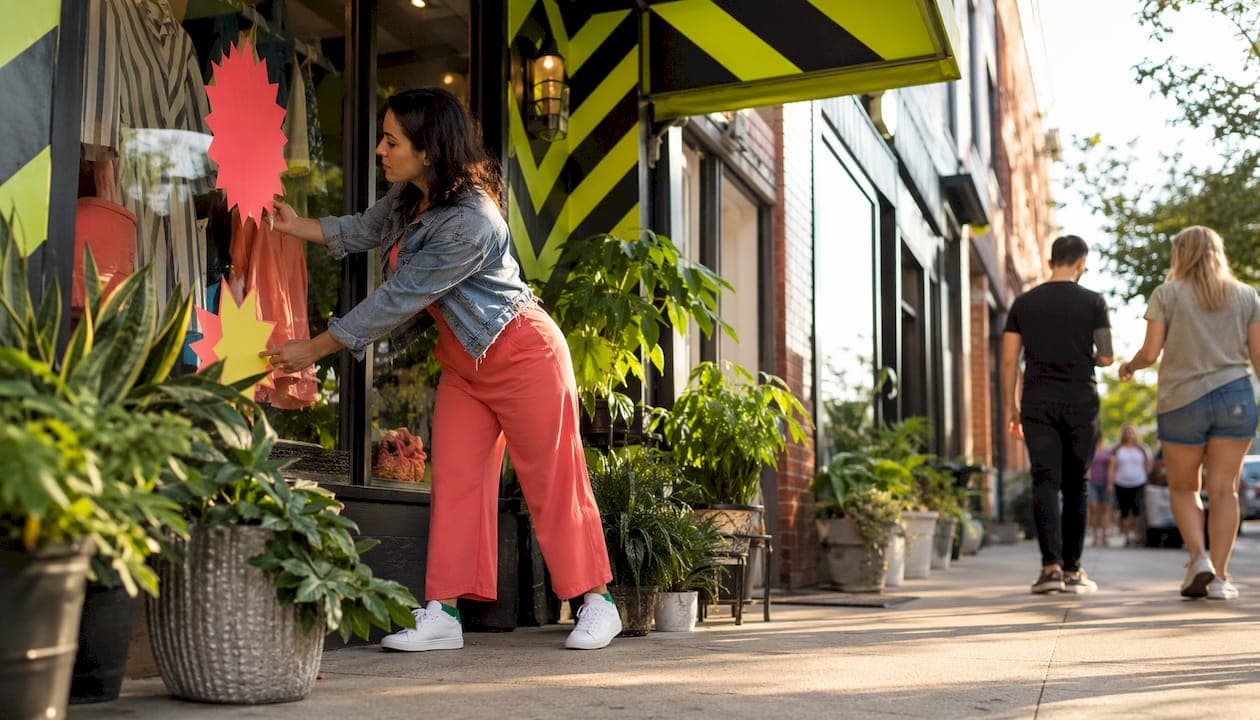
The fastest way to increase foot traffic right now is a three-part combination: optimize your Google Business Profile today, run one time-limited in-store exclusive this week, and push a geo-targeted ad or digital wallet notification to people within a mile of your door. You can see a measurable uplift within a few weeks; events and loyalty mechanics take several weeks to compound. Cost-wise, expect to spend modest amounts on local fixes and small campaigns, and more if you add sensors, advanced attribution, or a full agency engagement.
Quick wins you can do today:
- Claim and fully complete your Google Business Profile (hours, photos, categories, and a Google Post)
- Put an A-frame or window sign outside with a specific, time-limited offer
- Brief your staff on the promotion so the in-store experience matches what you advertised
Table of Contents
- What are the 12 fastest tactics to drive footfall right now?
- How do events and partnerships reliably bring more customers through your door?
- What in-store incentives actually convert visits into sales?
- How does local digital marketing move people from their phones to your door?
- Does your storefront actually pull people in, or push them past?
- How do you measure foot traffic and prove your campaigns are working?
- What does a 30/60/90-day playbook look like for a small business?
- How do you pick the right tactics for your specific business?
- Key Takeaways
- What most foot traffic advice gets wrong
- Crowdcompany handles the tactics that actually move the needle
- Sources and further reading
What are the 12 fastest tactics to drive footfall right now?
These are ranked by typical speed-to-impact. Pick one to three that fit your budget and start today.
- Google Business Profile update — Add current hours, five new photos, and one Google Post with a weekly offer
- Google Posts — Publish a "this week only" post directly on your GBP listing to appear in local search results
- A-frame sidewalk sign — Place a specific, readable offer at eye level at your entrance or nearest corner
- Window refresh — Swap in a bold, single-message display that communicates your best offer from 20 feet away
- Limited-time in-store exclusive — Offer a product, bundle, or discount available only in-store for 72 hours
- Tasting or sample day — Schedule a Saturday sample event and promote it 48 hours in advance on social
- BOPIS (buy online, pick up in-store) — Add a pickup option to your website and signal it clearly at the door
- Loyalty points expiry nudge — Send an SMS or email reminding customers their points expire in 7 days
- Geo-targeted social ad — Run a Meta or Google ad to a 1–3 mile radius around your store with a visit-focused offer
- Digital wallet card push — Send a geo-triggered Apple Wallet or Google Wallet notification when customers are nearby
- Referral incentive — Give existing customers a shareable discount code that rewards both them and the new visitor
- Community event or cross-promotion — Partner with a neighboring business or local chamber for a joint event or shared offer
How do events and partnerships reliably bring more customers through your door?

One-off experiences vs. recurring formats
Pop-ups, tastings, and influencer meet-and-greets generate a spike. A single well-promoted tasting can fill a slow Tuesday and introduce your brand to people who have walked past you for months. Recurring workshops and classes (a cooking demo, a styling session, a DIY craft night) build a habit: customers put your store on their calendar. Community partnerships, chamber events, and cross-promotions with neighboring businesses extend your reach without ad spend.
Event planning checklist
- Permitting: Check your city or county requirements for sidewalk events, food sampling, or amplified sound at least two weeks out
- Promotion: Start promoting 10–14 days before the event via email, social posts, and a Google Post; send a reminder 48 hours prior
- Staffing: Assign one person to greet and engage at the door; brief all staff on the event offer and any redemption rules
- Success metrics: Set a target attendance number, track incremental sales vs. a comparable prior day, and note new loyalty sign-ups
Budget bands and timeline
| Stage | Timeframe | Low budget | Mid budget |
|---|---|---|---|
| Prep + promotion | Days 1–10 | — | $150–$500 (boosted posts, flyers) |
| Execution | Event day | $50–$200 (supplies, samples) | $200+ (catering, décor, staff) |
| Follow-up | Days 1–7 after | $0 (email recap, social recap) | — |
Target KPIs: 20–50 attendees for a neighborhood event, a 15–30% lift in same-day sales vs. baseline, and a cost-per-visit under $10.
Promotion templates:
Email subject line: "Free [product] tasting this Saturday — [store name], 12–3 PM"
Social caption: "We're opening our doors for a free [product] tasting this Saturday. Bring a friend. Limited spots. [address + link]"
Pro Tip: When choosing a cross-promotion partner, pick a business whose customers overlap with yours but who does not compete directly. A coffee shop and a bookstore share the same Saturday-morning crowd. A restaurant and a wine shop share the same Friday-evening crowd. The overlap is where the foot traffic lives.
What in-store incentives actually convert visits into sales?
Time-limited mechanics that create a reason to show up
In-store exclusives work because they give a specific reason to visit that cannot be replicated online. Limited SKUs (a product only stocked in-store), time-window discounts (20% off between 2–5 PM on Wednesdays), and "reward redemption" events (redeem your points this weekend only) all create urgency. Sample programs lower the barrier for first-time visitors: a free taste, a trial-size product, or a complimentary add-on with any purchase removes the risk of trying somewhere new.
Loyalty triggers that create urgency are among the most cost-effective visit drivers available. A points-expiry SMS costs almost nothing to send and pulls customers back who might otherwise drift. VIP redemption windows ("your reward is valid this weekend only") work the same way. For low-budget operations, a paper stamp card or a free Apple Wallet pass handles the mechanics without a custom app.
Conversion tips once people are inside
- Place your best cross-sell items near the BOPIS pickup counter so customers browsing while they wait see them
- Use same-day redemption incentives ("spend $30 today and get a $5 credit for your next visit") to lift average order value
- Group complementary products in a single display rather than scattering them — a basket-building display near the register is one of the cheapest conversion lifts available
BOPIS customers who pick up orders tend to browse and make add-on purchases, which means your pickup area is a revenue zone, not just a logistics point. Keep it clean, well-lit, and stocked with impulse items.
Rough cost guidance: Stamp cards run $0.10–$0.30 each. A basic digital wallet pass setup costs $0–$50/month through most loyalty platforms. A sample program costs whatever the product margin allows. Target a 10–20% lift in conversion rate or a 15–25% bump in average transaction value from a well-executed incentive window.
How does local digital marketing move people from their phones to your door?
Google Business Profile: the highest-ROI free tool you have
78% of location-based mobile searches result in an offline purchase. That single figure explains why your GBP listing is worth more than most paid campaigns. Here is the setup checklist:
- Claim and verify your listing at business.google.com
- Set accurate hours, including holiday hours
- Add at least 10 photos (exterior, interior, product, team)
- Select the most specific primary category available
- Publish a Google Post every 7–10 days with a current offer or event
- Respond to every review within 48 hours
Geo-targeted ad playbook
Run Meta and Google ads to a 1–3 mile radius around your store. Keep the creative simple: one image, one offer, one call to action ("Visit us today — offer ends Sunday"). Start with $5–$15/day and let it run for two weeks before optimizing. Enable store-visit goals in Google Ads and Meta Ads Manager so the platform optimizes for physical visits, not just clicks.
Digital wallet cards: the highest-conversion push channel
Digital wallet passes reach 3–10x more users than a brand app and deliver geo-triggered push notifications when a customer is already near your store. That proximity is the key: a notification that fires when someone is two blocks away converts at a far higher rate than an email sent at 9 AM. If wallet integration is not yet in your budget, a well-timed SMS to your existing list with a location-specific offer is a workable alternative.
Statistic callout: 78% of location-based mobile searches lead to an offline purchase — making a complete, active Google Business Profile one of the highest-ROI moves available to any local business.
Attribution: knowing what actually worked
Use store-visit goals in your ad platforms, receipt-upload incentives (ask customers to upload a receipt for a small reward), and wallet-pass geofencing to create measurable attribution. Without proof-of-visit data, you are optimizing blind. A simple before/after comparison — average daily visits in the two weeks before a campaign vs. the two weeks during — gives you a baseline uplift number you can act on.
Does your storefront actually pull people in, or push them past?
Curb appeal checklist
- Readable signage: Your store name and primary offer must be legible from 30 feet at a walking pace; storefront signs are often the first and only impression a passerby forms
- Open-door signal: A propped-open door, a welcome mat, or a visible staff member near the entrance signals "come in" without a word
- Clean entry: Remove clutter, dead plants, and faded signage within 10 feet of your door
- Window message: One clear offer or product, not five; a cluttered window reads as noise and people walk past it
Merchandising inside the door
The first 5–10 feet inside your entrance is the decompression zone: customers are still adjusting. Do not put your best offers there. Place a power wall (your highest-margin or most visually striking products) on the first wall customers naturally turn toward. Group products by use case, not by brand or SKU. Put impulse items and cross-sells near the BOPIS counter or register.
For restaurants, speed-of-service signals matter more than décor. A visible menu board with clear pricing, a tabletop QR code for the waitlist, and a staff member who makes eye contact within 30 seconds of entry all reduce the friction that makes first-time visitors leave before sitting down.
Staff scripts and alignment
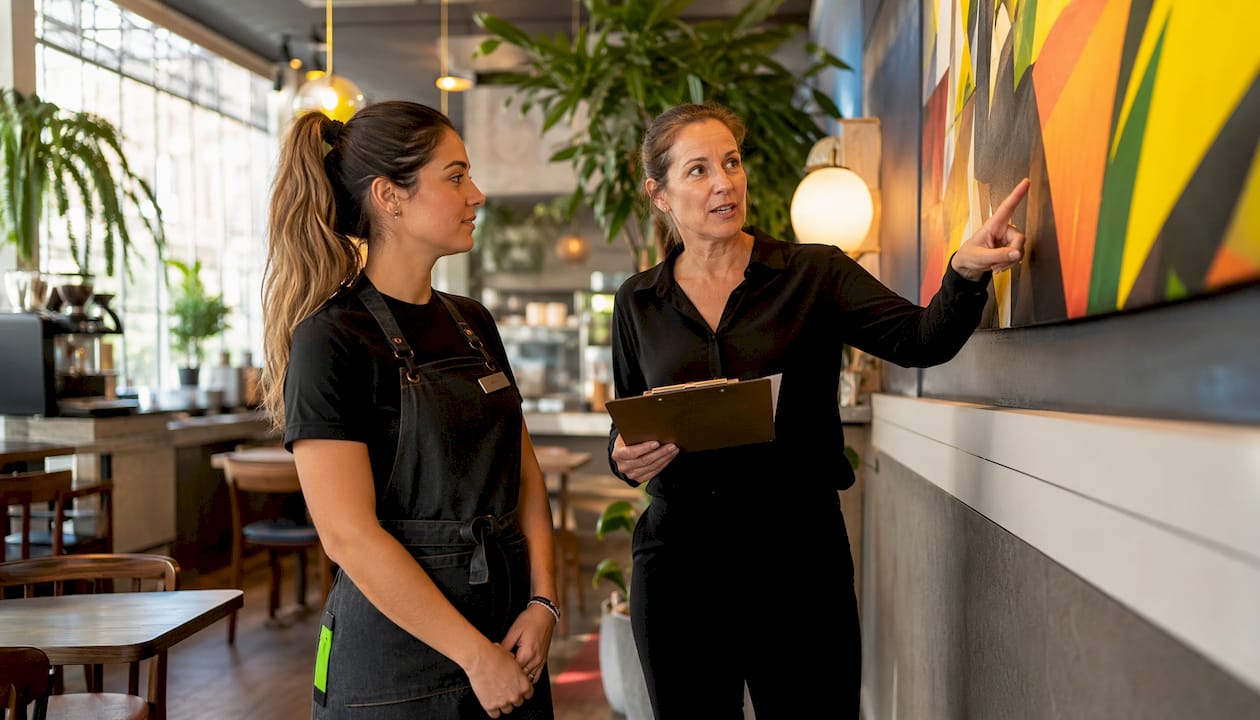
Brief your team every morning on the current promotion. A 90-second standup is enough: "Today's offer is X, it ends at close, here is how to mention it." Operational alignment is the most common failure point in foot traffic campaigns. The best ad in the world fails when the person at the register has no idea the promotion is running.
Pro Tip: Walk your own storefront as a stranger would. Stand across the street and look at your window for five seconds. If you cannot read the offer or identify what you sell, neither can a passerby. Fix that before you spend a dollar on ads.
For visual merchandising that goes beyond a single sign, think about how your window display tells a story — a seasonal theme, a product in use, a clear price point — rather than just stacking product.
How do you measure foot traffic and prove your campaigns are working?
Counting methods
- Manual counts: A staff member with a tally counter during peak hours; free but labor-intensive
- Door sensors: Infrared or thermal counters mounted at the entrance; cost $100–$500 per unit and provide automated daily counts
- Wi-Fi and Bluetooth panels: Anonymized device detection that estimates visit frequency, dwell time, and repeat visitors; typically $50–$200/month through platforms like Dor or Density
- POS-linked comparison: Compare transaction counts vs. a prior period as a proxy for visit volume
- Receipt-upload attribution: Ask customers to upload receipts for a reward; links digital ad exposure to an in-store purchase
KPI table
| KPI | Formula | Why it matters |
|---|---|---|
| Daily/weekly visits | Door count ÷ days in period | Baseline for all other metrics |
| Peak hour | Hour with highest count | Informs staffing and promotion timing |
| Conversion rate | Transactions ÷ visitors | Shows how well visits turn into sales |
| Average transaction value | Revenue ÷ transactions | Measures basket size per visit |
| Incremental visits | Campaign period visits − baseline visits | Isolates the campaign's actual effect |
| Cost per incremental visit | Campaign spend ÷ incremental visits | The core ROI metric |
Sample calculation: You spend $600 on a two-week geo-targeted campaign. Your baseline is 200 visits/week. During the campaign you average 260 visits/week, a gain of 60 incremental visits per week, or 120 total. Cost per incremental visit = $600 ÷ 120 = $5.00 per visit. If your average transaction value is $35 and your conversion rate is 40%, each incremental visit generates $14 in revenue. That is a positive ROI.
Statistic callout: Footfall KPIs including peak hours, dwell time, repeat visitor rate, and conversion rate are the metrics that tell you whether to spend more on marketing or fix something operational first.
Privacy note: For U.S. businesses, prefer first-party, hashed data (loyalty sign-ups, receipt uploads, wallet passes) over passive device tracking. Avoid linking personally identifiable information to analytics without clear consent disclosures. The FTC's guidelines on data collection apply to in-store analytics tools just as they do to digital platforms.
What does a 30/60/90-day playbook look like for a small business?
Day 1–30: fast wins
- Complete your Google Business Profile (photos, hours, categories, first Google Post)
- Install or refresh your A-frame and window display with a single, time-limited offer
- Run a brief staff script on the current promotion
- Launch one geo-targeted ad ($5–$15/day) with store-visit goals enabled
- Set up a digital wallet pass or send a geo-triggered SMS to your existing list
- Run a 72-hour in-store exclusive and track incremental transactions vs. the prior week
Budget band: Under $1,000 for the full 30 days if you handle creative in-house.
Day 31–60: scale what worked
- Launch a loyalty trigger: points expiry nudge or a VIP redemption window
- Host one community event or recurring workshop; promote it via email and a boosted social post
- Review your geo-ad data: which creative drove the most store-visit conversions? Pause the underperformer and double the winner
- Add BOPIS signage at your entrance and cross-sell displays near the pickup point
- Use direct mail and loyalty tools to reach customers who have not visited in 60+ days
Budget band: $1,000–$5,000, depending on event costs and ad spend.
Day 61–90: optimize and decide
- Run a measurement-controlled campaign: hold one week as a baseline, run the campaign the next, compare incremental visits
- Calculate cost-per-incremental-visit for each active tactic
- Cut any tactic where cost-per-incremental-visit exceeds your revenue-per-visit threshold
- Decide whether to invest in a door sensor or Wi-Fi analytics panel based on visit volume
- If wallet passes are generating geo-push conversions, expand the program; if not, test a different offer
Budget band: $1,000–$5,000 for optimization; $5,000–$15,000 if you add sensors, advanced attribution, or a managed agency engagement.
Decision rule: Diagnose first, pilot second, scale only when cost-per-incremental-visit is below your revenue-per-visit threshold.
How do you pick the right tactics for your specific business?
Three diagnostic questions
Before spending anything, answer these:
- Is this a market-level problem? Are all nearby businesses slow, or just yours? If foot traffic is down across the block, a local economic or seasonal factor is at play and marketing alone will not fix it.
- Is this a store-specific problem? Are competitors busy while you are quiet? That points to a visibility, awareness, or curb-appeal gap — marketing and signage fixes apply.
- Is this a conversion problem? Are people entering but not buying? That is an in-store experience, pricing, or staff issue — more traffic spend will not help until you fix what is happening inside.
Diagnosing the problem type before investing in campaigns is the single most important step most small business owners skip. Sit outside your store for an hour during peak time. Watch whether people pause at your window, walk past, or go straight to a competitor. That observation costs nothing and tells you more than a month of ad data.
Prioritization matrix
| Tactic type | Speed | Cost | Best for |
|---|---|---|---|
| GBP + local SEO | Fast (1–2 weeks) | Low (<$200) | Store-specific visibility gap |
| Geo-targeted ads | Fast (1–2 weeks) | Low–mid (small budget monthly) | Awareness gap in a defined radius |
| In-store exclusive + signage | Fast (same week) | Low (under $600) | Conversion or awareness gap |
| Events + partnerships | Medium (4 weeks or longer) | Mid ($500+) | Community awareness + new customers |
| Loyalty triggers | Medium (4 weeks or longer) | Low (<$200) | Lapsed customer reactivation |
| Sensors + advanced attribution | Long-term (60–90 days) | Mid–high ($500–$5,000+) | Optimization after pilots prove ROI |
Action checklist
- Run the three diagnostic questions above before selecting tactics
- Choose up to three tactics that match your problem type and budget
- Set a 30-day test window with a clear baseline and a target KPI
- If the problem is operational (slow service, confusing layout, undertrained staff), fix that before adding traffic spend
Key Takeaways
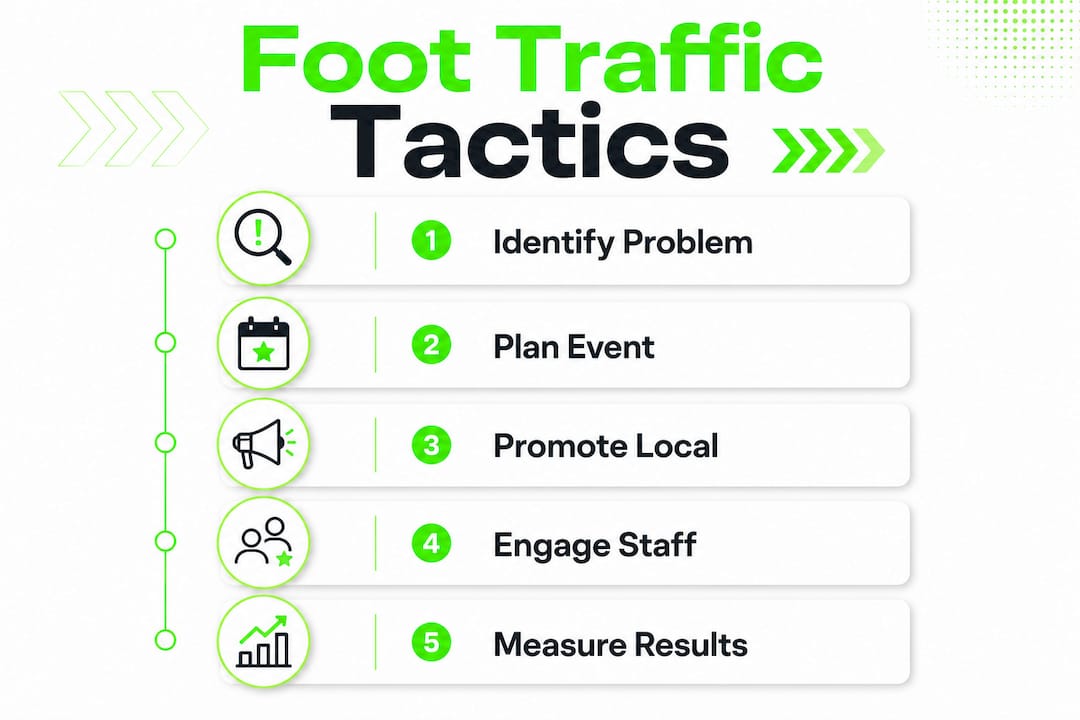
The highest-ROI moves to increase foot traffic are local SEO, a time-limited in-store exclusive, and a geo-targeted push — all executable within one week for under $500.
| Point | Details |
|---|---|
| Diagnose before you spend | Identify whether you have a market, visibility, or conversion problem before choosing tactics. |
| Local SEO is your fastest free lever | 78% of location-based mobile searches lead to an offline purchase — a complete GBP listing is non-negotiable. |
| Wallet passes outperform apps | Digital wallet cards reach 3–10x more users than a brand app and fire geo-triggered notifications when customers are nearby. |
| Measure cost per incremental visit | Divide campaign spend by incremental visits to know which tactics earn their budget and which to cut. |
| Crowdcompany runs the full playbook | From geo-targeted ads and loyalty programs to NFC products and event campaigns, Crowdcompany handles the execution so you can focus on running your business. |
What most foot traffic advice gets wrong
The conventional wisdom says "run more ads, host more events, post more on social." That is not wrong, but it skips the step that determines whether any of it works: diagnosing what kind of problem you actually have.
A restaurant that is quiet on Tuesday nights does not have a marketing problem. It has a perceived-value or awareness problem for a specific time slot. Running a broad Instagram campaign to fix that is like prescribing antibiotics for a broken arm. The right move is a Tuesday-specific offer, a Google Post targeting "dinner near me" searches, and a geo-push to loyalty members on Tuesday afternoon.
The other mistake is treating the ad as the whole campaign. The ad gets someone to your door. What happens at the door — the window display, the staff greeting, the in-store offer — determines whether they come in and whether they come back. Businesses that invest in the ad and ignore the in-store experience are paying to send people to a disappointing destination.
The businesses that consistently grow their walk-in traffic share one habit: they measure incrementally. Not total visits, but incremental visits per dollar spent. That number tells you which tactic to scale and which to cut, and it keeps you from confusing a busy Saturday with a successful campaign.
Crowdcompany handles the tactics that actually move the needle
Most of what drives foot traffic is not complicated, but it is time-consuming. Keeping your GBP updated, running geo-targeted ads with the right creative, building wallet passes, coordinating events, briefing staff, and tracking incremental visits — each piece is manageable alone, but together they are a part-time job on top of running your business.
Crowdcompany maps directly to the tactics in this playbook. The foot traffic growth service covers geo-targeted campaigns, wallet passes, and event-driven visits. Paid advertising handles radius targeting and store-visit optimization on Meta, Google, and TikTok. Retargeting and email covers loyalty triggers and lapsed-customer reactivation. Physical products — scratch-off cards, NFC stands, and yard signs — are available through the products page for low-cost offline attribution.
Engagements start with a 30/60/90 diagnostic: identify the problem type, pilot the highest-leverage tactics, and scale only what proves ROI. Request your diagnostic at crowdcompany.co and get a clear picture of where your foot traffic is leaking before spending another dollar.
Sources and further reading
- How to Drive Foot Traffic — Shopify Blog: Practical overview of using your website to promote store-only exclusives and drive high-intent visits
- How to Increase Foot Traffic in a Retail Store — Axonify: Covers operational alignment, VIP reward mechanics, and frontline staff coordination as visit drivers
- Drive Foot Traffic: Wallet Passes and Geo-Push — Loyoly: Data on digital wallet reach vs. brand apps and geo-triggered push notification performance
- How to Increase Foot Traffic: Data-Backed Strategies — PassBy: Diagnostic framework for identifying market-level vs. store-specific vs. conversion problems
- How to Drive Foot Traffic and Know Who Bought — Brij.ai: Attribution methods including store-visit goals and receipt-upload mechanics
- Footfall Analysis and Drive-to-Store Marketing — adpersonam: KPI definitions for peak hours, dwell time, catchment area, and conversion benchmarks
- Why Storefront Signs Matter — CrispSign Blog: Practical guidance on signage visibility and first-impression impact for small businesses
- Visual Merchandising Signage: Your 2026 Retail Guide — CrispSign Blog: Window display and visual merchandising strategies that complement curb appeal improvements
- U.S. Small Business Administration — sba.gov: Primary resource for small business marketing guidance, community outreach programs, and local business development tools
- Crowdcompany Foot Traffic Growth Services: Done-for-you foot traffic campaigns covering geo-ads, wallet passes, events, and attribution