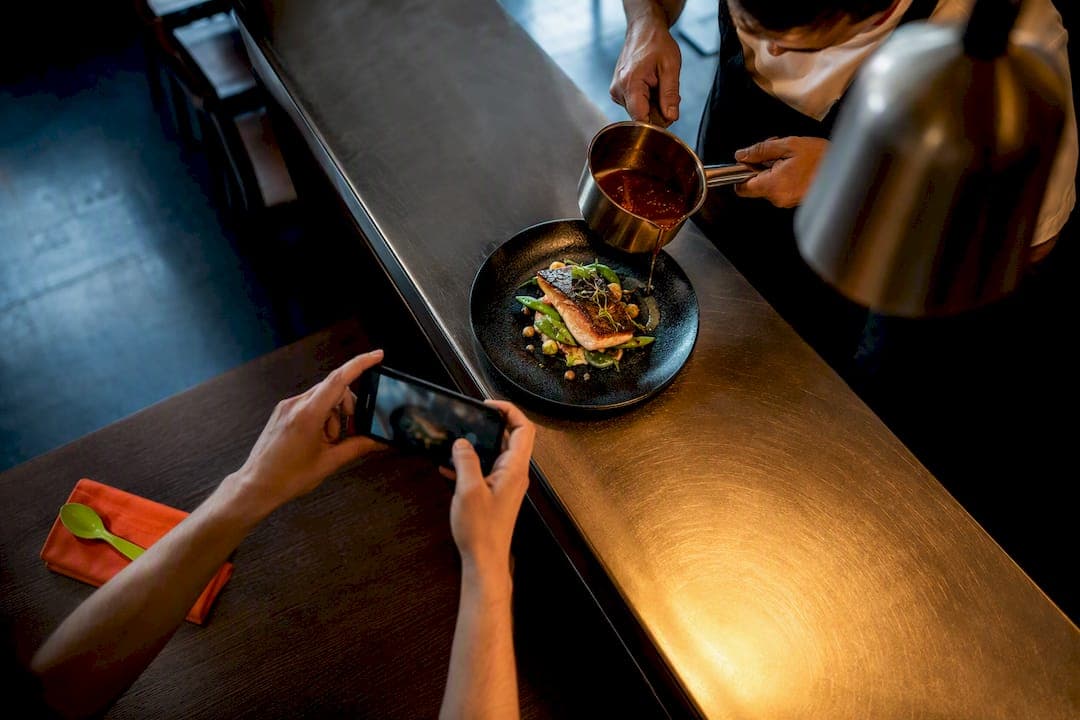
The fastest way to turn online views into reservations is a short-form-first content system, authentic phone footage for discovery, paired with 30-second conversion videos on your Google Business Profile and website. Run it with a two-person weekly batch workflow: one person shoots, one edits and posts. Aim for 10-15 pieces a week, and track Google Business Profile interactions plus landing page conversion, not vanity views.
TL;DR:
- Using short-form videos optimized for discovery and conversion can significantly increase reservations, provided the content matches each platform's format and intent.
- Batch shooting during specific kitchen windows and implementing a two-person workflow helps produce 10 to 15 clips weekly at low internal cost, boosting consistency.
- Prioritizing hooks in the first three seconds and captioning every video maximizes engagement across TikTok, Reels, Shorts, GBP, and your website.
- Focus on tracking Google Business Profile interactions and landing page conversions rather than vanity metrics to measure real results.
- Engaging with local audiences through comments, tags, and community collaborations builds trust and organic growth more effectively than chasing broad trends.
Table of Contents
- What Kind of Videos Should Restaurants Post?
- Where Should Restaurants Post Their Videos?
- How Do You Prepare for a Restaurant Video Shoot?
- How Do You Run a Weekly Video Production System?
- What Editing Rules Actually Improve Restaurant Video Performance?
- How Do You Measure Whether Restaurant Video Marketing Works?
- How Much Does Restaurant Video Marketing Cost?
- What Are Some Creative Video Ideas for Restaurants?
- Who Handles This for Restaurants That Don't Have Time?
- How Do You Build a Content Calendar for Consistent Video?
- How Do Restaurants Grow a Local Following Through Video?
- What's the One Thing Restaurants Get Wrong About Video?
- How Crowdcompany Turns This System Into Reservations
- Sources
- FAQ
What Kind of Videos Should Restaurants Post?
Every video should have one job. Trying to make a single clip handle discovery, trust, and conversion at once is why most restaurant accounts stall out at a few hundred views. Match the format to the goal first, then worry about polish.
Food-in-motion and plating close-ups exist to stop the scroll. A cheese pull, a sauce drizzle, a smash burger flattening on the griddle. These are your discovery engine, built for TikTok and Reels where strangers who've never heard of you decide in three seconds whether to keep watching.
Behind-the-scenes and staff personality clips build the loyalty that turns a first visit into a regular. A cook explaining why he sources a specific chili, a server's Friday-night routine. These humanize the business in a way a menu photo never will.
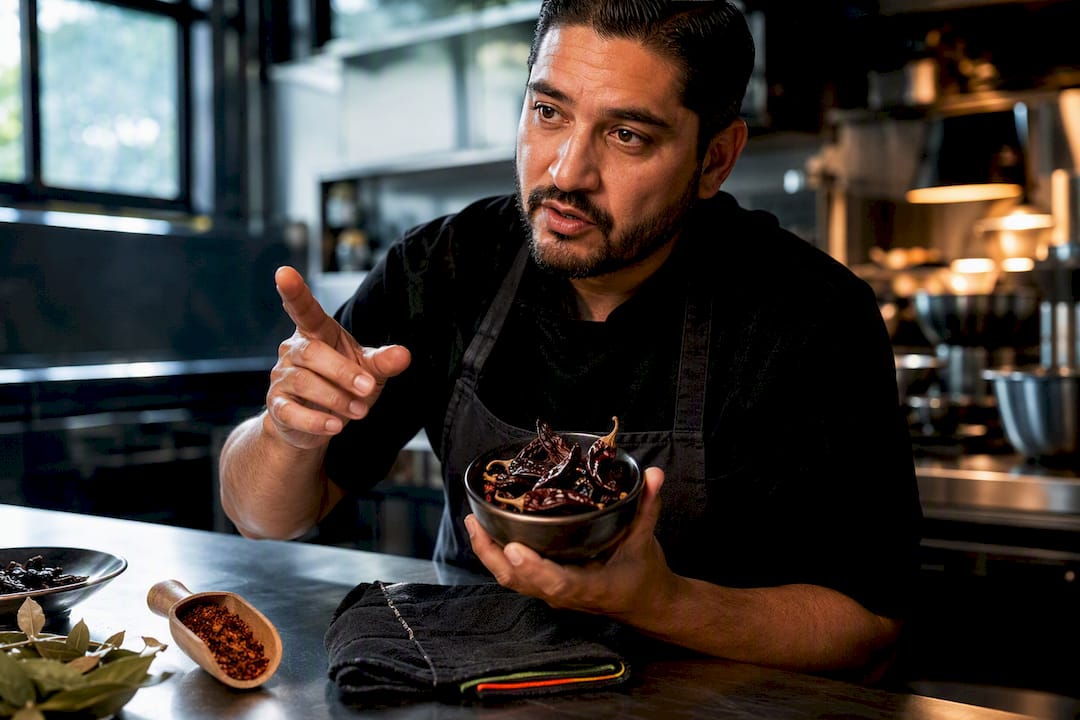
Menu and dish showcases do the heavy lifting on Google Business Profile and your website. Someone has already decided to consider you and just needs a nudge.
Day-in-the-life and service highlight reels build trust by showing the operation is real, busy, and cared for. UGC guest clips, reposted with a quick verbal or text consent from the guest, add credibility no branded content can fake.
- Food-in-motion: discovery, TikTok/Reels
- Behind-the-scenes: loyalty, all platforms
- Menu showcases: conversion, GBP/website
- Day-in-the-life: trust, Instagram/YouTube Shorts
- UGC reposts: credibility, everywhere, with consent
Where Should Restaurants Post Their Videos?
Not every platform wants the same video, and cross-posting the exact same file everywhere quietly kills your reach. Restaurants that treat each platform as a separate audience with separate intent consistently outperform those that just blast one video across every channel.
Short-form smartphone footage drives discovery, while short GBP and website videos drive conversion. That's not a minor nuance. It's the entire logic of where you spend your filming energy.
- TikTok and Instagram Reels: trending audio, native-feeling footage, built for strangers scrolling with no intent to visit yet.
- Google Business Profile: short, ambient clips of the dining room or a hero dish, aimed at people already searching "restaurants near me."
- Your website: the same conversion-focused clips embedded on the reservation or landing page, reinforcing intent right before someone books.
- YouTube Shorts: repurposed discovery content that also picks up search traffic over time, since Shorts index in regular YouTube search.
Adaptation matters more than most owners assume. Vertical 9:16 for TikTok, Reels, and Shorts; square or landscape for GBP and website embeds; captions on every version since most viewing happens muted; and strip any TikTok watermark before reposting to Reels, since watermarked cross-posts get measurably less reach on other platforms.
How Do You Prepare for a Restaurant Video Shoot?
A messy 20-minute shoot produces worse footage than a focused 8-minute one. The difference is almost always preparation, not talent or equipment.
- Pick your window. Film during prep, an hour before service, when the kitchen is active but not chaotic. Grab candid moments during actual service separately, without staging.
- Shoot from three angles minimum. Top-down for plating, 45-degree for texture and steam, and a tight close-up for the motion shot (pour, sear, garnish).
- Bring one cheap light. A $30 LED panel eliminates the yellow-tinted, grainy look of overhead kitchen lighting.
- Get audio right at the source. A clip-on mic for talking segments beats fixing bad audio in post every time.
- Style fast, not perfect. A dab of oil, a wipe of the plate rim, and better framing do more than 20 minutes of tweezer work.
- Get verbal consent from any guest or staff member on camera before you film them, and keep it simple. "Mind if this goes on our Instagram?" is enough for casual UGC use.
Pro Tip: Keep a running list of "boring" moments that actually photograph well, steam rising off a plate, a hand pulling fresh bread. These unscripted seconds usually outperform anything staged.
How Do You Run a Weekly Video Production System?
The two-person model solves the real bottleneck in restaurant content: not creativity, but consistency. One person, the operator, shoots. One person, the editor, edits and publishes on a fixed schedule. This split alone is what separates accounts posting weekly from accounts that post in bursts and disappear for a month.
A two-person weekly system can sustain 10 to 15 short-form pieces per week at a fraction of what freelance per-video rates would cost for the same volume. That's the number to build your calendar around, not a vague "post more" goal.
Batch your shooting into two fixed sessions a week, for example Tuesday and Friday mornings, and follow the rule to capture multiple times more raw clips than the number you plan to post, so the editor always has options.
- Operator: shoots during the two batch sessions, grabs opportunistic clips during service.
- Editor: runs one dedicated edit day, pulling from a template bank of 5 to 7 repeatable formats.
- Template bank: plating close-up, staff spotlight, dish showcase, day-in-the-life cut, UGC repost, GBP ambience clip, trending-sound reveal.
- Marginal cost: once the gear is bought, each additional piece costs mostly time, not money, unlike per-video freelance invoicing.
What Editing Rules Actually Improve Restaurant Video Performance?
The hook decides everything. If the first three seconds don't earn a second look, nothing else about the edit matters, not the color grading, not the music choice, not the transitions.
- Front-load the most visually interesting part of footage, even if it means reordering the clip.
- Add readable captions on every video since most people watch without sound.
- Skip heavy text overlays. A few words at most; let the footage carry the story.
- Export in vertical (9:16) for TikTok, Reels, and Shorts, and separately in square or landscape for GBP and website use.
- Strip watermarks before cross-posting to protect reach on the destination platform.
- Budget roughly 10 to 15 minutes of editing per finished piece once your template bank is built. Faster than that usually means skipping the hook edit.
Pro Tip: Cut your video down until it feels one beat too short. Viewers who wish there was more tend to rewatch, and rewatches are one of the strongest reach signals on short-form platforms.
How Do You Measure Whether Restaurant Video Marketing Works?
Views don't pay rent. Reservations do. The metrics that actually correlate with covers are Google Business Profile interactions (calls, direction requests, website clicks) and conversion on your landing page, not follower counts or hearts.
Run a simple A/B test: keep your current reservation page live for two weeks, then add a 30-second video and compare conversion for the next two weeks. Sites with video convert around 4.8% versus 2.9% without, a roughly 86% lift, so even a modest traffic volume should show a visible gap if the video is doing its job.
- Track GBP calls, direction requests, and website clicks weekly.
- Track saves and shares on TikTok/Reels as a leading indicator of discovery quality.
- Ask new guests directly, or run a small promo code tied to a specific video, to attribute walk-ins.
- Give the system 4 to 12 weeks of consistent cadence before judging results.
| Metric | Where it lives | What it tells you |
|---|---|---|
| GBP calls/directions | Google Business Profile | Conversion intent from local search |
| Landing page conversion rate | Website/reservation page | Whether video closes the decision |
| Saves/shares | TikTok, Instagram Reels | Discovery content resonance |
| Promo code redemptions | POS/reservation system | Direct attribution to a specific video |
How Much Does Restaurant Video Marketing Cost?
You don't need a production budget to start, you need a workflow. The real cost comparison isn't gear versus no gear, it's marginal internal cost versus paying a freelancer per video.
- In-house batch production: near-zero marginal cost per piece once equipment is bought, since one shoot session produces a week's worth of raw footage.
- Freelance per-video: typically priced per finished clip, which adds up fast at 10 to 15 pieces a week.
- Agency-assisted: worth it when you need strategy, GBP optimization, and consistency without hiring internally.
- Starter kit: a smartphone you already own, a $30 to $60 LED light, a $50 to $100 shotgun or clip mic, and a $20 tripod covers nearly everything for the first six months.
Low-budget owners should lean entirely on the in-house model. Mid-size operations often split the difference: in-house shooting with an outside editor. Multi-location groups tend to get more value from agency support that standardizes the system across sites.
What Are Some Creative Video Ideas for Restaurants?
These five templates cover most of what a restaurant needs to post consistently. Treat them as fill-in-the-blank formats, not one-off inspiration.
- Plating close-up: Hook with the final garnish drop or sauce swirl. Runtime 15 seconds. Caption: "This is why the [dish] sells out by 7pm."
- Trending-sound reveal: Cut plating, cooking, and a finished shot to a trending audio's beat drops. Repurpose the raw clips from your close-up shoot, no separate filming needed.
- Day-in-the-life compressed cut: 30 seconds spanning prep through service, sped up. Works especially well on Instagram Reels and YouTube Shorts.
- UGC capture and repost: Ask a guest, "Mind if we repost this?", then credit their handle in the caption. Costs nothing and reads as more trustworthy than branded content.
- Event or promo walkthrough: A 20-second walk through a live event or limited-time menu, built specifically for GBP and the website since it targets people already deciding.
Pro Tip: Keep a running note in your phone of every hook that performed well, and steal your own best openings for the next batch. The TikTok Ad Fatigue approach of rotating hooks weekly applies just as well to organic content as it does to paid.
Who Handles This for Restaurants That Don't Have Time?
Video is one of the pieces often run for restaurant clients because it's the format most owners start and abandon within a month.
We handle social media management, GEO and local search optimization, videography and editing, and content scripting, the exact skill set the two-person system above requires but rarely gets internally.
A typical engagement might include a weekly shoot plan built around actual prep and service hours, a template bank tailored to the menu and space, Google Business Profile optimization, and a monthly report tying video activity back to GBP interactions and landing page conversion.
- Weekly shoot plan matched to kitchen hours
- Custom template bank (5 to 7 formats)
- GBP video and listing optimization
- Monthly KPI reporting tied to reservations
How Do You Build a Content Calendar for Consistent Video?
A calendar only works if it's built around your kitchen's rhythm, not an arbitrary content grid. Start by locking your two weekly shoot sessions to actual prep windows, then work backward from there.
Map your template bank to specific days: Monday's edit day covers footage from the weekend rush, Tuesday's shoot targets a new dish or staff feature, and Friday's shoot grabs pre-weekend energy. Assign each day of the week a platform priority instead of trying to post everywhere at once. TikTok and Reels get the discovery-focused clips; GBP gets one fresh ambience or dish video every few days; your website gets updated whenever a new conversion-focused clip clears editing.
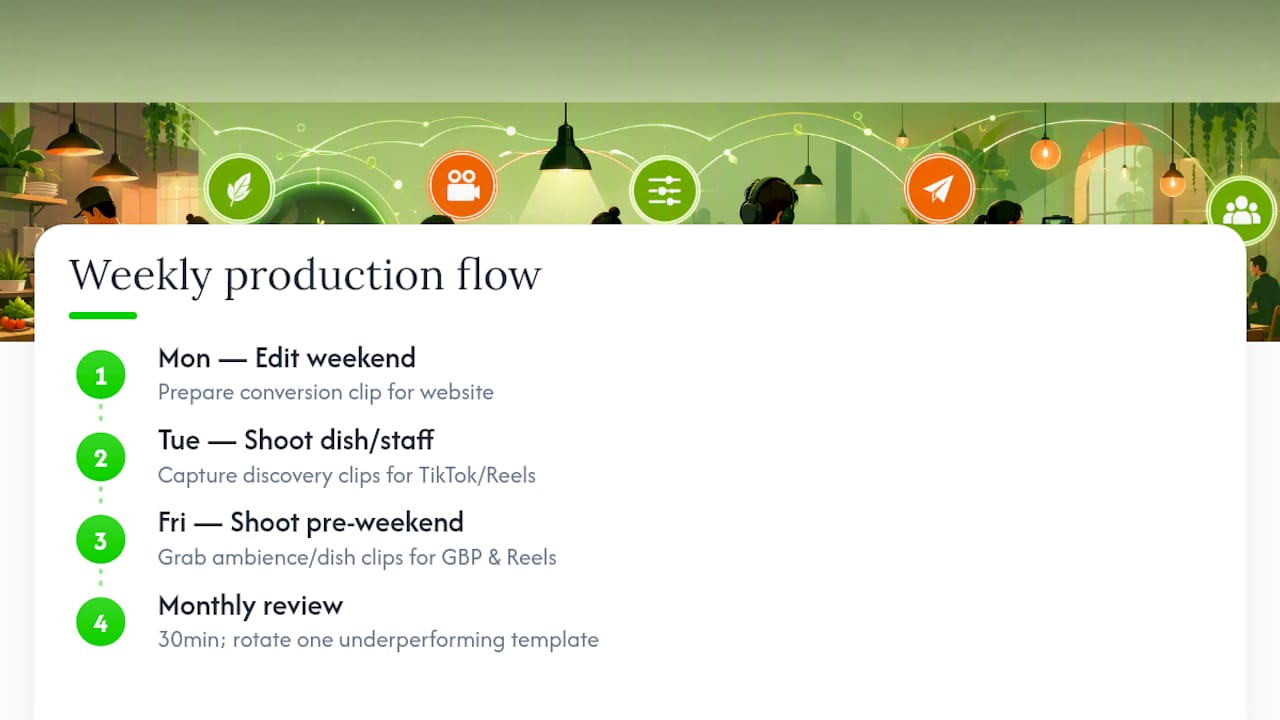
Build in a monthly review slot, thirty minutes, where you check which formats got saves and shares versus which fell flat, then rotate one underperforming template out of the bank. This keeps the system from going stale without requiring a full creative overhaul every month.
The biggest calendar mistake is planning content around holidays and promotions only. Those spikes matter, but the weekly baseline of ordinary plating shots and behind-the-scenes clips is what actually builds the following that sees your promotional content when it matters. Treat the calendar as infrastructure, something that runs whether or not there's a special event that week, and save the promo-heavy pushes for layering on top of an already-consistent baseline.
How Do Restaurants Grow a Local Following Through Video?
Local growth on video comes from responding to your own comments and reposting the community, not from chasing broader trends. Reply to every comment on your first 20 to 30 posts personally. It signals to the platform's algorithm that your content generates real engagement, and it signals to local viewers that a person, not a brand account, is on the other end.
Tag your neighborhood, not just your city, in captions and location settings. "Best brunch in [neighborhood]" pulls a more qualified, closer audience than a broad city-wide tag ever will. Partner with two or three nearby businesses, a coffee roaster, a local gym, a nearby venue, for simple cross-promotion clips. A 15-second "what's next door" video costs almost nothing to produce and puts you in front of an audience that already trusts a business down the street.
Run a small monthly "featured regular" format where you spotlight an actual customer, with their permission, talking about their go-to order. This does more for local trust than almost any other format because it's proof, not promotion. Combine that with occasional paid boosts on your best-performing organic clips, targeted tightly to a five-mile radius, which tends to stretch further than a broad city-wide ad campaign aimed at strangers who'll never realistically drive over.
What's the One Thing Restaurants Get Wrong About Video?
The biggest mistake isn't a bad camera or a weak concept. It's perfectionism disguised as quality control, the instinct to reshoot a plating shot four times instead of publishing it and moving to the next one. Consistency beats polish almost every time on short-form platforms.
Start tomorrow with one thing: block two 20-minute shoot windows this week, no more planning required. Then measure GBP interactions and landing page conversion in four weeks, not vanity views, and adjust the template bank based on what actually drove clicks.
— E
How Crowdcompany Turns This System Into Reservations
If the two-person model above sounds right but you don't have the two people, that's exactly the gap we close. Crowdcompany runs the batch shoot plan, the editing, the GBP optimization, and the landing page video implementation as one connected system instead of scattered freelance pieces.
A starter engagement usually begins with a quick audit of your current GBP listing and website, then a two-week pilot where we shoot, edit, and publish your first template bank while you keep running the restaurant. From there, most clients move into ongoing social management and content scripting so the weekly cadence never depends on someone remembering to grab their phone during the rush.
If you're ready to see what a structured video system looks like for your dining room specifically, take a look at theme pages and local expansion services built for exactly this kind of scaling, or reach out directly to get a pilot scoped for your kitchen.
Sources
The Search Engine Journal landing page data backs the conversion-lift math throughout this guide. The Masterestaurant white paper is the source for the two-person production model and its cadence numbers. For platform strategy and the discovery-versus-conversion split, yume.video's breakdown is worth a full read, and Toast's format guide offers additional format examples beyond what's covered here.
FAQ
What Is the 30/30/30 Rule for Restaurants?
There's no single agreed-upon definition of a "30/30/30 rule" specific to restaurant marketing; the term shows up inconsistently across guides. A more reliable framework is the one this guide uses: roughly 30 seconds for conversion-focused GBP and website videos, filmed during a 30-minute batch session, published on a weekly cadence you can actually sustain.
How Much Does Video Marketing Cost for a Restaurant?
In-house batch production costs mostly time once you own basic gear, a phone, a small LED light, and a clip mic. Freelance per-video rates add up quickly at the 10 to 15 pieces per week volume this system recommends, which is why the two-person internal model tends to be far cheaper at scale.
What Are the 7 Ps of Restaurant Marketing?
The classic marketing mix, product, price, place, promotion, people, process, and physical evidence, applies to restaurants broadly, but video marketing specifically touches promotion (short-form content), people (staff and guest features), and physical evidence (dish and ambience showcases) most directly.
What Are Some Creative Video Ideas for Restaurants?
Plating close-ups, trending-sound reveals, compressed day-in-the-life cuts, UGC guest reposts, and event or promo walkthroughs cover most of what a restaurant needs. Each one maps to a specific platform and goal, from TikTok discovery to GBP conversion.
How Often Should Restaurants Post Video Content?
Aim for 10 to 15 short-form pieces per week split across TikTok, Reels, and Shorts, plus 2 or more fresh updates to your Google Business Profile weekly to keep local search signals active.