Why direct mail for restaurants still works in 2026
Printed mail sent to the right households drives real foot traffic. That is the short version. The longer version: restaurant postcard marketing puts a physical offer in someone's hand at home, where there is no algorithm filtering it out and no competing ad three inches away.
The formats that get opened and acted on are straightforward:
-
Jumbo postcards (6x9 or 6x11): high visual impact, affordable via USPS Every Door Direct Mail (EDDM), and hard to ignore on a kitchen counter
-
Folded menus or self-mailers: ideal for grand openings or seasonal menu launches
-
Coupon packs and loyalty cards: strong for repeat-visit campaigns targeting known customers
-
Letter packages: less common for restaurants but effective for catering or private dining outreach
Response rates for restaurant campaigns with specific promotional offers typically range from 1.5% to 5%, while loyalty campaigns sent to existing customers yield 4% to 9%. For context, email marketing rarely clears 1% click-through on cold lists. Direct mail is tactile, targeted, and timed by you, not a platform's algorithm.
It also fits naturally into a multichannel approach. A postcard that lands Tuesday can be reinforced by a social media ad Wednesday and an email Thursday, turning a single campaign into a coordinated push.
Table of Contents
- Core strategies that make restaurant mail campaigns succeed
- What restaurant direct mail actually costs
- What successful restaurant mail campaigns actually look like
- The 30/30/30 rule: the framework behind every high-performing campaign
- Crowdcompany handles your restaurant's direct mail from list to door
- Key Takeaways
Core strategies that make restaurant mail campaigns succeed
Targeting is where most campaigns win or lose before a single piece is printed.
Geographic and demographic precision matter more than volume. EDDM saturates every address on a carrier route, which works well for a new location or a neighborhood-wide promotion. Targeted mailing lists let you filter by household income, age, proximity to your restaurant, or dining behavior. Sending 2,000 pieces to the right zip codes beats sending 10,000 to the wrong ones.
- Craft offers with urgency and specificity. "Buy one entrée, get one free through March 31" outperforms "Come visit us." Time-limited, specific incentives give recipients a reason to act now rather than set the mailer aside.
- Design for appetite. Professional food photography, a clean layout, and a single dominant call to action are the baseline. Cluttered postcards with three different offers and six fonts get recycled.
- Timing and frequency. Align mail drops with seasons, local events, or your own promotions. Mailing too frequently causes fatigue; once a month or once a quarter, timed to a real reason, keeps response rates healthy.
- Integrate with digital follow-ups. A postcard with a QR code tied to a landing page lets you track redemptions and retarget non-converters with digital ads. That combination improves conversions and gives you actual ROI data.
- Use loyalty data to segment. Customers who visited once respond differently than regulars. Separate those lists and write different offers for each.
Pro Tip: Add a unique promo code to each mail version so you can track exactly which list segment, carrier route, or offer drove the most redemptions. It takes five minutes to set up and turns anecdotal results into real data.

What restaurant direct mail actually costs
The number that trips up most restaurant owners is the gap between a print quote and the real all-in cost.

| Cost Component | Typical Per-Piece Range | Notes |
|---|---|---|
| Printing (EDDM postcard) | — | 6x9 or 6x11 postcards |
| Postage (EDDM) | — | USPS flat rate, saturation routes |
| Printing (oversized postcard) | $0.10–$0.20 | 6x9 or 6x11 |
| Postage (targeted marketing mail) | — | Oversized postcard rate |
| Design | — | Amortized across print run |
| List management / NCOA | — | Address verification, deduplication |
| Postal prep labor | — | Bundling, tray labeling, USPS submission |
| All-in per piece (EDDM) | $0.40–$0.75 | Local saturation campaigns |
| All-in per piece (targeted) | $0.40–$0.75 | Filtered list, oversized postcard |
Print-only quotes often come in at $0.10–$0.20 per piece, which looks attractive until you add postage, design, and mailing prep. The true all-in cost for a local restaurant direct mail campaign, including printing, postage, list management, and design, usually ranges from $0.40 to $0.75 per piece. A targeted campaign of several thousand pieces represents a realistic budget range for a mid-size local restaurant.
EDDM is the most affordable entry point, with total per-piece costs usually toward the lower end of the $0.40–$0.75 range. The trade-off is that you cannot filter by income or dining behavior. If your restaurant is in a mixed-income area and your price point is above casual dining, a targeted list at higher per-piece cost within this range often delivers a lower cost per new customer.
Volume discounts from printers and USPS presort rates can reduce per-piece costs by 15–30% on larger runs. For most independent restaurants, co-mingle pooling through a print vendor is the fastest way to access those savings without committing to enterprise volume.
What successful restaurant mail campaigns actually look like
The campaigns that consistently perform share a few structural traits, regardless of format or budget.
A regional pizza chain running a grand opening used 6x9 EDDM postcards across six carrier routes within three miles of the new location. The offer was a free appetizer with any pizza order, valid for 30 days. The postcard featured a single high-quality photo of their signature pie, a bold redemption deadline, and a QR code. Redemption tracking showed a 1.5–5% response rate consistent with industry benchmarks, and the campaign paid for itself within the first two weeks of the promotion.
A fine dining restaurant targeting anniversary and birthday diners used a filtered list of households within five miles with incomes above $100,000. The mailer was a 6x11 oversized postcard with a "complimentary dessert for two" offer tied to a reservation. The higher per-piece cost of a targeted list was justified by the average check size.
Key lessons from campaigns that underperform:
- Weak or vague offers ("Stop by and see us!") generate almost no response. The offer has to have clear, immediate value.
- Ignoring list hygiene wastes budget. Undeliverable addresses add cost with zero return. NCOA-cleaned lists are non-negotiable.
- Mailing once and stopping rarely builds momentum. A single drop is a test. Two or three drops to the same list, spaced four to six weeks apart, compound response.
- No tracking mechanism means no learning. A unique promo code or dedicated phone number on each campaign version is the minimum.
- Mismatched design and brand voice confuse recipients. The postcard should look and feel like your restaurant, not a generic coupon flyer.
The 30/30/30 rule: the framework behind every high-performing campaign
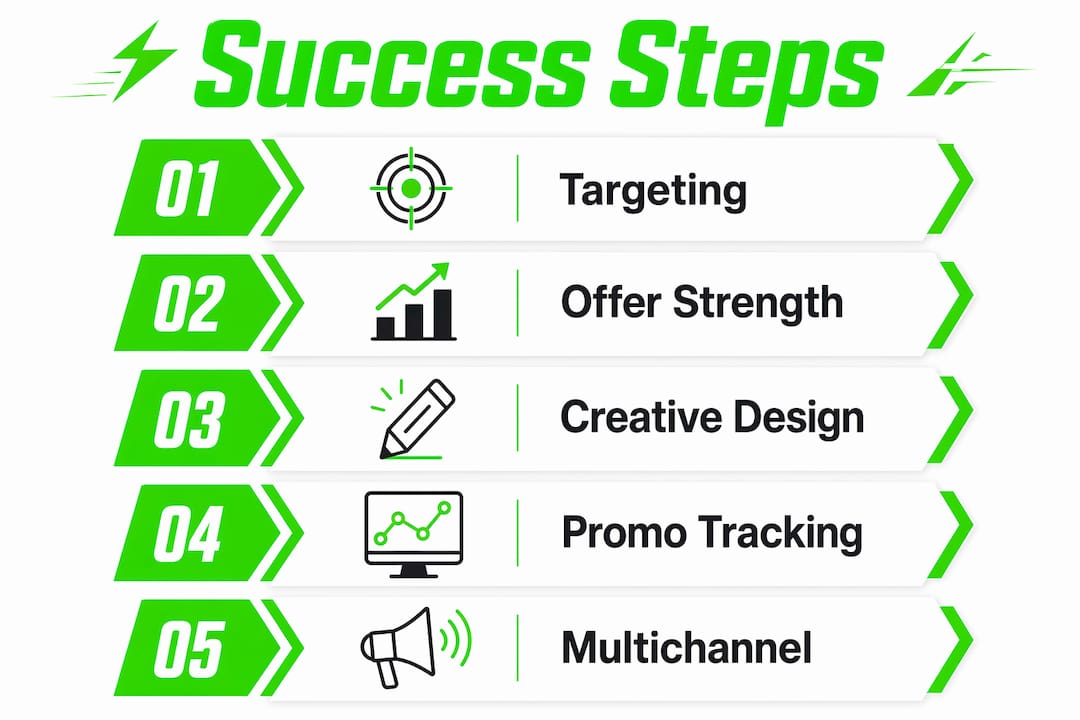
The 30/30/30 rule is the most useful single framework for allocating your direct mail budget and effort. It breaks campaign success into three equal pillars, with a fourth smaller factor rounding out the picture.
Neglect any one of those three main pillars and the other two cannot compensate. A beautiful postcard with a compelling offer mailed to the wrong addresses produces nothing. A perfectly targeted list with a weak offer gets ignored. Strong targeting and a strong offer buried in a cluttered design with no clear call to action leaves money on the table.
Here is how to apply each pillar practically:
- List (30%): Use EDDM for broad local saturation or a filtered targeted list for demographic precision. Clean the list before every campaign. Segment existing customers from cold prospects and write different offers for each.
- Offer (30%): Make it specific, time-limited, and genuinely valuable. BOGO entrées, free appetizers, percentage discounts with a hard expiration date, and birthday rewards all outperform vague "come visit us" messaging.
- Creative and CTA (30%): One dominant image, one headline, one offer, one call to action. Professional food photography. A QR code or unique promo code for tracking. Your restaurant's name and address prominent and readable.
- Timing and execution (10%): Mail ahead of weekends, holidays, or local events. Avoid mailing during periods when your restaurant is closed or understaffed. Coordinate the mail drop with a matching social media push for reinforcement.
The rule does not guarantee a specific response rate. What it does is prevent the most common failure mode: spending the entire budget on beautiful design while mailing to an unfiltered list with a generic offer.
Crowdcompany handles your restaurant's direct mail from list to door
Most restaurant owners do not have time to manage carrier route selection, list hygiene, design production, postal prep, and digital follow-up coordination simultaneously. That is exactly the gap Crowdcompany fills.
Crowdcompany's direct mail and loyalty programs are built for local restaurants and businesses that want campaigns executed correctly the first time. The agency handles audience research, targeted list building, postcard design, print coordination, and USPS submission, then layers in retargeting and email follow-ups to turn a single mail drop into a full-cycle customer acquisition campaign. Every campaign includes tracking mechanisms so you see actual redemption data, not guesswork. If you want a campaign that covers all three pillars of the 30/30/30 rule without managing five vendors, get in touch with Crowdcompany to scope your next campaign.
Key Takeaways
Direct mail for restaurants works when targeting, offer strength, and creative execution are treated as equally critical, not afterthoughts to a print budget.
| Point | Details |
|---|---|
| Response rates are real | Targeted restaurant campaigns yield 1.5–5% response; loyalty campaigns reach 4–9%. |
| Budget for the true all-in cost | Targeted campaigns typically cost $0.40–$0.75 per piece, higher than print-only quotes of $0.10–$0.20. |
| EDDM vs. targeted lists | EDDM and targeted lists both typically cost $0.40–$0.75 per piece all-in; EDDM lacks demographic filtering, while targeted lists cost more to assemble but often deliver a lower cost per new customer. |
| The 30/30/30 rule | List quality, offer strength, and creative each drive 30% of results; neglecting any one pillar kills ROI. |
| Crowdcompany | Manages the full direct mail and loyalty campaign cycle for restaurants, including list building, design, postal prep, and digital retargeting. |