The fastest way to turn Facebook traffic into reservations is using a tight local radius, a conversion or lead objective, and a 15-second Reel or 3–5 card carousel. That combination drives the lowest cost per booking and the fastest signal on whether your offer works.
Start here — three things to set before you launch:
- Audience radius: 1–3 miles for urban locations, 3–8 miles for suburban, up to 15 miles for destination concepts
- Creative format: 15-second vertical Reel for awareness; 3–5 card carousel for menu consideration; lead form or link ad for direct booking
- Campaign objective + CTA: Conversions or Leads objective with one of these CTAs:
- "Book tonight" with an in-app lead form (zero friction, no website needed)
- "Reserve a table" linking directly to your OpenTable or Resy page
- "Limited seats — book now" with daypart scheduling (run 11 AM–2 PM for lunch, 4–7 PM for dinner)
According to 2026 benchmarks for restaurant operators, food and beverage CPMs on Meta are lower than the all-industry average, providing more local impressions per dollar. You get more local impressions per dollar here than almost anywhere else in paid media.
Table of Contents
- Why do Facebook and Instagram ads still work for restaurants?
- How do you match your restaurant's goal to the right Meta campaign?
- How do you set up tracking so every reservation traces back to an ad?
- What audiences actually bring in local diners?
- What creative formats and ad copy actually convert for restaurants?
- How do you run A/B tests that actually produce reliable results?
- What does a 90-day restaurant Meta ad program actually look like?
- Key Takeaways
- The part most restaurant owners get wrong about Meta ads
- When does it make sense to hire agency support for your restaurant's Meta ads?
- Useful resources for restaurant Meta advertising
Why do Facebook and Instagram ads still work for restaurants?
The short answer: Meta gives you inexpensive local reach, fast creative testing, and the ability to target people by location, time of day, and dining interest simultaneously. No other ad platform lets a single-location restaurant reach people within two miles who have shown interest in "date night dining" and "new restaurants" for under $10 a day.
The food and beverage CPM advantage is real and measurable. Link CPC in the F&B category is typically below a dollar, which means you can drive meaningful traffic to a booking page for less cost than many other industries. That gap exists because restaurant ads face less competition in local auctions than national e-commerce brands.
Video and carousel formats consistently outperform single-image ads for restaurant objectives. Video drives awareness and emotional appetite appeal; carousels let users self-select the dish or offer that interests them, which lowers cost per click and cost per conversion. A slow Tuesday night is a perfect test case: run a limited-time prix fixe offer to a 3-mile radius with a lead form, and you can have a dozen new reservations by 6 PM for under $30 in spend.
Meta also pairs naturally with restaurant SEO as a channel stack. Owned local discovery (Google Business Profile, local search) is your floor; paid Meta is the burst layer you add for openings, events, and slow-period fills.
How do you match your restaurant's goal to the right Meta campaign?
Picking the wrong objective is the single most common mistake restaurant owners make. Meta's algorithm optimizes for whatever outcome you tell it to find. If you select Traffic when you want reservations, Meta will find people who click links, not people who book tables.
Campaign objective map
| Business goal | Meta objective | Best creative format | Key KPI |
|---|---|---|---|
| New location awareness | Reach or Video Views | 15s Reel | CPM, video completion rate |
| Menu launch or seasonal push | Engagement or Traffic | Carousel (3–5 cards) | CTR, link clicks |
| Reservation fill (ongoing) | Conversions or Leads | Lead form or link to booking page | Cost per reservation |
| Event or private dining inquiry | Messages or Leads | Single image or Reel + lead form | Cost per lead, message rate |
| Retargeting warm visitors | Conversions | Single image or short video | ROAS, conversion rate |
How do you set up tracking so every reservation traces back to an ad?
Tracking is not optional. Without it, you are spending money and guessing at results. The goal is to record a reservation event in Meta every time someone books, so the algorithm can optimize toward that outcome and you can calculate a real cost per reservation.
Step-by-step setup
- Create a Meta Business Manager account at business.facebook.com. Add your Facebook Page and ad account. Add a payment method.
- Install the Meta Pixel on your website. In Business Manager, go to Events Manager → Connect Data Sources → Web → Meta Pixel. Copy the base code and paste it into the
<head>of every page, or install via Google Tag Manager. - Map your reservation events. The most useful standard events for restaurants are
CompleteRegistration(reservation confirmed),Lead(form submitted), andPurchase(if you charge a deposit). Fire the correct event on your booking confirmation page. - Connect the Conversions API (CAPI). CAPI sends server-side event data directly to Meta, bypassing browser ad blockers and iOS privacy restrictions. Most booking platforms have a native CAPI integration. If yours does not, use Meta's direct API or a connector like Zapier.
- Integrate your booking platform. OpenTable and Resy both support Meta Pixel event firing on confirmation pages. Map the confirmation URL as a custom conversion in Events Manager. For phone reservations, capture UTM parameters in your call tracking tool and pass them to your CRM.
- Set UTM parameters on every ad link. Use this template:
utm_source=facebook&utm_medium=paid_social&utm_campaign=[campaign_name]&utm_content=[ad_name] - Test with Meta's Test Events tool. In Events Manager → Test Events, enter your website URL and walk through a test reservation. Confirm the event fires correctly. Allow 24–72 hours for attribution data to stabilize before drawing conclusions.
Tracking checklist before launch:
- Pixel fires on all pages (use Meta Pixel Helper Chrome extension to verify)
- Reservation confirmation event fires correctly in Test Events
- CAPI connected and deduplication enabled
- UTM parameters on all ad destination URLs
- Attribution window set to 7-day click, 1-day view in campaign settings
Pro Tip: If your booking system does not support Pixel events natively, create a custom "thank you" page that loads after a reservation is confirmed and fire your conversion event there. It takes 20 minutes to set up and immediately gives you clean attribution data.
The TouchBistro guide to restaurant advertising makes the same point: aligning your tracking setup with your business objective before you spend a dollar is what makes the difference between a campaign you can optimize and one you can only guess at.
What audiences actually bring in local diners?
The most effective restaurant audiences combine a tight geographic radius with interest signals and behavioral data. Cold targeting alone wastes budget; retargeting alone limits scale. You need both layers running at once.
Radius rules by concept type
Urban locations (dense metro areas like NYC, Chicago, Miami): 1–3 miles. Most diners will not travel more than 15 minutes for a casual meal. Suburban locations: 3–8 miles. Destination concepts (tasting menus, destination brunch spots, event venues): up to 15 miles.
The full-funnel Meta playbook recommends a 3–8 km radius (roughly 2–5 miles) as the default starting point for most U.S. restaurant markets, tightening or expanding based on your first two weeks of data.
Four audience recipes to run
Cold new-diner audience: Radius targeting + ages 25–55 + interests: "restaurants," "food and dining," "date night," "new restaurants nearby." Exclude past purchasers and current website visitors.
Warm retargeting: People who watched 50%+ of your video ads in the last 30 days, plus website visitors in the last 14 days. These people already know you. Show them a specific offer or a limited-time event.
Lookalike from reservation list: Upload your customer email list (minimum 100 emails, ideally 500+) and build a 1–2% lookalike audience. This is your highest-quality cold audience because Meta finds people who statistically resemble your actual paying customers.
High-intent weekend/date-night segment: Layer "anniversary," "date night," and "special occasion dining" interest signals onto your radius. Run this Thursday through Saturday with a slightly higher daily budget.
Retargeting playbook: Set a 7-day window for website visitors and a 30-day window for video viewers. Cap frequency at 3–4 impressions per person per week to avoid ad fatigue. Exclude anyone who has already converted (booked a reservation) from your retargeting audiences. Rotate creative every 7–10 days in retargeting campaigns because these audiences are small and burn through creative quickly.
What creative formats and ad copy actually convert for restaurants?
Use short-form vertical video (Reels) for awareness, carousel for menu consideration, and lead form or link ads for direct bookings. That is the format-to-objective match that restaurant ad examples consistently show performing across objectives.
Copy templates by use case
Slow-night offer: Grand opening: Special event (Valentine's Day, New Year's Eve): Menu launch: The ezcater gallery of high-performing restaurant ads shows that the most effective campaigns share three traits: an appetite-triggering visual in the first frame, a specific offer or reason to act now, and a CTA that removes friction (lead form or direct booking link, not a homepage).
Placement guidance: Use Advantage+ placements by default. Meta will distribute your budget across Facebook Feed, Instagram Feed, Stories, and Reels based on where it finds the cheapest conversions. The only time to force a specific placement is when you are running a Reels-only creative test or a Stories-specific offer that does not translate to a feed format.
Pro Tip: Lead ads keep users inside Meta's app, which removes the friction of loading an external website. Restaurants that use pre-filled lead forms for reservation capture often see significantly higher form completion rates compared to click-to-site flows, because the user's name, email, and phone number are already populated.
Attribution basics
Meta's default attribution window is 7-day click, 1-day view. This means a reservation counts as attributed if the person clicked your ad within 7 days or viewed it within 1 day before booking. For restaurants with same-day booking behavior, this window captures most conversions accurately.
Server-side Conversions API data fills the gap left by iOS privacy restrictions. If you see a significant discrepancy between Meta-reported conversions and your booking platform's data, CAPI is likely the fix.
UTM template: utm_source=facebook&utm_medium=paid_social&utm_campaign=slow-night-fill&utm_content=reel-v1-tuesday
How do you run A/B tests that actually produce reliable results?
Test one variable at a time. Testing creative and audience simultaneously makes it impossible to know which change drove the result. Collect a minimum of 1,000–2,000 impressions or 50–100 link clicks before drawing any conclusion, depending on your objective.
A/B test template
- State the hypothesis: "A Reel showing the chef plating a dish will generate a lower CPR than a static food photo because it creates more appetite appeal."
- Isolate the variable: Creative format only. Keep audience, budget, objective, and CTA identical.
- Set the sample size: Run until each variant has at least 1,000 impressions or 50 link clicks.
- Define the KPI: CPR for conversion campaigns; CTR for awareness tests.
- Set a duration: Minimum 5 days, maximum 14 days. Shorter tests produce noise; longer tests risk external factors (weather, local events) skewing results.
- Evaluate and act: Pause the loser. Scale the winner's budget by 20–30%. Document the result in a running test log.
Optimization checklist:
- Pause any ad set with a CTR below 0.5% after 1,000 impressions
- Refresh creative after 7–14 days in small retargeting audiences (frequency above 4)
- Schedule seasonal creative refreshes 2–3 weeks before major holidays (Valentine's Day, Mother's Day, New Year's Eve)
- Test one new creative concept per week during the growth phase
- Never run more than 3–4 active ad variations per ad set; too many variations split the learning budget
The OpenTable Meta ads guide recommends starting with small daily tests ($5–$10) to validate creative before committing larger budgets, which aligns with this testing structure.
What does a 90-day restaurant Meta ad program actually look like?
A 90-day program pairs always-on local discovery with paid bursts. The first four weeks focus on data collection and creative testing; weeks 5–8 scale the winners; weeks 9–12 optimize and build the next seasonal push.
Three budget tiers and expected outcomes
Starter ($300/month):
- Structure: One conversion campaign, one creative variation, cold local audience
- Expected CPR: $8–$15 depending on market density and offer strength
- Realistic outcome: 20–40 reservation leads per month; enough data to identify one winning creative
Sustainable ($500–$800/month):
- Structure: Awareness + conversion + retargeting, 2–3 creative variations
- Expected CPR: $5–$12 with optimized creative
- Realistic outcome: 50–100 reservation leads per month; stable learning phase, consistent booking flow
Growth ($1,200+/month):
- Structure: Full three-campaign stack, lookalike audiences, UGC creator content, seasonal bursts
- Expected CPR: $3–$8 with mature creative library
- Realistic outcome: 100–200+ reservation leads per month; cross-channel funnel with email retargeting and direct mail support
What an agency does differently
Creative volume is the biggest gap between DIY and agency-managed campaigns. Meta's algorithm rewards variety: feed it a short Reel, a 3–5 card carousel, and a hero image, and it will find the cheapest delivery path across all three. Most restaurant owners can produce one creative per week; a full-service agency produces 4–8 variations per month, which keeps the algorithm fed and prevents fatigue.
Server-side tracking (Conversions API) is the second gap. Most DIY setups rely on browser-side Pixel only, which underreports conversions by 15–30% on iOS devices. Agencies set up CAPI from day one, which means the algorithm has cleaner data to optimize against.
Break-even ROAS guidance: If your average check is $60 and your CPR is $8, your break-even ROAS is 7.5x (one reservation generates $60 in revenue against $8 in ad spend). Any CPR below 15% of your average check is generally a profitable acquisition.
Pro Tip: Pair your Meta paid campaigns with local expansion content so that when someone sees your ad and searches your restaurant name, they land on a well-optimized local page that reinforces the offer and closes the booking.
Compliance notes for restaurant ads
Meta's advertising policies have specific rules that affect restaurants. Alcohol promotions cannot target users under 21 and must comply with local laws; Meta requires you to select an age gate in your campaign settings. Health-related claims ("our food cures," "clinically proven ingredients") violate both Meta's policies and FTC guidelines. Promotional claims ("50% off") must be accurate and not misleading. Review Meta's advertising policies before running any promotion involving alcohol, health claims, or sweepstakes.
Key Takeaways
The most effective Facebook ads for restaurants combine a tight local radius, a conversion or lead objective, and video or carousel creative to drive reservations at a cost well below 15% of the average check.
| Point | Details |
|---|---|
| Match objective to goal | Use Conversions or Leads for reservations; Reach or Video Views for new location awareness. |
| CPM advantage is real | F&B CPMs average around $8.14 vs. the all-industry ~$13.48, giving restaurants more local reach per dollar. |
| $300/month is the floor | Budgets below $300/month rarely exit Meta's learning phase; $300–$800/month is the sustainable operating range. |
| Video and carousel outperform | Single-image ads consistently underperform video and carousel formats for restaurant conversion objectives. |
| Crowdcompany handles the full stack | From Pixel setup and CAPI to creative production and UGC management, Crowdcompany runs the complete Meta program for local restaurants. |
The part most restaurant owners get wrong about Meta ads
The conventional wisdom says "just boost your best post." Every agency, every marketing blog, every well-meaning friend tells restaurant owners to start there. It is almost always the wrong move.
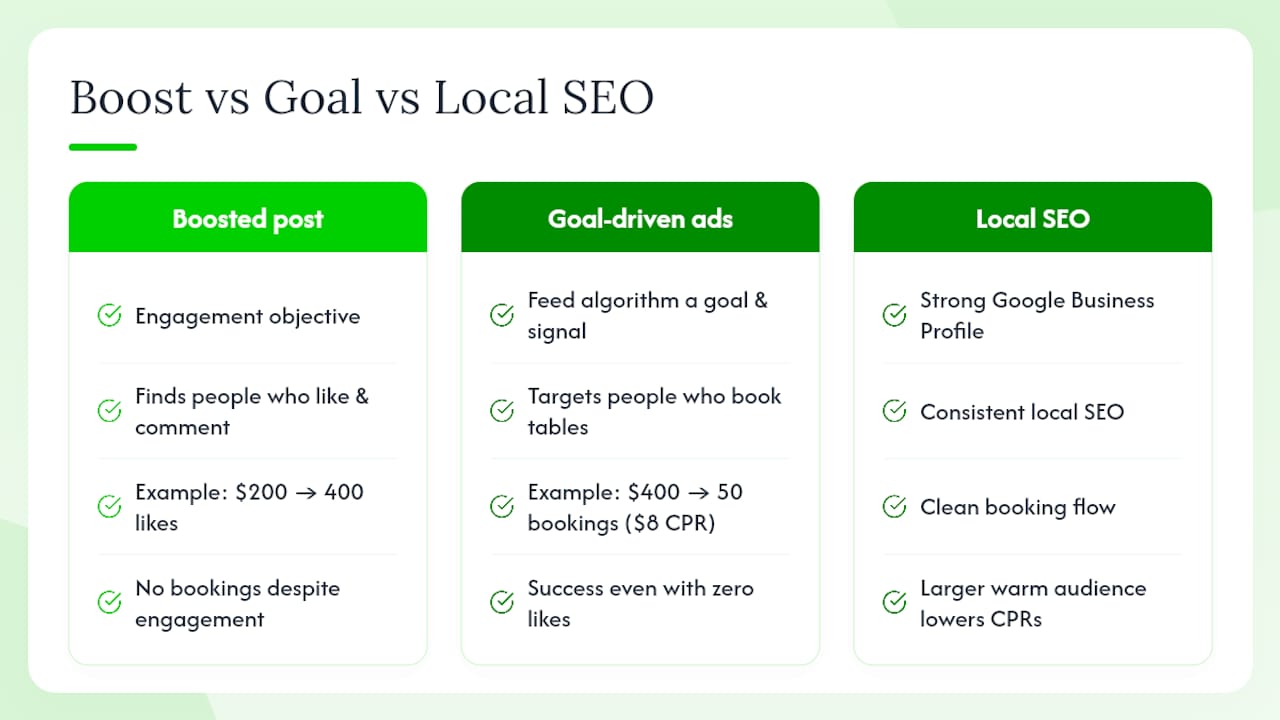
Boosted posts use the Engagement objective by default, which means Meta finds people who like and comment, not people who book tables. You can spend $200 boosting a beautiful food photo and generate 400 likes from people who will never set foot in your restaurant. The algorithm did exactly what you asked. You just asked for the wrong thing.
The deeper issue is that most restaurant owners treat Meta ads as a broadcast channel, the way they would think about a newspaper ad or a radio spot. You put the message out and hope the right people see it. Meta is not a broadcast channel. It is a targeting and optimization engine. The moment you stop thinking about it as "running an ad" and start thinking about it as "feeding the algorithm a goal and a signal," the whole thing clicks.
That shift also changes how you evaluate results. A campaign that spends $400 and drives 50 confirmed reservations at an $8 CPR is a success even if it got zero likes and no one shared it. A campaign that goes viral and generates 10,000 impressions but zero bookings is a failure. Vanity metrics are genuinely useless for a restaurant with 60 covers and a Friday night to fill.
The other thing most guides skip: Meta ads work best when they are layered on top of owned local discovery, not used as a replacement for it. A restaurant with a strong Google Business Profile, consistent local SEO, and a clean booking flow will see lower CPRs from Meta because the warm audience is larger. Paid Meta is the burst layer. Local SEO is the floor. Run both.
When does it make sense to hire agency support for your restaurant's Meta ads?
When you need creative volume, server-side tracking, or a cross-channel local expansion plan, the DIY approach starts costing more in wasted spend than an agency retainer would.
Crowdcompany runs full Meta programs for local restaurants: Pixel and Conversions API setup, creative production (Reels, carousels, UGC creator management), audience research, campaign management, and monthly reporting tied to actual reservation data. The difference from a typical agency is that Crowdcompany also handles the surrounding stack: local expansion pages, direct mail retargeting, and CRM automation so that every lead from your ads flows into a follow-up sequence, not a dead inbox.
Rated the #1 marketing agency in Boca Raton, Crowdcompany works with single-location restaurants and small multi-location groups across South Florida and beyond. If you are spending more than $300/month on Meta ads without a clear cost-per-reservation number, that is the signal to bring in a specialist. Get a paid advertising assessment and find out what a properly structured campaign should cost per cover in your market.
Useful resources for restaurant Meta advertising
A short list of tools and references worth bookmarking:
- Restaurant Facebook Ads for Operators 2026: Buyer's Guide
- A guide to creating Meta ads for restaurants
- Meta Ads for Restaurants: 2026 Full-Funnel Playbook
- Best Restaurant Meta Ads Examples 2026
- Get inspired by 20 of the best restaurant ad examples
- Restaurant Ads: 13 Creative Advertising Ideas to Inspire You