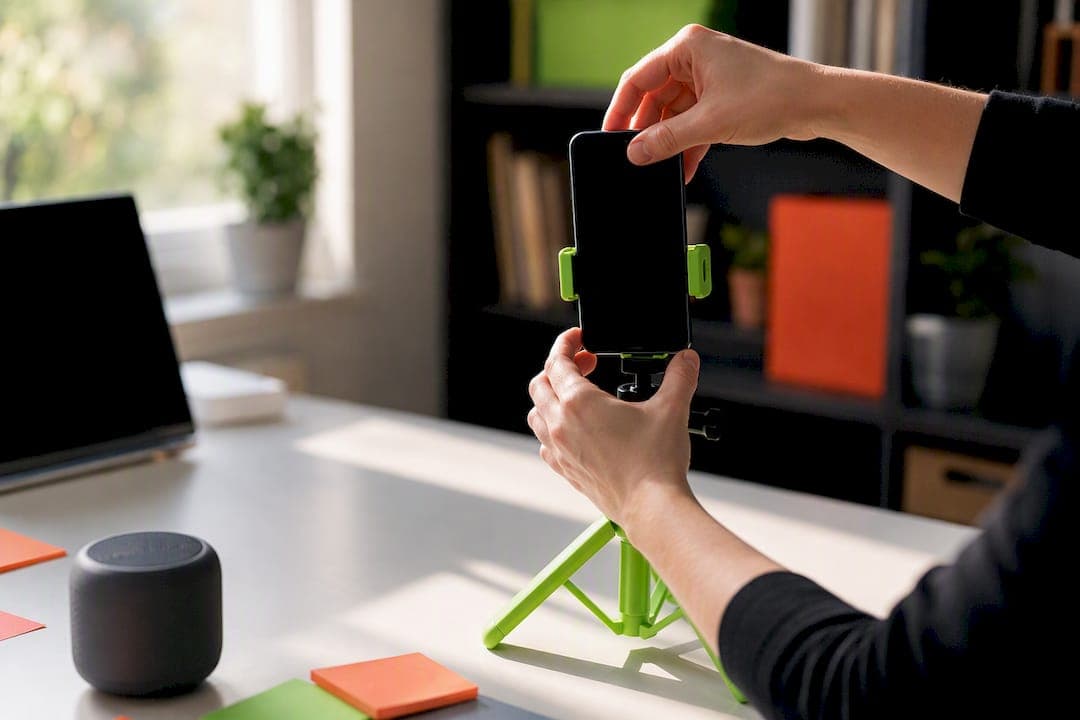
Film a 3-step tutorial when you want saves, a before/after transformation when you want conversions, and a comment-reply Reel when you want comments and shares. Those three formats cover the four goals almost every creator and business owner cares about, and none of them requires a production budget.
The reason they work is structural, not lucky. A tutorial or checklist Reel gives people a reason to save it for later. A before/after taps curiosity in the first frame and resolves it by the end, which keeps completion rates high. A comment-reply video answers a question your audience already asked, so the hook writes itself.
- 3-step tutorial → goal: saves. Hook with the result, show three quick steps, end with "save this for later."
- Before/after transformation → goal: conversions. Open on the "after," then rewind to the "before" for a curiosity loop.
- Comment-reply Reel → goal: comments and shares. Screenshot a real question, answer it in under 20 seconds.
- Myth-bust → goal: reach. State a common belief, then contradict it in the first second.
- Bookmark-worthy checklist → goal: saves and DM shares. List 5 to 7 items fast, no fluff.
Pro Tip: Your hook needs to land inside the first 0.8 to 1 second, before the viewer's thumb even finishes scrolling. If your video opens with a logo, a slow zoom, or "hey guys," you've already lost the algorithm's attention window.
Key Takeaways
Reels formats that combine an immediate hook, original audio, and a clear payoff consistently outperform polished videos that lack a structural reason to save or share them.
| Point | Details |
|---|---|
| Lead with a fast hook | Land your hook inside the first 0.8 to 1 second before viewers scroll past. |
| Sort ideas by goal | Group formats into reach, engagement, saves, and conversions instead of guessing randomly. |
| Repurpose the right way | Remove watermarks and re-record the opening hook before reposting TikTok or Shorts content. |
| Test formats for a month | Run 3 to 5 Reels weekly and give each format four weeks before judging it. |
| Get managed support | Crowdcompany scripts, films, edits, and tracks saves and shares for local businesses that want measurable results. |
Table of Contents
- 30 Instagram Reels Ideas Organized by the Goal You're Chasing
- 10 Reels You Can Shoot in Five Minutes Flat
- Turning One Video Into Three: Repurposing for Reels, TikTok, and Shorts
- Production Checklist: What Separates a Reel That Reaches People From One That Doesn't
- How Local Businesses Turn Reels Into Foot Traffic
- Collaboration Ideas With Influencers and Brands for Reels
- Why Audience Analysis Should Drive Every Content Idea You Film
- Creative Storytelling Techniques That Make a 15-Second Reel Feel Like a Story
- Analytics Tools That Show Whether a Reel Format Is Working
- Using Music Effectively Inside Your Reels
- Trending Challenges: When to Join In and When to Skip It
- How Often to Post and When to Kill a Format That Isn't Working
- Sources
30 Instagram Reels Ideas Organized by the Goal You're Chasing
Chasing a single "viral" idea is the wrong game. The smarter move is building a bank of Reels content ideas sorted by what you actually want the video to do, because reach, engagement, saves, and conversions each reward different structures. Here's a working idea bank split into four buckets, with a one-line execution brief for each.
Reach: get in front of new people
- Myth vs. fact — Open with "Everyone thinks X. Here's why that's wrong." Payoff frame: the corrected fact on screen as text.
- Local trend reaction — React to a trending topic in your niche or city; hook with the trend's name in text overlay at 0 to 1 second.
- "Things nobody tells you about X" — List format, three quick cuts, ends on the most surprising one.
- Day-in-the-life — Cold open on the most visually interesting moment of your day, not the alarm clock.
- Rapid-fire Q&A — Pull five questions from your DMs, answer each in five seconds flat.
- Trend remix with your twist — Use a trending audio but apply it to your specific niche for contrast.
- "I wish I knew this sooner" — Regret-framed hook, works especially well for service businesses.
- Behind-the-scenes chaos — Show the messy, real version of what you do; people trust imperfection.
Engagement: drive comments and shares
- Unpopular opinion — State it plainly in text at 0 to 1 second, then defend it for 15 seconds.
- This or that — Two options on screen, ask viewers to comment their pick.
- Finish the sentence — Give a setup, leave it open, invite completions in comments.
- Duet/stitch reaction — React to a trending clip in your niche with your own commentary layered in.
- Poll-style debate — Present two conflicting expert takes and ask which one the audience trusts.
- "Tag someone who…" — Build the payoff frame around a shareable, relatable scenario.
- Client or customer shoutout — Feature a real customer story with their permission; tag them for organic reach.
- Comment-reply deep dive — Take one recurring question from your comments and give it a full, tight answer.
Saves: become a reference people bookmark
- 3-step tutorial — Number each step on screen; end on "save this for when you need it."
- Checklist Reel — 5 to 7 items, text-heavy, minimal talking.
- Before/after (skill or result) — Show the transformation with a timestamp overlay.
- Common mistakes list — "3 mistakes killing your [result]" format, ends with the fix.
- Tool or resource roundup — List what you use to get a result; frame it as a cheat sheet.
- Step-by-step recipe or process — Works for any niche with a repeatable sequence.
- Glossary Reel — Define 3 terms your audience mixes up, fast cuts between each.
Conversions: move people toward buying
- Product demo in 15 seconds — Show the product solving the exact problem your buyer has, no narration needed.
- Before/after with a CTA — Same format as #19, but the payoff frame includes "book now" or "link in bio."
- Objection-buster — Name the top reason people hesitate, then answer it directly.
- Behind-the-scenes of the service — Show what happens after someone books; reduces buying anxiety.
- Price transparency Reel — Break down what's included, which builds trust fast for local service brands.
- Customer walkthrough — A real client showing the result on camera (with permission).
- Limited-time offer countdown — Text-forward, urgency-driven, paired with a clear CTA in the final frame.
Every one of these follows the same skeleton: a hook at 0 to 1 second, context or build at 1 to 3 seconds, and a payoff frame that either resolves the loop or hands off to a CTA. Reels formats that earn the most distribution in 2026 share three traits: an immediate hook, original audio, and a structural reason to replay or send the video to someone else.
10 Reels You Can Shoot in Five Minutes Flat
Some days you don't have a shot list, a tripod, or a plan. These ten need nothing but your phone and a wall.
- "3 things I'd tell my past self" — Face-to-camera, static shot. Hook: "If I could go back, I'd tell myself these three things." Captions on, original audio. CTA: "Which one hits home?"
- Overhead product flat-lay — One overhead shot, item arranged, text overlay listing benefits. Faceless-friendly.
- "Here's what $X actually gets you" — Show the product or service, price on screen. CTA: "DM me for details."
- Quick myth-bust — Face-to-camera. Hook: "This is wrong, and here's proof." Second clip shows the proof.
- Comment screenshot response — Screenshot a real comment, read it aloud, answer in 15 seconds. Faceless-friendly if you voice over instead.
- "POV: you just found out…" — Single static shot, text-driven storytelling, no talking needed. Faceless-friendly.
- Before/after phone pan — Pan from "before" to "after" in one continuous motion. Caption: "Wait for it."
- "3 mistakes I made so you don't have to" — Face-to-camera, numbered list, quick cuts.
- Desk or workspace tour — Overhead or handheld walk-through, voiceover naming each tool. Faceless-friendly.
- "Rating my own [product/service] honestly" — Face-to-camera, self-deprecating hook builds trust fast.
For every one of these, turn captions on before you post, keep the original audio (or a trending sound with your own voice layered over it), and shoot vertical from the start so nothing gets cropped.
Turning One Video Into Three: Repurposing for Reels, TikTok, and Shorts
You don't need three separate content plans. You need one strong clip and three small edits. Repurposing existing short-form content works reliably, but only if you handle the platform mechanics correctly.
- Identify your top-performing clip on TikTok or YouTube Shorts using view count and completion rate, not just likes.
- Strip the third-party watermark, since Instagram's algorithm suppresses Reels carrying a visible TikTok logo.
- Re-record or overlay the opening 1 to 2 seconds with original audio, because a cold-open hook built for TikTok's pacing often lands flat on Instagram.
- Re-time the clip to Instagram's sweet spot, trimming a 45-second TikTok down to something closer to 30 to 35 seconds if the middle sags.
- Swap the outro or CTA to match Instagram behavior (saves and shares) instead of TikTok behavior (comments and follows).
Third-party watermarks hurt distribution because Instagram wants to keep viewers inside its own ecosystem, not funnel them toward a competitor app. A visibly reposted TikTok signals "this content lives elsewhere first," and the algorithm reins in its reach accordingly.
Pro Tip: Before you repurpose anything, check the TikTok Creative Center and your own For You Page for patterns. If three unrelated creators in your niche are using the same sound or format this week, that's your signal to adapt it, not copy it outright.
Production Checklist: What Separates a Reel That Reaches People From One That Doesn't
Most Reels fail in the first second, not the last. Before you hit record, run through this list.
Hook patterns that work at 0 to 1 second:
- Result-first ("Here's what happened after 30 days")
- Number drop ("3 things," "$500 mistake")
- Contradicted expectation ("This should have failed, but…")
Technical checklist:
- Shoot vertical, 9:16, full frame
- Captions burned in or auto-generated, always on
- Original audio, or trending audio with your own voiceover layered on top
- Clean, non-blurry thumbnail frame (Instagram grabs whatever frame you set)
- Natural or ring light, no dark corners
- Zero visible TikTok or CapCut watermark
What to measure: Prioritize saves, DM shares, and completion rate over likes. Early impression velocity in the first several hundred views tells you within hours whether a format is worth scaling, even on a small account. Recommended posting cadence sits at 3 to 5 Reels per week, and you should run one format consistently for four weeks before judging whether it works.
How Local Businesses Turn Reels Into Foot Traffic
A restaurant running a "behind the counter" BTS series for four weeks can watch DM inquiries about catering climb without spending a dollar on ads. A boutique posting before/after styling Reels tends to see saves outperform likes by a wide margin, which is exactly the signal that predicts future purchase intent.
- Goal: foot traffic → Format: BTS of prep or setup → Outcome: increased "are you open" and location-tag DMs.
- Goal: bookings → Format: before/after client result → Outcome: higher save rate, more link-in-bio clicks.
- Goal: brand awareness → Format: comment-reply series → Outcome: sustained comment volume across a multi-week run.
Saves and DM shares carry more weight in Instagram's 2026 distribution model than likes ever did, which is why a short, reference-style checklist Reel often outperforms a polished, high-production video with no clear takeaway.
Businesses ready to build a repeatable posting rhythm can start with the Instagram content calendar template to map four weeks of formats in one sitting. If you're already stretched thin on time, or you want someone tracking saves and shares weekly instead of guessing, that's when a managed service starts to pay for itself instead of costing you more hours than it saves; check out Konvuno — Stop making visitors search. Let them ask..
Collaboration Ideas With Influencers and Brands for Reels
Two accounts posting a joint Reel almost always outperforms either one posting solo, because each audience discovers a creator they didn't already follow. A local coffee shop pairing with a nearby bakery for a "pastry pairing" Reel taps both follower bases at once, at zero media spend.

Start with a duet or stitch collaboration, where one creator films a reaction or addition to another's clip. It's low-lift, requires no shared shoot location, and works well between a small business and a local micro-influencer.
For a deeper partnership, try a skill swap Reel: a hairstylist and a makeup artist trade services on camera, each posting their own cut of the same session. Both parties get fresh content and a built-in audience introduction.
Cross-promotion Reels work well for service businesses that share a customer base without competing directly. A personal trainer and a nutrition coach can trade "day in the life" cameos, tagging each other so both audiences see the crossover.
When approaching a potential collaborator, propose a specific format and goal upfront. Vague "let's collab sometime" messages rarely convert into scheduled shoots. Instead, pitch: "Want to do a 30-second before/after Reel together next week? I'll handle editing." Specificity gets a yes far more often than an open-ended ask.
Why Audience Analysis Should Drive Every Content Idea You Film
The idea bank above only works if you know who's actually watching. A 30-second tutorial aimed at beginners flops with an audience of advanced users, and a price-transparency Reel meant for budget-conscious shoppers falls flat with a luxury clientele.
Start with Instagram's native Insights tab and look at three things: age range, top locations, and active hours. If most of your audience is active between 6 and 9 p.m., posting at noon wastes your best hook on the smallest possible audience.
Next, read your comments as research, not just engagement. Recurring questions reveal exactly what content your audience wants but hasn't gotten yet. If five people ask "how much does this cost" in a month, that's a signal to make a price-transparency Reel, not a coincidence to ignore.
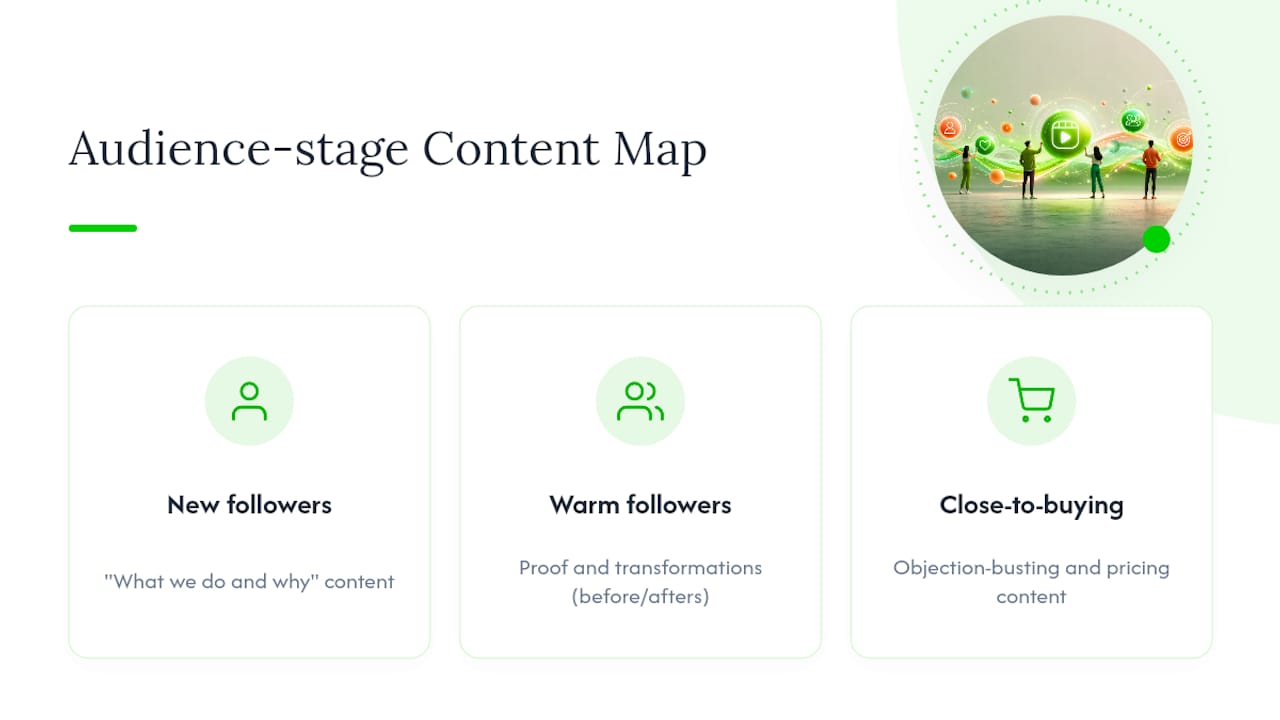
Segment your ideas by where a viewer sits in their relationship with your brand. New followers need "what we do and why" content. Warm followers who already engage need proof and transformation content, like before/afters. Followers close to buying need objection-busting and pricing content. Mapping your 30-idea bank against these three stages keeps you from making the same beginner-level Reel on repeat.
Creative Storytelling Techniques That Make a 15-Second Reel Feel Like a Story
A Reel is a story compressed into three beats, and skipping any one of them is why so many videos feel flat. The strongest format for this is the micro-narrative: hook at 0 to 1 second, context or tension at 1 to 3 seconds, and a payoff or CTA on the final frame.
Loopability is one of the most underused storytelling tricks available. If the last frame visually connects back to the first frame, or ends mid-action instead of fully resolving, viewers rewatch instinctively, and rewatches count toward completion rate. A video that ends on "and that's when everything changed" without showing the change invites a second viewing far more than a neatly wrapped conclusion.
Contrast drives most high-performing hooks. Before/after, expectation versus reality, and myth versus fact all work because the brain locks onto a gap and wants it closed. Open on the gap, not the explanation.
Specificity beats generality every time. "I made a mistake with my business" is forgettable. "I lost $3,000 because I skipped this one step" gets watched to the end. Trade vague statements for exact numbers, exact timeframes, and exact outcomes wherever you can.
Finally, resist the urge to explain everything. A Reel that leaves one small question unanswered, saved for the comments or a follow-up video, builds a reason for someone to come back to your page.
Analytics Tools That Show Whether a Reel Format Is Working
Instagram's built-in Insights tab, accessible from any professional account, remains the fastest way to check performance without leaving the app. Look past the reach number first and go straight to saves, shares, and average watch time, since those three metrics predict whether the algorithm will keep pushing a Reel past its first wave of viewers.
Meta Business Suite gives a wider view across a week or month, useful for spotting which of your 2 or 3 test formats is consistently outperforming the others rather than judging off one lucky post.
For creators managing multiple accounts or comparing performance against competitors, third-party tools add context Instagram's native dashboard doesn't show, like posting-time heatmaps and hashtag performance over time. Whichever tool you use, track the same handful of numbers weekly instead of chasing every metric available. Consistency in what you measure matters more than the sophistication of the dashboard.
Using Music Effectively Inside Your Reels
Music isn't decoration on a Reel. It's timing, and timing is what makes a cut feel intentional instead of random. Matching a hard cut or reveal to a beat drop makes even a phone-shot video feel produced.
Trending audio helps discovery, since Instagram surfaces Reels using popular sounds to people who've engaged with that sound before. But trending audio alone won't save a weak hook, and using it without adapting the opening frame to your specific niche often falls flat. Layer your own voiceover over a trending sound when the words matter more than the beat, which works especially well for tutorial and myth-bust formats.
Original audio carries its own advantage: it's less crowded, and Instagram has leaned toward rewarding original sound as one of the traits shared by formats earning strong distribution. For talking-based formats like comment-replies or myth-busts, skip trending audio entirely and let your voice carry the video.
Keep volume levels in mind, too. A voiceover buried under loud background music loses the exact words that were supposed to hook the viewer in the first second.
Trending Challenges: When to Join In and When to Skip It
Not every trend deserves your time. Before jumping into a challenge or trending format, ask whether it can genuinely connect to your niche without feeling forced. A trending dance means little for a plumbing business, but a trending "rating things on a scale" format adapts easily to almost any product or service.
Check the TikTok Creative Center and your own For You Page a few times a week to catch a trend early rather than three weeks after it's already saturated. The window for a trending sound or format to still feel fresh is short, often just a handful of days for niche audiences.
When you do adapt a trend, twist it toward your specific offering instead of copying it exactly. A trending "things I wish I knew" format becomes far more useful when it's "things I wish I knew before opening my restaurant" instead of a generic personal reflection. The trend gets you the hook structure and possibly the sound; your niche knowledge gets you the actual value.
How Often to Post and When to Kill a Format That Isn't Working
Post 3 to 5 Reels per week, and resist the temptation to switch formats every time one underperforms. Give any single format a genuine four-week test before deciding it doesn't work, since early inconsistency in views is normal and doesn't always reflect the format's real ceiling.
Track saves and DM shares above likes and comments, since those two signals correlate most closely with Instagram continuing to push a Reel past its first wave of viewers. If a format shows strong early impression velocity within its first several hundred views but weak completion rate, the hook is working and the middle is losing people, which tells you exactly what to fix before you scrap the whole format.
Kill a format only after it has had a fair four-week run and consistently underperforms your account average on saves and shares, not after one slow post. One bad week is noise. Four weeks of flat numbers is data.
Why repeating formats wins over chasing one-hit trends
Chasing a new trend every week resets your learning curve constantly. Pick 2 to 3 formats and run each one weekly for four weeks, watching sends-per-reach as your pruning metric. The format with the best ratio earns more of your posting slots. For a plug-and-play version of this, the content calendar template maps it out for you.
— E
How Crowdcompany Turns Your Reels Into Bookings, Not Just Views
Crowdcompany is the alternative to guessing your way through a content calendar alone. Instead of filming, editing, posting, and tracking saves on your own between running a business, our team handles scripting, filming direction, editing, posting cadence, and analytics as one managed workflow. That means you get consistent output without the four-week trial-and-error learning curve most solo creators go through first.
This fits local businesses, restaurateurs, and service providers who want Reels tied to measurable outcomes, like bookings, foot traffic, or DM inquiries, not just view counts. We build the idea bank, shoot the hooks that hold attention, and report back on which formats actually move your saves and shares, so you're not stuck reading analytics dashboards after closing. If you're ready to stop treating Reels as a side project, check our digital PR and content scripting services to see what a managed plan looks like for your business.
Sources
- YouTube Shorts ideas — Buffer
- Instagram Reels Ideas: 40 Formats for 2026 - TINS HUB
- 100+ Instagram Reels Ideas for Every Niche (2026) | Eliro
- TikTok content ideas: where to get them — Influencer Marketing Hub