
TikTok Spark Ads let you turn an existing organic TikTok post into paid media while every like, comment, share, and follow it earns stays credited to the original post. The verdict: if you have a post with real organic traction, Spark Ads are almost always the right call. Paid spend compounds social proof instead of replacing it, and that compounding effect is what separates Spark from every other TikTok format.
The biggest benefits at a glance:
- Preserved engagement: Likes, comments, and follows accumulate on the original post, not a throwaway ad unit.
- Creator identity: The creator's handle and profile stay visible, which builds trust in a way a brand-only ad rarely achieves.
- Long-term organic lift: A sparked post keeps performing after the campaign ends because the social proof stays on it.
Where Spark Ads fall short: if you need to run rapid A/B creative tests with different captions, or if your legal team requires exact control over every word on screen, a standard in-feed dark post is the cleaner tool. Spark Ads lock the caption at authorization, and that constraint is real.
Key Takeaways
TikTok Spark Ads are most effective when you promote posts that already have genuine organic traction, because paid spend compounds existing social proof rather than creating it from scratch.
| Point | Details |
|---|---|
| Pick proven posts | Only spark posts with real organic engagement; a strong hook and existing comments signal paid-ready content. |
| Request 365-day codes for evergreen assets | Match authorization duration to your campaign flight plus a buffer to prevent mid-flight delivery stops. |
| Lock captions before requesting codes | Caption edits are impossible after authorization; confirm disclosure and copy in writing before the creator generates the code. |
| Measure follower lift alongside CPA | Spark Ads build a retargetable audience through follows; track organic follower growth as a secondary KPI alongside cost per result. |
| Crowdcompany manages the full workflow | From creator sourcing and rights clearance to Ads Manager setup and reporting, Crowdcompany runs Spark Ads programs end-to-end. |
Table of Contents
- How do TikTok Spark Ads actually work?
- How do Spark Ads compare to other TikTok ad formats?
- Step-by-step setup for brand posts and creator posts
- What are the creative specs and best practices for Spark Ads?
- How should you target and measure Spark Ads?
- What can go wrong with Spark Ads, and how do you fix it?
- How does a growth marketing team run Spark Ads at scale?
- The agency perspective on Spark Ads
- Crowdcompany runs Spark Ads programs so you do not have to build the workflow yourself
- Sources
How do TikTok Spark Ads actually work?
The mechanics are straightforward once you see the full sequence. An organic post, either one your brand owns or one a creator authorizes, gets promoted through TikTok Ads Manager as a Spark Ad. The post itself never changes. What changes is its distribution: TikTok pushes it into paid placements while routing all engagement back to the original post's counters.
Attribution and what stays on the post
Every interaction a viewer takes during the paid campaign, a like, a comment, a follow, a share, gets attributed to the original organic post. This is the core difference from a standard in-feed ad, where engagement disappears when the campaign ends. With Spark Ads, a post that ran for 30 days of paid promotion keeps every comment and like it earned. That social proof is visible to anyone who finds the post organically afterward, which is why Spark Ads consistently report higher completion and engagement rates versus standard in-feed placements.
How authorization codes work
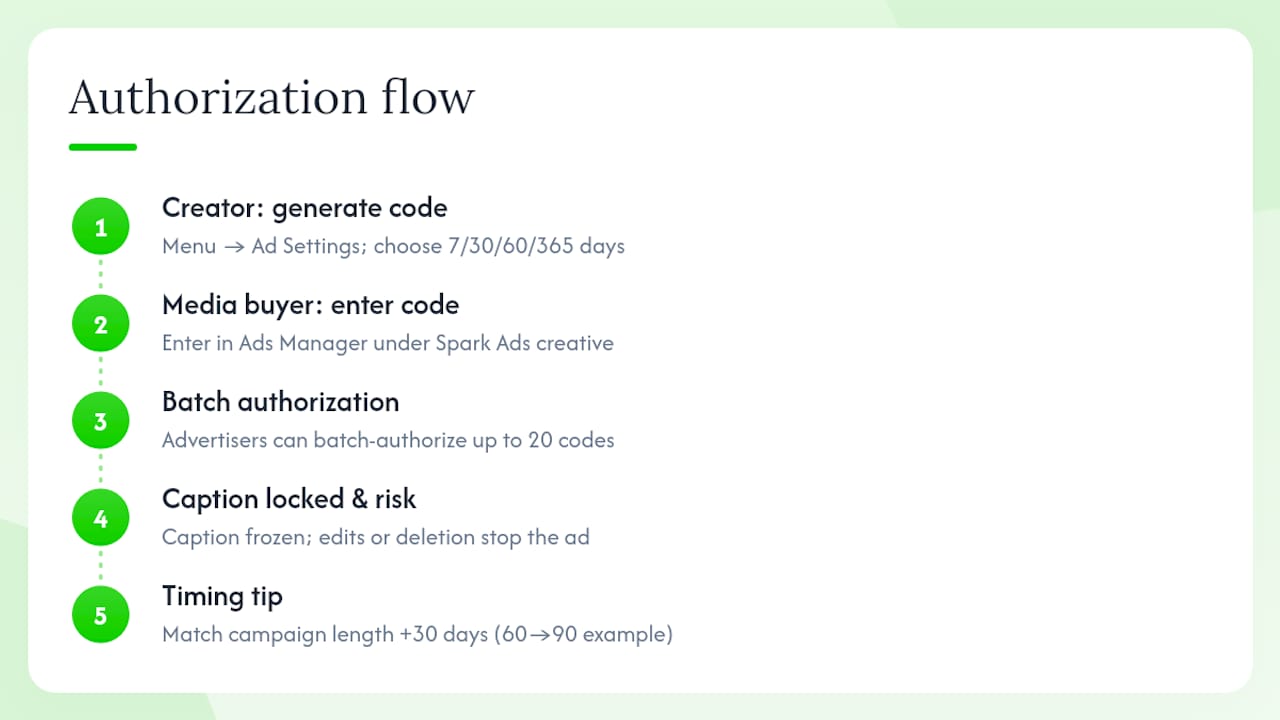
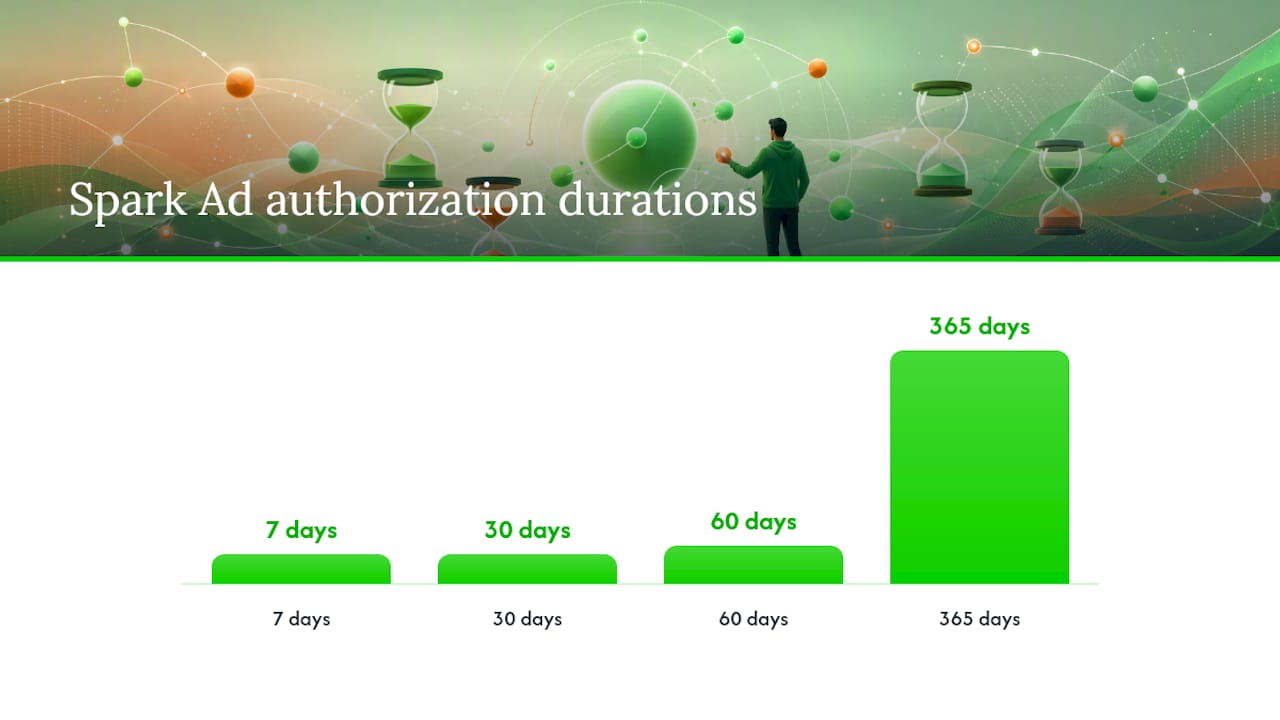
For creator posts, the authorization flow runs like this: the creator opens the post, taps the three-dot menu, goes to Ad Settings, and generates a code. Creators can choose an authorization duration of 7, 30, 60, or 365 days, and advertisers can batch-authorize up to 20 codes at once. The media buyer then enters that code in Ads Manager under the Spark Ads creative section, which pulls in the post with all its existing engagement intact.
One hard constraint: the caption cannot be edited after authorization. If the creator changes the caption or deletes the post mid-flight, the ad stops running. A sparked post also cannot be deleted while an active authorization is in place.
Lock the caption before you request the code. Once a creator generates an authorization code, the post is frozen. Any caption revision, disclosure tag, or link update needs to happen before the code is issued, not after. Build a caption-review step into your creator brief so this never becomes a last-minute scramble.
Pro Tip: Match the authorization duration to your campaign flight plus a 30-day buffer. If your campaign runs 60 days, request a 90-day code. This prevents an expired authorization from killing a live ad mid-flight without warning.
How do Spark Ads compare to other TikTok ad formats?
Spark Ads are not the right tool for every campaign. The table below maps the key decision dimensions across the formats media planners most often weigh.
| Use Case | Spark Ads | Standard In-Feed / Dark Post | Catalog / Shopping Ads |
|---|---|---|---|
| Best for | Engagement, trust, conversion with social proof | Rapid creative testing, controlled messaging | Product discovery, direct purchase |
| Post ownership | Brand-owned or creator-authorized organic post | Brand-created, no organic post required | Product feed, no organic post |
| Creative editability | Caption locked at authorization | Full control, editable at any time | Feed-driven, limited creative control |
| Engagement attribution | Stays on original post permanently | Disappears when campaign ends | Not applicable |
| Cost efficiency | Higher CTR potential from existing social proof | Predictable CPM, easier to A/B test | Efficient for catalog scale |
| Authenticity signal | High (creator handle visible, organic feel) | Lower (clearly branded ad unit) | Low |
When to choose Spark Ads first: You have a post with genuine organic traction, you want the creator's identity to stay visible, or you're running an awareness or engagement objective where trust matters more than message control. Industry analysis places Spark Ads as the strongest fit for engagement, trust, and conversion objectives within the TikTok ad mix.
When to choose a dark post instead: You need to test five caption variants simultaneously, your legal team requires pre-approved copy that cannot be touched by a creator, or you're launching a product that has no organic content yet.
Step-by-step setup for brand posts and creator posts
Setting up a brand-owned Spark Ad
- Connect your brand's TikTok account to your TikTok for Business account via Business Center.
- In Ads Manager, create a new campaign and select your objective (Traffic, Conversions, Video Views, App Installs, Lead Gen, or Reach).
- At the ad level, choose Spark Ad as the ad format and select Use Account Post.
- Pick the organic post you want to promote from your account's post library.
- Add your destination URL, CTA button, and any tracking parameters (UTM or pixel events).
- Submit for review. TikTok's review typically completes within 24 hours.
Setting up a creator-authorized Spark Ad.
- Send the creator a brief that includes the final caption, required disclosures, and any music rights notes. Get written sign-off before they post.
- Ask the creator to open the post, tap the three-dot menu, select Ad Settings, and generate an authorization code. They choose the duration: 7, 30, 60, or 365 days.
- Confirm the post is set to Public and that the paid partnership disclosure is present.
- In Ads Manager, at the ad level, select Spark Ad and choose Use Authorized Post. Enter the code.
- Select your campaign objective and configure ad group settings: targeting, budget, bid strategy, and schedule.
- Add tracking parameters and submit for review.
Supported objectives for Spark Ads: Traffic, Video Views, Conversions, App Installs, Lead Generation, and Reach. Community Interaction (follower growth) is also supported for brand-owned posts.
Minimum daily budget: $20 at the campaign level and $20 at the ad group level in the US market.
Authorization-code checklist before requesting a code:
- Caption is final and includes required paid partnership disclosure.
- Music is either original, royalty-free, or licensed for commercial use.
- Post is set to Public visibility.
- Creator has confirmed they will not delete or edit the post during the campaign flight.
- Authorization duration covers the full campaign flight plus a buffer.
Pro Tip: When running multiple creator posts in one campaign, use batch authorization to import up to 20 codes at once. Name each ad unit with the creator handle and post date (e.g., @handle_YYYYMMDD) so reporting stays readable when you have dozens of active Spark Ads running simultaneously.
What are the creative specs and best practices for Spark Ads?
Key specifications
| Spec | Requirement |
|---|---|
| Aspect ratio | vertical, full-screen recommended |
| Resolution | full HD vertical resolution recommended |
| Max video length | 10 minutes |
| Optimal length for engagement | between 9 and 15 seconds |
| Caption length | Up to 2,200 characters; first 50–80 visible before truncation |
| File format | MP4, MOV, AVI, GIF (video) |
| Sound | Required; muted videos perform significantly worse |
Creative best practices
The single biggest mistake brands make with Spark Ads is picking a polished, brand-produced video and wondering why it underperforms. The format rewards native-looking content. Consumers consistently want more creative variety from brand advertising, and TikTok's own feed trains viewers to scroll past anything that looks like a commercial.
- First frame is everything. The hook must land in the first 1–2 seconds. A question, a surprising visual, or a direct address to the viewer ("Wait, you're still doing it this way?") outperforms a logo reveal every time.
- Keep sound native. Use trending audio or original sound that fits the creator's voice. Video remains a dominant channel precisely because sound and motion together create engagement that static formats cannot replicate.
- On-screen text should support, not duplicate. Captions and text overlays help viewers watching on mute, but stacking the same words the creator is saying reads as noise.
- CTAs that fit the format. "Link in bio" feels native. "Shop now" in a hard-sell overlay does not. Match the CTA to the post's energy.
- Music rights matter. Before sparking any creator post, confirm the music is cleared for paid promotion. TikTok's Commercial Music Library is the safest option.
Spark-ready post checklist:
- Post has existing organic engagement (comments, shares, saves).
- First frame stops the scroll without looking like an ad.
- Creator's voice and style are intact throughout.
- Caption includes a natural CTA and paid disclosure.
- Audio is cleared for paid use.
How should you target and measure Spark Ads?
Targeting options at the ad group level
Spark Ads use the same targeting stack as other TikTok formats, applied at the ad group level. For detailed audience strategies, the TikTok ads targeting guide covers the full option set. The core levers:
- Custom audiences: Upload customer lists, retarget website visitors via TikTok Pixel, or build audiences from video engagement.
- Lookalike audiences: Seed with your best customers or highest-LTV purchasers for prospecting.
- Interest and behavior targeting: TikTok's interest categories are broad; layer in behavioral signals (users who have engaged with similar content) to tighten relevance.
- Demographic and geo targeting: Age, gender, location down to the DMA level. For local campaigns, geo-targeting paired with Spark Ads driving foot traffic is a high-efficiency combination.
Creative-to-audience matching: A creator post that resonates with a niche community will almost always outperform a generic brand post when targeted to that community's interest graph. Let the creator's existing audience signal tell you who to target first.
Bidding and budget strategies
TikTok Ads Manager offers three primary bid strategies for Spark Ads: Lowest Cost (automated, maximizes results within budget), Cost Cap (targets a specific CPA), and Bid Cap (sets a maximum CPM or CPC). For most Spark Ads campaigns, start with Lowest Cost to gather data, then shift to Cost Cap once you have at least 50 conversion events in a 7-day window.
Metrics to watch
Because engagement stays on the original post, standard ad-level reporting does not capture the full picture. Monitor both:
- Video completion rate (VCR): The clearest signal of creative quality. A 6-second view-through rate above the platform average indicates the hook is working.
- Engagement rate: Comments, shares, and saves relative to impressions. Spark Ads' persistent engagement means this number grows even after the campaign ends.
- Cost per result: Whether that's a click, a lead, or a purchase, track it at the ad group level and compare across creative variants.
- Organic follower lift: Check the brand or creator account's follower count before and after the campaign. Spark Ads that drive follows are building a retargetable audience at no extra cost.
- Comment sentiment: Read the comments. Negative sentiment on a sparked post is visible to everyone who finds it organically, which is a risk standard in-feed ads do not carry.
Pro Tip: Pull a post-level report from TikTok Analytics alongside your Ads Manager campaign report. The two together show you whether paid spend is lifting organic reach, which is the compounding effect Spark Ads are designed to create.
What can go wrong with Spark Ads, and how do you fix it?
Common errors and policy pitfalls
Invalid or expired authorization codes are the most frequent issue. A code expires on the duration the creator selected, and if the campaign is still live when it expires, the ad stops serving. Fix: request a new code and re-enter it in Ads Manager before expiration.
Creator un-authorizes mid-flight. This happens when a creator revokes access or deletes the post. The ad pauses immediately. Fix: build a clause into your creator agreement that prohibits deletion or revocation during the campaign flight.
Caption edit restrictions. Once a code is generated, the caption is locked. If a legal review flags the caption after authorization, the only option is to have the creator delete the post, re-post with the corrected caption, and issue a new code. This resets all organic engagement, so prevention is far cheaper than the fix.
Music rights violations. A post using a trending sound that is not cleared for paid promotion will be rejected by TikTok's ad review. Always confirm music rights before requesting a code.
Paid disclosure missing. TikTok requires a paid partnership label for branded content. A post without it will fail review or be flagged after launch.
Pre-launch and mid-flight troubleshooting checklist
Pre-launch:
- Confirm post is set to Public.
- Verify authorization code is valid and duration covers the full flight plus buffer.
- Check music is cleared for commercial use.
- Confirm paid partnership disclosure is present.
- Validate pixel or tracking parameters are firing correctly.
Mid-flight:
- Check Ads Manager for delivery errors daily for the first 72 hours.
- Monitor authorization expiration dates weekly.
- Review comment section for sentiment shifts that could affect brand safety.
- Confirm the creator has not edited or deleted the post.
How does a growth marketing team run Spark Ads at scale?
Scaling Spark Ads is an operational challenge more than a technical one. The rights, caption freeze, and authorization windows are where programs stall, not the Ads Manager setup.
Team roles and handoffs
- Influencer/creator manager: Sources posts, sends briefs, collects authorization codes, and manages creator relationships and agreements.
- Media buyer: Imports codes into Ads Manager, configures targeting and bidding, monitors delivery, and flags expiring authorizations.
- Creative lead: Vets posts for Spark-readiness (hook quality, native feel, social proof), approves captions, and identifies which posts to test organically before sparking.
- Data analyst: Builds the reporting dashboard, tracks campaign-level ROAS and CPA, monitors organic follower lift, and runs post-campaign attribution analysis.
- Legal/rights reviewer: Confirms music clearance, paid disclosure compliance, and creator agreement terms before any code is requested.
Operational checklist
- Creative vetting complete (hook, caption, music, disclosure).
- Caption frozen and approved by legal before code request.
- Authorization code requested using a standardized template that specifies duration.
- Batch authorization used for multi-creator campaigns (up to 20 codes per batch).
- Ads Manager naming convention applied:
[Brand]_[Creator]_[Objective]_[Date]. - Runbook documented for re-authorization if a code expires mid-flight.
Content pipeline structure
Organize posts into three lanes to avoid wasting paid budget on low-potential content:
- Test organically: New posts go here first. Let them run for 48–72 hours. If they gain traction, move them to the next lane.
- Spark-ready: Posts with genuine engagement, a strong hook, and cleared rights. These get authorized and promoted.
- Stay organic: Posts that perform well organically but are not suitable for paid promotion (music not cleared, caption not compliant, or content too niche for paid targeting).
Reporting KPIs
Track these at minimum in your weekly dashboard: campaign-level ROAS, CPA by objective, video completion rate, 6-second view-through rate, organic follower lift, and comment sentiment score (manual or via a social listening tool). For ecommerce brands, add add-to-cart rate and purchase ROAS as primary conversion metrics.
The agency perspective on Spark Ads
The conventional wisdom is that Spark Ads are simply "more authentic" than regular ads. That framing is too simple, and it leads brands to spark the wrong posts.
The real decision rule is this: Spark Ads are for posts that have already proven something. Paid spend on that post compounds a signal that already exists. Sparking a post with 12 views and no comments is just a dark post with extra steps.
The other thing most guides understate is the operational cost. Rights management, caption freezes, and authorization windows are where Spark Ads programs break down at scale. A brand that runs 10 creator posts per month needs a documented workflow, not just an Ads Manager login. The UGC creator management side of a Spark Ads program is often more labor-intensive than the media buying side.
The brands that get the most out of Spark Ads treat them as a paid+organic flywheel. They test content organically, identify what resonates, spark the winners, and use the follower lift from those campaigns to build a retargetable audience for the next cycle. That loop is what makes Spark Ads a compounding asset rather than a one-time spend.
Crowdcompany runs Spark Ads programs so you do not have to build the workflow yourself
Running Spark Ads well means managing creator relationships, rights clearances, authorization windows, Ads Manager configuration, and performance reporting simultaneously. Most brands hit a wall at the operational layer, not the strategy layer.
Crowdcompany handles the full stack: creator sourcing and contracting, authorization management, Ads Manager setup and optimization, creative vetting, and weekly reporting. Whether you need an ongoing Spark Ads program on retainer or a single campaign built and launched, the team covers every handoff from brief to post-campaign analysis.
For brands that want paid advertising campaigns managed end-to-end, including creator outreach, content scripting, and TikTok ad execution, Crowdcompany's digital PR and content services are the starting point. Book a strategy call to see what a Spark Ads program looks like for your brand.
Sources
The sources below are the most reliable places to check for current policy, spec updates, and creator-facing guidance:
- TikTok Spark Ads: Complete Setup, Strategy & Benefits Guide (2026) - TikAdTools
- TikTok Spark Ads: Setup, Codes, and Creator Authorization That Lasts Up to 365 Days | Novoads AI
- How to advertise on TikTok — WordStream
- Admanage