
The single best approach to TikTok ads for ecommerce right now: launch native creator-style creative, connect your TikTok Pixel and product catalog, then run a GMV Max or Smart+ conversion test for at least 30 days. That combination works because TikTok's algorithm rewards content that looks organic, and the catalog/pixel gives it the conversion signals it needs to find buyers, not just viewers.
Quick-start checklist (copy into your project tracker):
- Create a TikTok Ads Manager account and link it to your TikTok For Business Business Center
- Install the TikTok Pixel on your store (Shopify users: use the native TikTok app in the Shopify App Store)
- Sync your product catalog via Catalog Manager
- Produce 3 creative angles: problem/solution, unboxing, and a use-case demo
- Set a daily campaign budget appropriate for your business and run for at least 30 days before making major changes
First 7 days: verify pixel fires on ViewContent, AddToCart, and Purchase events; confirm catalog products are approved; upload your 3 creatives into a single ad group targeting broad audiences; set your objective to Sales/Conversions.
Table of Contents
- What TikTok ad formats work best for ecommerce?
- How do you set up TikTok Ads Manager for ecommerce?
- What creative actually works for TikTok ecommerce ads?
- How should you target, bid, and optimize TikTok ecommerce campaigns?
- Which KPIs actually matter for TikTok ecommerce measurement?
- How do you scale TikTok ecommerce campaigns without killing margins?
- What does a managed TikTok ecommerce program actually look like?
- Your 30/60/90 day TikTok ecommerce action plan
- TikTok ecommerce ad compliance and policy in the US
- Key Takeaways
- When TikTok ads are the right call and when they are not
- Crowdcompany runs your TikTok ecommerce program so you can focus on the product
- Useful sources and further reading
What TikTok ad formats work best for ecommerce?
TikTok offers more format variety than most ecommerce advertisers use. Picking the right one depends on whether you're driving awareness or purchases, and whether your checkout lives inside TikTok or on your own site.
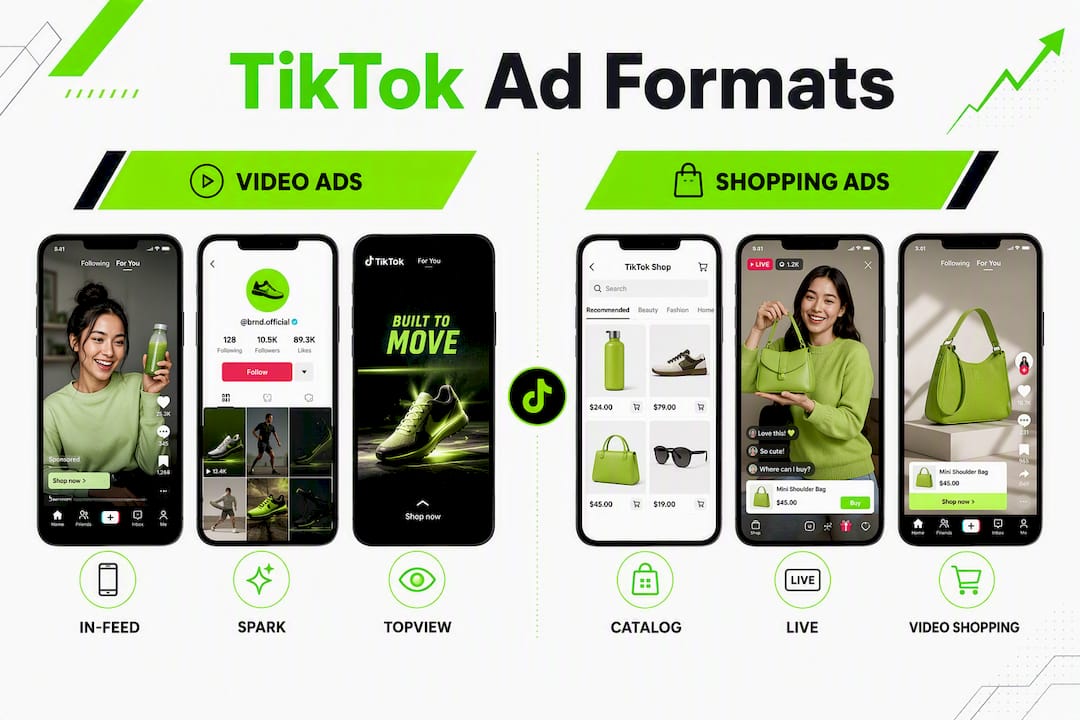
In-feed video ads
The workhorse format. These appear natively in the For You feed, run up to 60 seconds, and include a CTA button to your product page or TikTok Shop. Shopify recommends keeping them 9–15 seconds for best engagement. Use these for prospecting and retargeting at every funnel stage.

Spark Ads
Spark Ads let you amplify an existing organic post, either from your own account or from a creator who has granted you permission. Because the post already has organic engagement, it carries social proof into the paid placement. This is the format to use when a creator video is already performing well organically.
Catalog Ads and Collection Ads
Catalog Ads sync directly with your product feed to generate personalized carousel or video ads. Users can tap through to your site, an in-app Instant Page, or TikTok Shop. These are the right choice when you have 10+ SKUs and want the algorithm to match products to the most relevant users automatically.
GMV Max
As of July 2025, GMV Max is TikTok's AI-powered campaign automation system for TikTok Shop Ads. You set a daily budget, an ROI target, and the products you want promoted. TikTok handles creative selection, audience targeting, and spend distribution. It requires TikTok Shop to be active and sufficient pixel event volume to work well.
Video Shopping Ads and TikTok Shop

Video Shopping Ads place product tags directly inside a video, letting viewers tap to purchase without leaving the app. TikTok Shop in-app checkout typically delivers a conversion rate of 3–8%, outperforming off-platform checkout in most verticals because it eliminates the redirect friction.
LIVE Shopping Ads
These promote an active TikTok Live session and drive viewers into the stream where hosts can demo products in real time. Best for brands with a confident on-camera presence and products that benefit from live demonstration.
TopView Ads
Full-screen takeover that fires the moment someone opens the app. Maximum reach and recall, but you must contact TikTok's sales team directly to qualify. Reserve this for major product launches or seasonal campaigns with significant budgets.
Format comparison
| Format | Primary objective | Requires TikTok Shop? | Conversion behavior |
|---|---|---|---|
| In-Feed Video | Awareness → Conversion | No | Click-through to site or Shop |
| Spark Ads | Consideration → Conversion | No | Amplifies organic; click-through |
| Catalog / Collection Ads | Consideration → Conversion | No (catalog required) | Dynamic product match; tap-through |
| GMV Max | Conversion (Shop) | Yes | Automated; in-app purchase |
| Video Shopping Ads | Conversion | Yes | In-app product tag purchase |
| LIVE Shopping Ads | Conversion | Yes | Live-stream purchase |
| TopView | Awareness | No | Brand recall; click-through |
How do you set up TikTok Ads Manager for ecommerce?
Getting the plumbing right before you spend a dollar is the difference between campaigns that optimize and campaigns that spin their wheels.
Account prerequisites
- Create a TikTok For Business account at business.tiktok.com.
- Set up a Business Center and add your Ads Manager account to it.
- Link your organic TikTok account to Ads Manager so you can run Spark Ads from your own posts.
- If you plan to use TikTok Shop, connect it through the Business Center and verify your seller account.
Pixel vs. Events API
The TikTok Pixel is a JavaScript snippet that fires browser-side events. It is the fastest way to start collecting data. The Events API (server-side) sends events directly from your server to TikTok, which means it is not blocked by iOS privacy changes or browser extensions. For most Shopify stores, start with the Pixel via the native TikTok Shopify app, then layer in the Events API once you are generating consistent purchase volume.
Pixel installation checklist:
- Install via TikTok Shopify app or manually paste the base code in your theme header
- Verify ViewContent, AddToCart, InitiateCheckout, and Purchase events fire correctly using TikTok Pixel Helper (Chrome extension)
- Set your attribution window to 7-day click + 1-day view as a starting baseline
- Enable engaged-view attribution to capture users who watched 6+ seconds but did not click
Catalog integration
- Export your product feed in Google Shopping XML or CSV format
- Upload to TikTok Catalog Manager; products must include title, description, price, availability, image URL, and landing page URL
- Images should be at least 800×800px; avoid heavy text overlays on product images
- Allow 24–48 hours for catalog review and approval before launching Catalog Ads
Campaign objectives and structure
Use the Sales objective (formerly Conversions) when your pixel has enough data. TikTok recommends at least 50 weekly purchase events before switching to automated bidding or GMV Max. Below that threshold, use the Traffic or Product Sales objective with manual bidding to accumulate data first.
Common setup problems:
- Pixel not firing: check that the base code is in the
<head>tag and that no consent management platform is blocking it before opt-in - Product mismatch errors: confirm your catalog currency matches your Ads Manager account currency (USD for US stores)
- Spark Ads permissions denied: the creator must authorize your Ads Manager ID specifically; a general content agreement is not enough
What creative actually works for TikTok ecommerce ads?
Native, creator-led content built around a problem → demo → CTA structure consistently outperforms polished studio spots. The single biggest creative mistake is running TV-style commercials. TikTok's feed is built on authenticity, and users scroll past anything that looks like an ad within two seconds.
Technical specs:
- Aspect ratio: 9:16 vertical (full screen)
- Resolution: 1080×1920px minimum
- Length: 9–30 seconds is the sweet spot; TikTok's own attention threshold sits around 6 seconds, and users who watch past that point convert at meaningfully higher rates
- File format: MP4 or MOV
- Sound: always on; use trending audio or original sound with clear voiceover
High-performing hook formulas:
- Problem/solution: "I was spending $80 a month on [X] until I found this." Cut to product demo.
- Before/after: Show the problem state in the first 3 seconds, then the result.
- Unboxing: Authentic, slightly imperfect unboxing with genuine reaction. No scripted enthusiasm.
- Use-case demo: Show the product doing exactly what it does, in context, with no setup.
UGC and creator collaboration
Brief creators with a one-page document: the hook you want, the key product claim, the CTA, and what NOT to say (avoid compliance landmines). Give them creative freedom on delivery. For Spark Ads, get a written authorization that includes your specific Ads Manager ID and an expiration date.
Commission models vary. A flat fee per video ($150–$500 for micro-creators with 10K–100K followers) is common for initial tests. Performance-based affiliate commissions through TikTok Shop's affiliate program work well once you have proven product-market fit on the platform.
Creative testing cadence
High-performing ecommerce brands publish 6–8 new videos per month to sustain engagement and avoid ad fatigue. Test each creative for at least 7 days before drawing conclusions. Primary metrics to watch: hook rate (percentage of viewers who watch past 3 seconds), watch-through rate, add-to-cart rate, and CVR.
Pro Tip: Pair your paid creative volume with a disciplined creator seeding program. Send products to 10–15 micro-creators monthly, even without a paid agreement. When one of their organic posts gains traction, you already have the relationship to turn it into a Spark Ad quickly, and that organic proof dramatically lowers your effective CPA.
How should you target, bid, and optimize TikTok ecommerce campaigns?
Start broader than you think you need to. TikTok's algorithm is strong enough that over-targeting early actually starves it of data. Let it find your buyers first, then layer in refinements.
Audience strategy by funnel stage:
- Prospecting: broad targeting with interest categories (e.g., "Beauty & Personal Care," "Home & Garden") plus behavioral signals. Avoid stacking more than 2–3 interest categories in a single ad group.
- Lookalikes: build from your Purchase custom audience once you have 1,000+ purchasers. A 1–5% lookalike is a reliable prospecting layer once you have that seed.
- Retargeting: target users who viewed your product page (ViewContent), added to cart, or watched 75%+ of a video ad. Use 7-day and 14-day windows separately to compare intent levels.
- Catalog retargeting: use Dynamic Product Ads to show the exact product a user viewed but did not purchase.
Bidding options:
- Lowest cost (no bid cap): best for early learning. Let TikTok spend freely to gather data.
- Cost cap: set a target CPA once you have 30+ days of purchase data. Expect some variance of 20–30% above your cap during learning.
- Smart+/GMV Max: fully automated. Requires 50+ weekly purchase events and a healthy creative library. Do not activate before you hit that threshold.
Weekly optimization checklist:
- Check CTR by creative. Anything below 0.5% on prospecting deserves a new hook.
- Review watch-through rate. Below 20% at the 6-second mark means your opening 3 seconds are not working.
- Check add-to-cart rate vs. CVR. A high add-to-cart with low CVR points to a landing page or checkout problem, not an ad problem.
- Pause ad sets that have spent 3× your target CPA without a purchase.
- Refresh creatives every 3–4 weeks or when CTR drops more than 30% from its peak.
When to adjust budgets: increase by 20% increments every 3–4 days on winning ad sets. Doubling a budget overnight resets the learning phase. When to change audience granularity: if a broad ad set is hitting CPA targets, do not narrow it. Narrowing a working audience is one of the most common and costly mistakes on TikTok.
Which KPIs actually matter for TikTok ecommerce measurement?
ROAS is a starting point, not the finish line. The number that determines whether TikTok is profitable for your business is contribution margin after ad spend, creator costs, and COGS. Tracking contribution margin rather than raw ROAS is the standard that experienced ecommerce teams use.
Primary KPIs:
- Return on ad spend (ROAS) targets vary by margin but generally follow common ecommerce baselines
- Cost per acquisition (CPA) benchmarks vary considerably depending on vertical and checkout type
- Contribution margin: revenue minus COGS, ad spend, and creator costs
- Average order value (AOV): higher AOV gives you more room on CPA
- Add-to-cart rate and CVR: diagnostic metrics that tell you where the funnel breaks
US ecommerce benchmarks (typical ranges):
- CPM: $3–10
- CPC: $0.17–1.50
- CPA (ecommerce): $8–35
- CTR: 0.5–1.5% for in-feed prospecting
Engaged-view attribution captures roughly 30–40% more conversions from users who watched at least 6 seconds of your ad but did not click immediately. If you are running last-click attribution only, you are likely undercounting TikTok's real contribution to your sales.
Testing horizon: run at least 30 days before drawing conclusions. At 60 days, you have enough data to compare creative angles statistically. At 90 days, you can make confident budget allocation decisions. Before scaling any ad set, confirm it has generated at least 30 purchase events at a CPA within 20% of your target.
Blended CAC: add your monthly creator fees to your total ad spend, then divide by total new customers acquired. This number, not platform-reported CPA, is your real acquisition cost.
How do you scale TikTok ecommerce campaigns without killing margins?
Scaling on TikTok is less about finding a magic audience and more about maintaining creative freshness while incrementally increasing spend on what is already working.
Safe scaling sequence:
- Identify ad sets that have hit your CPA target for 7+ consecutive days.
- Increase the daily budget by 20% and wait 3–4 days before touching it again.
- Duplicate the winning ad set into a new campaign rather than the same one to avoid internal auction competition.
- Introduce 2 new creative variants alongside the winner to extend the learning curve.
- Once you hit 50+ weekly purchase events consistently, activate Smart+ or GMV Max for that product set.
Advanced tactics:
- Dayparting: analyze your hourly conversion data in Ads Manager. If purchases cluster between 7–10 PM, concentrate budget there. Not all verticals show strong dayparting signals, but beauty and apparel often do.
- Dynamic catalog creative: let TikTok auto-generate video ads from your catalog feed for retargeting. These are not beautiful, but they are highly relevant and often outperform hand-crafted retargeting ads on CPA.
- AR try-ons: available for beauty and eyewear brands through TikTok Effect House. Higher engagement rates and useful for reducing return rates on fit-sensitive products.
- Live shopping events: schedule weekly or bi-weekly LIVE sessions tied to a paid LIVE Shopping Ad. Brands that combine organic LIVE with paid promotion report stronger in-session CVR than video ads alone.
- Server-side tracking: implement the Events API alongside your pixel to recover attribution lost to iOS privacy restrictions. This is especially important if more than 30% of your traffic comes from iPhone users.
Prerequisites for Smart+/GMV Max: active TikTok Shop, minimum ~$1,000 in first-month spend to gather signals, 50+ weekly purchase events, and at least 5–10 approved creatives in your library.
Margin-first scaling checklist:
- Calculate contribution margin before and after each budget increase
- Track blended CAC weekly, not just platform-reported CPA
- Set a hard CPA ceiling in your bidding strategy before scaling
- Review your AOV trend; scaling often attracts lower-intent buyers who reduce AOV
Pro Tip: Before you scale spend, scale creative. Doubling your budget on a single creative will accelerate fatigue. Add 2 new videos before you increase spend, so the algorithm has fresh options to rotate.
What does a managed TikTok ecommerce program actually look like?
A mid-size apparel brand with a moderate average order value and a catalog size came to a managed program with a modest monthly ad budget and no existing TikTok presence. The objective was to reach their target CPA within about three months.
Baseline (Day 1): no pixel data, no catalog sync, no creator relationships. The brand had been running the same two studio-produced videos on Meta for six months.
Interventions over 90 days:
- Week 1–2: pixel installation, catalog sync, Shopify integration, and 6 creator briefs sent to micro-creators in the brand's niche
- Week 3–4: launched 3 in-feed ad sets (broad targeting, lowest cost bidding) with 6 creator videos
- Day 30: CPM averaging $7, CPA at $41, CTR at 0.6%. Identified 2 winning creative angles (before/after and use-case demo)
- Day 31–60: paused underperforming creatives, produced 4 new videos doubling down on winning angles, added catalog retargeting for ViewContent audiences
- Day 60: CPA, ROAS, and add-to-cart rate improved compared to initial results.
- Day 61–90: activated GMV Max for top 10 SKUs, layered in Spark Ads from two organic creator posts that had hit 50K+ views, introduced 7-day lookalike from purchasers
Day 90 results: CPA at $22, ROAS at 2.9×, conversion rate up from 1.1% to 2.6%.
Three lessons from this program:
- Creative iteration speed matters more than initial creative quality. The winning videos were not the most polished ones.
- Catalog retargeting activated at Day 31 drove a disproportionate share of the CPA improvement.
- GMV Max underperformed in the first two weeks after activation (expected burn-in), then stabilized below the manual CPA target by Day 80.
Your 30/60/90 day TikTok ecommerce action plan
Early-stage ecommerce brands are advised to allocate a portion of their total marketing budget to TikTok while testing campaigns. Here is how to spend it.
| Stage | Key actions | Success criteria | Sample daily budget |
|---|---|---|---|
| Days 1–30 | Pixel + catalog setup, 3 creative angles, broad prospecting, lowest cost bidding | Pixel firing on all events, 30+ purchase events, CPA baseline established | $30–50/day |
| Days 31–60 | Pause underperformers, add 3–4 new creatives, activate catalog retargeting, build lookalike from purchasers | CPA within 20% of target, CTR above 0.5%, add-to-cart rate above 2% | $50–100/day |
| Days 61–90 | Activate Smart+/GMV Max (if 50+ weekly events), Spark Ads from top organic posts, scale winners 20% per week | ROAS at or above target, blended CAC tracked, contribution margin positive | $100/day |
Budget distribution by objective:
- Prospecting (new audiences): 60–70% of budget
- Retargeting (cart abandoners, product viewers): 20–25%
- Creator seeding and Spark Ads: 10–15%
Decision triggers:
- Stop a creative: spent 3× target CPA with zero purchases
- Scale an ad set: 7 consecutive days at or below CPA target
- Change creative angle: CTR drops 30%+ from peak performance
- Pause a campaign: blended CAC exceeds contribution margin per order
Practical checklist items:
- Assign pixel/catalog setup to a developer or agency in Week 1
- Brief 5–10 creators before launch so videos are ready at Day 1
- Schedule a weekly 30-minute performance review every Monday
- Set up a simple contribution margin spreadsheet before you spend your first dollar
TikTok ecommerce ad compliance and policy in the US
TikTok's advertising policies for US ecommerce brands are specific and actively enforced. Violations result in ad disapproval, account flags, or permanent bans, so understanding the rules before launch saves significant time.
Prohibited and restricted categories: TikTok prohibits ads for tobacco, most firearms and ammunition, adult content, and certain financial products. Restricted categories (alcohol, supplements, weight loss products, and some health claims) require pre-approval and may have age-gating requirements. If your products make health or efficacy claims, review the Federal Trade Commission's guidelines on substantiation before writing ad copy.
Product claims: any claim that a product treats, cures, or prevents a health condition must be substantiated. "Clinically proven" and "dermatologist tested" require documentation. TikTok's review team flags these aggressively, and a disapproved ad can delay your entire launch.
Intellectual property: you must have rights to all music, images, and video content in your ads. TikTok's Commercial Music Library provides licensed tracks for paid ads. Using a trending sound from the organic feed in a paid ad without a commercial license is a common and costly mistake.
TikTok Shop seller requirements: to run GMV Max or Video Shopping Ads, your TikTok Shop account must be in good standing, your products must pass TikTok's catalog review, and your return/refund policy must be publicly posted. Products in certain categories (food, cosmetics, supplements) require additional documentation.
Data and privacy: TikTok's pixel and Events API collect user data subject to US state privacy laws, including the California Consumer Privacy Act (CCPA). Your privacy policy must disclose TikTok pixel tracking, and you should implement a consent management platform if you sell to California residents. The broader regulatory environment around TikTok's US operations has been subject to ongoing legislative scrutiny; monitor TikTok For Business announcements for any platform-level changes that affect advertiser access.
This article is general information, not legal or compliance advice. Confirm current TikTok advertising policies and applicable US regulations with TikTok For Business directly and with a qualified legal professional for your specific product category.
Key Takeaways
TikTok ads for ecommerce work best when native creator-style creative, catalog/pixel integration, and a full-funnel test run together for at least 30 days before any major budget decisions.
| Point | Details |
|---|---|
| Lead with native creative | Creator-led, problem-to-demo videos outperform studio ads; publish 6–8 new videos per month. |
| Pixel and catalog first | Install the TikTok Pixel and sync your catalog before spending; all automation depends on clean event data. |
| Engaged-view attribution | Enable it to capture the 30–40% of conversions that last-click models miss from 6-second viewers. |
| Scale in 20% increments | Increase winning ad set budgets by 20% every 3–4 days; doubling overnight resets the learning phase. |
| Crowdcompany manages it end-to-end | Crowdcompany handles pixel setup, creator management, campaign management, and measurement for ecommerce brands. |
When TikTok ads are the right call and when they are not
TikTok is genuinely one of the best paid channels available for visual, impulse-friendly products right now. The discovery-first algorithm, the in-app checkout through TikTok Shop, and the engaged-view attribution model together create a purchase path that did not exist five years ago. For the right product, the economics are hard to argue with.
The ideal profile is specific: a visual product with an AOV under roughly $150, at least one hero SKU that demonstrates well on video, and a team that can produce or source 6–8 new videos per month. Beauty, apparel, home goods, food and beverage, and fitness accessories consistently perform. If your product needs a 10-minute explanation or a sales call to close, TikTok is the wrong first channel.
When not to prioritize TikTok: B2B products, high-ticket items above $500 without a strong retargeting and email follow-up sequence, and any category where your target buyer skews 45+ and is not yet active on the platform. TikTok's US user base is growing older, but the core buying behavior is still driven by the 18–34 demographic.
On the DIY vs. agency question: if you have a dedicated performance marketer who can commit 10–15 hours per week to creative production, optimization, and creator management, DIY is viable. If you are a founder running operations and fulfillment simultaneously, the creative velocity requirement alone will break you. Three checkpoints when vetting an agency: ask to see actual Ads Manager screenshots from a comparable ecommerce account (not just case study PDFs), ask how they handle creative production and creator sourcing, and ask specifically how they track blended CAC and contribution margin. Any agency that cannot answer the third question clearly is not the right partner.
Crowdcompany runs your TikTok ecommerce program so you can focus on the product
Most ecommerce brands that struggle with TikTok ads are not failing on strategy. They are failing on execution speed: not enough creatives, inconsistent optimization, and no one tracking blended CAC week over week. Crowdcompany solves exactly that.
Crowdcompany handles the full managed program: TikTok Pixel and catalog setup, UGC creator management, creative production and scripting, campaign management across prospecting and retargeting, and consolidated measurement that tracks contribution margin, not just platform ROAS. The starting point is a paid advertising audit that maps your current tracking gaps and creative inventory, followed by a 30/60/90 plan with specific budget recommendations and creative milestones.
Engagements run on monthly retainer packages (Starter, Growth, Enterprise) and à la carte flat-fee services at $500/month per service, so you can start with pixel setup and creative production before committing to full campaign management. Crowdcompany also offers digital PR and content scripting that integrates with your TikTok creative program to build brand authority alongside paid performance.
Book a discovery call at crowdcompany.co to get your audit and 30-day action plan.
Useful sources and further reading
The following official documentation and benchmark studies informed this guide and are worth bookmarking for ongoing reference.
Official TikTok documentation:
- TikTok For Business: Ads Manager, TikTok Shop, and Catalog Manager — the authoritative source for policy updates, format specs, and feature releases
- Shopify: TikTok Ads in 2026: Strategy, Costs & Best Practices — practical setup guidance for Shopify merchants integrating TikTok Shop
Benchmark studies and playbooks used in this guide:
- Improvado: TikTok Advertising Guide: Strategy & Analytics (2026) — engaged-view attribution data, creative benchmarks, and search volume growth figures
- HiveHQ: TikTok Advertising Prices: A Full 2026 Breakdown — CPM, CPC, and CPA benchmark ranges; creator content performance data
- TikAdSuite: TikTok Ads for eCommerce (2026) — Smart+/GMV Max event volume requirements and budget thresholds
- Funnelish: TikTok Ads for Ecommerce: 2026 Guide — TikTok Shop CVR and ROAS benchmarks vs. off-platform checkout
- ConversionStudio: Ecommerce Marketing Strategy Framework — budget allocation guidance and contribution margin tracking methodology
Suggested next reads:
- TikTok's Creative Center (ads.tiktok.com/business/creativecenter) for trending sounds, top-performing ad examples, and creative briefs by vertical
- TikTok Catalog Manager help documentation for product feed troubleshooting and image spec requirements
- Crowdcompany's guide to offline conversion tracking for brands combining TikTok acquisition with in-person or hybrid fulfillment