
TikTok ads targeting is the collection of ad-group level controls in TikTok Ads Manager that determine who sees your creative: demographics, location, interests, behaviors, device attributes, custom audiences, lookalike audiences, and Smart Targeting. The fastest path to results is not the most precise audience you can build — it is a broad, creative-led setup that gives the algorithm enough signal to find converters on its own. Before you touch a single interest category, confirm three things: your TikTok Pixel and Events API are firing, your ad group objective matches your funnel stage, and your prospecting and retargeting audiences are separated into distinct ad groups.
The four moves that matter most:
- Start broad. Broad targeting consistently outperforms narrow targeting because TikTok's algorithm finds converters inside large pools — let it work.
- Use custom audiences for retargeting. Pixel-based and engagement audiences let you re-engage warm users with a different message than cold prospects get.
- Use lookalikes for scale. Seed them with your highest-intent users (purchasers, high-LTV customers) and keep seeds above 10,000 users for reliable performance.
- Pair targeting with creative-first funnels. The creative format itself signals the algorithm toward the right users — creative-first targeting architecture is what separates TikTok from Meta.
Table of Contents
- What targeting dimensions does TikTok Ads Manager support?
- How do custom audiences, lookalikes, and saved audiences work?
- How does TikTok interest targeting actually work?
- How does TikTok's targeting logic work, and how should you layer it?
- Location, age targeting, and U.S. compliance considerations
- How to configure targeting in TikTok Ads Manager step by step
- How to measure targeting performance and structure your tests
- The creative-first targeting framework that actually works
- The most common targeting mistakes and a pre-launch checklist
- Key Takeaways
- The part most TikTok guides get wrong
- Crowdcompany runs TikTok campaigns so you can focus on your business
- Useful sources
What targeting dimensions does TikTok Ads Manager support?
Every targeting decision lives at the ad group level. TikTok Ads Manager groups the available dimensions into several categories, each suited to a different job.
| Dimension | What it targets | Best funnel use |
|---|---|---|
| Demographics (age, gender, language) | Basic user attributes | All stages; lock age/gender for compliance |
| Location (country, state, metro, city, zip) | Geographic area | Local promos, geo-tests |
| Interests | Long-term content affinities | Top and mid funnel prospecting |
| Behaviors | Recent in-app actions (likes, follows, purchases) | Mid and lower funnel intent |
| Device & OS | Device type, OS version, carrier | App installs, OS-specific offers |
| Household income (U.S. only) | Income tier proxy | Premium product targeting |
| Connection type | Wi-Fi vs. cellular | High-bandwidth creative delivery |
| Custom audiences | Pixel, CRM, app events, engagement | Retargeting, exclusions |
| Lookalike audiences | Algorithmically similar to a seed | Prospecting at scale |
| Smart / Smart+ Targeting | Automated expansion | Scaling campaigns with existing data |
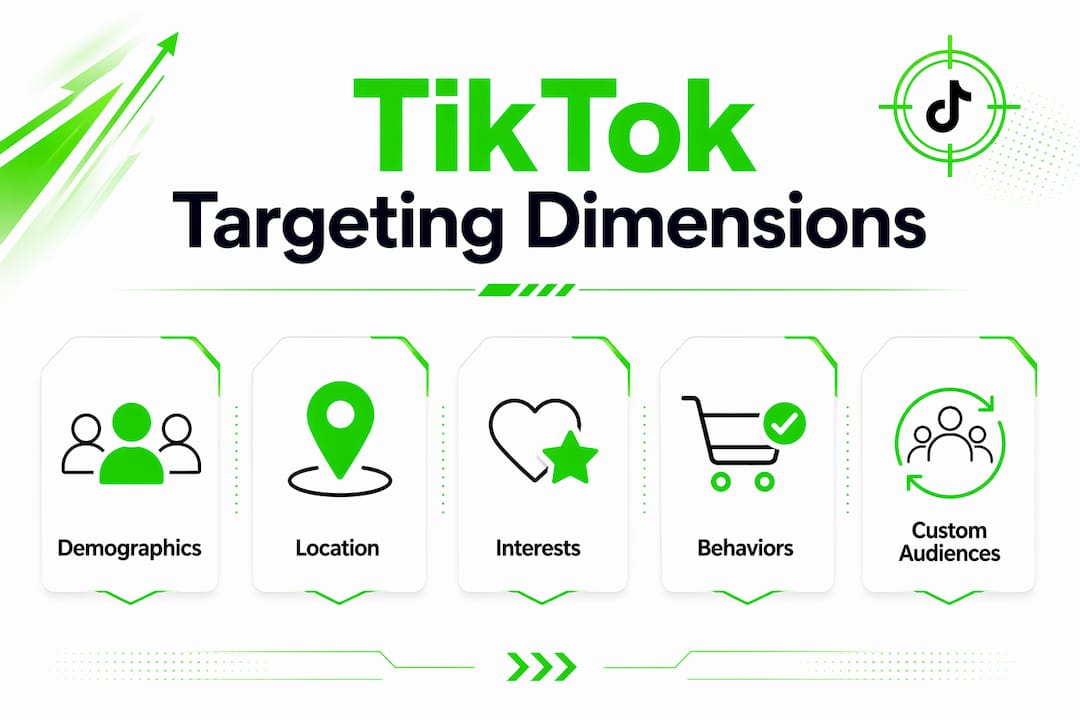
Lock vs. leave broad. Location and age are the two dimensions worth locking from day one — location because it defines your actual market, age because it affects compliance. Everything else, especially interests and behaviors, can stay wide during the learning phase. Smart Targeting automatically expands delivery when it detects delivery slowdowns, and Smart+ Campaigns bundle targeting, bidding, and creative optimization into a single automated layer — useful once a campaign already has performance data.
Pro Tip: Household income targeting in the U.S. is a proxy derived from third-party data, not verified income. Use it as a directional filter for premium products, but do not rely on it as a hard qualifier — layer it with interest and behavior signals for better accuracy.
How do custom audiences, lookalikes, and saved audiences work?
Building the right audience sources before launch is what separates a campaign that learns fast from one that spins its wheels.
-
Create your pixel and Events API first. No audience source works reliably without clean event data; for more on TikTok measurement and attribution strategies, see Usar datos TikTok para decisiones de ventas eficaces. Install the TikTok Pixel on your site and connect the Events API for server-side tracking. Relying on the pixel alone can miss a significant share of conversions in a post-ATT environment — server-side Events API reduces that undercounting meaningfully.
-
Build custom audiences from four sources. Customer file uploads (hashed email/phone), pixel events (website visitors, add-to-cart, purchasers), app events (installs, in-app actions), and engagement audiences (users who watched your TikTok videos, visited your profile, or interacted with your content). Custom audiences require a minimum of 1,000 matched users to activate.
-
Create lookalike audiences from high-intent seeds. Go to the Audiences section in Ads Manager, select a custom audience as your seed, and choose a similarity percentage (1% is tightest, 20% is broadest). Lookalikes need at least 10,000 seed users to perform reliably; 50,000 or more produces stable scale. Seed with purchasers or high-LTV customers, not all website visitors.
-
Save audiences for reuse. After configuring an audience combination at the ad group level, save it as a named audience template. This prevents configuration drift across campaigns and speeds up new ad group creation.
-
Refresh and maintain audiences regularly. Pixel-based audiences update dynamically, but customer file uploads go stale. Re-upload CRM lists monthly. Exclude purchasers from prospecting ad groups — failing to do so is one of the most common audience targeting mistakes that wastes budget on users who already converted.
-
Replace degraded seeds. If a lookalike's CPA climbs steadily over several weeks, the seed may have been contaminated by broad traffic. Rebuild it from a tighter, higher-intent segment.
For audience research and seed creation, the quality of your source data determines everything downstream.
How does TikTok interest targeting actually work?
TikTok infers interests from long-term engagement signals: what users watch to completion, follow, share, and interact with via hashtags. That is different from behavior targeting, which captures recent in-app actions like profile visits, video likes in the past 7–15 days, or purchase-intent signals. Interest = long-term affinity. Behavior = recent intent. Both matter, but they serve different jobs.
The practical distinction: Interest categories are best for top-of-funnel prospecting where you want reach among people likely to care about your category. Behavior targeting is better for mid-to-lower funnel, where recent actions signal that someone is actively in a buying mode. Stacking both in the same ad group is often redundant — test them separately first.
Interest categories in TikTok Ads Manager are organized hierarchically. A category like "Beauty & Personal Care" contains subcategories like "Skincare Routine" and "Makeup Tutorials." Broader parent categories give the algorithm more room; subcategories tighten reach but can starve delivery if the audience is too small.
A practical framework for picking interest categories:
- Top funnel: Use 2–3 broad parent categories. Give the algorithm room to find users.
- Mid funnel: Add 1–2 subcategories that match your product's use case.
- Lower funnel: Skip interest targeting entirely and use custom audiences or lookalikes instead.
- Niche products: Interest targeting can be powerful here because the relevant category is specific enough to be meaningful. Test a single tight interest category against a broad no-interest setup to see which delivers better CPAs.
- Stop stacking at 4–5 categories. Beyond that, you are not adding precision — you are just creating an OR condition that the algorithm treats as a large, undifferentiated pool anyway.
How does TikTok's targeting logic work, and how should you layer it?
TikTok applies OR logic within a dimension and AND logic across dimensions. Add three interest categories and TikTok shows your ad to users who match any of them. Add a location filter on top and TikTok shows your ad to users who match any of those interests and are in that location. Every dimension you add with AND logic shrinks your audience.

That math matters. A campaign targeting U.S. women aged 25–34 who follow skincare content and have visited a competitor's profile in the last 14 days sounds precise. In practice, that audience may be too small for a conversion campaign to exit the learning phase.
Common layering mistakes to avoid:
- Over-stacking interests. More categories feel like more precision but often just create a large, noisy pool. Start with fewer.
- Overlapping lookalikes. Running a 1% lookalike and a 10% lookalike in the same campaign without exclusions means they compete for the same users.
- Prospecting into tiny geos. A city-level geo plus interest plus behavior targeting can produce an audience too small to deliver at any meaningful scale.
- Copying Meta campaign structures. TikTok's algorithm needs creative signals to guide delivery — a tightly segmented, Meta-style audience tree chokes it.
The practical rule: limit new ad groups to one or two restrictive dimensions during the learning phase. Lock location and age, leave interests broad or off entirely, and let the algorithm do the rest. Add more constraints only after you have a steady and statistically reliable volume of conversions per ad group per week and clear performance data to guide the decision.
Location, age targeting, and U.S. compliance considerations
TikTok Ads Manager offers five levels of location granularity for U.S. campaigns: country, state/region, designated market area (DMA), city, and zip code or radius. National e-commerce campaigns typically run at the country level. Local businesses targeting a specific metro use DMA or city targeting. Zip-code targeting is available but narrows audiences quickly — combine it with broad interest settings to preserve delivery volume.
Household income targeting is available to U.S. advertisers as an additional demographic layer. It uses third-party data to estimate income tiers, so treat it as a directional signal rather than a verified qualifier.
Age targeting carries compliance weight. For ad content directed at users under 18, TikTok's advertising policies restrict certain product categories and require age-appropriate creative. Before targeting any audience that includes minors, review the current guidelines in the TikTok Business Help Center — policies update regularly and the platform enforces them at the account level.
A pre-launch compliance checklist for age and location:
- Confirm your target market is available in Ads Manager before building the campaign.
- Set the minimum age floor appropriate for your product category.
- Verify your landing page experience matches the age and language of your target audience.
- Check that creative assets meet TikTok's content policies for any age group you include.
How to configure targeting in TikTok Ads Manager step by step
-
Choose your campaign objective. In Ads Manager, create a new campaign and select the objective that matches your funnel stage: Reach or Video Views for awareness, Traffic or Community Interaction for consideration, Conversions or App Events for performance. The objective determines which bidding strategies and optimization events are available.
-
Create ad groups by funnel stage. One ad group per audience type keeps data clean and prevents audience overlap from muddying performance signals. Name each ad group with a consistent convention:
[Funnel Stage]_[Audience Type]_[Date](e.g.,TOF_Broad_Jan2026). -
Set location, age, and language. These are your hard constraints. Set them first before adding any other targeting layer.
-
Add interest, behavior, or custom audiences. For prospecting, start with broad interest categories or no interest targeting at all. For retargeting, select your pixel-based or engagement custom audiences. For lookalike prospecting, select your saved lookalike audience.
-
Set placements. Automatic placements let TikTok optimize across its owned properties. Manual placement selection (TikTok feed only) is useful when you want to control creative context.
-
Save your audience configuration. After setting all targeting parameters, save the audience as a named template for reuse.
-
Check audience size estimates. The Ads Manager UI shows an estimated audience size as you build. For conversion campaigns, aim for audiences above 500,000 — over-constraining below that threshold frequently causes delivery issues.
Troubleshooting: If an audience shows as "inactive," the custom audience has likely fallen below the minimum match threshold. Re-upload a fresh customer file or expand the pixel event window. Low delivery on a new ad group usually means either the budget is too low relative to your target CPA or the audience is too narrow — broaden first, then adjust budget.
How to measure targeting performance and structure your tests
Track performance by funnel stage, not just by final conversion.
| Funnel stage | Primary KPIs | Secondary KPIs |
|---|---|---|
| Top funnel | Hook rate (3-sec views / impressions), hold rate | CPM, reach |
| Mid funnel | CTR, landing page view rate | Cost per landing page view |
| Lower funnel | Add-to-cart rate, cost per purchase | Blended CAC, ROAS |
| Retargeting | Cost per conversion, return rate | Frequency, overlap rate |
Test creative vs. audience separately. Run an A/B test where one variable changes at a time: same creative, different audience, or same audience, different creative. TikTok's built-in split testing tool handles this at the campaign level. For incrementality, geo-holdout tests (running the campaign in some DMAs but not others) give more defensible data than last-click attribution alone.
Optimization thresholds: Run new ad groups for at least 7 days before making changes. Target 50+ conversion events per ad group per week to exit the learning phase and unlock stable algorithmic optimization. When scaling, increase budgets by no more than 30% per day and avoid editing live ad groups in the first 72 hours — both actions restart the learning phase.
On attribution: Last-click attribution systematically undercounts TikTok's contribution to conversions. Pair the TikTok Pixel with the Events API and consider a multi-touch attribution platform or geo-holdout tests for defensible incrementality measurement. For multi-channel campaigns, offline conversion tracking through NFC or print products can close the loop on in-store visits driven by TikTok ads.
The creative-first targeting framework that actually works
The biggest strategic mistake on TikTok is importing a Meta campaign structure and expecting it to perform. TikTok's algorithm reads creative signals to find the right users — the format, hook, and content of your ad does more targeting work than your interest categories do.
A full-funnel creative architecture looks like this:
- Top funnel: Native UGC-style hooks under three seconds, vertical format, captions, platform-approved audio. These feel organic and signal the algorithm toward users who engage with similar content.
- Mid funnel: Social proof narratives, transformation stories, before/after formats. Pair with engagement custom audiences (video viewers, profile visitors).
- Bottom funnel: Hard-offer creative with a clear CTA, price anchoring, or urgency. Tie to conversion events and retargeting audiences.
Operational workflow: source a creator roster, plan 4–6 creative variants per angle, and build a refresh cadence. Creative decay on TikTok is faster than on Meta — expect winning creatives to degrade after 3–6 weeks. A steady pipeline of variants is not optional; it is the operational requirement for sustained performance.
For native TikTok content production, having a managed creator process makes the difference between a campaign that scales and one that stalls on stale creative.
Spark Ads amplify existing organic posts and carry the original post's engagement signal into the paid distribution, which frequently lowers CPA compared to standard In-Feed Ads. Use In-Feed Ads for rapid creative testing (cheapest iteration cycle) and Spark Ads for scaling proven content.
Pro Tip: Launch new ad groups at a daily budget of at least 20x your target CPA. At a $30 target CPA, that means a $600 daily budget minimum per ad group. Underfunding the learning phase is the single most common reason campaigns stall before they ever generate useful data.
The most common targeting mistakes and a pre-launch checklist
Mistakes that kill campaigns before they start:
- Mirroring Meta structures with tight demographic and interest stacks — TikTok's algorithm needs creative signals, not audience sculpting.
- Audiences below 500,000 for conversion campaigns, which choke delivery.
- Daily budgets too low to generate 50+ conversions per week, trapping ad groups in permanent learning.
- Single-creative ad groups with no variants, which starve the algorithm of signal and burn out fast.
- Not excluding existing customers from prospecting ad groups, wasting spend on users who already converted.
- Editing live ad groups in the first 72 hours, which resets the learning phase.
Pre-launch checklist:
- Pixel firing confirmed on all key events (ViewContent, AddToCart, Purchase)
- Events API connected and deduplication enabled
- Prospecting and retargeting ad groups separated
- Purchasers excluded from prospecting audiences
- Lookalike seeds above 10,000 users, sourced from high-intent segments
- Naming convention applied to campaigns, ad groups, and audiences
- Minimum 4 creative variants per ad group
- Daily budget set at 20x target CPA or higher
- Audience size estimate above 500,000 for conversion objectives
- Age and location compliance verified against TikTok's advertising policies
Key Takeaways
TikTok ads targeting works best when broad creative-led audiences give the algorithm room to find converters, supported by clean pixel data, high-intent lookalike seeds, and strict prospecting/retargeting separation.
| Point | Details |
|---|---|
| Start broad, not narrow | Broad audiences outperform over-constrained ones; lock only location and age, leave interests wide. |
| Seed quality drives lookalike quality | Lookalikes need 10,000+ seed users from high-intent segments (purchasers, high-LTV) to perform reliably. |
| Budget for the learning phase | Launch ad groups at 20x target CPA daily and target 50+ conversions per week to exit learning. |
| Creative is your targeting signal | The format and hook of your ad guides algorithmic delivery more than interest categories do. |
| Crowdcompany handles the full stack | Crowdcompany manages audience research, creative production, Ads Manager operations, and retargeting for local and e-commerce clients. |
The part most TikTok guides get wrong
Most TikTok advertising guides spend 80% of their word count on interest categories and almost nothing on what actually drives results: the relationship between creative format and algorithmic signal. Marketers who obsess over finding the perfect interest stack are solving the wrong problem. TikTok's delivery system is fundamentally a content-matching engine. It looks at your creative, identifies what kind of content it resembles, and distributes it to users who engage with similar content. Your interest targeting is a guardrail, not a precision instrument.
The practical implication is uncomfortable for people who came from Meta or Google: you cannot engineer your way to a perfect audience on TikTok. You can only engineer better creative and give the algorithm enough budget and time to find the users who respond to it. Agencies that understand this stop spending hours building elaborate audience trees and start spending that time on creative variant planning and refresh cadence. That shift in operational focus is what separates campaigns that scale from campaigns that plateau at $200 a day.
There is also a measurement problem that most guides ignore. Last-click attribution makes TikTok look worse than it is, because TikTok drives a lot of assisted conversions that never get credited. If you are evaluating TikTok purely on last-click ROAS, you are almost certainly undervaluing it and under-investing. The fix is not complicated — connect the Events API, run a geo-holdout test for two weeks, and compare. The incrementality numbers usually tell a very different story than the dashboard does.
Crowdcompany runs TikTok campaigns so you can focus on your business
If you have read this far, you know TikTok ads targeting is not a set-it-and-forget-it system. It requires clean attribution infrastructure, a steady creative pipeline, audience hygiene, and someone watching the data closely enough to catch a degrading creative or a stalled learning phase before it burns budget.
Crowdcompany handles every layer of that for local businesses and e-commerce brands: audience research and targeting setup, UGC creator management, full Ads Manager operations, and retargeting and email sequences that activate warm audiences after the click. Campaigns are structured as monthly retainers or flat-fee project engagements, with no long-term lock-in beyond what the work requires. The agency is rated the number one marketing agency in Boca Raton and works with clients across local services, restaurants, and e-commerce.
Ready to stop guessing at audiences and start running campaigns that actually learn? Talk to Crowdcompany about your TikTok paid advertising setup.
Useful sources
- Ad Targeting Dimensions — TikTok Ads Manager Help Center: Official documentation for all supported targeting dimensions and ad-group level configuration.
- About Interest Targeting — TikTok Ads Manager Help Center: Official reference for how interest categories are built and applied.
- TikTok Ads in 2026: Strategy, Costs & Best Practices — Shopify: Practitioner overview of ad formats, targeting options, and creative best practices.
- How to Build a Full-Funnel TikTok Ad Strategy That Converts in 2026 — D2C Times: Source for budget/learning thresholds, creative-first architecture, Events API guidance, and scaling rules.
- TikTok Ads Best Practices: The Ultimate 2026 Playbook — TikAdTools: Broad targeting rationale, Spark Ads vs. In-Feed Ads comparison, and creative best practices.
- TikTok Ads Targeting: How to Reach Your Ideal Customer — ConversionStudio: Interest vs. behavior distinction, audience size guidance, and common targeting mistakes.
- TikTok Ad Targeting Options: Find Your Audience in 2026 — TikAdSuite: Smart Targeting and Smart+ Campaigns explanation.
- TikTok Ads Targeting: Audience Options & Best Practices 2026 — Benly.ai: Lookalike seed size requirements and custom audience activation rules.