
TikTok works for restaurants when you build it as a booking channel, not a vanity project. The fastest path to real reservations: post short dish-prep and behind-the-scenes videos with a direct booking link in your bio, then put a small ad budget behind the two or three organic clips that already prove themselves. Give it two to three months to establish a baseline before judging results.
TL;DR:
- Focus on short, native-feeling videos with strong hooks in the first two seconds, and promote only the organic clips that already perform well.
- Build a clear conversion path with a single bio link leading to a reservation page, and track clicks with UTM parameters to measure success precisely.
- Test staying power of TikTok trends by running limited-time menu items or reaction videos, then analyze customer engagement for real demand signals.
- Prioritize working with local micro-influencers and nano creators who offer authentic content and trackable results, rather than chasing high follower-count influencers.
- Develop a consistent posting schedule of two to five videos weekly, batch-shoot content, and manage sound licensing and customer consent to stay compliant and effective.
Table of Contents
- Setting Up TikTok for Restaurants the Right Way
- What Kind of Restaurant Content Actually Performs
- TikTok Food Trends Worth Testing in 2026
- Working With Micro and Nano Creators
- Turning Organic Wins Into a Paid Media Engine
- Which Metrics Actually Prove TikTok Is Working
- Building a TikTok Workflow You Can Actually Sustain
- Music Rights and Copyright Rules You Can't Ignore
- Real Restaurant Campaigns That Prove the Model
- What Restaurants Get Wrong About TikTok
- How Crowdcompany Builds Your TikTok Program
- Sources
Setting Up TikTok for Restaurants the Right Way
Skip the personal account. A TikTok Business account unlocks analytics you'll need to spot which videos actually move people toward a reservation, and it's free to switch in the app's settings menu.
Your bio is the entire conversion path, so treat it that way. One link, one landing page, no exceptions.
- Bio link: point to a single mobile-optimized page with your reservation button or ordering link front and center, not your homepage
- Bio copy: a short line that tells a scroller exactly what you serve and where ("Wood-fired pizza in the Arts District, walk-ins welcome")
- Contact info: phone number visible, especially if you take call-in orders
- Pinned video: your highest-performing or most conversion-friendly clip, pinned to the top of your profile grid
Set up UTM parameters on that bio link before you post anything, so you can trace clicks back to TikTok specifically instead of lumping them into generic "social" traffic. If you plan to run ads later, install the TikTok pixel on your booking page now. Retrofitting tracking after a video takes off means you've already lost the data on your best-performing traffic.
Test the booking flow on your own phone using mobile data, not office WiFi. If it takes more than three taps to reserve a table or place an order, you're losing people who were already convinced.
What Kind of Restaurant Content Actually Performs
TikTok's own guidance for food businesses points toward short, native-feeling videos over polished commercials, and the platform reports that 72% of users try new products or brands more often since joining TikTok. That appetite for discovery is exactly what a restaurant should be feeding.
A handful of formats show up again and again in what performs well for restaurants:
- Dish prep, sped up or real-time — the sizzle, the plating, the pull of melted cheese. This is the format that tends to convert best because it answers the viewer's unspoken question: what am I actually getting?
- Behind-the-scenes — the 5 AM prep, the walk-in cooler tour, the chef arguing with a vendor over tomatoes. Humanizes the place before someone ever walks in.
- Reaction content — a first-time customer's face on the first bite, filmed with permission. Social proof that reads as real because it is.
- Menu spotlights — one dish, one angle, one clear reason to order it this week.
- Surprise-volume content — a hundred wings coming out of the fryer at once, a wall of desserts. Visually loud, algorithm-friendly.
Short 15 to 30 second dish-prep videos with a strong opening hook perform consistently for restaurants that treat TikTok as a sales tool rather than a branding exercise. The first two seconds carry the weight. If the video opens on a static shot of your dining room, you've already lost the scroll.
Shoot everything vertical, in good kitchen lighting (window light or a $30 ring light beats overhead fluorescents), and caption every line of spoken dialogue since most viewers watch muted. Keep your phone's native camera app in 4K if storage allows; it gives you more room to crop tight without losing quality.
Pro Tip: Film three versions of your opening hook for every video: a question, a bold claim, and a visual shock. Post whichever tests best, then reuse that hook style on your next five uploads.
Two shoots you can knock out in a single afternoon shift:
- The "one dish, three angles" video: overhead plating shot, close-up of the key ingredient, and the first bite. Fifteen seconds, one song, one CTA in text overlay.
- The "what regulars order" video: your host or server naming three dishes locals actually request, filmed walking through the dining room. Doubles as a menu tour and a trust signal.
TikTok Food Trends Worth Testing in 2026
Not every trend deserves a menu change. The test is simple: does it have staying power in flavor or format, or is it a five-day sugar rush that dies the moment the sound fades? Trends expert Katie Ayoub notes that TikTok accelerates flavor and format adoption, which is exactly why watching the platform functions like a fast, low-cost focus group before you commit kitchen resources to anything.
For 2026, the trends with real staying power rather than a one-week spike include:
- Musubi variations beyond the classic Spam and rice version, opening room for protein swaps and regional riffs
- Banana flavor profiles, showing up in desserts and even savory glazes
- Tom Yum as a flavor system, not just a soup, applied to sauces, marinades, and even cocktails
- Corn innovations, from elote-inspired sides to corn-forward desserts
- Chili crisp variants, pushing beyond the original condiment into dressings and toppings
Run these as limited-time menu tests before a full rollout. A three-week special, a tasting flight of two or three versions, or a direct ask for customers to film their own reaction all give you low-risk data. Track orders of the test item against a control dish from the same price tier, and watch which version customers film unprompted. That's the real signal, not just the order count.
Working With Micro and Nano Creators
Skip the influencers with a million followers chasing a brand deal fee. For most local restaurants, micro-influencers deliver the strongest mix of authenticity and measurable local conversion, and the reason is simple: their audience is local, engaged, and trusts their taste more than a celebrity's.
Two tiers do the heavy lifting:
- Nano creators (1,000 to 10,000 followers): typically work for a complimentary meal plus tagged content, ideal for consistent low-cost coverage
- Micro creators (10,000 to 100,000 followers): usually expect a comped tasting plus a modest flat fee, often in the range of $100 to $300 per video depending on your market
Let the creator keep their own voice and editing style. A restaurant that hands over a rigid script usually gets a stiff, low-performing video, because TikTok viewers can smell a paid ad from the first frame. What you should insist on: a trackable link, a unique promo code, or a UTM-tagged bio link so you know exactly what that partnership produced.
Pro Tip: Ask every creator to say the name of your restaurant out loud in the first five seconds. TikTok's search function increasingly works like a local search engine, and spoken keywords get indexed alongside captions and hashtags.
Always disclose paid partnerships per FTC guidelines, whether that's a #ad tag or TikTok's built-in branded content toggle. It protects you and the creator, and disclosed content still performs fine when the food looks good.
Turning Organic Wins Into a Paid Media Engine
Starting with ad spend before you have organic proof is how restaurants burn budget on the wrong creative. The smarter sequence: build a baseline first, then pay to amplify what's already working.
Run two to three months of consistent organic posting before spending a dollar on ads. That baseline tells you which videos already resonate without a boost, which is exactly the data you want before you pay to widen the audience. Once you've got that baseline:
- Pull your top three to five performing videos by watch time and shares, not just views
- Boost them with $100 to $500 per month, using TikTok's Spark Ads format, which promotes existing organic posts rather than requiring new ad-specific creative
- Target a radius of 5 to 15 miles around your location, layered with food and dining interest categories
- Refresh creative roughly every three to four weeks to avoid ad fatigue, since the same face and same kitchen shot loses impact fast on repeat views
Modest local ad budgets in this range produce measurable booking lift for restaurants in both tourist-heavy and neighborhood markets. If a boosted post's cost per click climbs while impressions flatten, pause it and rotate in your next-best organic performer instead of pushing more budget into a fading creative. For deeper targeting mechanics, a dedicated targeting guide walks through audience layering in more detail than most restaurants need on day one.
Which Metrics Actually Prove TikTok Is Working
Views feel good and mean almost nothing on their own. The metrics that tell you whether TikTok is filling seats sit one layer deeper.
- Profile visits and link clicks: the first sign someone moved from watching to considering
- Booking completions and promo-code redemptions: the actual proof of revenue, tied to a specific video or campaign through UTM tags
- Video completion rate: a stronger predictor of algorithmic reach than raw view count
- Shares: TikTok's algorithm weights shares heavily, since they signal content worth spreading beyond your existing followers
Reporting on restaurant virality shows that a viral moment doesn't automatically become a booked table; without a conversion path already built, a spike in views can pass through a restaurant with barely a ripple in actual covers.
Assign every promotion its own reservation code or unique link so a spike in bookings has a paper trail back to the video that caused it. Expect modest, inconsistent numbers in the first two months while you're still building an audience, then a clearer pattern once you've got 15 to 20 videos and a boosted post or two in the data. Use whichever three or four videos post the highest completion rate as your template for the next batch, not your personal favorites.
Building a TikTok Workflow You Can Actually Sustain
Consistency beats brilliance on this platform. A starter cadence of two to three videos a week is enough to keep the algorithm interested, with a goal of scaling to three to five per week once you've got a repeatable process.
- Assign roles clearly: one on-camera face (chef or a front-of-house regular), one person filming and editing, one person handling comments and DMs
- Batch-shoot on your slowest prep day: film three to five videos in one 45 minute session rather than trying to create daily
- Build two or three edit templates in CapCut or TikTok's native editor, so every video isn't starting from a blank timeline
- Run a pre-publish checklist: does it have a hook in the first two seconds, a spoken or captioned CTA, and the bio link mentioned or shown on screen?
Small teams that skip the checklist step are the ones who post a great video and forget to mention where to book a table.
Music Rights and Copyright Rules You Can't Ignore
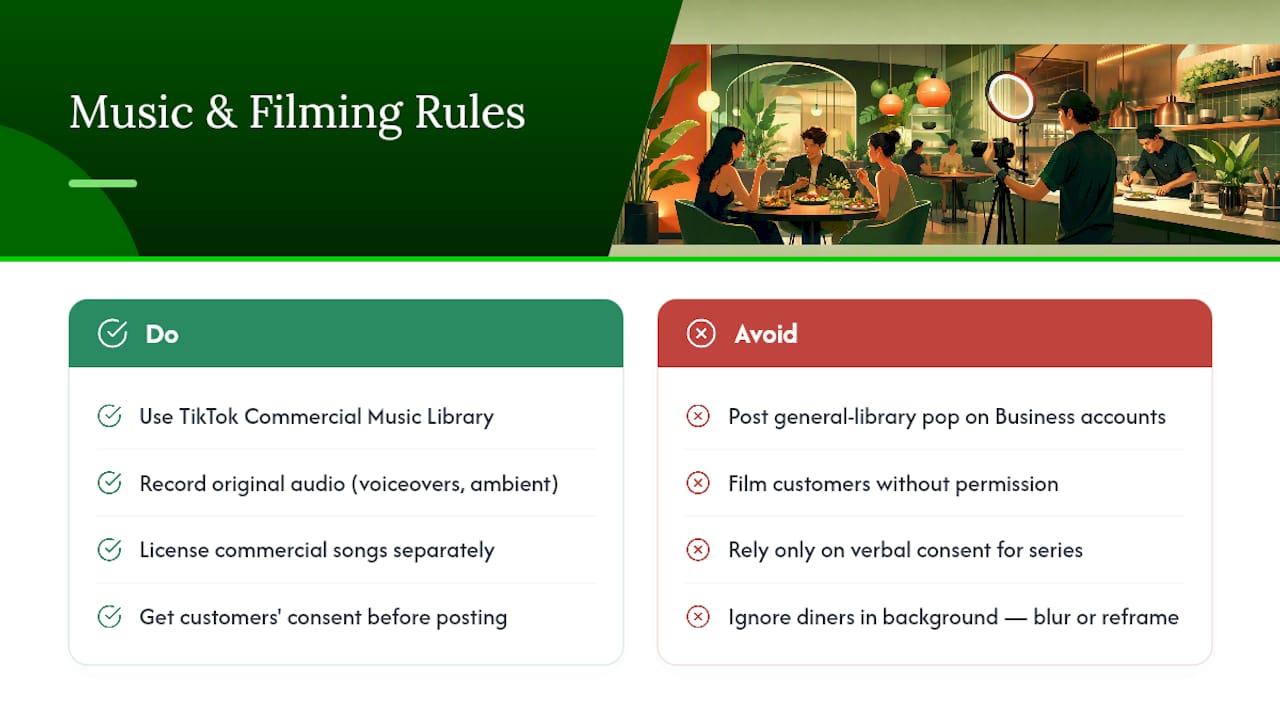
TikTok's in-app sound library is licensed for personal use on the platform, but that license changes once your account crosses into commercial use. TikTok Business accounts are restricted to TikTok's Commercial Music Library, a separate catalog cleared specifically for brands and businesses, rather than the full library available to personal accounts.
Posting a trending pop song from the general library on a Business account risks a takedown, a muted video, or in repeat cases a strike against your account. Since your bookings depend on that account staying live, it's not a risk worth taking for the sake of one trending audio clip.
A few practical rules to keep the account clean:
Original audio you record yourself, including voiceovers and ambient kitchen sound, is always safe. If you want to use a specific commercial song for atmosphere, license it separately or stick to the Commercial Music Library's options, which does include recognizable genres and moods even if it's smaller than the personal-use catalog.
Filming customers requires their consent before you post, especially for reaction content or table shots that clearly show someone's face. A verbal "mind if we post this?" and a follow-up comment tag is the minimum, and a simple release form is safer if you're running reaction content as a regular series. The same goes for filming other diners in the background. Blur faces or reframe the shot if you don't have permission.
Real Restaurant Campaigns That Prove the Model
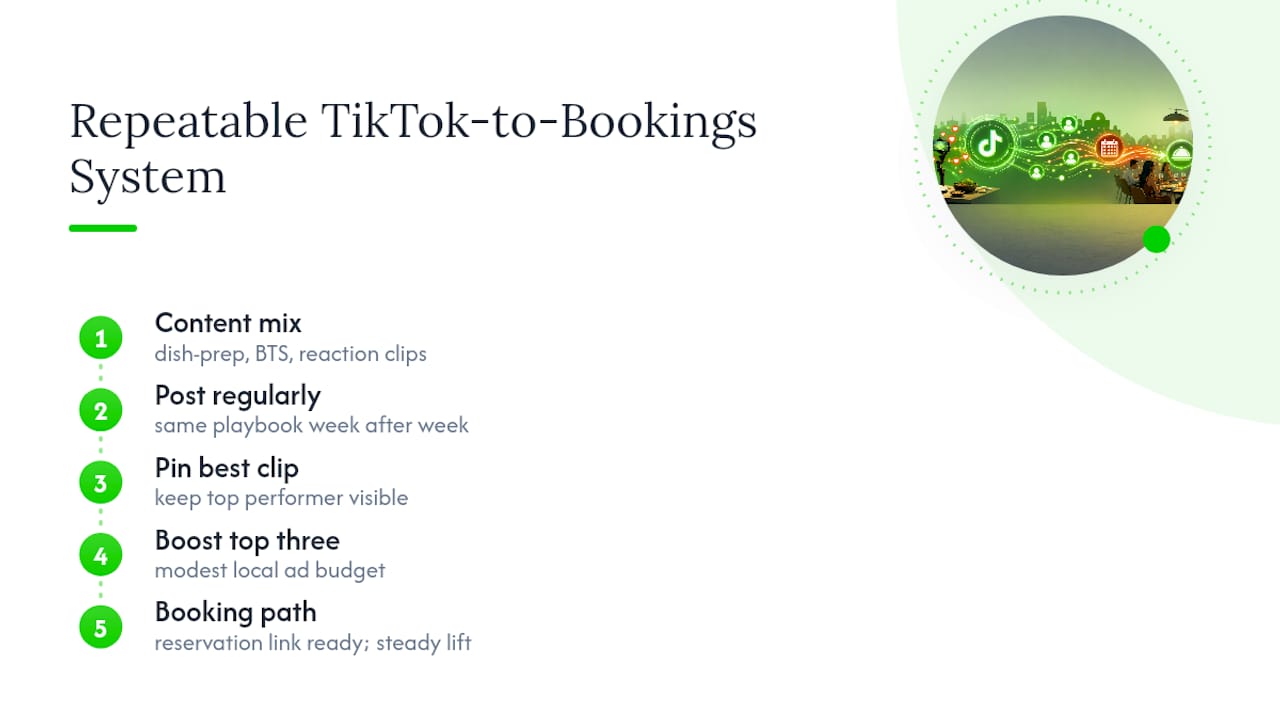
The restaurants seeing consistent traction on TikTok aren't the ones chasing a single viral hit. They're the ones running the same playbook week after week: a dish-prep video, a behind-the-scenes clip, a reaction video, repeat. Short, high-hook videos performed as a sales tool rather than a branding exercise are the pattern behind most of the sustained wins in the category, not one-off virality.
The common thread across restaurants that turn TikTok into real bookings looks less like luck and more like a repeatable system. A busy independent restaurant that posts a dish-prep video every few days, pins its best performer, and boosts its top three clips with a modest local budget will typically build a steadier booking lift over a few months than a restaurant waiting for one video to blow up. The lesson holds even for restaurants that do go viral: Bon Appétit's reporting notes that the restaurants who benefited most from a viral spike were the ones who already had a reservation link ready to catch the traffic, not the ones scrambling to build one after the fact. Virality is a bonus. A conversion path is the actual strategy.
What Restaurants Get Wrong About TikTok
Most restaurant owners treat TikTok like a lottery ticket: post and hope for a viral hit that fixes slow Tuesdays. For those considering exit strategies or valuations, resources like Sell Your Restaurant or Food Service Business With Captyx offer valuable guidance on long-term planning. That's backwards. The restaurants seeing steady booking lift are the ones running it like a channel with inputs and outputs, the same discipline they'd apply to a POS report or a labor schedule.
Crowdcompany is rated the #1 marketing agency in Boca Raton, and the pattern holds across every restaurant client we've worked with: social media management paired with local expansion tactics outperforms social media run in isolation. A great video with no local creator network and no boosted-post plan behind it is a wasted asset.
If you're starting from zero, the checklist is short: set up the Business account and bio link, build three to five video templates, line up two or three local nano or micro creators, and run a two to three month baseline before boosting anything. Our TikTok Spark Ads guide and targeting guide cover the mechanics once you're ready for that step.
— E
How Crowdcompany Builds Your TikTok Program
Running this playbook well takes a dedicated content shooter, a creator network, and someone watching the ad dashboard daily, which is exactly why most restaurant owners end up outsourcing it after month one. A dedicated agency can handle the whole loop: content scripting, filming and editing, influencer coordination with local micro and nano creators, and paid TikTok campaign management once your organic baseline is ready to boost.
A starter engagement typically begins with an audit of your current content and bio setup, a batch content shoot, and creator outreach in your local market, followed by a boosting plan built around your first proven videos. Restaurants working with Crowdcompany also get access to our broader digital PR and local expansion services, which pair TikTok growth with the kind of press and partnership visibility that compounds over time. If theme pages and audience-building fit your market better than a straight TikTok push, our theme pages and local expansion service covers that angle too. Ready to see what a managed program looks like for your restaurant? Schedule a consultation and we'll map out a starter plan built around your kitchen, your market, and your current TikTok footprint.
Sources
- Food and beverage advertising for small businesses
- TikTok for Restaurants: Boost Sales Without Going Viral | Intermenu
- TikTok virality and restaurant success