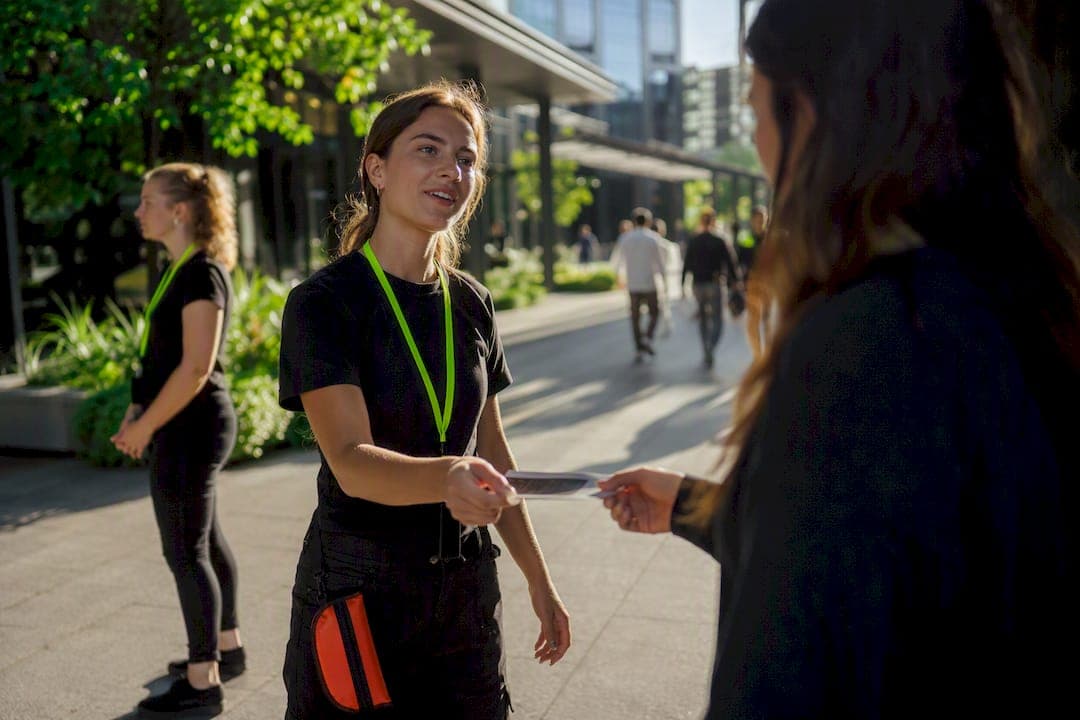
Street team marketing puts trained brand representatives in high-traffic public spaces to hand out samples, start conversations, and push people toward an immediate purchase or sign-up. It works best when you need fast, measurable consumer trial or foot traffic lift in a concentrated area, not broad awareness. Skip it if you can't staff, train, and measure it properly. Done right, it beats passive advertising on cost-per-interaction.
TL;DR:
- A street team is most effective for immediate product trials, event promotions, and local market entry, especially when clear, measurable actions like coupon redemptions are prioritized.
- Best results come from designing quick-call-to-action strategies such as QR codes or coupons, often stacking multiple tactics like perimeter intercepts and pop-ups to boost conversions.
- Proper staffing involves dedicated supervisors, comprehensive training, and contingency plans, with permits required in most cities to avoid legal issues.
- Campaign success relies on tracking operational metrics, conversion signals, and attribution methods, with larger projects aiming for thousands of interactions over weeks.
- Costs vary by city and scope but typically include staff wages, permits, samples, collateral, and depend on the campaign’s length, with pilots around four days and 800 interactions as an entry point in most cases.
Table of Contents
- What Is Street Team Marketing and When Should You Use It?
- 12 Street Marketing Ideas Worth Testing
- How Do You Staff and Run a Street Team?
- What KPIs Prove a Street Team Campaign Worked?
- What Does a Street Team Campaign Cost?
- Dos, Don'ts, and Common Mistakes
- How Crowd Runs Street Team and Field Marketing
- DIY Street Team or Hire an Agency: How to Decide
- How Crowd Can Help You Launch a Street Team Pilot
- Sources
- FAQ
What Is Street Team Marketing and When Should You Use It?
Street team marketing has its roots in the music industry, where labels sent grassroots crews to plaster flyers and hype up shows before a band had radio play. That model of unpaid, then paid, field marketing spread into consumer packaged goods, retail launches, and app marketing over the following decades, according to Street team on Wikipedia.
Field teams and street promotions create direct contact through sampling, collateral, and one-on-one conversation, which is why brands still lean on them for launches, event tie-ins, and market entries, per American Guerrilla Marketing's overview. Here's where the tactic earns its place:
- Product sampling: Get a new beverage or snack into hands at a farmers market or transit stop.
- Event perimeter promotion: Intercept concertgoers or sports fans before they enter the venue.
- Market entry: Introduce a brand to a new city with zero existing footprint.
- Retail lift: Drive walk-ins to a specific store location during a slow period.
- Social amplification: Generate user content and word-of-mouth that outlasts the activation day.
Against passive out-of-home ads or paid social, a street team wins on conversation and immediate conversion, especially when the goal is trial rather than impressions.
12 Street Marketing Ideas Worth Testing
Pick tactics based on your objective, not novelty. Here's a working menu, roughly ordered from lowest to highest complexity:
- Point-of-purchase sampling — station reps near checkout to hand out product with a coupon. Small team, low difficulty, strong for immediate trial.
- Event perimeter intercept — work the entry lines at concerts or games. Medium team, medium difficulty, high volume of interactions.
- Pop-up experience — build a branded mini-booth in a plaza or parking lot. Requires a permit and more setup time, but produces strong content.
- Transit hub deployment — hit train stations or bus stops during rush hour for volume.
- Campus takeover — target student unions and quads for youth and lifestyle brands.
- Mobile billboard plus team — pair a wrapped vehicle with reps for a roaming, visible push.
- Door-to-door neighborhood blitz — best for local services and home brands with a geographic radius.
- Gym or studio partnerships — seed samples at check-in desks for wellness and food brands.
- Restaurant or bar seeding — get bartenders and staff talking about your product directly to patrons.
- Flash performance — a short choreographed or musical moment that draws a crowd and phones.
- Mural or stencil activation — semi-permanent street art that keeps working after the crew leaves.
- AR or phygital activation — a physical prop tied to a scannable AR filter or game.
For each idea, the real execution tip is the same: design the call to action so it's the shortest possible path to purchase, whether that's a coupon good at the nearest register or a QR code tied to a discount page, according to American Guerrilla Marketing. Stacking two or three tactics, say, perimeter intercept plus a pop-up plus a flash moment, tends to outperform any single tactic run alone, per Street Teams Co's tactical breakdown.
How Do You Staff and Run a Street Team?
A reliable activation needs a role mix, not just warm bodies. Plan for one field supervisor per five to eight brand ambassadors, with the supervisor auditing roughly 10% of interactions for message accuracy, a ratio drawn from field marketing staffing guidance in EventStaff's activation guide.
Before anyone hits the street, run them through:
- A tight talk track, no more than 20 seconds to the ask.
- Objection handling for the three most common pushbacks.
- Product truth training, so nobody oversells or misstates a claim.
- Live role drills with a supervisor grading tone and pacing.
Shift design matters as much as talent. Break the day into two- to three-hour blocks tied to foot-traffic peaks, stagger arrival and exit points so the crew doesn't clump at one corner, and build in a replenishment run for samples and collateral before stock runs low.
Permits are non-negotiable in most cities for tabling, sound, or vehicle use in public space, and rules vary by jurisdiction. Call the local permits office at least two weeks out, confirm insurance requirements, and carry a printed copy of the permit on-site.
Pro Tip: Build a one-page contingency sheet before day one: backup location if you're denied a permit, rain plan, and a phone tree for no-show staff. The cost of writing it is ten minutes; the cost of not having it is a wasted deployment day.
What KPIs Prove a Street Team Campaign Worked?
Set the measurable objective before you set foot on the street, not after, using call tracking for small businesses to tie field activations to inbound calls. A well-designed activation names a specific target, such as generating 500 direct consumer trials in a deployment day, according to American Guerrilla Marketing.
Track three layers of data:
- Operational metrics: interactions per hour per rep, samples distributed, average time-to-engagement.
- Conversion signals: QR scans, coupon redemptions, short-link visits, email or SMS opt-ins.
- Attribution methods: compare a control zone with no activation against your activation zone, watch for correlated lift in nearby retail sales, and track redemptions inside a defined window after the deployment.
Larger launches typically run one to three weeks and aim for 1,000 to 2,000 total consumer interactions to generate statistically useful learnings, while even a short three- to five-day pilot can surface directional signal, per American Guerrilla Marketing's benchmarks.
Feed everything into your CRM rather than a spreadsheet that dies after the campaign. Field teams that log results centrally give sales and product teams usable qualitative insight, not just a headcount report, according to Salesloft's field marketing overview. Pairing that CRM data with offline conversion tracking closes the loop between a street handoff and an online sale.
What Does a Street Team Campaign Cost?
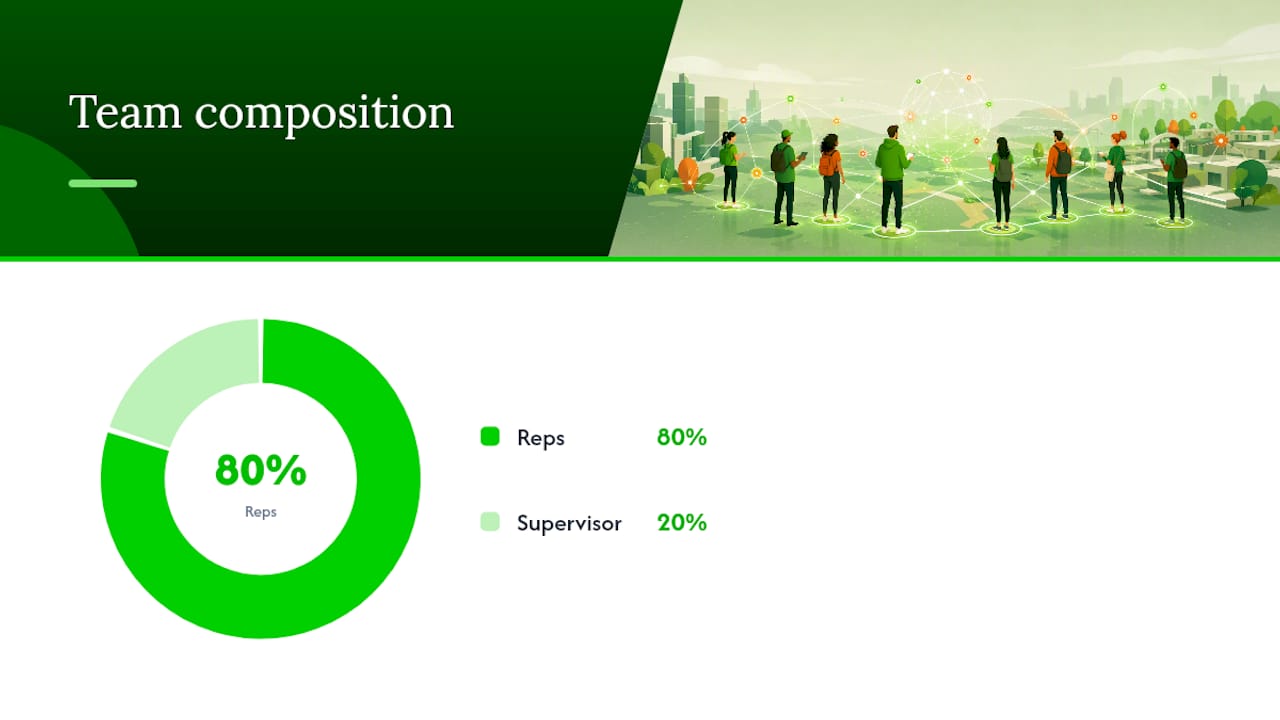
Costs swing on city, headcount, and duration, but a few drivers show up in almost every budget: rep day rates, supervisor overhead, permit fees, sample or product cost, and collateral printing. A single-market pilot with four to six reps and one supervisor over three to five days is a reasonable entry point for testing an idea before committing real budget.
A sample pilot structure:
- Team: 4 reps, 1 supervisor
- Duration: 4 days
- KPI goal: 800 interactions, 150 redemptions
Decide whether to scale using both hard numbers and softer signals. If cost per redemption beats your target and reps report consistent positive reactions in the field, expand to more days or markets. Run the ROI formula against the pilot's cost per acquisition before committing to a second, larger deployment.
Dos, Don'ts, and Common Mistakes
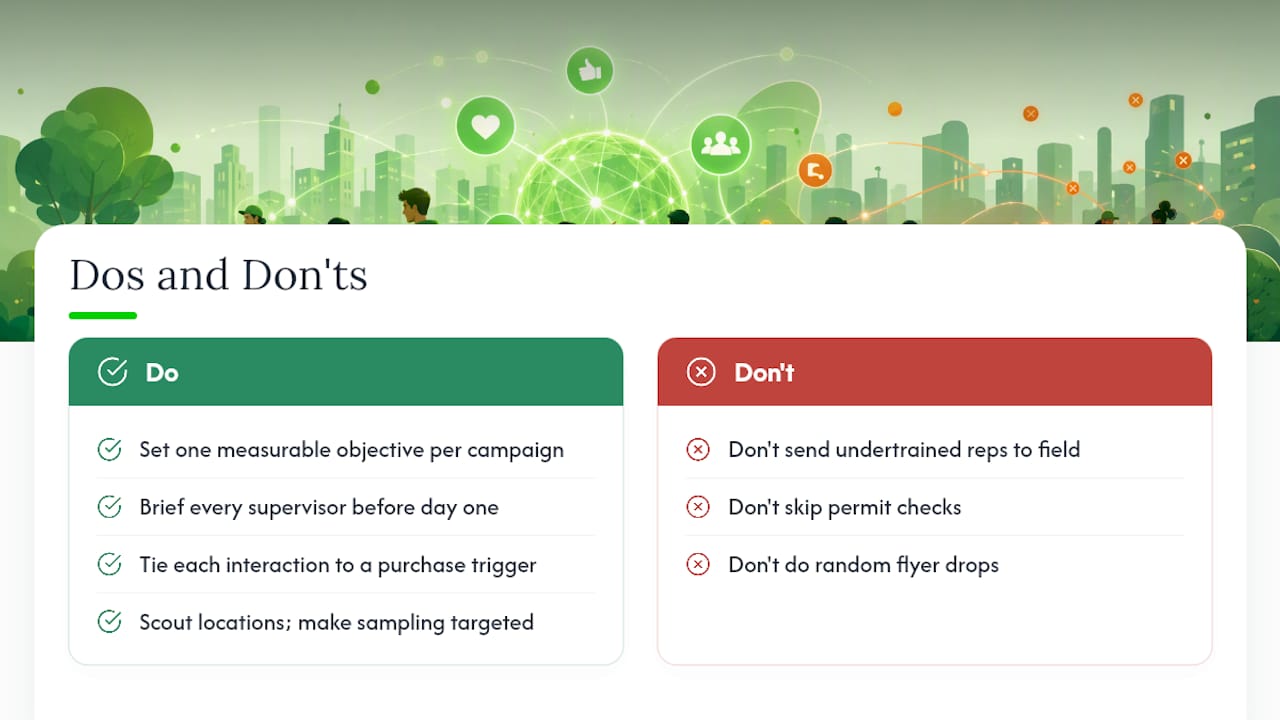
Set one specific, measurable objective per campaign and brief every supervisor on it before day one. Tie every rep interaction to an immediate purchase opportunity, a coupon, a discount code, a nearby retailer, rather than a vague brand impression.
Don't send undertrained reps into the field just to hit a headcount, and don't skip the permit check because "it's just a table." Treat sampling as a targeted, location-scouted activity, not a random flyer drop on whatever corner looks busy.
Quick fixes when things go sideways: if a permit gets denied last minute, move to private property with owner permission (a parking lot, a storefront apron). If a rep no-shows, pull your strongest performer to cover two shifts rather than leaving a gap.
How Crowd Runs Street Team and Field Marketing
Crowd applies the same measurement-first approach to music and event marketing, local expansion, staffing, and offline conversion tracking that connects a street handoff to a tracked sale. Pilots are often built around a specific KPI target rather than a generic activation, with results reported back into client systems for a clear read on cost per interaction.
DIY Street Team or Hire an Agency: How to Decide
Run it yourself if your budget is tight, your market is one location, and you can supervise directly. Hire a partner once you need multi-market coordination, tighter attribution, or reps trained faster than you can manage solo. Cost and control favor DIY; scale and measurement confidence favor an experienced partner.
— E
How Crowd Can Help You Launch a Street Team Pilot
You've got other paths here: build the crew yourself with a hiring post and a training doc, or bring in freelance brand ambassadors through a staffing marketplace. An advantage for small businesses or local brands is packaging permit navigation, rep training, and offline conversion tracking into one managed engagement instead of multiple separate vendors.
Crowd pairs street-level activation with Digital PR and local expansion so a single deployment day generates coverage and search visibility on top of foot traffic, rather than disappearing once the crew packs up. For businesses considering a pilot in Boca Raton, Delray Beach, or nearby South Florida markets, it is recommended to request a pilot plan that scopes team size, duration, and KPI target before committing budget. The next step is to reach out for an activation quote and receive a written pilot proposal back within days.
Sources
These practitioner guides shaped this playbook's tactics, staffing ratios, and pilot windows: American Guerrilla Marketing on measurement and CTA design, EventStaff on hiring and supervision, and Street Teams Co on tactic stacking.
- Street Team Promotions: How Ground-Level Marketing Works in 2026 | American Guerrilla Marketing
- How to Hire, Plan, and Measure a Street Team Marketing Activation
- 15 Street Team Promotion Ideas That Drive Real Conversions (2026) | Street Teams Co
- Street team — Wikipedia
- Field marketing overview | Salesloft
FAQ
Are Street Team Members Paid?
Most brands pay street team reps an hourly or day rate, though some grassroots and fan-driven campaigns still rely on volunteers the way early music street teams did, per Wikipedia's history of the format.
What Is Street Marketing?
Street marketing is any promotional tactic that puts a brand directly in front of consumers in public spaces, through sampling, flyers, pop-ups, or performance, rather than through paid media.
What Does a Street Team Member Do?
A street team member engages passersby in short conversations, distributes samples or coupons, answers basic product questions, and drives people toward an immediate action like a scan or redemption.
What Does a Field Marketing Team Do Day to Day?
A field marketing team plans locations and permits, trains and supervises reps, tracks interaction and conversion data, and logs results into CRM so sales and product teams get usable feedback from the ground, according to Salesloft.