For most small and mid-size businesses, a points program layered with tiers and rewarded non-purchase actions produces the fastest measurable results and the highest participation. The rest comes down to sequencing: pick two or three mechanics that fit your margins and buying frequency, then roll them out over 90 days instead of launching everything at once, following best practices from retention marketing strategies. Below is a working shortlist, a framework for choosing among it, and a launch calendar you can hand to your team Monday morning.
TL;DR:
- Loyalty programs that combine points for purchase with engagement incentives significantly boost participation and can yield measurable results within 30 days.
- Launching the program gradually over 90 days, starting with core mechanics and layering in tiers and referrals later, improves data quality and customer experience.
- Tracking key KPIs such as participation, active earning, redemption, and purchase lift is essential to evaluate whether the program effectively drives repeat business.
- Small businesses must ensure POS and CRM integration, clear program ownership, and policies on point expiry before launching to avoid operational issues.
- Simplified enrollment options like wallet QR codes and straightforward reward mechanics tend to outperform app downloads or complex onboarding, especially in the early stages.
Table of Contents
- 14 Loyalty Program Ideas Worth Testing
- How to Choose the Right Loyalty Model for Your Business
- Your 90-Day Loyalty Program Launch Checklist
- Reducing Friction: Enrollment and Redemption Options
- KPIs That Actually Tell You the Program Is Working
- Three Mini-Cases That Show the Mechanics in Action
- What Crowdcompany Sees Fixing Loyalty Programs in the Field
- Why Most Loyalty Advice Undersells Execution
- Get Your Loyalty Program Built and Running Without the Guesswork
- Sources
14 Loyalty Program Ideas Worth Testing
Not every idea below fits every business, so each one lists who it's built for and how to get it live without a six-month IT project.
- Points for purchase. The baseline mechanic. Best for retail and restaurants with frequent repeat visits. Setup tip: start with a simple $1 = 1 point ratio so customers can do the math in their head.
- Points for engagement. Reward reviews, social shares, and profile completion, not just checkout. Best for brands with a visual product or service worth showing off. This alone can raise participation 2 to 4 times over purchase-only programs. Setup tip: cap engagement points below purchase points so spending still matters most.
- Tiered VIP status. Silver/gold/platinum with escalating perks. Best for apparel, beauty, and travel brands with strong AOV variance. Setup tip: name tiers after your brand, not generic labels.
- Paid membership. A flat annual or monthly fee for guaranteed perks like free shipping. Best for high-frequency categories where the membership value clearly exceeds the fee. Setup tip: run the math on your average order value before pricing the membership.
- Two-sided referrals. Give and get a reward when a friend signs up. Best for subscription and service businesses. Setup tip: cap referral rewards per customer to control fraud.
- Pay-with-points checkout. Let members redeem partial balances at checkout instead of only full rewards. Best for e-commerce with a POS or cart integration budget. Setup tip: pilot on your top 20% of SKUs first.
- Birthday and anniversary rewards. Automated, low-effort, high goodwill. Best for every retail and restaurant model. Setup tip: send it three days before the date, not on it, so it doesn't get lost in inbox clutter.
- Surprise-and-delight rewards. Unannounced bonuses for high-value or lapsed customers. Best for brands wanting an emotional edge over discount-only competitors. Setup tip: budget a small monthly pool and let staff trigger it manually.
- Members-only drops or early access. Best for apparel and limited-inventory brands. Setup tip: cap drop quantities publicly so scarcity feels real, not manufactured.
- Charity donation options. Let points convert to a cause instead of a reward. Best for values-driven brands with younger customer bases. Setup tip: rotate causes quarterly to keep it fresh.
- Gamified streaks and challenges. "Visit 5 times in a month" style mechanics. Best for coffee shops, gyms, and consumable-goods brands. Setup tip: keep streak windows short (weekly, not monthly) so momentum doesn't die.
- Partner perks. Cross-promote with a complementary local business. Best for service businesses without margin for deep discounts. Setup tip: pick one partner with an overlapping but non-competing audience.
- Digital wallet cards. No app download required. Best for any business worried about enrollment friction. Setup tip: print the QR enrollment code directly on receipts.
- Subscription and autoship incentives. Bonus points or discounts for recurring orders. Best for consumables and beauty brands. Setup tip: front-load the first autoship bonus to break the habit barrier.
How to Choose the Right Loyalty Model for Your Business
Four numbers decide which mechanics belong in your program: average order value, purchase frequency, margin headroom, and how much your brand runs on community versus convenience.
- High AOV, low frequency (furniture, travel): tiers plus experiential rewards beat point-chasing, since customers won't earn enough points fast enough to stay engaged.
- Low AOV, high frequency (coffee, quick-service food): streaks and punch-card style points work because the reward horizon is short.
- Thin margins: lean on non-purchase points, referrals, and partner perks instead of deep discounts.
- Healthy margins: paid membership and pay-with-points checkout become viable.
- Community-driven brand: charity options and members-only drops outperform generic cashback.
Before building anything, ask finance six questions: What's our current gross margin per category? What percentage of revenue comes from repeat customers today? What's our average customer lifespan in months? Can our POS or CRM support points tracking without custom development? What's our tolerance for point liability on the balance sheet? Who owns customer communications once the program launches?
Three red flags mean stop and fix before launch: no clear owner for the program, no POS/CRM integration path, and no written policy on point expiry.
Pro Tip: Survey a sample of your actual customers before picking a model. Some prefer flat discounts over points, and building the wrong mechanic for your audience is the most common early mistake in loyalty design.
Your 90-Day Loyalty Program Launch Checklist
Rushing every mechanic into one launch is the fastest way to confuse both your team and your customers. A staged rollout gives you clean data at each checkpoint.
- Days 1 to 30: Launch core mechanics only. Points for purchase, a birthday reward, and retroactive points for recent purchases to seed early goodwill. Target: a substantial share of active customers earning points at least once.
- Days 31 to 60: Layer in tiers and referral mechanics. Target: measurable referral activation and visible tier progression among enrolled members.
- Days 61 to 90: Run engagement campaigns. Bonus point weekends, surprise rewards for lapsed customers. Target: rising redemption rate and an early customer lifetime value signal.
Before day one, work through this operational checklist:
- Confirm POS and CRM integration for point tracking
- Finalize the rewards catalog and point values
- Draft terms and conditions, including expiry rules
- Set up accounting treatment for points liability
- Build the customer communication calendar for launch week
This sequencing mirrors what several loyalty vendors recommend: start small, measure, then add complexity.
Reducing Friction: Enrollment and Redemption Options
The mechanic matters less than whether customers actually sign up. Three enrollment paths dominate right now:
- Native app: powerful for redemption and push notifications, but adoption is often low for small businesses without an existing app habit among their customers.
- Digital wallet cards: install via QR code into Apple Wallet or Google Wallet, no download required.
- Email or phone enrollment: fastest to set up, ties directly to POS receipts.
App fatigue is a real barrier for small businesses, and wallet cards installed via QR code tend to outperform app downloads) on sign-up rate. Pay-with-points at checkout delivers strong perceived value but demands deeper POS integration, so treat it as a phase-two feature once core enrollment is working.
KPIs That Actually Tell You the Program Is Working
Track five numbers, not fifteen. Participation rate, active earning rate, redemption rate, average order value lift, and repeat purchase rate cover the full funnel from signup to habit.
- Participation rate: percentage of customers enrolled within 30 days of launch
- Active rate: percentage of enrolled members who actually earn or redeem
- Redemption rate: percentage of earned points actually claimed
- AOV lift: spend difference between members and non-members
- CLV signal: early trend in repeat purchase frequency among members
A 2025 Bond report found 79% of respondents say they're more likely to recommend brands with good loyalty programs, and many say a good program keeps them shopping with that brand. Those numbers make a strong case for the investment, but watch for measurement traps: returns that don't reverse earned points, unclear expiry rules, and reward fraud from bulk-referral abuse. Modeling point liability from day one avoids a nasty accounting surprise six months in.
Three Mini-Cases That Show the Mechanics in Action
A consumables brand built a weekly purchase streak paired with pay-with-points checkout. The takeaway: frequency-based mechanics only work when the reward window matches how often customers naturally buy.
An apparel brand used tiers plus members-only drops with capped inventory per tier. The takeaway: exclusivity mechanics need real scarcity, meaning inventory has to be reserved and tracked, not just marketed as limited.
A local service business paired a two-sided referral program with wallet-card enrollment instead of an app. The takeaway: cutting signup friction and rewarding referrals together drove more new customers than either mechanic alone.

What Crowdcompany Sees Fixing Loyalty Programs in the Field
Most loyalty programs don't fail because the idea was bad. They fail because of execution gaps nobody budgeted for.
- Tracking gaps: points earned in-store don't reconcile with online purchases, so customers lose trust fast.
- Messaging cadence: either total silence after signup or so many emails members opt out entirely.
- Experiential reward fulfillment: promising early access or events without a real operational plan to deliver them.
- Partner coordination: cross-promotions that fall apart because neither business owns the customer communication.
Layering in a direct-mail component alongside digital touchpoints often closes the tracking and communication gaps at once, since it gives you a physical, trackable enrollment channel that doesn't depend on email opens.
Why Most Loyalty Advice Undersells Execution
The idea list isn't the hard part. Any business can copy 14 mechanics off a page. What separates a program that lifts repeat revenue from one that quietly dies after month three is whether someone owns the operational grind: reconciling points across channels, writing clear expiry terms, and actually delivering on experiential rewards once customers redeem them.
Conventional loyalty advice leans hard on the reward menu and barely touches the plumbing. That's backwards. A five-tier VIP program with a beautiful rewards catalog means nothing if your POS can't track redemptions accurately or if nobody replies when a member asks why their points disappeared.
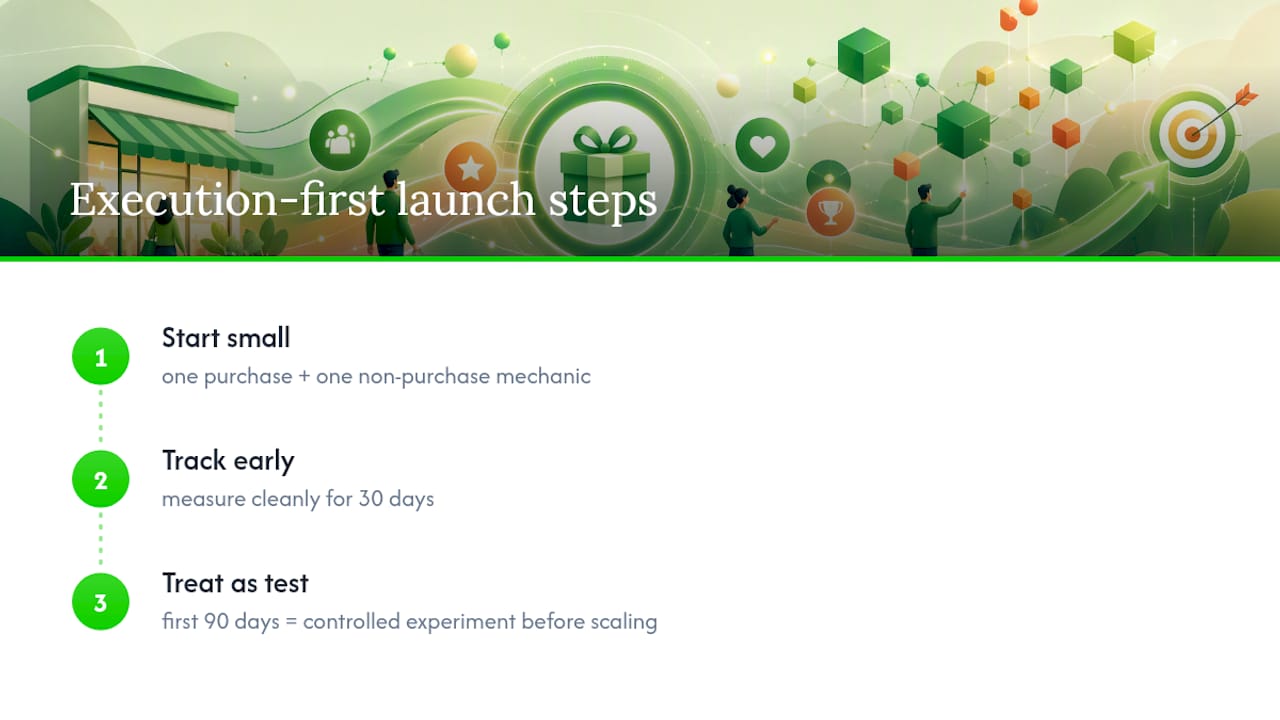
Start smaller than you want to. One purchase-points mechanic and one non-purchase mechanic, tracked cleanly for 30 days, beats five mechanics launched simultaneously with no measurement plan behind them. The businesses that get loyalty right treat the first 90 days as a controlled test, not a finished product. Everything else, tiers, referrals, gamification, only earns its place once the foundation holds up under real customer behavior.
— E
Get Your Loyalty Program Built and Running Without the Guesswork
Crowdcompany builds the operational side most businesses skip: direct mail and loyalty integration, CRM setup that actually reconciles points across channels, and campaign execution that keeps members engaged past week one instead of going quiet after signup.
If you've got the mechanics picked out but need someone to handle the POS integration, the reward fulfillment, and the launch communications, that's exactly where Crowdcompany's direct mail and loyalty services come in, paired with retargeting and email support to keep members active after signup. For businesses in South Florida, book a look at Crowdcompany's digital PR and local campaign services to see how a loyalty launch fits into your broader growth plan.
Sources
- 12 Loyalty Program Ideas That Work for Shopify in 2026
- How to start a small business loyalty program (Shopify)
- Most successful loyalty programs (Yotpo)