
A review generation strategy is a repeatable, ethical system that converts satisfied customers into verified online reviews across platforms like Google Business Profile, Yelp, and Facebook. Here is the one-line plan: verify the purchase, ask at the right moment, deliver a frictionless link or QR code, automate the follow-up sequence, and respond to every review within 48 hours.
Start here:
- Confirm the customer completed their purchase or service before asking
- Time the request to peak satisfaction (delivery confirmation, service completion, product milestone)
- Send a direct Google Business Profile link or QR code
- Automate follow-up with email or SMS (one reminder maximum)
- Respond to all reviews, negative ones first
- Stay compliant with FTC guidelines and platform policies at every step
Crowdcompany builds and manages these programs for local businesses, restaurants, and e-commerce brands that want results without the guesswork of running it themselves.
Key Takeaways
A repeatable review generation strategy built on verified-purchase signals, compliant ask sequences, and active response workflows consistently outperforms any one-time review campaign.
| Point | Details |
|---|---|
| Timing drives completion | Ask within 24 hours of delivery or service completion; satisfaction peaks fast and fades faster. |
| Compliance is non-negotiable | FTC rules require incentive disclosure and prohibit conditioning rewards on positive reviews. |
| Velocity matters as much as volume | Steady 8–10 reviews per month outperforms a burst of 50 followed by silence for Google's algorithm. |
| Triage by star rating | Respond to 1–2 star reviews within 24 hours using the L.A.S.T. framework; automate thanks for 4–5 stars. |
| Crowdcompany manages the full program | From platform setup and automation to daily response triage and monthly reporting, starting at $500/month. |
Table of Contents
- What does a review generation strategy actually include?
- Why do reviews move the needle on revenue and search?
- What channels, timing, and verification should your program use?
- What are the ethics and legal rules you cannot ignore?
- Which tools should you evaluate for automation and management?
- What do effective ask templates and sequences look like?
- How do you measure whether your program is working?
- How should you triage, respond, and escalate incoming reviews?
- Where else can you put reviews to work?
- What mistakes do most review programs make?
- How Crowdcompany runs review-generation campaigns
- The honest truth about review programs most agencies won't say
- Crowdcompany's managed review program: what it covers and how to start
- Sources
What does a review generation strategy actually include?
Think of it as a program with seven interlocking components. Each one feeds the next, and skipping any of them creates a gap that shows up in your metrics.
The seven core components:
- Audience segmentation: Not every customer is worth asking at the same time. Segment by purchase value, recency, and satisfaction signals (NPS score, support ticket history) to prioritize who gets a request first.
- Verified-purchase signals: Reviews tied to a confirmed transaction carry more weight with platforms and readers. Verified-purchase badges reduce fraud and increase click-through on review-bearing pages.
- Ask moments: The trigger that fires the request. Mapped to the customer journey, not a calendar.
- Channels: Email, SMS, in-app prompts, receipts, QR codes, and platform-specific widgets. Each channel has a different open rate and friction level.
- Automation: The engine that sends requests, tracks responses, and queues follow-ups without manual effort.
- Response workflow: Who replies, what they say, and how fast. This is where most programs break down.
- Analytics: Volume, average rating, velocity, sentiment, and conversion lift. Without measurement, you cannot improve.
How these connect in sequence: a customer completes a purchase (trigger) → segmentation logic qualifies them → the automation sends a channel-appropriate ask → the customer leaves a review → the response workflow fires → analytics capture the outcome → segmentation logic updates based on the result. That loop, running continuously, is the program.
Why do reviews move the needle on revenue and search?
Social proof is not a soft benefit. Research from the Spiegel Research Center at Northwestern University shows that displaying reviews can lift conversion rates significantly, with the effect strongest for higher-priced products where purchase risk feels higher. Five reviews on a product page outperform zero reviews by a wide margin, and the lift compounds as volume grows.
On the local search side, Google's ranking algorithm for the local pack factors in review quantity, recency, and response rate. A business with 200 recent reviews and active owner responses consistently outranks a competitor with 40 stale ones, even when the competitor has a marginally higher average rating. Recency matters more than most owners realize.
The business case in three points:
- Reviews reduce purchase hesitation, particularly for first-time buyers who have no prior relationship with the brand
- Google Business Profile listings with regular new reviews rank higher in local and map results, driving organic foot traffic and calls
- Review content feeds search engines with keyword-rich, user-generated text that no paid ad can replicate
Stat to know: The Spiegel Research Center found that the purchase likelihood for a product with five reviews is 270% greater than for a product with no reviews.
What channels, timing, and verification should your program use?
The channel mix and ask timing are where most programs either win or waste their budget. Here is how to build both correctly.
Channels by business type:
- E-commerce: Post-purchase email triggered by delivery confirmation; SMS for high-AOV orders; in-app prompts for repeat buyers; QR codes on packing inserts
- Local service businesses (restaurants, salons, contractors): In-person ask at service completion; follow-up SMS within two hours; printed QR code on receipt or table card
- SaaS and B2B: In-app prompt at a product milestone (first successful export, 30-day active use); email from the account manager; G2 review portal requests timed to renewal conversations
Ask moments mapped to satisfaction peaks:
The right moment is when the customer has just experienced value. For e-commerce, that is within 24 hours of confirmed delivery. For a restaurant, it is while the customer is still at the table or within two hours of leaving. For SaaS, Gartner recommends timing requests to product milestones rather than arbitrary calendar intervals, because milestone moments correlate with genuine satisfaction.
Verification and anti-fraud:
Never ask for a review before confirming the purchase. Verified-purchase badges, available through platforms like Shopify's native review tools and third-party apps, signal authenticity to both readers and search engines. Shopify's guidance recommends prioritizing verified reviews in display and automation logic.
Sequencing and pacing:
| Step | Timing | Channel | Action |
| --- | --- | --- | --- | | Initial request | Day 1 post-trigger | Email or SMS | Send review link with context | | Single follow-up | Day 4–7 | Email | Gentle reminder, different subject line | | Close loop | Day 10 | Internal | Mark as non-responder, suppress future asks |
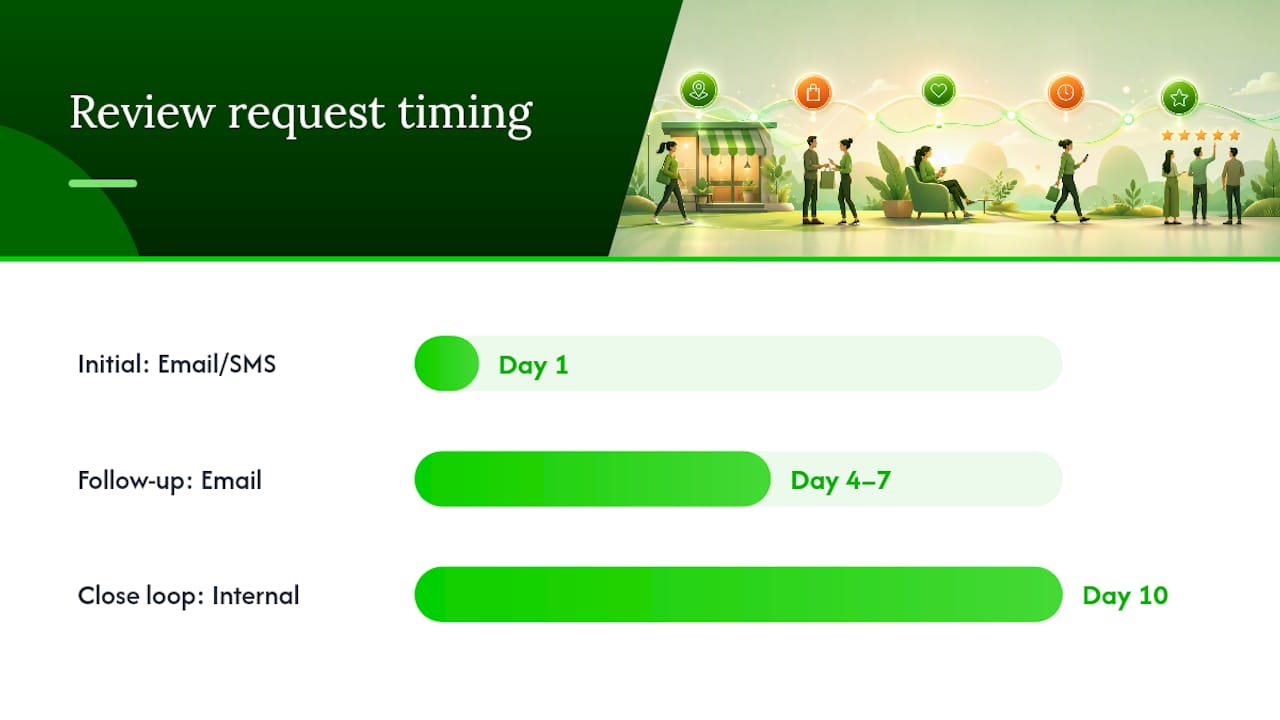
Never send more than two contacts per review request cycle. Velocity spikes, where dozens of reviews arrive in a short window, trigger platform suppression filters on Google and Yelp.
Pro Tip: Add a UTM parameter to every review link you send. You will know exactly which channel, which email, and which timing window drives the most completions, and you can cut what does not work within 30 days.
What are the ethics and legal rules you cannot ignore?
Compliance is not optional, and the rules are clearer than most marketers assume.
The FTC's plain-language guidance on soliciting and paying for reviews is direct:
That means a $5 coupon for any honest review is legal with disclosure. A $5 coupon for a 5-star review is not. Review gating, the practice of routing unhappy customers to private feedback and only sending happy ones to public review platforms, violates both FTC principles and Google's review policies.
Platform policy highlights:
- Google: Prohibits fake reviews, incentivized reviews that are not disclosed, and review gating. Violations can result in review removal or listing suspension.
- Yelp: Has one of the strictest policies. Yelp actively discourages businesses from asking customers for reviews at all, and its algorithm flags solicited reviews for removal. Focus Yelp efforts on organic mentions and responding to existing reviews.
- Facebook: Allows businesses to ask for recommendations but prohibits fake or incentivized reviews without disclosure.
Practical dos and don'ts:
- Do: Ask all customers, not just the ones you think are happy
- Do: Disclose any incentive in the request itself, not buried in fine print
- Do: Pace requests to avoid velocity spikes
- Don't: Gate reviews by satisfaction score
- Don't: Offer incentives conditioned on star rating or positive language
- Don't: Post reviews on behalf of customers or use third-party services that do
Which tools should you evaluate for automation and management?
The right tool depends on your channel mix, platform, and whether you need verified-purchase enforcement. Here is how the major options break down.
E-commerce and Shopify-native tools:
- Shop Product Reviews (Shopify): Built into Shopify, free, handles basic post-purchase email requests and displays reviews on product pages. No SMS, limited analytics.
- Junip: Strong on photo and video UGC, integrates with Klaviyo and Shopify, supports verified-purchase enforcement, and offers a clean merchant dashboard.
- Judge.me: High-volume merchants favor it for its unlimited review requests on paid plans, multi-language support, and Google Shopping integration.
- Okendo: Built for mid-market and enterprise Shopify brands. Deep segmentation, attributes (size, fit, age), and strong analytics. Integrates with Klaviyo, Gorgias, and Attentive.
- Loox: Photo-first. Automatically requests photo reviews and displays them in shoppable galleries. Works well for visually driven product categories.
- Yotpo: The broadest feature set: reviews, SMS, loyalty, and UGC in one platform. Pricing scales with volume, making it better suited to brands with significant review velocity.
Email and CRM-integrated tools:
- Klaviyo Reviews: Natively integrated with Klaviyo's email and SMS flows. If you already run Klaviyo for email marketing, adding reviews keeps everything in one platform and lets you trigger review requests off any Klaviyo event.
B2B and multi-platform:
- G2 vendor portal: For SaaS and B2B software companies, G2's review collection tools include milestone-triggered requests, verified-purchase enforcement, and campaign management.
Running a vendor trial: Pick two tools, run identical ask sequences for 30 days, and measure completion rate, photo submission rate, and support response time. Those three data points tell you more than any feature comparison.
What do effective ask templates and sequences look like?
Scripts matter less than timing, but a poorly written request kills an otherwise well-timed ask. Here are templates you can drop into your automation tool today.
Email subject line variations:
- "How did we do, [First Name]?"
- "Your order arrived — quick question"
- "Got a minute? We'd love your feedback"
- "[First Name], your honest opinion matters to us"
Email body template (e-commerce, post-delivery):
Hi [First Name],
Your [product name] arrived — we hope you love it. If you have 60 seconds, leaving a review helps other shoppers make confident decisions and helps us keep improving.
[Leave a Review → direct link]
Honest feedback is always welcome. If something was not right, reply to this email and we will make it right.
Thanks, [Brand Name]
SMS template (local service, within 2 hours of completion):
In-app prompt (SaaS, milestone trigger):
Cadence by business type:
- E-commerce: Day 1 (delivery confirmation email) → Day 5 (single follow-up email if no review)
- Local service: Same-day SMS → Day 3 email if no response
- SaaS/B2B: Milestone in-app prompt → Day 7 email from account manager → Day 21 final email
Routing positive vs. private feedback:
For positive-opinion routing, send customers directly to the Google or platform review page. For private feedback routing (customers who signal dissatisfaction through a low NPS score or a support ticket), send them to an internal feedback form instead. This is not review gating if you still allow and encourage them to leave a public review afterward. The distinction: you are prioritizing resolution, not suppressing negative reviews.
Pro Tip: Test two subject lines simultaneously using your email platform's A/B feature. Run the test for 14 days before declaring a winner. Subject line alone can move open rates by 10–20 percentage points, which directly affects your review completion rate.
How do you measure whether your program is working?
Track these metrics and nothing else until your program is stable. Adding more KPIs before you have baseline data creates noise, not insight.
Primary KPIs:
- Review volume: Total new reviews per month, by platform
- Average rating: Tracked weekly, not just monthly, so you catch drops early
- Review velocity: New reviews per week. A sudden spike or drop signals a problem.
- Verified vs. unverified ratio: Higher verified percentage means stronger platform trust
- Sentiment score: Positive, neutral, and negative mentions by topic (shipping, quality, service)
- Conversion lift: Compare conversion rate on pages with reviews vs. pages without
Dashboard fields and reporting cadence:
| Metric | Reporting cadence | Owner | Alert threshold |
|---|---|---|---|
| Review volume | Weekly | Marketing manager | Less than 5 new/week |
| Average rating | Weekly | Marketing manager | Drop below average rating threshold |
| Review velocity | Daily (automated) | Automation tool | Spike above 20/day |
| Sentiment score | Monthly | Marketing or ops | High negative mention rate |
| Conversion lift | Monthly | Analytics team | No lift after 60 days |
What to A/B test:
Test one variable at a time. Start with ask timing (Day 1 vs. Day 3), then move to CTA language ("Leave a review" vs. "Share your experience"), then incentive transparency (disclosed coupon vs. no incentive). Each test needs at least 200 sends per variant to produce reliable data.
How should you triage, respond, and escalate incoming reviews?
Speed and personalization are the two variables that determine whether a response helps or hurts. Response playbooks recommend triaging by star rating: automated templated thanks for 4–5 stars, a feedback solicitation for 3 stars, and a senior personal response for 1–2 stars.
Triage rules:
- 5 stars: Respond promptly. Thank the customer by name, mention a specific detail from their review, and invite them back.
- 4 stars: Respond promptly. Acknowledge any mild criticism briefly and thank them.
- 3 stars: Respond soon. Ask what could have been better. Offer to connect directly.
- 1–2 stars: Respond quickly. Use the L.A.S.T. framework: Listen (acknowledge the issue), Apologize (without admitting liability), Solve (offer a resolution), Thank (thank them for the feedback). Move the resolution offline immediately.
Escalation flow:
Operational issues (damaged product, service failure) go to the operations manager within the hour. Product defects mentioned in multiple reviews go to the product team as a weekly digest. Legal threats or defamatory content go to leadership and legal counsel before any public response is posted.
Sample 1-star reply template:
Search Engine Land's guidance reinforces that pacing re-contact after a negative review matters: do not follow up on a public review with another automated ask. Suppress that customer from future review request sequences once they have responded.
Pro Tip: Set a Google Alert for your business name plus "review" so you catch mentions on third-party sites that your monitoring tool might miss. A review on a niche directory can rank for your brand name and go unaddressed for months.
Where else can you put reviews to work?
A review sitting only on Google or a product page is underutilized. The content is already created. Distributing it costs almost nothing.
Display locations:
- Homepage: A rotating widget showing recent 5-star reviews with verified-purchase badges
- Product pages: Reviews displayed below the fold with photo UGC, filtered by attribute (size, use case)
- Landing pages: One or two testimonials placed near the primary CTA, not at the bottom
- Paid ads: Google Seller Ratings pull from verified review aggregators automatically; Meta ads can feature review screenshots as creative
- Email campaigns: A "what customers are saying" block in nurture sequences
UGC extraction:
Photo and video reviews submitted through tools like Loox, Junip, or Okendo can be repurposed for social media, product detail pages, and paid ad creative. Always confirm the platform's terms of service and, where required, get explicit consent from the reviewer before using their content in paid advertising.

Integrations:
Connect your review platform to your CRM so that a customer who leaves a 5-star review is automatically tagged as a brand advocate. That tag can trigger a loyalty reward, a referral program invitation, or a UGC creator outreach sequence. Shopify's review tools integrate directly with most major CRMs and email platforms, making this connection straightforward for e-commerce merchants.
What mistakes do most review programs make?
Most programs fail not because the strategy is wrong but because execution drifts over time. These are the specific failure modes to watch.
- Review gating: Routing only happy customers to public platforms. Violates Google policy and FTC principles. Fix: send all customers the same request, regardless of NPS score.
- Velocity spikes: Sending 50 requests in one day after months of inactivity. Platforms flag this as suspicious. Fix: pace requests at a consistent weekly volume.
- Canned replies: Responding to every review with the same template. Readers notice, and it signals that no one actually read the review. Fix: require at least one personalized sentence referencing a specific detail from the review.
- Ignoring negatives: Leaving 1-star reviews unanswered for weeks. This is the single most damaging visible signal to prospective customers. Fix: set a 24-hour SLA for all negative reviews and assign a named owner.
- Misusing reviewer content: Repurposing a customer's photo or quote in paid advertising without consent. Fix: build a consent request into the review submission flow for any content you plan to use in ads.
- Re-contacting reviewers: Sending another review request to a customer who already left a review. Fix: sync your review platform with your CRM suppression list daily.
How Crowdcompany runs review-generation campaigns
Crowdcompany's campaign methodology follows a five-phase structure that applies whether the client is a local restaurant, a regional service business, or an e-commerce brand.
Phase 1: Discovery. Audit the client's existing review footprint (volume, rating, velocity, platform distribution), identify the highest-traffic review platforms for their category, and map the current customer journey to find ask moments.
Phase 2: Tooling selection. Match the client's tech stack to the right review platform. Shopify merchants typically start with Junip or Okendo. Local service businesses use a combination of Google Business Profile direct links and SMS automation. B2B clients get a G2 campaign setup.
Phase 3: Automation setup. Build the ask sequences in the client's email and SMS platform (often Klaviyo or a CRM), configure verified-purchase triggers, and set suppression rules for recent reviewers and dissatisfied customers.
Phase 4: QA and pacing. Run a 14-day soft launch at reduced send volume to catch deliverability issues, test completion rates, and confirm platform compliance before scaling.
Phase 5: Response playbook. Train the client's team (or Crowdcompany's managed response team) on the triage system, assign star-rating ownership, and set escalation contacts for operational and legal issues.
Ownership split:
| Function | Client team | Crowdcompany |
|---|---|---|
| Review platform setup | Provides access | Configures and tests |
| Ask sequence copy | Approves | Writes and A/B tests |
| Ongoing response | Handles escalations | Manages daily triage |
| Reporting | Reviews monthly | Builds and delivers |
Anonymized example outcomes: A local restaurant client in South Florida went from 47 Google reviews at a 3.8 average to 190 reviews at a 4.6 average over six months. A regional home services company added 80 verified Google reviews in 90 days after implementing a post-job SMS sequence, moving from page 2 to the local pack for three target keywords.
The honest truth about review programs most agencies won't say
Most businesses treat review generation as a one-time campaign rather than an always-on program. That is the wrong frame. A burst of 50 reviews in January followed by silence for six months looks worse to Google's algorithm than a steady 8–10 reviews per month, every month. Recency is a ranking signal, and platforms weight it heavily.
The other thing worth saying plainly: in-house programs work, but they require someone who owns the process and checks the metrics weekly. When that person changes roles or gets pulled onto other priorities, the program quietly dies. An agency-managed program does not have that single point of failure. It runs on a system, not a person.
Crowdcompany's managed review program: what it covers and how to start
Crowdcompany's review management service handles the full program: platform setup, ask sequence automation, daily response triage, monthly reporting, and compliance monitoring. Clients on the Growth or Enterprise retainer get review generation included as part of a broader local SEO and reputation program. À la carte review management starts at $500/month and covers one primary platform (Google or a Shopify review app) with full automation and response handling.
The clearest next step: book a discovery call with Crowdcompany to audit your current review footprint and identify the fastest path to more verified reviews. For local businesses in South Florida, Crowdcompany's local expansion services pair review generation with local SEO to compound the visibility impact. For e-commerce brands, the CRM and lead automation setup integrates review requests directly into your existing customer flows. Start at Crowdcompany or reach out directly to get a program scoped for your business.
Sources
These are the primary sources behind the guidance in this article. Each one is worth bookmarking for policy updates, since platform rules change more often than most marketers check.
- Federal Trade Commission — Soliciting and paying for online reviews (plain-language guide)
- Google Business Profile Help — Tips to get more reviews
- Shopify — Review generation: how to encourage customer reviews
- Reviewz — How to respond to negative reviews: L.A.S.T. framework and templates
- G2 — Review playbook for vendors