
Customer acquisition cost is the average amount you spend to win one paying customer, calculated by dividing your total acquisition spend by the number of new customers gained in a given period. That's the whole idea in one sentence. The harder question is what counts as "spend," and that's where most business owners get the number wrong.
Before you do anything else with your CAC number, run two more calculations: your customer lifetime value and your payback period. A $200 CAC means nothing on its own. It means something once you know whether that customer is worth a few times that amount or far less over their lifetime, and how many months it takes to earn that $200 back.
- CAC formula: Total acquisition spend ÷ new customers acquired in the period
- Immediate check: LTV ÷ CAC (aim for roughly 3:1 or better)
- Second check: Months to recover CAC from gross margin (shorter is safer)
Key Takeaways
Customer acquisition cost only means something when it's paired with a clearly defined LTV:CAC ratio and a payback period matched to your business model.
| Point | Details |
|---|---|
| Pick one CAC formula | Label it paid-only, fully-loaded, or blended, and never compare across versions. |
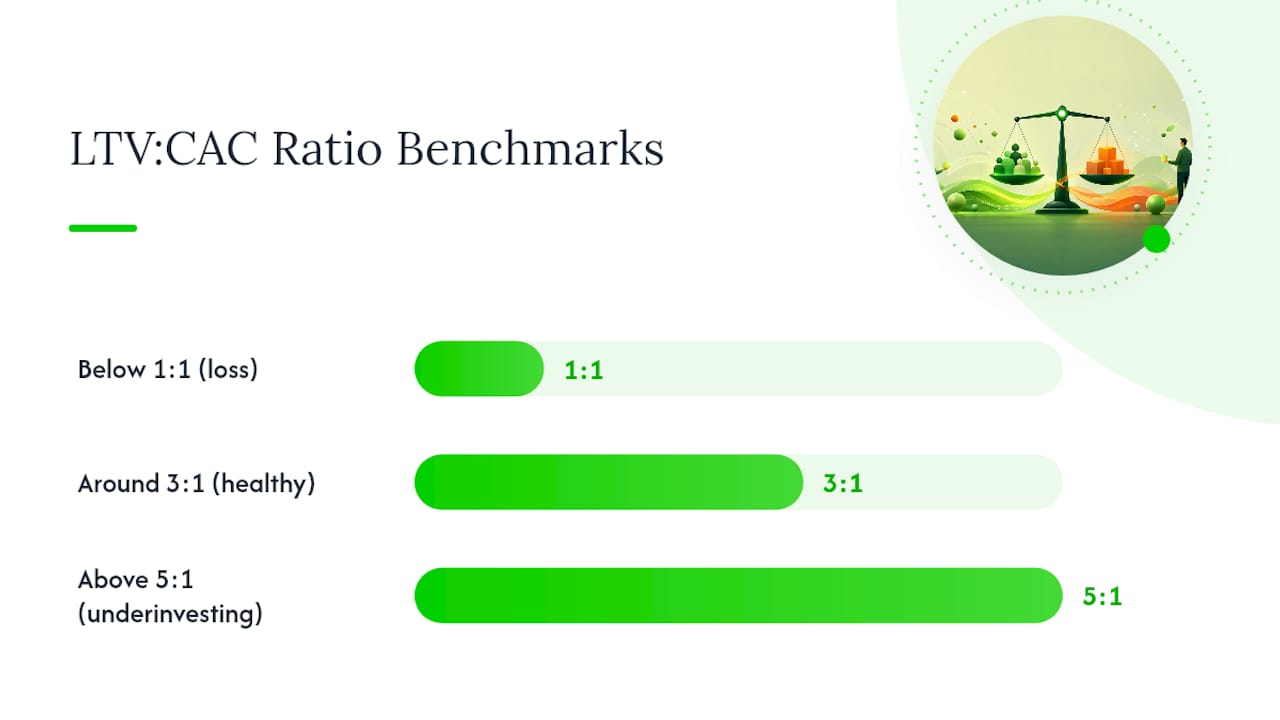
| Check the 3:1 ratio | A healthy LTV:CAC benchmark is around 3:1; below 1:1 signals a loss on acquisition. |
| Match payback to your model | Target under 12 months for most small SaaS businesses, longer for enterprise deals. |
| Use cohorts, not calendar months | Align spend with the conversion month it actually influenced to avoid distorted numbers. |
| Fix retention before chasing cheaper clicks | Lower churn and higher ARPA usually improve the ratio more than shaving ad costs. |
Table of Contents
- What Is Customer Acquisition Cost and How Do You Calculate It?
- What Belongs in the CAC Numerator and Denominator
- A Worked Example: Paid-Only vs. Fully-Loaded CAC
- Why CAC Matters: LTV:CAC Ratio and Payback Period
- How to Analyze CAC the Right Way: Cohorts, Lag, and Common Traps
- Practical Tactics to Reduce Customer Acquisition Cost
- How an Agency Actually Moves the CAC Number
- The Number Everyone Gets Wrong About CAC
- Sources
What Is Customer Acquisition Cost and How Do You Calculate It?
There isn't one CAC formula. There are three, and picking the wrong one for the situation is how founders end up arguing with their board over numbers that don't mean what everyone assumes they mean.
The basic version is straightforward: CAC = Sales and Marketing Spend ÷ New Customers Acquired. Every other version is a variation on what you stuff into that numerator, according to the breakdown on Wikipedia, which lays out both the simple ratio and the more layered version used for investor reporting.
Three variants matter in practice:
- Paid-only CAC counts just media spend and ad platform fees divided by customers from that channel. Use it when you're optimizing a specific campaign or comparing Meta against Google performance week to week.
- Fully-loaded CAC adds salaries for sales and marketing staff, software subscriptions, agency retainers, and a slice of overhead. Boards and investors expect this version because it reflects what growth actually costs the business, not just the ad bill.
- Blended CAC divides total spend across all channels by total new customers, ignoring channel attribution entirely. It's a useful sanity check but hides which channels are actually working.
A useful rule from the CAC guide at Metrickit: pick one definition, label it explicitly (something like "Paid CAC, Q1"), and never compare it against a number calculated a different way. Segment-level CAC, broken out by channel or customer plan, beats a single blended figure any time you're deciding where to spend the next dollar.
What Belongs in the CAC Numerator and Denominator
Getting CAC right isn't about the math. It's about deciding what counts as acquisition cost before you start adding numbers, according to Andrew Chen's guide to calculating CAC, which flags omitted salaries and tools as the most common source of a misleading figure.
For a fully-loaded number, your numerator should include:
- Paid media spend across every channel (Meta, Google, TikTok, YouTube)
- Agency or freelancer fees tied to acquisition work
- Salaries and commissions for sales and marketing staff, prorated to time spent on acquisition
- Software and tools used for campaigns, landing pages, and CRM
- Onboarding promotions or discounts used specifically to convert new sign-ups
For the denominator, count only new paying customers acquired in the period. Returning customers who churned and came back later get counted separately as reactivations, not new acquisitions, or your CAC will look artificially cheap.
Pro Tip: Trial users and leads are not customers. If your denominator includes anyone who hasn't paid yet, your CAC is fiction. Wait for the conversion event, then count them.
Borderline cases like product support during onboarding usually belong in the numerator if that support exists specifically to convert a trial, not to serve an existing account.
A Worked Example: Paid-Only vs. Fully-Loaded CAC
Say a local ecommerce brand spent $8,000 on Meta and Google ads in March and picked up 80 new customers. Paid-only CAC is easy: $8,000 ÷ 80 = $100 per customer.
Now add the full picture. The same month, the business paid $3,000 in marketing salaries, $600 for CRM and email tools, and $400 to an agency for landing page work. Total spend jumps to $12,000.
- Add all costs: $8,000 (ads) + $3,000 (salaries) + $600 (tools) + $400 (agency) = $12,000
- Divide by new customers: $12,000 ÷ 80 = $150 fully-loaded CAC
- Compare the two: paid-only CAC understates true cost by 50%
That gap matters. A 50% swing between paid-only and fully-loaded CAC is common for small teams, and reporting the wrong version to a board or investor makes your unit economics look better than reality.
One more wrinkle: if your sales cycle runs longer than a few weeks, the customers who converted in March may have been influenced by February's ad spend. Andrew Chen's practitioner formula handles this by weighting spend across months rather than assuming instant conversion. It's a fix worth applying before you trust any single month's number.
Why CAC Matters: LTV:CAC Ratio and Payback Period
CAC by itself tells you what you spent. It doesn't tell you if that spend was smart. For that, you need customer lifetime value and the ratio between the two.
Calculate LTV using gross-margin-adjusted revenue, not raw revenue, and hold your churn definition constant across periods. Mismatched definitions between LTV and CAC are the single biggest reason two people at the same company report wildly different ratios for the same business.
Once you have both numbers, the commonly cited LTV:CAC benchmark is about 3:1.
| Ratio | What it signals |
|---|---|
| Below 1:1 | You're losing money on every customer acquired |
| Around 3:1 | Generally healthy, sustainable growth |
| Above 5:1 | Possibly underinvesting in growth |
- A ratio near 1:1 means marketing is barely breaking even before overhead
- A ratio far above 5:1 often means you could spend more aggressively and still profit
- Neither extreme is automatically wrong. Context like margin and churn changes what "healthy" looks like
Payback period adds a time dimension the ratio misses. For many small and mid-sized SaaS businesses, a CAC payback period under 12 months is the target, with longer windows tolerated for enterprise deals with bigger contract values. A local service business with high margins might reasonably aim for a payback period measured in a few months.
How to Analyze CAC the Right Way: Cohorts, Lag, and Common Traps
Monthly CAC numbers lie to you when your sales cycle runs longer than your reporting period. A customer who converts in June might have been driven by an ad campaign from April, and lumping that spend into June's numerator distorts the real cost of that channel.
Cohort-level analysis fixes this. Group customers by the month they signed up, then track the spend and revenue tied to that specific cohort over time rather than by calendar month. Segmenting further by channel, plan tier, or acquisition cohort usually reveals that one channel is quietly subsidizing the rest.
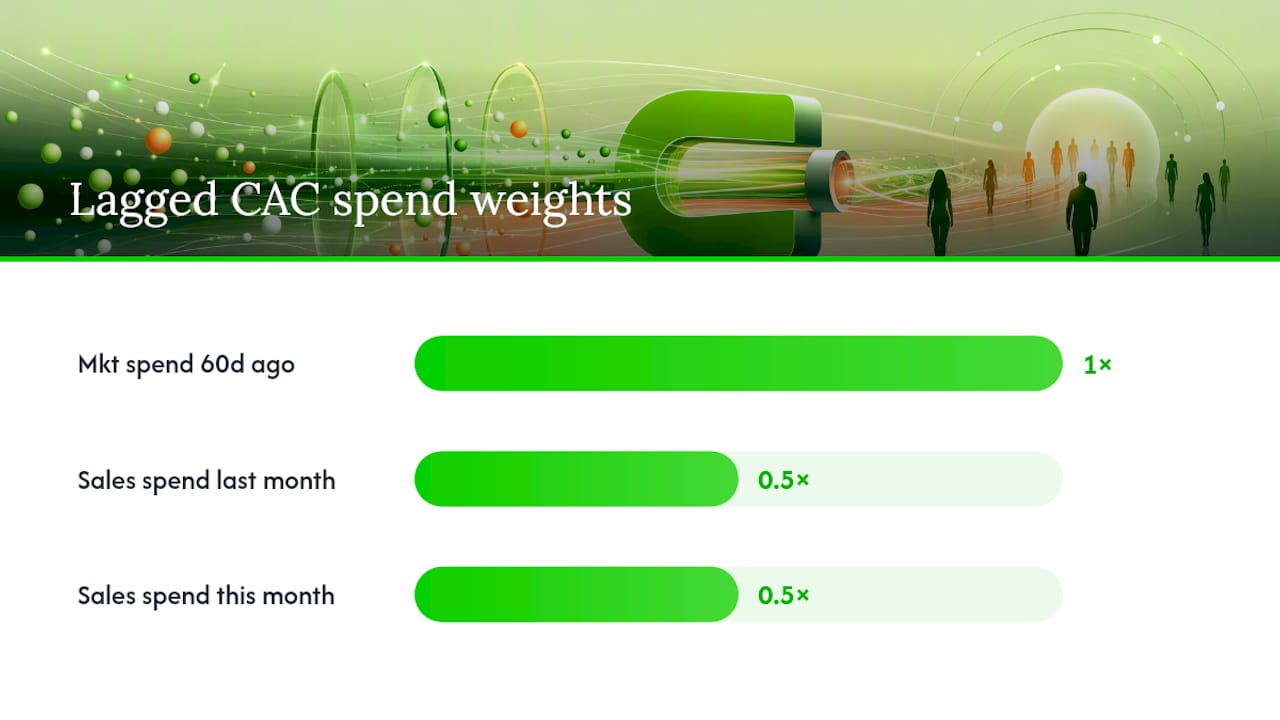
A practical lagged formula used by growth teams weights spend across the weeks leading up to conversion: CAC = (Marketing spend from 60 days ago + half of last month's sales spend + half of this month's sales spend) ÷ new customers this month. It smooths out the noise that a single bad or great week creates.
Pro Tip: If your average deal takes 45 days to close, don't compare this month's ad spend to this month's new customers. You're measuring two different cohorts and calling it one number.
The most common traps: counting leads or trial signups as customers, comparing a paid-only figure against a fully-loaded target, and switching definitions between quarters without telling anyone.
Practical Tactics to Reduce Customer Acquisition Cost
Lowering CAC rarely comes down to one big lever. It's usually five or six smaller ones compounding together.
- Cut underperforming channels first. Calculate CAC by channel every month, and reallocate budget away from anything trending above your payback target for two consecutive periods.
- Fix the landing page before the ad. A confusing offer or a slow page kills conversion rate no matter how good the targeting is. Testing headline clarity and page load speed usually moves the needle faster than a new audience segment.
- Retarget before you acquire new. Warm traffic converts at a fraction of the cost of cold traffic. A Facebook retargeting strategy built around cart abandoners or past visitors often outperforms fresh prospecting campaigns on cost per conversion, and a Google remarketing setup does the same across search and display.
- Reduce churn before you chase volume. Improving retention and increasing average revenue per account often does more for your LTV:CAC ratio than shaving dollars off ad spend, since a small drop in monthly churn compounds over a customer's whole lifespan.
- Automate the boring parts. CRM workflows and lead scoring reduce the labor cost baked into fully-loaded CAC, and they catch leads that would otherwise go cold before a human ever follows up. Marketing automation tools carry their own ongoing subscription costs worth factoring into that fully-loaded number.
- Track offline conversions too. If foot traffic or events feed your funnel, offline conversion tracking closes the loop between a scratch-off card or event signup and the sale that follows, which keeps your denominator honest.
How an Agency Actually Moves the CAC Number
Most of the levers above sound simple written down and get messy in execution: attribution breaks, teams disagree on definitions, and nobody owns the retargeting audience that's quietly outperforming everything else.
Crowdcompany runs these levers as a connected system rather than isolated fixes. That typically means digital PR and local SEO to lower the cost of earned traffic, conversion rate optimization on landing pages already receiving spend, CRM and lead automation to stop qualified leads from going cold, and foot-traffic programs for businesses that convert offline as much as online.
A typical engagement follows an audit, test, and scale flow: audit current CAC by channel and flag the leaks, run controlled tests on the weakest links (usually the landing page or the retargeting setup), then scale whatever moved the ratio in the right direction.
- Digital PR and local SEO to reduce paid dependency over time
- CRO work on existing landing pages before adding ad spend
- CRM and lead automation to shorten the sales cycle and cut labor cost per customer
- Foot-traffic and event programs for businesses where offline conversion matters
The Number Everyone Gets Wrong About CAC
Most advice on lowering CAC treats it like a marketing problem. It's usually a retention problem wearing a marketing costume. A business spending $150 to acquire a customer who churns after two months has a much worse ratio than a business spending $300 for a customer who stays three years, and no amount of ad optimization fixes that gap.
The conventional advice, cut ad spend, test more creative, chase cheaper channels, isn't wrong, but it's third on the priority list, not first. Fix your denominator first: make sure you're counting actual paying customers, not leads or trials. Fix your definition second: decide whether you're reporting paid-only or fully-loaded CAC and stop switching between them mid-quarter. Only then does channel optimization actually tell you something true.
The businesses getting this right aren't the ones with the lowest CAC. They're the ones who know exactly which CAC number they're looking at, and why it moved.
— E