
Start with a rule-based multi-touch model, most likely time-decay or U-shaped, and only move to data-driven attribution once you have reliable monthly conversion volume. Match the model to your sales cycle and channel mix rather than chasing the most sophisticated option on the market. Attribution is directional guidance for budget decisions, not a precise ledger, so pick the simplest model that still tells you where to spend the next dollar.
TL;DR:
- For most businesses, starting with a simple multi-touch model like time-decay or U-shaped is best unless monthly conversions exceed 300 to 400, in which case data-driven attribution can be considered.
- Building a reliable attribution system requires high-quality first-party data, consistent event definitions, and offline-to-online tracking, as third-party cookies diminish.
- Offline channels, cross-device activity, and dark social sources remain blind spots, accounting for up to 40% of some buyer journeys, which limits model accuracy.
- Combining attribution with incrementality tests and ROI calculations prevents overreliance on potentially flawed credit assignments and guides better budget decisions.
- Ongoing governance, including regular reviews, documented processes, and dedicated ownership, safeguards against data drift and ensures trustworthy attribution over time.
Table of Contents
- What Marketing Attribution Models Actually Measure
- Single-Touch Attribution: First-Touch, Last-Touch, and Last Non-Direct
- Multi-Touch Models: How Linear, Time-Decay, and Position-Based Attribution Split Credit
- Data-Driven Attribution: When Algorithmic Models Actually Work
- Marketing Mix Modeling vs. Click-Based Attribution
- How to Choose an Attribution Model for Your Business
- Setting Up Attribution the Right Way: Data Capture and Governance
- The Attribution Blind Spots Nobody's Dashboard Shows
- How Crowdcompany Approaches Attribution for Local and Ecommerce Clients
- Where AI Is Actually Changing Attribution
- Turning Attribution Reports Into Actual Budget Decisions
- How GDPR and CCPA Are Reshaping Attribution Tracking
- Connecting Attribution Data to the Rest of Your Reporting Stack
- What Attribution Actually Tells You (And What It Doesn't)
- How Crowdcompany Helps You Build an Attribution System You Can Trust
- Sources
- FAQ
What Marketing Attribution Models Actually Measure
Marketing attribution is the practice of assigning credit for a conversion to the marketing touchpoints that led a customer there. A marketing attribution model is the rule set, or the algorithm, that decides how much credit each touchpoint gets when a buyer clicks three ads, opens two emails, and visits your site five times before finally converting.
That sounds simple until you ask where the data actually comes from. Every attribution model runs on a stack of signals, and the quality of that stack determines whether the output is trustworthy or noise.
The core data sources most teams stitch together include:
- First-party analytics: on-site behavior captured directly by your own tracking, not a third party's cookie.
- Ad platform events: conversion pixels and API feeds from Meta, Google, and TikTok reporting what they saw on their side of the funnel.
- CRM records: the offline half of the story, tracking when a lead becomes an opportunity and when an opportunity closes.
- Server-side and offline joins: connecting a phone call, an in-store visit, or a mailed offer back to a digital touchpoint using promo codes or matched contact data.
The split between first-party and third-party data matters more now than it did five years ago. Third-party cookies are disappearing from major browsers, and platform-reported conversions increasingly rely on modeled estimates rather than a hard, observed click. First-party data, meaning what you collect directly through your own website, app, and CRM, is now the most durable foundation. Identity stitching built on your own systems survives platform changes; a model built entirely on someone else's cookie doesn't.
This is also why attribution windows matter so much. A seven-day click window on one platform and a thirty-day window on another will produce two different stories about the same customer, so before you even pick a model, you need to agree on how far back you're willing to look.
Single-Touch Attribution: First-Touch, Last-Touch, and Last Non-Direct
Single-touch models give 100% of the credit to one interaction in the customer's path. They're the oldest form of attribution and still the default in tools that haven't been configured otherwise.
- First-touch attribution credits the very first interaction that brought a person into your world, often an organic search result or a display ad. It answers "what got this person's attention in the first place?" and tends to inflate the value of top-of-funnel channels like content and paid social prospecting.
- Last-touch attribution credits the final interaction before conversion, usually a branded search or a retargeting ad. It answers "what closed the deal?" and tends to overvalue bottom-funnel channels while making top-of-funnel work look worthless, even when it's the reason the buyer knew your name.
- Last non-direct click attribution is a small but important fix on last-touch: it ignores direct traffic (someone typing your URL) and credits the last channel before that, since direct visits usually mean someone already knew you and just wasn't tracked properly.
The practical effect shows up fast in reporting. Switch a dashboard from first-touch to last-touch and watch paid search's reported value jump while your top-of-funnel content spend suddenly looks like it's doing nothing. Neither number is wrong. They're just answering different questions.
Single-touch models earn their keep in narrow situations: very short sales cycles, low overall conversion volume where a multi-touch model would have nothing to work with, or reporting constraints where the tool simply doesn't support anything more granular. A local service business that gets most leads from one Google Business Profile click and a phone call doesn't need U-shaped attribution modeling. It needs to know which channel picked up the phone.
Pro Tip: If you're on a single-touch model because your tool defaults to it, check whether last non-direct click is available before accepting plain last-touch. It's a small setting change that removes one of the most common distortions in attribution reporting.
Multi-Touch Models: How Linear, Time-Decay, and Position-Based Attribution Split Credit
Multi-touch attribution, often shortened to MTA, spreads credit across every touchpoint in the journey instead of handing it all to one moment. It's a better match for the reality that most buyers, especially in B2B, interact with a brand many times before converting.
- Linear attribution splits credit evenly across every touchpoint. Five interactions means each one gets 20%. It's simple to explain to a finance team, but it treats a first blog visit the same as the demo request that happened three days before signing, which understates the touchpoints that actually moved the deal.
- Time-decay attribution gives more credit to touchpoints closer to conversion, using a decreasing weight as you move backward in time. It suits sales cycles where recent activity is a stronger buying signal, which describes most consideration-heavy purchases.
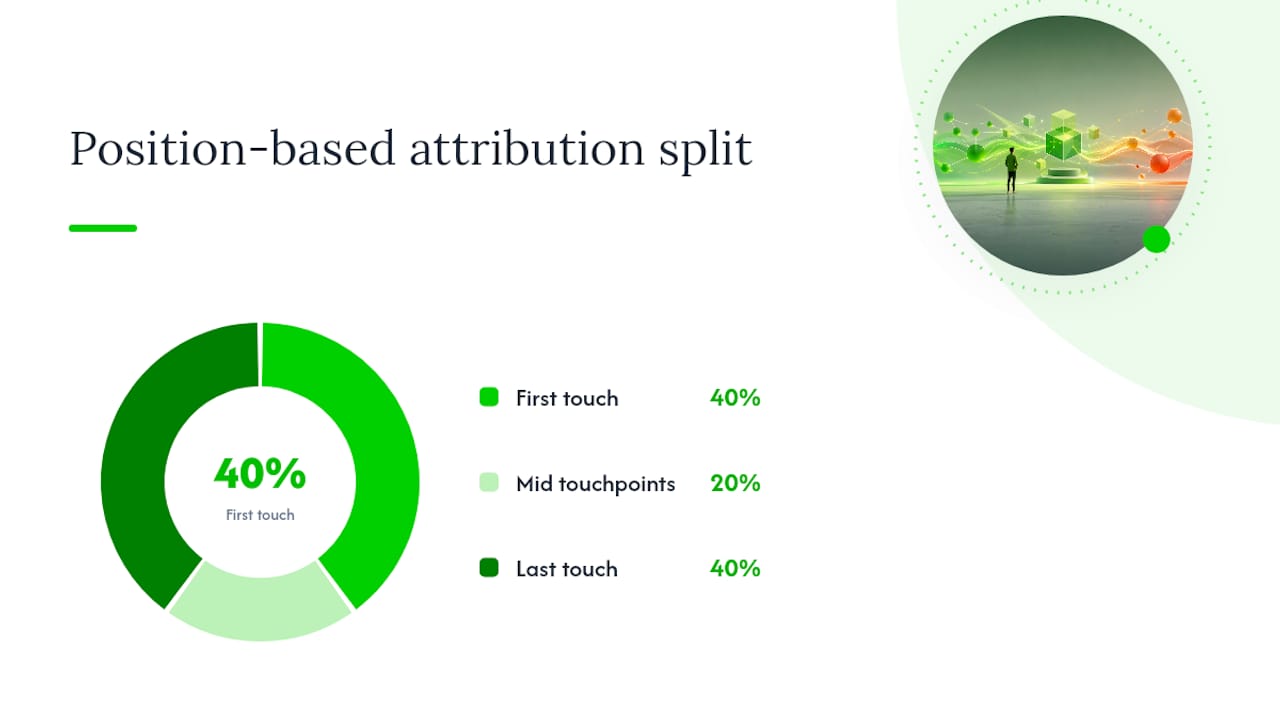
- Position-based (U-shaped) attribution weights the first and last touchpoints heavily, commonly a 40/20/40 split, with the middle 20% divided among everything in between. It rewards both the channel that created awareness and the channel that closed the deal, which makes it a common default for marketing teams that need to defend both top-of-funnel and bottom-funnel budgets.
- W-shaped attribution adds a third major weighted point: the moment a lead converts to a marketing-qualified or sales-qualified stage. A typical split runs something like 30/30/30 across first touch, lead creation, and opportunity creation, with the remaining 10% spread across everything else. This only works if your CRM cleanly marks those milestones.
- Full-path attribution extends that logic across the entire funnel, including post-opportunity stages like proposal sent or contract signed, giving credit at every major milestone rather than just three.
- Custom attribution models let you set your own weights based on what your own sales data says actually predicts a close, which is powerful but requires enough historical data to trust the weighting.
The CRM instrumentation requirement is where most teams stall. W-shaped and full-path models are only as good as your CRM's stage definitions; if "opportunity created" means five different things depending on which rep logged it, the model will produce garbage. Linear and time-decay are more forgiving because they only need consistent event tracking on the marketing side, not a clean CRM handoff.
By business type, the pattern is fairly consistent. B2B companies with sales-assisted cycles tend to get the most value from W-shaped or full-path models because the CRM milestones already exist and matter. DTC ecommerce brands with short, high-volume purchase cycles usually do better with time-decay or linear, since there's rarely a meaningful "opportunity" stage to weight around. Local service businesses somewhere in between often find U-shaped attribution strikes the right balance without demanding CRM complexity they don't have. Multi-touch attribution still misses offline and untracked interactions no matter which weighting scheme you choose, a limitation worth remembering before you treat any single-model output as final.
Data-Driven Attribution: When Algorithmic Models Actually Work
Data-driven attribution, sometimes called algorithmic attribution, uses statistical modeling to compare converted and non-converted paths and infer how much marginal impact each touchpoint contributed. Instead of applying a fixed rule like "40% to first touch," the algorithm learns the weighting from your own historical data.
That sounds like the obvious upgrade from every rule-based model above. It usually isn't, at least not yet, for most businesses.
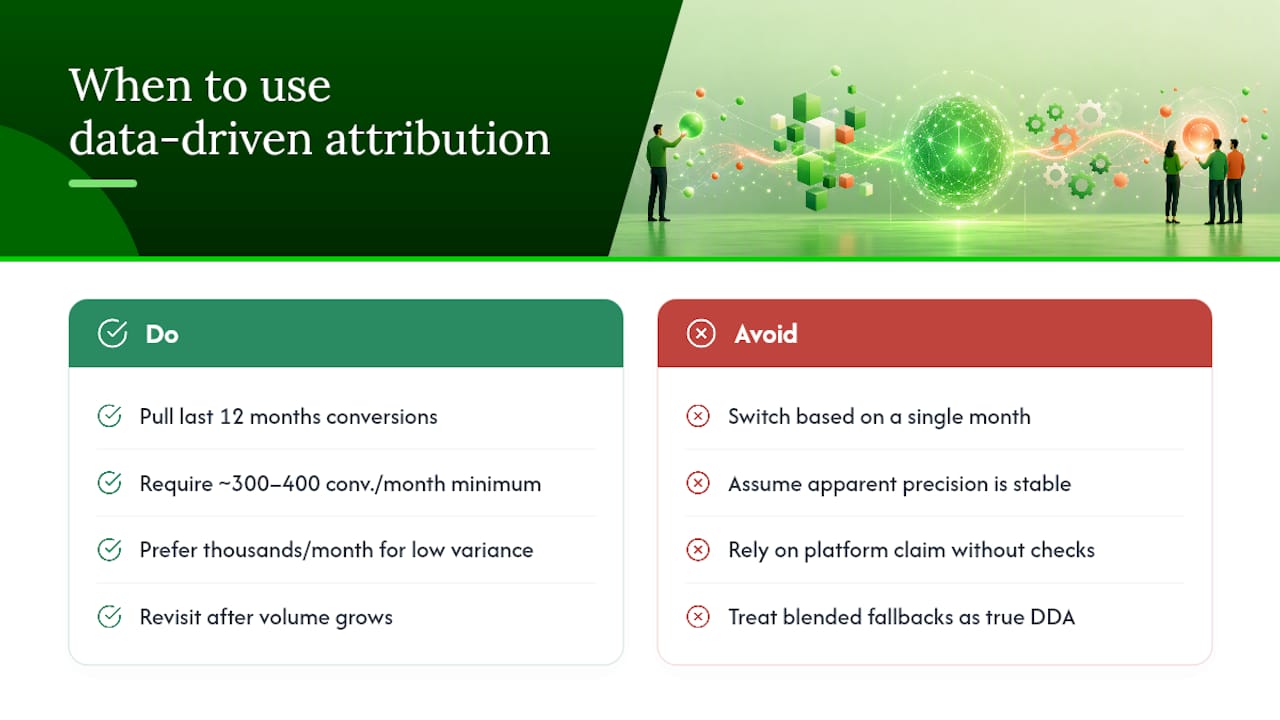
The threshold that matters: Algorithmic attribution needs a statistically stable sample to produce reliable output. Industry guidance commonly cites 300 to 400 conversions per month as a practical floor, with thousands of conversions per month preferred for genuinely low-variance, trustworthy results.
Below that floor, the model doesn't fail loudly. It fails quietly, producing confident-looking percentages that shift dramatically month to month because the underlying sample is too thin to be stable. That's the core pitfall: apparent precision that isn't reproducible. A dashboard showing "Paid Social: 34.2% credit" looks authoritative right up until next month's number is 19.8% with no real change in strategy behind it.
Platform-limited views compound the problem. Google Ads and similar platforms will fall back to simpler rule-based models when conversion volume is insufficient, which means a business that thinks it's running data-driven attribution may actually be getting a blended, opaque version of last-touch without knowing it. The "black box" complaint about algorithmic attribution is fair: even when it works, most platforms won't show you exactly how the weighting was calculated.
Pro Tip: Before switching to data-driven attribution, pull your last twelve months of monthly conversion counts. If more than half those months fall under 300 conversions, stay on a rule-based model and revisit the decision after volume grows, not before.
Marketing Mix Modeling vs. Click-Based Attribution
Marketing Mix Modeling, or MMM, solves a different problem than any attribution model discussed so far. MMM uses regression analysis on aggregate spend and revenue data over time rather than tracking individual users through a journey, which means it never needs a cookie, a pixel, or a CRM join to function.
That structural difference creates real trade-offs:
- MMM strengths: it captures offline channels (TV, radio, print, direct mail) that click-based models can't see at all, it's immune to cookie deprecation and ad-blocker interference, and it works at a strategic, portfolio level.
- MTA strengths: it operates at the individual campaign or ad-set level, giving you the granularity to decide which specific Meta ad set to pause this week, something MMM simply cannot do.
- The trade-off: MMM runs on a lag, typically requiring weeks or months of aggregate data before producing a read, while MTA can tell you within days whether a campaign is pulling its weight.
Mature marketing teams generally don't pick one over the other. The common hybrid pattern uses multi-touch attribution for day-to-day campaign optimization, deciding which ads to scale or kill this week, while MMM runs in parallel to guide the bigger quarterly or annual question of how much total budget should go to paid search versus paid social versus offline. Neither model replaces the other. MTA answers "which lever do I pull," and MMM answers "how big should the whole machine be." If your business runs any meaningful offline spend, whether that's local sponsorships, direct mail, or radio, MMM is the only piece of this puzzle that will actually count it.
How to Choose an Attribution Model for Your Business
Four questions decide the right starting model, and none of them are "which tool has the best reviews."
- How long is your sales cycle? A same-day ecommerce purchase and a six-month enterprise software deal need fundamentally different weighting logic. Short cycles tolerate simpler models; long cycles need something that respects the middle of the funnel.
- What's your monthly conversion volume? This single number rules out or rules in data-driven attribution before anything else matters. Below a few hundred conversions a month, stay rule-based.
- How complex is your channel mix, including offline? If a meaningful share of revenue comes through channels a pixel can't see, no click-based model, however sophisticated, will give you the full picture on its own.
- What decision are you actually trying to make? Optimizing this week's ad spend calls for a different tool than deciding next year's total marketing budget split.
Attribution model choice should map to sales cycle length, conversion volume, channel complexity, and the specific decision at hand, and the same business can reasonably run different models for different questions.
A few concrete starting points: a DTC ecommerce brand under 1,000 monthly conversions generally does best starting with time-decay or linear attribution. A B2B company with a sales-assisted process should look at W-shaped first, then consider data-driven only once monthly conversions clear the few-hundred mark consistently for several months running. A B2B SaaS company with a long trial-to-paid cycle often benefits from full-path models that credit both the marketing touchpoints and the in-product activation milestones.
Pro Tip: Set a calendar reminder to revisit your attribution model every two quarters, not because the model breaks, but because your conversion volume and channel mix will have changed enough by then to justify a different one.
Setting Up Attribution the Right Way: Data Capture and Governance
Getting the model right doesn't matter if the instrumentation underneath it is broken. Four steps come before you touch a single weighting scheme.
- Define objectives and pick a system of record. Decide upfront whether this model exists to optimize campaigns or allocate budget, and name one platform as the single source everyone will defend numbers from.
- Map conversion events and funnel milestones. Every stage, from first site visit to closed deal, needs a consistent, documented definition that doesn't vary by team or by rep.
- Instrument first-party tracking and CRM joins. This is where the offline-to-online connection either works or quietly fails, so test it with real customer records before trusting the dashboard.
- Run comparison experiments and validate with incrementality tests. Running multiple models side by side while designating one as the source of truth prevents the common failure of two teams presenting two different attribution numbers to the same executive.
Governance matters more than most teams expect going in. Without a named owner, attribution reporting drifts. Someone tweaks an attribution window in one platform, nobody documents it, and three months later two dashboards disagree with no clear reason why.
- Set a review cadence, quarterly is a reasonable default, and stick to it even when nothing seems urgent.
- Document your attribution window (seven day, thirty day, ninety day) in writing, and apply it consistently across every platform you report from.
- Assign one person or team as the final word when numbers conflict, before the conflict happens.
The Attribution Blind Spots Nobody's Dashboard Shows
Every attribution model, no matter how well built, has holes. Knowing where they are matters more than picking the "best" model, because the holes exist regardless of which one you choose.
The dominant blind spots show up in predictable places:
- Offline channels: direct mail, events, and in-store visits rarely leave a digital trace unless you deliberately build one.
- Cross-device gaps: someone researches on their phone and buys on a laptop, and most tracking treats that as two different people.
- Dark social: shares in private messages, group chats, and closed communities that drive real traffic but show up as "direct" or "unknown" in your reports.
- Platform double-counting: Meta and Google Ads each claim credit for the same conversion under their own last-click logic, so adding their reported numbers together always overstates total performance.
Untracked touchpoints commonly account for 20 to 40% of the B2B buyer journey in a typical marketing stack, which means even a well-built multi-touch model is working from an incomplete map. The mitigation isn't a perfect fix, since one doesn't exist, but a combination of unique promo codes tying offline campaigns to online redemptions, first-party identity stitching across devices, and periodic incrementality tests (turning a channel off entirely for a short window to see what actually changes) closes most of the gap. Treating attribution outputs as directional signals rather than exact accounting is the healthiest mindset going in, and it's the one that keeps teams from making a six-figure budget call off a number that was never meant to carry that much weight.
How Crowdcompany Approaches Attribution for Local and Ecommerce Clients
The right starting model tends to split cleanly along business type. For local businesses, most conversions cluster around a handful of channels, Google Business Profile, local paid social, and referral traffic, so a simple last non-direct or U-shaped setup, paired with clean offline tracking through unique phone numbers or promo codes, usually beats a complex model the volume can't support. For ecommerce clients running paid campaigns across Meta, Google, and TikTok simultaneously, time-decay attribution tends to reflect reality better, since the last few days before purchase almost always carry more weight than the first discovery click weeks earlier.
Crowdcompany builds measurement setups around whichever model fits the client's actual conversion volume and sales cycle rather than defaulting to whatever a single ad platform reports by default. That means CRM instrumentation for service businesses with longer sales cycles, and cleaner event tracking for ecommerce brands that need fast, campaign-level answers every week.
Pro Tip: Ask whoever runs your attribution setup for a one-page audit of what's currently being tracked versus what's actually happening in your business. The gap between those two lists usually explains more than any dashboard percentage.
Where AI Is Actually Changing Attribution
Machine learning has been quietly running underneath data-driven attribution models for years, but the newer shift is in how fast and how cheaply that modeling can happen. Algorithms that once required a dedicated data science team to configure are now built into standard ad platform interfaces, which lowers the barrier but doesn't remove the conversion-volume floor discussed earlier. A small business running an AI-driven attribution feature with 80 monthly conversions still gets an unstable model, just one wrapped in a friendlier interface.
The more consequential trend is predictive modeling layered on top of attribution data: instead of only explaining which past touchpoints drove a conversion, newer systems attempt to forecast which in-progress leads are likely to convert based on the touchpoint pattern so far. That shifts attribution from a rearview mirror into something closer to a live scoring system, letting sales teams prioritize the leads whose journey looks like past customers who closed.
Privacy-driven data scarcity is pushing the same machine learning techniques toward modeled conversions, essentially statistical estimates filling gaps where real tracking data no longer exists because of cookie restrictions or opted-out users. That's a genuine technical advance, but it's also worth watching skeptically. A modeled conversion is an estimate, not an observation, and treating the two as equally reliable in a board deck is how attribution numbers quietly become less trustworthy even as the tools reporting them get more sophisticated. The practical move is to keep asking any platform, plainly, how much of a given number is observed versus modeled.
Turning Attribution Reports Into Actual Budget Decisions
An attribution report that doesn't change a single budget line by the next quarter wasn't worth building. The gap between generating a report and acting on it is where most of the value gets lost.
Start by looking for consistent patterns across at least two or three reporting periods before reallocating spend, since a single month's attribution swing is often noise, not signal. If a channel's credited share moves by a wide margin from one month to the next with no real change in strategy, that's usually a sign of thin data or a platform quirk, not a genuine shift in performance.
Cross-reference attribution output against a metric attribution can't fake: customer acquisition cost. A channel can look strong in a time-decay model while quietly delivering customers at an unsustainable cost, and the two numbers together tell a more honest story than either alone. Similarly, run any major reallocation decision through a basic marketing ROI calculation before committing budget, since attribution tells you where credit falls but ROI tells you whether that credit was worth the spend.
When attribution and incrementality testing disagree, meaning a model claims a channel drives 25% of conversions but turning it off for two weeks barely moves total volume, trust the test over the model. Attribution models are inference; incrementality tests are closer to direct evidence. The most useful habit going forward isn't running a better model. It's building a standing quarterly rhythm where attribution output, CAC, and a periodic incrementality check all get reviewed together before any budget moves.
How GDPR and CCPA Are Reshaping Attribution Tracking
Privacy regulation hasn't broken attribution, but it has permanently changed what data is legally available to build it on. The General Data Protection Regulation in the European Union and the California Consumer Privacy Act in the United States both restrict how personal data can be collected, stored, and used for tracking without explicit consent, which directly affects the third-party cookies and cross-site identifiers that older attribution models leaned on heavily.
The practical fallout shows up in a few consistent ways. Consent banners now gate whether a visitor's activity gets tracked at all, which means a growing share of journeys start with a blank spot before tracking even begins. Cross-device and cross-site matching, once handled largely through third-party cookies, has grown harder and less complete, widening the same blind spots discussed earlier around cross-device gaps and dark social. And ad platforms operating under these regulations increasingly report modeled conversions rather than fully observed ones, filling gaps with statistical estimates rather than direct data.
None of this makes attribution useless, but it does make first-party data collection, meaning what you gather directly through your own website, app, and CRM with proper consent, the most resilient foundation available. A business that has spent the past two years building direct customer relationships and its own tracking infrastructure is far less exposed to a browser update or a regulatory change than one still leaning on third-party signals it doesn't control. The businesses feeling the most pain right now are the ones that never built a first-party alternative in the first place.
Connecting Attribution Data to the Rest of Your Reporting Stack
Attribution data is only useful once it talks to the rest of your reporting environment. An attribution model sitting in isolation inside one ad platform's dashboard tells you a partial story; the full picture requires connecting that output to web analytics, CRM records, and finance reporting so everyone is arguing from the same numbers.
The most common integration point is a business intelligence layer, whether that's a dedicated dashboarding tool or a well-built spreadsheet pipeline, that pulls conversion and spend data from every ad platform alongside CRM stage data and web analytics events. Without that central layer, marketing sees one number, sales sees another pulled from the CRM, and finance sees a third derived from actual revenue recognition, and all three teams end up debating whose number is right instead of what to do next.
CRM integration deserves particular attention because it's where marketing attribution meets sales reality. A lead that an attribution model credits heavily to a paid social campaign means little if that lead never converts to a qualified opportunity in the CRM. Feeding attribution data into the same system sales already trusts, rather than keeping it siloed in a marketing-only tool, is what makes the output usable for cross-functional budget conversations rather than just a marketing team talking point. For businesses tracking offline touchpoints too, connecting offline conversion data back into digital reporting closes one of the most persistent gaps between what marketing measures and what the business actually experiences.
What Attribution Actually Tells You (And What It Doesn't)
Every model in this article promises the same thing: a clean number that tells you where credit belongs. None of them fully deliver on that promise, and the sooner a marketing team accepts that, the better its budget decisions get.
The conventional advice treats model selection as the hard part, find the "right" model and the numbers will finally make sense. That's backward. The harder, more valuable work is building the discipline to distrust any single number, run comparisons, and check attribution against incrementality tests before moving real budget. A perfectly configured W-shaped model fed by broken CRM data will produce a confident, wrong answer faster than a simple linear model built on clean tracking.
What gets underweighted almost everywhere is data quality over model sophistication. Teams spend months debating time-decay versus U-shaped when the actual problem is that half their conversions aren't being tracked at all. Fix the instrumentation first. The model matters less than most vendors selling attribution software would like you to believe.
Prioritize this, in order: get your first-party tracking and CRM joins clean, pick the simplest model your conversion volume can support, and only then start arguing about weighting schemes. Everything else is optimization on a foundation that either holds or doesn't.
— E
How Crowdcompany Helps You Build an Attribution System You Can Trust
Getting attribution right takes more than picking a model. It takes clean tracking, a CRM that actually reflects your funnel, and someone checking the setup before a bad number drives a budget decision. Crowdcompany runs measurement audits that map exactly where your current tracking has gaps, whether that's offline conversions never making it into your CRM, inconsistent event definitions across ad platforms, or a W-shaped model built on milestones nobody agreed on.

The work covers CRM instrumentation, coordinating inputs for a Marketing Mix Modeling approach when offline spend justifies it, and building dashboards that give your team one consistent number instead of three conflicting ones. For businesses in South Florida, that measurement work sits alongside the digital PR and local growth services Crowdcompany already runs for clients across the region. If your current reporting can't tell you with confidence which channel actually earned last month's best customers, start with a free measurement audit and see exactly where the gaps are before you spend another dollar guessing.
Sources
- Multi-touch attribution: what it is, and how to do it well — Adobe
- Marketing attribution models explained — WallStreetMojo
- Multi-touch attribution models guide — Observix
FAQ
What are attribution models in marketing?
An attribution model is the rule set that decides how much credit each marketing touchpoint, an ad click, an email open, a website visit, gets for leading to a conversion. Models range from simple single-touch rules to algorithmic systems that infer credit from historical conversion data.
Which attribution model is best?
There's no single best model; the right one depends on your sales cycle length, monthly conversion volume, and channel mix. Most teams should start with a rule-based multi-touch model like time-decay or U-shaped and move to data-driven attribution only once conversions consistently exceed a few hundred per month.
What is attribution theory in marketing?
Attribution theory is the broader idea that a conversion results from a series of contributing touchpoints rather than one isolated event, and that measurement should reflect that chain rather than crediting a single moment. It's the conceptual foundation behind every multi-touch model discussed in this article.
What is attribution modeling in performance marketing?
In performance marketing, attribution modeling is how teams decide which paid channels and campaigns deserve credit for a sale, directly shaping where ad budget gets allocated next. Since attribution outputs are best treated as directional rather than exact, performance marketers typically pair the model with incrementality testing before making major budget shifts.
How many conversions do I need for data-driven attribution to work?
Most industry guidance points to roughly 300 to 400 conversions per month as a practical minimum, with thousands per month preferred for genuinely stable results. Below that threshold, stick with a rule-based multi-touch model instead.