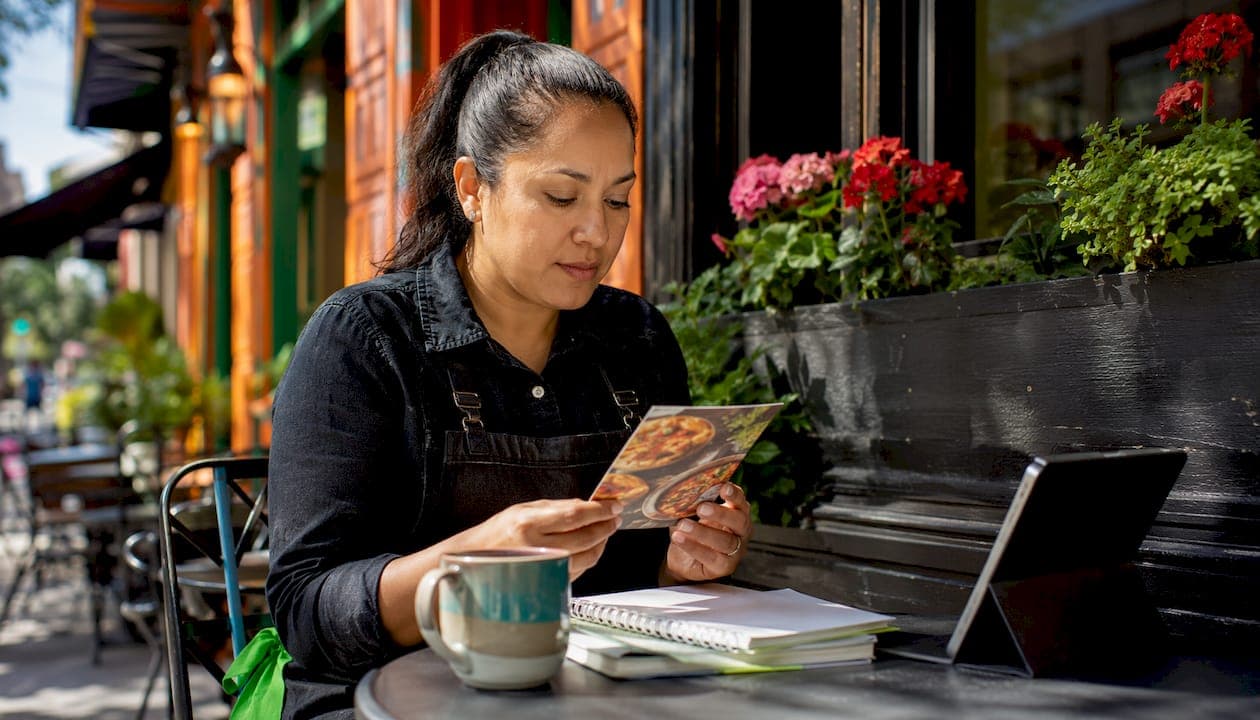
What is restaurant direct mail marketing and why does it still work?
Restaurant direct mail marketing is the practice of sending printed materials, such as postcards, menu mailers, and promotional flyers, to targeted households or segmented customer lists to drive foot traffic and sales. Unlike digital ads that scroll past in seconds, a well-designed postcard lands on the kitchen counter and stays there. Direct mail has a 60% higher engagement rate among millennials compared to email, which makes it far from an outdated channel.
The modern version of this channel is a hybrid. Physical mail pieces carry QR codes, unique promo codes, or links to mobile wallet passes, turning every mailer into a trackable digital event. That combination of tangible reach and measurable attribution is what keeps direct mail advertising relevant for restaurants in 2026.
Key components of restaurant direct mail:
- Formats: Postcards (6x9 or jumbo 6.25x11), tri-fold menu mailers, coupon envelopes, and self-mailers
- Targeting methods: Every Door Direct Mail (EDDM) for neighborhood saturation, or targeted lists filtered by demographics and purchase behavior
- Digital integration: QR codes, unique redemption codes, and landing pages that capture response data
- Measurable outcomes: Foot traffic lift, coupon redemptions, and online order conversions tied directly to the mailing
How to build an effective direct mail strategy for your restaurant
The foundation of any successful campaign is the list. EDDM, offered by the USPS, lets you mail every active address on selected carrier routes without purchasing a list. It's the go-to for grand openings and neighborhood saturation. For retention campaigns, your own customer database, built from loyalty programs, reservation systems, or online ordering platforms, gives you the targeting precision that EDDM cannot.

Timing matters more than most owners realize. A recommended cadence is monthly for new customer acquisition and quarterly for retention or seasonal promotions. Sporadic one-off drops rarely build the brand recognition that consistent mailings do. Think of it like a regular table at your restaurant: familiarity breeds loyalty.
Core strategy elements:
- List segmentation: Separate new-mover lists, lapsed customers, and active loyalty members for different offers
- Offer clarity: One compelling offer per piece, whether a free appetizer, a percentage off, or a buy-one-get-one deal
- Personalization: Including a recipient's name can increase response rates by 135%
- Digital endpoint: Every mailer should link to a dedicated landing page or online ordering URL for tracking
- Frequency discipline: High-frequency restaurant offers can mail more often than considered-purchase categories, but avoid back-to-back drops within two weeks
Pro Tip: Add a unique promo code to each mailing segment. When customers redeem it online or in-store, you know exactly which list, offer, and drop date drove the visit, giving you real attribution without guesswork.
Audience research and targeting at the zip-code or carrier-route level sharpens your EDDM drops and reduces wasted spend on households unlikely to visit.
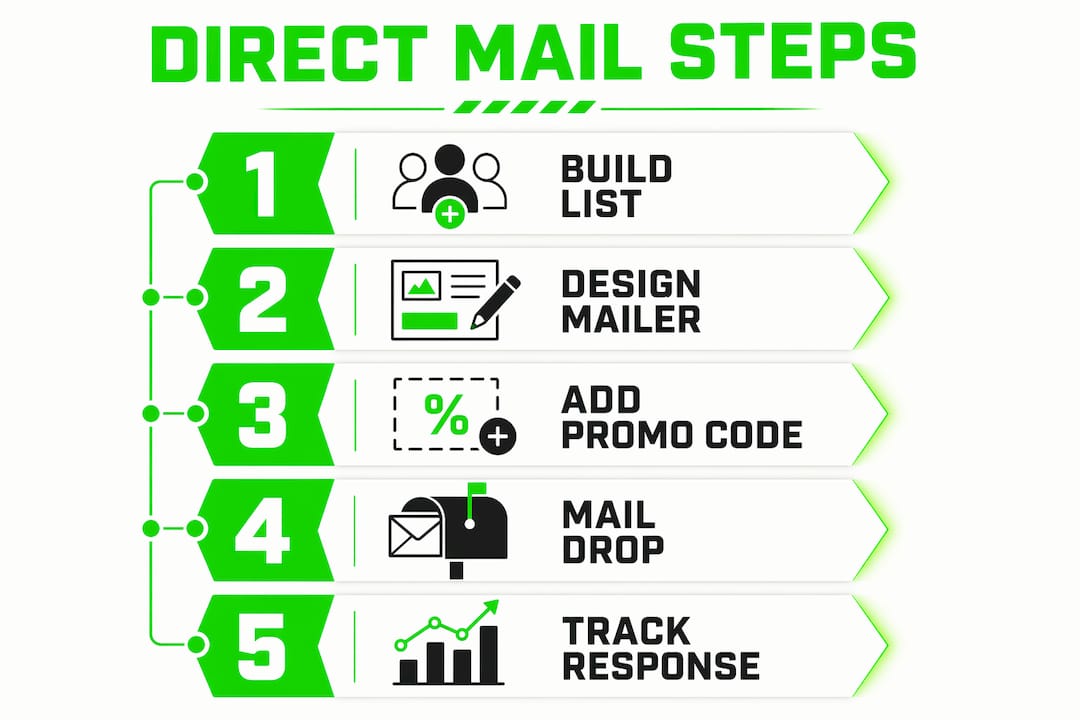
What do successful restaurant direct mail campaigns actually look like?
The campaigns that consistently perform share three traits: a clear offer, a targeted list, and a trackable response mechanism. Grand opening mailers sent via EDDM to a 5-mile radius, birthday offer postcards mailed to loyalty members, and seasonal menu drops to lapsed customers each serve a distinct purpose and produce measurable results.
| Campaign Type | Format | Typical Offer | Key Success Factor |
|---|---|---|---|
| Grand opening | Jumbo postcard (EDDM) | — | Neighborhood saturation, bold design |
| Birthday promotion | Personalized postcard | Free dessert or entrée | Name personalization, timely delivery |
| Seasonal menu launch | Tri-fold menu mailer | New items + limited-time deal | Visual food photography, clear CTA |
| Lapsed customer win-back | Postcard with QR code | "We miss you" discount | Segmented list, unique redemption code |
| Food delivery promotion | Postcard with app link | Free delivery on first order | QR code to ordering page, trackable URL |
Combining print mail with QR codes linking to mobile wallet passes improves attribution and re-engagement in every one of these formats. The digital endpoint is where the real data lives.
Birthday campaigns stand out as a high-ROI format because the list is already segmented by date, the offer feels personal rather than promotional, and redemption rates tend to run well above average campaign benchmarks. A lapsed-customer win-back mailer with a strong offer and a unique code gives you a clean read on reactivation cost per customer.
What does restaurant direct mail cost and how do you measure ROI?
Postcard campaigns typically cost between $0.42 and $0.72 per piece at scale for local businesses, all-in for printing and postage. EDDM Retail postage runs $0.260 per piece for saturation drops without a mailing permit, making neighborhood-wide drops accessible even for independent operators. Tri-fold menu mailers run $0.55–$0.95 per piece, while letter packages with personalization cost more, typically $0.85–$1.45 per piece.
Direct mail campaigns can increase foot traffic by up to 29% and produce a sales lift of up to 23% for restaurants when offers are tracked properly. Those numbers only hold when you have a redemption mechanism in place.
Steps to track and measure campaign ROI:
- Assign a unique promo code or QR code to each mailing segment
- Set up a dedicated landing page or online ordering URL for each campaign
- Log redemptions at the point of sale and match them to the mailing date and list segment
- Calculate cost per redemption: total campaign cost divided by number of redeemed offers
- Compare average check size from direct mail customers against your baseline
Statistic to watch: Direct mail response rates in the restaurant industry can reach near 5%, which significantly outperforms typical email marketing benchmarks.
Common pitfall: running a campaign with no tracking at all. Without a code or a dedicated URL, you cannot attribute a single visit to the mailing, and the budget might as well have been spent on something you can measure. Linking physical mail with trackable digital elements is the only way to close that loop.
Best practices for restaurant mailers and mistakes that kill campaigns
The single biggest design mistake is trying to say too much. A cluttered mailer dilutes the call to action and confuses the reader. Simple, bold designs with one clear offer and a strong CTA consistently outperform busy layouts with multiple promotions.

Pro Tip: Apply the "kitchen counter test" before you print. Set your proof on a counter alongside a few other pieces of mail. If your mailer doesn't immediately stand out and communicate the offer within three seconds, redesign it.
Best practices:
- Keep the headline to one line and the offer to one sentence
- Use high-quality food photography; it sells the experience before the customer reads a word
- Include your address, hours, and a clear CTA (scan, call, order online)
- Run NCOA list hygiene before every drop to avoid wasting budget on undeliverable addresses; skipping it can burn 5–10% of your mailing spend
- Prepare your website and online ordering page to receive the traffic before the mail hits
Mistakes to avoid:
- Mailing to a cold, unfiltered list with no demographic screening
- Sending a single drop and expecting lasting results; consistent cadence outperforms one-off campaigns
- Ignoring that restaurants lose a significant portion of first-time customers annually, which means retention mailers are important
- Failing to update your digital presence before a campaign launches; unprepared websites miss the conversion opportunity entirely
Legal compliance is straightforward for standard restaurant mailers: follow USPS addressing standards, honor opt-out requests from your house list, and avoid deceptive offer language. EDDM saturation mail goes to all active addresses on a route, so there is no individual opt-out concern.
How Crowdcompany makes restaurant direct mail campaigns perform harder
Crowdcompany handles every layer of a restaurant direct mail program, from list building and design to printing, mailing, and digital tracking. The team embeds trackable QR codes, unique promo codes, and loyalty links directly into each mailer, then connects those endpoints to your CRM or online ordering platform so every redemption is attributed.
What Crowdcompany brings to your campaign:
- Audience segmentation by neighborhood, demographics, and purchase behavior for precise targeting
- Full-service design and print production with food-forward creative that passes the kitchen counter test
- EDDM and targeted list management, including NCOA hygiene before every drop
- QR codes and unique promo codes tied to dedicated landing pages for clean ROI tracking
- Scratch cards and NFC print products that add interactivity and boost redemption rates
- Integration with retargeting and email campaigns to re-engage recipients who scanned but didn't convert
- Campaign analysis after each drop with recommendations for the next mailing
Pro Tip: Pair your direct mail drop with a retargeting campaign on Meta or Google targeting the same zip codes. Recipients who see your ad online after receiving your mailer convert at a higher rate than either channel alone.
Crowdcompany consolidates what would otherwise require a printer, a list broker, a designer, and a digital agency into one monthly program, cutting both cost and coordination time for restaurant owners.
Crowdcompany handles your direct mail from design to door
Running a restaurant means you don't have time to manage a printer, a list vendor, a designer, and a tracking setup separately. Crowdcompany's direct mail and loyalty program handles all of it under one roof, with full digital attribution built in from day one.
You get targeted mailers that reach the right households, offers designed to convert, and clear data on what each campaign produced. Whether you're launching a new location, reactivating lapsed customers, or running a seasonal promotion, Crowdcompany builds the campaign and measures the results. Get a quote at crowdcompany.co and see what a fully tracked direct mail program looks like for your restaurant.
Key Takeaways
Restaurant direct mail works best when physical mailers carry trackable digital elements, campaigns run on a consistent cadence, and list hygiene is maintained before every drop.
| Point | Details |
|---|---|
| Response rates beat email | Direct mail campaigns in the restaurant industry can reach response rates near 5%, significantly outperforming typical email benchmarks. |
| Personalization drives results | Including a recipient's name can increase response rates by 135%, making segmented lists worth the investment. |
| Track every campaign | Unique promo codes and QR codes are the only way to attribute foot traffic and sales to a specific mailing. |
| List hygiene protects budget | Skipping NCOA cleansing can waste a portion of your mailing spend on undeliverable addresses. |
| Crowdcompany manages it all | Crowdcompany's direct mail and loyalty program covers design, targeting, printing, mailing, and digital ROI tracking. |