
Pick Triple Whale if you're running a Shopify-native brand under $10M GMV with a lean team and need attribution live this week. Pick Northbeam if you're spending heavily across multiple channels, need statistically defensible numbers for CFO-level budget conversations, or run an agency managing several accounts.
The practical case for that split:
- Triple Whale and Northbeam together account for the majority of the dedicated DTC attribution market in the U.S., with an estimated combined market share of 60–65% as of mid-2026. This comparison covers the two tools most DTC teams will actually evaluate.
- Triple Whale entry tiers start at a low monthly fee, with setup under two hours for most Shopify stores; Northbeam starts at a higher monthly price and typically takes weeks to calibrate
- Triple Whale shipped a native TikTok Shop connector in early 2026, while Northbeam's equivalent was still in beta at the same point
- The fastest way to validate your choice is to run both tools in parallel for 30–60 days, then reconcile attributed revenue against your actual order-level data before committing budget decisions to either output
Table of Contents
- How do Triple Whale and Northbeam compare side by side?
- Why ecommerce teams add a third-party measurement layer
- How each vendor builds attribution: model families and what they mean for your decisions
- Data collection, signal loss, and the integrations that actually matter
- Triple Whale: what you actually get day-to-day
- Northbeam: what you get when depth matters more than speed
- Which platform fits your team?
- Pricing, contracts, and what implementation actually costs
- Which integrations should you verify before committing?
- How to evaluate accuracy: what to test and what to watch for
- When to consider alternatives instead
- How this comparison was built
- What's the final verdict, and how do you run the pilot?
- Key Takeaways
- The real cost of running two attribution tools
- Crowdcompany runs the measurement work your team doesn't have time for
- Useful sources for your evaluation
How do Triple Whale and Northbeam compare side by side?
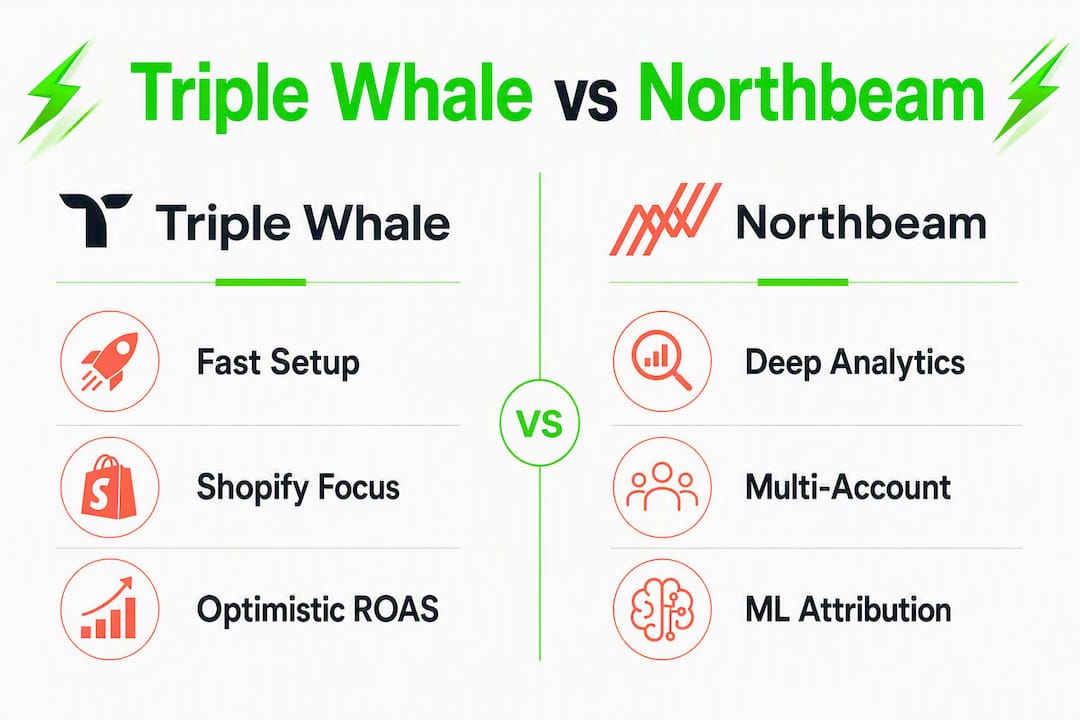
| Dimension | Triple Whale | Northbeam |
|---|---|---|
| Best for / buyer persona | Shopify-first brands under $10M GMV; founder-led or 1-marketer teams | Mid-market to enterprise brands $10M+ GMV; agencies; in-house analysts |
| Attribution model & transparency | Blended ROAS, pixel-first MTA, Moby AI layer, MMM (fast setup) | ML multi-touch engine, Northbeam Synthetic probabilistic layer, MMM+ (analyst-grade) |
| Tracking & signal-loss mitigation | First-party pixel, server-side events, post-purchase surveys | Probabilistic synthetic fills, deterministic view stitching, ML retraining |
| Key features | Creative analytics, Sonar benchmarking, mobile app, TikTok Shop connector (native) | Multi-account workspace, Amazon DSP ingestion, advanced view-through, CFO-ready outputs |
| Integrations & destinations | Shopify, Meta CAPI, Google Ads, TikTok Shop (native), Klaviyo, warehouse exports | Shopify, Meta CAPI, Google Ads, Amazon DSP (stronger), TikTok Shop (beta mid-2026) |
| Pricing & contract terms | Flat-fee tiers from ~$129/month; monthly and annual options | Ad-spend-based pricing; higher entry; enterprise contracts common |
| Onboarding & support | Under 2 hours for Shopify; live chat, community, docs | Weeks to months for full MMM calibration; dedicated CSM at higher tiers |
| Accuracy & validation methods | Blended model with synthetic fills; optimistic on Meta ROAS | Holdout-aligned outputs; Northbeam Synthetic; ~8% deviation vs geo-holdout in reported audits |
Buyer rule: if your monthly paid media is under roughly $200K and your team has no dedicated analyst, start with Triple Whale. Above that threshold, or when you need model outputs that survive a CFO's scrutiny, Northbeam's depth justifies the cost and setup time.
Why ecommerce teams add a third-party measurement layer
Platform-reported ROAS is not wrong — it's just incomplete. Meta counts a conversion if someone saw your ad. Google counts it if they clicked. Both claim the same sale. Without a neutral layer, you're allocating budget based on each platform's self-reported score.
The specific gaps that push teams toward a dedicated tool:
- Cross-channel double-counting: view-through credits on Meta and Google Ads can each claim the same order, inflating total attributed revenue well above actual revenue
- iOS and browser signal loss: Apple's App Tracking Transparency and ITP have degraded pixel-based tracking enough that platform-reported conversion windows are materially incomplete for many Shopify stores
- Fragmented data sources: brands running Shopify plus Amazon plus TikTok Shop have no native way to see blended performance; each platform reports in its own silo
- Creative testing at scale: knowing which ad creative drives incremental revenue (not just clicks) requires a measurement layer that can isolate creative-level contribution
- MMM and budget forecasting: upper-funnel spend on CTV, podcasts, or direct mail is invisible to pixel-based tools; a media mix model is the only way to credit it
A third-party tool is probably not worth the cost if you're spending under roughly $5K/month on paid media, running a single channel, or fully relying on a single ad platform's own conversion API. At that stage, offline conversion tracking and clean UTM hygiene will get you further than a $500/month attribution platform.
How each vendor builds attribution: model families and what they mean for your decisions
Attribution models are not interchangeable; the model a vendor uses determines which channels look efficient, which creative gets scaled, and whether your CFO believes the numbers.
The main model families you'll encounter:
Pixel-first blended models (Triple Whale's default) combine first-party pixel data with platform-reported signals, applying a blending algorithm to produce a single ROAS figure per channel. They are fast to set up and easy to read, but the blending logic is proprietary and not fully auditable.
ML multi-touch attribution (MTA) (Northbeam's core engine) assigns fractional credit to every touchpoint in the path using a machine-learning model trained on your own conversion data. It is more granular but requires enough conversion volume to train reliably—thin catalogs or low-volume channels produce noisy outputs.

Media mix modeling (MMM) uses regression-based econometric models to estimate channel contribution from aggregate spend and revenue data without relying on user-level tracking. Both vendors offer MMM, but Triple Whale's setup completes in days, while Northbeam's MMM calibration typically takes weeks to months and requires analyst involvement.
Probabilistic / synthetic layers fill gaps where deterministic signals are missing—iOS users, incognito browsers, cross-device paths. Northbeam calls its version Northbeam Synthetic; Triple Whale uses its own probabilistic fills within the pixel model.
The practical implication: Triple Whale's blended output will often show higher Meta ROAS than Northbeam's MTA output for the same account. That's not a bug — it reflects model philosophy. In one reported single-brand audit, Triple Whale attributed roughly 22% more paid social revenue than Northbeam, while Northbeam's output aligned within about 8% of observed geo-holdout lift. The question is which number you want to make budget decisions from.
Pro Tip: Ask every vendor three questions before signing: How often does the model retrain? Can you export touch-level event tables to your own warehouse? How does the platform integrate incrementality test results — does it ingest holdout data, or just display it separately?
Data collection, signal loss, and the integrations that actually matter
The gap between "we support that channel" and "we ingest order-level data from that channel" is where most vendor evaluations go wrong.
Common ingestion methods across both platforms:
- First-party pixel: JavaScript tag on your storefront captures page views, add-to-carts, and purchases; subject to browser blocking and ITP
- Server-side event streams: order confirmation data sent directly from your server or Shopify webhook, bypassing browser-level blocking; more reliable but requires setup
- Ad-platform APIs: pulls spend, impressions, and click data directly from Meta, Google, TikTok, and others; does not capture user-level paths
- Order-level connectors: direct feeds from Shopify, Amazon Seller Central, or TikTok Shop that match revenue to ad events at the order ID level
Signal loss handling differs meaningfully. Northbeam uses its Synthetic probabilistic model to fill gaps, with vendor-reported reduction in modeled error versus a 2024 baseline. Triple Whale uses probabilistic fills within its pixel model and supplements with post-purchase survey data that can be weighted into attribution outputs.
On TikTok Shop specifically, Triple Whale launched a native TikTok Shop connector in early 2026, while Northbeam's full integration was still in beta with general availability slated later in the year. If TikTok Shop revenue is material to your business, that gap matters now. For TikTok ad measurement more broadly, the channel-specific nuances are worth reviewing in a dedicated TikTok ads playbook for ecommerce brands.

Pro Tip: Before your vendor pilot, audit your order metadata. Every order should carry a UTM source, medium, and campaign in the notes field or a custom attribute. Vendors that ingest order-level data can only match as well as your tagging allows — garbage UTMs produce garbage attribution regardless of how sophisticated the model is.
Triple Whale: what you actually get day-to-day
Triple Whale is built around the idea that a single operator should be able to open one screen and know whether today is a good day to spend more. That philosophy shapes everything from the UI to the pricing.
The core product stack:
- Sonar benchmarking: — peer-group ROAS and CPM benchmarks drawn from anonymized Triple Whale network data, useful for sanity-checking your own numbers against similar brands
Triple Whale's real competitive advantage isn't the attribution model — it's the speed at which a non-analyst can go from "I installed this" to "I'm making decisions from this." For founder-led brands and lean marketing teams, that time-to-value gap between the two platforms is the whole ballgame.
The honest caveats: the blended model's optimism on Meta ROAS is real and documented. For very complex funnels with heavy upper-funnel spend, the pixel-first approach can over-attribute paid social. Amazon DSP integration was still in beta as of mid-2026. And if your CFO needs a statistically defensible attribution model with auditable methodology, Triple Whale's outputs may require supplemental holdout testing before they hold up in a board presentation.
Setup under two hours for Shopify brands is reported, and the live chat support and active community (Slack-based) are consistently cited as strengths in operator reviews.
Northbeam: what you get when depth matters more than speed
Northbeam is built for teams that want to question the numbers, not just read them. The product assumes you have at least one person who knows what a confidence interval is and cares about it.
Core capabilities:
- Amazon DSP ingestion: — stronger Amazon DSP support than Triple Whale as of mid-2026, relevant for brands running significant display spend on Amazon
The trade-offs are real. Northbeam's pricing starts in the several-hundred to low-thousands per month range, and large accounts pay significantly more. Onboarding and MMM calibration takes weeks to months, not hours. The interface is less polished than Triple Whale's, and non-analysts will find the model outputs harder to interpret without training. TikTok Shop order-level ingestion was still in beta at mid-2026.
Where Northbeam earns its price: agency operators managing many brands consistently cite its multi-account architecture as more mature, and the ML MTA outputs are better suited for CFO-level justification than a blended ROAS figure. If you're running TV, podcast, or direct mail alongside digital and need a single model that credits all of it, Northbeam's MMM+ is the more defensible choice.
Which platform fits your team?
The choice usually comes down to three variables: monthly ad spend, in-house analytics capacity, and primary channel mix. Here's how that maps to a vendor recommendation.
| Persona | Revenue / Monthly Ad Spend | Analytics Capacity | Recommended Platform |
|---|---|---|---|
| Founder-led Shopify brand | Under $10M GMV / under $50K/mo | Solo marketer or founder | Triple Whale |
| Mid-market DTC team | $10M–$50M GMV / $50K–$200K/mo | 1–2 analysts or senior media buyer | Triple Whale (start), Northbeam (when defensibility matters) |
| Enterprise brand or multi-channel | $50M+ GMV / $200K+/mo | In-house data science or analytics team | Northbeam |
| Agency managing multiple brands | Mixed / multiple accounts | Dedicated account managers + analysts | Northbeam (multi-account workspace) |
| Brand with heavy TikTok Shop revenue | Any | Any | Triple Whale (native connector live now) |
A few decision signals worth running before you sign anything:
- Do you need your attribution output to survive a CFO or board review? If yes, Northbeam's MTA outputs are more defensible than a blended ROAS figure.
- Is your primary channel Meta + Google with Shopify as the only storefront? Triple Whale covers that stack cleanly and at a fraction of the cost.
- Are you running Amazon DSP or heavy upper-funnel spend on CTV or podcasts? Northbeam's MMM+ handles those channels better.
- Does your agency need to manage five or more brand accounts from one workspace? Northbeam's multi-account architecture is more mature for that use case.
Pricing, contracts, and what implementation actually costs
The pricing structures are fundamentally different, and that difference matters more than the headline numbers.
Triple Whale uses flat-fee tiers based on GMV or store size. Entry tiers start near $129/month, which makes it accessible for early-stage brands. Annual contracts are available at a discount; monthly billing is an option. Managed onboarding add-ons exist but are not required for most Shopify setups.
Northbeam prices against ad spend, with a higher entry point in the several-hundred to low-thousands per month range. Enterprise accounts pay significantly more, and the contract structure typically involves annual commitments at higher tiers. Dedicated customer success management is included at enterprise levels.
What to probe during vendor calls:
- Data warehousing fees: some tiers charge extra for raw event exports to BigQuery or Snowflake; confirm whether your tier includes warehouse destinations or bills them separately
- Custom modeling fees: bespoke MMM configurations or custom attribution windows may carry additional charges not visible in the base tier pricing
- Historical re-ingestion costs: loading 12–24 months of historical order and ad data is often required for MMM calibration; ask whether that's included or billed as a setup fee
- Overage charges: ad-spend-based pricing (Northbeam) can produce unexpected bills if a campaign scales quickly; understand the overage structure before launch
On implementation timelines: Triple Whale MMM setups typically complete in days; Northbeam often requires weeks to months for onboarding and MMM calibration. The internal cost of that calibration time — analyst hours, UTM cleanup, historical data pulls — is often larger than the platform fee itself for mid-market brands.
Which integrations should you verify before committing?
A vendor's integration page and its actual production-ready connector are two different things. Verify these before you sign.
High-priority integrations to confirm are live and order-level (not just spend-level):
- Shopify order feed with line-item revenue and discount codes
- Meta CAPI (Conversions API) with server-side event deduplication
- Google Ads including Performance Max campaign-level data (see Google remarketing setup considerations for PMax attribution nuances)
- TikTok Shop order connector (native in Triple Whale; beta in Northbeam as of mid-2026)
- Amazon DSP and Seller Central (stronger in Northbeam as of mid-2026)
- Klaviyo or your email/SMS platform for owned-channel revenue attribution
- Data warehouse destinations (BigQuery, Snowflake, Redshift) if you plan to run custom models downstream
The integrations that most commonly require manual reconciliation post-launch are Amazon Seller Central (SKU-level matching), TikTok Shop (order ID alignment across platforms), and any offline channel like direct mail or in-store. Build reconciliation time into your pilot plan — assume at least two weeks of data before trusting channel-level outputs.
Push vs. pull matters: some connectors push data to the vendor on a schedule (hourly or daily); others pull on demand. For real-time creative decisions, a 24-hour data lag on a key channel is a meaningful limitation. Ask specifically about refresh cadence for each connector you depend on.
How to evaluate accuracy: what to test and what to watch for
Neither vendor publishes fully auditable third-party validation. That means the accuracy evaluation is your job during the pilot.
Validation checklist:
- Install both vendor tracking and your existing platform tracking simultaneously; run them in parallel for at least 30 days before making any budget changes based on vendor output
- Reconcile attributed revenue in the vendor dashboard against actual order-level revenue in Shopify or your OMS; a persistent gap above 10–15% warrants investigation
- Run a geo-based or time-based holdout test: pause spend in one region or for one week, then compare vendor-attributed lift against actual revenue change in that region
- Audit view-through attribution specifically: check whether the vendor is crediting impressions that occurred days before a conversion that was clearly driven by a search click
- Watch for attribution shifts after campaign changes: if a new campaign launches and attributed revenue from an unrelated channel suddenly spikes, the model may be redistributing credit incorrectly
Common red flags:
- Total attributed revenue across all channels consistently exceeds actual Shopify revenue by more than 20%
- A channel with no creative changes shows a sudden ROAS improvement after you launch a new campaign elsewhere
- View-through credit on Meta accounts for more than 30–40% of total attributed revenue without a corresponding lift in holdout tests
- The vendor cannot provide raw event-level export tables for independent validation
Operators report Triple Whale tends to produce more optimistic Meta ROAS, while Northbeam's numbers track better against geo-based holdout testing. Neither outcome makes one tool wrong — it makes the holdout test the arbiter, not the dashboard.
When to consider alternatives instead
Both platforms assume you want a packaged SaaS solution. That's not always the right answer.
The strongest case for skipping both vendors: you already have a data warehouse, a data engineer, and a business intelligence tool. In that setup, a custom attribution model built on your own event data often outperforms a packaged vendor on accuracy, costs less at scale, and gives you full control over model assumptions. The trade-off is build time and ongoing maintenance.
Alternatives worth evaluating by situation:
- In-house measurement + data warehouse (BigQuery/Snowflake + dbt + Looker): best for brands with a data engineer and 6+ months to build; produces the most defensible and customizable outputs, but requires ongoing analyst time
- CDP with modeling (Segment, Rudderstack): useful when you need clean event data piped to multiple destinations; attribution modeling is typically less sophisticated than either vendor but data governance is stronger
- Platform-native reporting plus periodic MMM audits: viable for brands spending under $50K/month on a small number of channels; run a quarterly MMM audit through an agency or consultant instead of paying a monthly SaaS fee
- Agency-run incrementality programs: for brands that need defensible budget allocation but lack internal analytics capacity, an agency running geo holdouts and translating results into channel budgets can replace a packaged vendor entirely
Feature categories where alternatives often beat packaged vendors: strict data governance requirements (healthcare, financial services), custom econometric MMM with proprietary variables, and specialized marketplace attribution for brands with complex Amazon catalog structures.
How this comparison was built
This comparison draws on vendor documentation, public case studies, independent industry reporting from sources including D2C Times and Ecommerce Times, operator interviews, and hands-on demos where available.
Limitations to understand:
- Neither vendor publishes fully auditable third-party validation of their attribution models; all accuracy claims are vendor-reported or drawn from single-brand operator audits
- Integration rollout timelines change quickly; the TikTok Shop and Amazon DSP status noted here reflects mid-2026 reporting and may have changed
- Pricing is subject to change and varies by account size, contract length, and negotiation; treat all figures as directional, not contractual
- Model outputs are proprietary; neither vendor allows full inspection of the weighting logic inside their ML models
To re-run this evaluation on your own data:
- Request a sandbox or trial account from each vendor with your own historical data loaded
- Run both tools in parallel for 30 days minimum before drawing conclusions
- Reconcile attributed revenue against Shopify order-level data weekly
- Run at least one geo or time-based holdout test before committing budget changes to either output
What's the final verdict, and how do you run the pilot?
Decision rule: if your monthly paid media is under $200K, your primary channels are Meta and Google, and your team has no dedicated analyst, start with Triple Whale. If you're above that threshold, running multi-channel campaigns that include offline or upper-funnel spend, or managing multiple brand accounts, Northbeam's depth is worth the cost and setup time.
30–60 day pilot plan:
- Week 1–2: clean your UTM taxonomy across all active campaigns; every campaign should have a consistent source, medium, and campaign name before you ingest historical data
- Week 2–3: install vendor pixel and server-side connector; load 12 months of historical order data; confirm Shopify order feed is reconciling within 5% of actual revenue
- Week 3–4: connect all active ad platforms (Meta CAPI, Google Ads, TikTok); verify spend data matches platform-reported spend within 2–3%
- Week 4–6: run a geo-based holdout test on one channel (pause spend in one state or DMA); compare vendor-attributed lift against actual revenue change in that region
- Week 6–8: present channel-level ROAS outputs to your CFO or finance team; note any figures that require explanation or that conflict with platform-reported numbers
- End of pilot: reconcile total attributed revenue against actual Shopify revenue for the full period; if the gap exceeds 15%, investigate before making budget changes
Questions to ask during vendor demo calls:
- What is the model retraining cadence, and how are we notified when the model updates?
- Can we export raw event-level tables to our own warehouse, and is that included in our tier?
- What are your SLAs for data freshness on each connector we depend on?
- How does the platform ingest holdout test results — does it update model weights, or just display them separately?
- What is the escalation path if a connector breaks or data goes missing for 48+ hours?
- Are there additional fees for custom attribution windows, historical re-ingestion, or bespoke MMM configurations?
Key Takeaways
Triple Whale fits lean Shopify-first teams that need fast setup and readable outputs; Northbeam fits analytically mature teams and agencies that need statistically defensible attribution at scale.
| Point | Details |
|---|---|
| Spend threshold matters | Under $200K/month paid media, Triple Whale's speed and price are hard to beat; above it, Northbeam's depth justifies the cost. |
| Onboarding gap is real | Triple Whale sets up in under two hours for most Shopify stores; Northbeam MMM calibration typically takes weeks to months. |
| TikTok Shop connector | Triple Whale's native connector was live in early 2026; Northbeam's was still in beta at mid-2026. |
| Validate before deciding | Run a 30–60 day parallel audit and at least one geo holdout test before committing budget changes to either platform's output. |
| Crowdcompany as an alternative | Teams without internal analytics capacity can work with Crowdcompany to run holdout tests, reconcile vendor outputs, and translate attribution data into budget decisions. |
The real cost of running two attribution tools
The conventional wisdom in DTC measurement circles is to pick one tool and commit. Agencies that run measurement audits across multiple accounts know the reality is messier. Many mid-market brands end up running Triple Whale for real-time creative decisions and Northbeam for monthly budget allocation — and the hidden cost of that setup is not the software fees, it's the analyst time spent explaining why the two tools disagree.
That disagreement is not a bug. It reflects genuinely different model philosophies: one optimizes for speed and operator accessibility, the other for statistical rigor. The mistake is treating both outputs as equally authoritative for the same decision. Use Triple Whale's creative analytics to kill underperforming ads this week. Use Northbeam's MTA outputs to defend next quarter's channel budget to your CFO. When you blur those use cases, you end up in meetings arguing about which number is "right" instead of making decisions.
The practical tip for hybrid setups: designate one tool as the decision-making system of record for each decision type before you launch the pilot. Write it down. "Creative rotation decisions use Triple Whale. Budget allocation above $50K/channel uses Northbeam." That single rule eliminates most of the conflicting-signal confusion that makes dual-vendor setups expensive.
Crowdcompany runs the measurement work your team doesn't have time for
If you've read this far and your honest reaction is "we don't have the analyst capacity to run a 60-day parallel audit and a geo holdout test," that's the real problem — and it's more common than either vendor's sales deck acknowledges.
Crowdcompany handles the measurement layer that packaged vendors leave to you: custom integration setup, UTM taxonomy cleanup, geo holdout design, and translating attribution outputs into actual budget decisions your finance team will accept. We work with ecommerce brands that need the rigor of a Northbeam-style audit without the six-figure annual contract or the internal data science hire. Whether you're evaluating Triple Whale, Northbeam, or deciding whether either tool is worth the investment at your current spend level, a discovery call with Crowdcompany gets you a clear answer faster than a vendor trial. See how our approach compares to other agency options before you commit to a platform or a retainer.
Useful sources for your evaluation
These are the primary sources and vendor documents worth consulting as you run your own comparison:
- Triple Whale vs. Northbeam (2026) — Let's Talk Shop: pricing breakdown, attribution methodology comparison, and AI feature notes
What to check first in vendor docs: look for the raw export schema (event tables, order tables), the incrementality testing guide, and the connector-specific data refresh SLAs. Those three documents tell you more about a vendor's actual capabilities than any feature comparison page.