
Local link building is the practice of earning backlinks from geographically or topically relevant websites, chambers, press, and community organizations to raise the "prominence" signal Google uses in local rankings. The single best first move is auditing your Google Business Profile, then targeting three high-quality local link sources instead of dozens of low-value ones. Quality and relevance beat volume every time.
TL;DR:
- Earning backlinks from relevant local sources, such as chambers or press, significantly boosts your Google prominence signal more than volume or generic directories.
- Prioritizing high-quality, geographically relevant links like industry associations and local media is more effective than mass directory submissions or low-value placements.
- Building relationships through sponsorships, partnerships, and locally useful content can earn sustained links with less outreach effort over time.
- Fixing inconsistent NAP data and avoiding spammy, low-quality link buying are essential steps before expanding your local link profile.
- Generally, 20 to 50 high-quality local links are enough to improve rankings in low-competition markets, while more may be needed in highly competitive areas.
Table of Contents
- What Local Link Building Does for Your Local SEO
- The Local Link Tactics Worth Your Time
- Your Monthly Local Link Building Workflow
- How to Measure Local Link Building Success
- Common Local Link Building Mistakes to Avoid
- How Crowdcompany Approaches Local Link Building
- When Local Links Are Worth Prioritizing First
- Get Managed Local Link Building Without the Learning Curve
- Sources
- FAQ
What Local Link Building Does for Your Local SEO
Google's own documentation defines prominence as a ranking factor built from review volume, business information, and links pointing to your site. Prominence tells Google how well known and established a business is offline and online, and links are one of the clearest signals the algorithm can crawl and verify.
Backlinks and citations do different jobs. A citation, a mention of your business name, address, and phone number on a directory, doesn't need to link anywhere to help you show up in the Local Pack. A backlink, a clickable link from another site, passes authority and can move both map rankings and organic search results. You need both, but they aren't interchangeable.
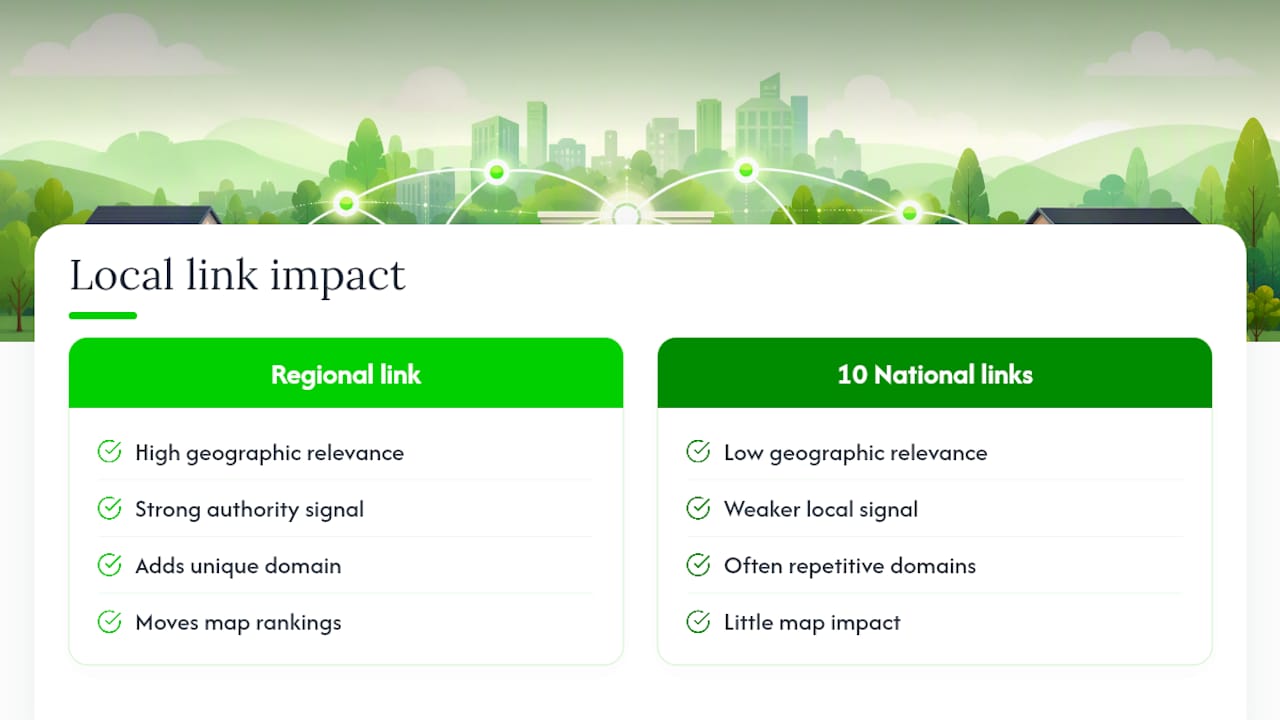
Geographic relevance matters more than most business owners assume. A link from a small regional newspaper in your city often does more for local rankings than ten links from national directories that have never heard of your town. A patent describing how search systems calculate location prominence shows that the number and authority of documents referencing a business feed directly into that score. Diversity of referring domains, not raw count, is what search engines weigh.
The Local Link Tactics Worth Your Time
Not every tactic deserves equal effort. Some placements take an afternoon and pay off for years; others burn a week of outreach for a single low-value mention. Here's the priority order that consistently works for small and mid-sized local businesses.
1. Chamber of Commerce and trade association listings
Joining your local chamber typically involves an annual fee that varies depending on your city and business size, and most chambers list every paying member on a searchable directory page. That's a legitimate, editorially reviewed link from a domain with real local authority. Trade associations tied to your industry (a state restaurant association, a regional contractors' guild) work the same way and often carry more topical weight than the chamber listing itself.
2. Local press and editorial features
A mention in your city's business journal or a feature on a local news site is worth more than almost anything else you can earn. Pitch angles that actually land: a hiring milestone, a partnership with another local business, a seasonal community event you're sponsoring, or data you can share (foot traffic trends, hiring numbers, customer surveys). Reporters need stories, not press releases about your anniversary sale.
3. Event sponsorships and nonprofit partnerships
Sponsoring a 5K, a school fundraiser, or a nonprofit gala usually gets your business name and a link on the event page, and sometimes a shoutout on the organization's sponsor page year after year. Costs range widely, from a $100 in-kind donation to a $2,500 title sponsorship, but even small sponsorships often include a permanent link on an "our supporters" page that sticks around long after the event ends.
4. Partner and supplier reciprocal listings
If you have vendors, suppliers, or complementary local businesses you refer customers to, ask if they maintain a "partners" or "preferred vendors" page. A landscaper and a pool company, a bakery and a coffee roaster, a dentist and an orthodontist down the street, these relationships already exist. Formalizing them into a link exchange takes one email: "We send clients your way regularly, mind adding us to your partners page? Happy to do the same."
5. Locally useful content that earns links on its own
Pages built specifically for your area attract links without outreach. Think neighborhood guides, "best parking near [your street]" posts, local event calendars, or a data-driven piece on your industry in your metro area. This is where a 90-day local SEO strategy helps, because content built for Map Pack gains needs a plan, not a single blog post.
6. Reclaiming unlinked mentions
Search your business name plus your city in Google and see how many articles, directories, or community sites mention you without linking. Reclaiming unlinked mentions and converting existing local relationships into links is often the fastest, cheapest win available, since the relationship already exists. A quick email asking a site to add the link usually gets a yes within a week.
7. Guest posts, podcasts, and scholarships
Local business podcasts, regional trade publications, and .edu scholarship pages are underused. Offering a modest scholarship (even $500) to a local high school or community college often earns a link from the school's financial aid page, a domain type that carries unusual trust. Guest posting on a local industry blog or appearing on a regional business podcast works the same way, one placement, one durable link.
8. Cleanup and monitoring
Before chasing new links, fix what's broken. Inconsistent NAP data across old directories actively works against you. Set up a monitoring routine using Google Alerts for your business name and a paid tool for tracking new and lost backlinks.
Pro Tip: Five to ten quality local links from sources like your chamber, a regional paper, and a nonprofit sponsor page will typically outperform fifty generic directory submissions, and they take less time to earn once you build the relationships.
Your Monthly Local Link Building Workflow
Local link building works best as a repeatable monthly cycle, not a one-time sprint. Here's a workflow one part-time person can run.
- Week 1: Build your prospect list. Identify 10 to 15 targets, chambers, local reporters, nonprofits, potential partners, and draft short, specific outreach emails for each.
- Week 2: Create or refine. Write the content piece, data angle, or press pitch you'll actually send. Editorial contacts respond to specifics, not generic "we'd love to be featured" requests.
- Week 3: Follow up and submit. Send follow-up emails to Week 1 contacts, submit sponsorship applications, and reach out about scholarship or podcast opportunities.
- Week 4: Audit and plan. Review what landed, update your tracking sheet, and build next month's target list based on what worked.
Keep a simple spreadsheet with these fields for every link:
- Referring domain and estimated authority
- Date acquired
- Contact name and email
- Link type (citation, editorial, sponsorship, partner)
- Status (pitched, pending, live, lost)
This sheet becomes your evidence for what's working and your reminder list for relationships worth nurturing next quarter.
How to Measure Local Link Building Success
Watch four numbers: referring domains, organic traffic to the pages earning links, Google Business Profile impressions and queries, and your position for target local keywords. Track them monthly, not weekly, since local ranking shifts take time to show up.
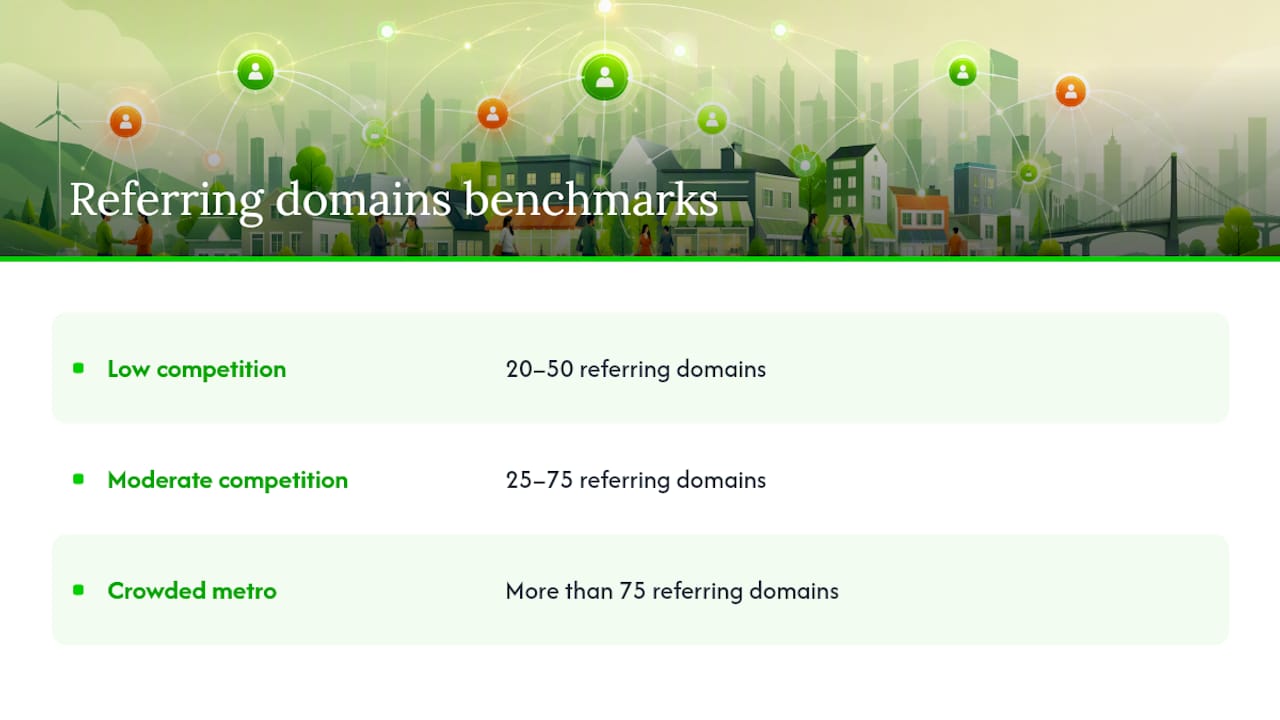
For benchmarks, practitioner data suggests that low-competition niches often rank with 20 to 50 referring domains, moderate competition needs roughly 25 to 75, and crowded metro markets can require more than 75. Your actual target depends heavily on what your closest map pack competitors already have.
Whitespark's ranking factor research puts link signals at roughly 15% of local ranking weight, behind Google Business Profile signals and reviews but still a meaningful, controllable lever.
Use Google Search Console alongside a paid backlink tracking tool to see which new links correlate with traffic or ranking movement. Links rarely work alone, pair them with steady GBP updates and review velocity for the clearest Map Pack gains.
Common Local Link Building Mistakes to Avoid
Cheap bulk link packages, the "$5 per link" offers flooding freelance marketplaces, cause more harm than good. These links usually sit on low-quality directories with no editorial review and no real audience, and Google's algorithms are increasingly good at discounting or penalizing them.
Watch for these red flags before buying any link package:
- No editorial context: the link sits in a footer, sidebar, or hidden widget with no surrounding content
- Promises of rapid scale ("50 links in 30 days") with no explanation of where they come from
- Vague site lists that the seller won't disclose before payment
- Identical anchor text used across dozens of placements, a pattern that reads as manipulative to search engines
Inconsistent NAP data across your existing citations undermines everything else you build. If three directories list an old suite number or a disconnected phone line, fix those before spending a dollar on new outreach. Vary your anchor text naturally, too, mix your business name, your city plus service, and generic phrases like "visit their site" rather than repeating the same exact-match phrase on every placement.
Pro Tip: Run your business name through a citation audit tool once a quarter. Catching a wrong address on one directory before it spreads to five more saves hours of cleanup later.
How Crowdcompany Approaches Local Link Building
Local link building works best paired with the foundational pieces most businesses skip. Crowdcompany's 90-day local SEO strategy lays out a 30/60/90 plan built around Map Pack gains, and the Boca Raton local SEO checklist covers the GBP fundamentals that should be locked down before outreach starts. The citation-building guide breaks down what separates a useful citation from a wasted one.
Typical service work includes digital PR outreach to local press, citation cleanup across major directories, and ongoing GEO and blog SEO to create the locally useful content pages that attract links naturally..
When Local Links Are Worth Prioritizing First
Service-area businesses, local retail, and low-competition niches see the fastest returns from local link building, often before paid ads even finish their learning phase. If your GBP profile is thin or your reviews are stalled, fix those first, links amplify a strong profile far more than they rescue a weak one. Expect three to six months before ranking movement becomes obvious and attributable.
— E
Get Managed Local Link Building Without the Learning Curve
Running chamber outreach, press pitches, and citation cleanup on top of everything else it takes to run a local business eats a week most owners don't have. These services are offered as part of an engagement with flat, transparent pricing, no long-term contracts, and monthly reporting focused on leads and revenue instead of vanity link counts.
The GEO & Blog SEO service covers exactly the tactics in this article: digital PR outreach, citation audits, and locally useful content built to attract links on its own. If you'd rather see the full local marketing picture first, the services overview lists everything at $500 per service per month, and the Boca Raton checklist is a free next step if you want to audit your own GBP before talking to anyone. Either way, start by seeing what's actually missing from your current setup.
Sources
For the full picture on prominence, read Google's own guidance on ratings and prominence. Whitespark's ranking factors survey breaks down exactly how much weight links carry against reviews and GBP signals. For tactic-level detail, The Stacc's local link building guide and SERPView's link building glossary are both worth bookmarking for ongoing reference.
- Google Business Profile help — About your business’s rating and prominence
- Whitespark Local Search Ranking Factors (2026)
- How Many Backlinks Do You Actually Need to Rank Locally? — Serpnetic
FAQ
What Is Local Link Building in SEO?
Local link building is earning backlinks from geographically or topically relevant sources, chambers, local press, sponsorships, to boost the prominence signal Google uses for local rankings. It differs from general link building by prioritizing relevance to your city or service area over raw domain authority.
How Much Should I Pay for Local Link Building?
Costs vary by tactic: chamber memberships often require an annual fee depending on the location and business size, while event sponsorships can range widely in cost from small donations to larger sponsorships. Crowdcompany's GEO & Blog SEO service is priced at $500 per month if you want the outreach and content work managed for you.
What Is Meant by Link Building?
Link building is the process of getting other websites to link to yours, which search engines read as a signal of trust and authority. In a local context, the most valuable links come from sources tied to your city or industry rather than generic national directories.
Is Doing Local SEO Worth It?
Yes, for most service-area and local retail businesses, since Google Business Profile signals, reviews, and local links together determine who shows up in the Map Pack. Whitespark's research puts link signals at roughly 15% of local ranking weight, meaningful but only one piece of a larger local visibility strategy.
How Many Local Links Do I Actually Need?
Realistic targets depend on competition: low-competition niches often rank with 20 to 50 referring domains, while competitive metro markets may need more than 75. Check what your top three map pack competitors have before setting your own goal.