
The fastest way to drive local customers is to fix your Google Business Profile, lock down NAP consistency across the web, and build steady review velocity, then run those fixes through a 90-day sprint you actually measure. Most small businesses see early movement in local pack visibility within four to six weeks and compounding gains by month three. This works because Google leans on Google Business Profile (GBP) data, structured citations, and LocalBusiness schema to decide who shows up. That is the whole game; everything else in this guide builds on it.
TL;DR:
- Most local SEO gains stem from fixing Google Business Profile (GBP) data, citation consistency, and building review momentum within the first 90 days of a structured plan.
- GBP optimization, review acquisition, and citation cleanup are the highest priority steps to influence relevance, prominence, and ranking signals.
- Building a steady review flow of five or more reviews per month fosters more consistent signals than irregular review spikes.
- Technical website health, including accurate NAP placement, page speed, and schema markup, supports ranking efforts but must follow foundational local SEO actions.
Table of Contents
- What Is a Local SEO Strategy and Why Does It Matter?
- How Does Google Decide Local Search Rankings?
- The Local SEO Playbook: Audits, GBP, Reviews, Citations, and Links
- Your 90-Day Local SEO Sprint, Week by Week
- What Technical Fixes Actually Support Local Rankings?
- Which Tools and Weekly Checklist Actually Move the Needle?
- Why Sequencing Beats Scattershot Fixes
- Ready to Run Your Local SEO Sprint?
- Sources
- FAQ
What Is a Local SEO Strategy and Why Does It Matter?
A local SEO strategy is the set of actions that get your business found by nearby customers on Google Maps, the local map pack, and local organic search results. Done right, it turns "coffee shop near me" or "plumber in [your town]" searches into phone calls, walk ins, and booked appointments without paying for every single click.
Three factors decide where you land: relevance, distance, and prominence. Google's own ranking guidance confirms these are the core levers, and a complete, accurate Google Business Profile improves your odds of showing up in that coveted three pack at the top of Maps results.
Relevance means how well your business profile matches what someone searched. Distance is how close you are to the searcher or the location they typed in. Prominence covers everything that signals you're a real, trusted, established business, meaning reviews, citations, backlinks, and general online visibility.
Why should a small business owner care about the mechanics? Because local search intent converts at a much higher rate than generic browsing. Someone searching "emergency electrician open now" isn't window shopping.
The payoffs show up in a few concrete ways:
- More phone calls and direction requests straight from your Google Business Profile
- Increased walk in foot traffic from map pack visibility
- Higher booking and quote request rates because local searchers are closer to a buying decision
- Better conversion rates than broad, non-local organic traffic, since intent is already narrowed to your area
None of this requires a massive marketing budget. It requires getting the fundamentals right, in the right order, and sticking with it long enough for the signals to compound.
How Does Google Decide Local Search Rankings?
Google's local algorithm runs on the same three pillar system in every market and every industry: relevance, distance, and prominence. Understanding which levers you can actually pull matters more than memorizing ranking theory.
Relevance comes from how precisely your GBP categories, services list, and website content match a search query. A general contractor who lists "kitchen remodeling" as a specific service ranks better for "kitchen remodeler near me" than one who just lists "contractor."
Distance is largely out of your control on a per-search basis, since Google calculates it from the searcher's location. But you can influence which broader areas you're competitive in by building location-specific pages and citations that reinforce your service area.
Prominence is where most of your effort should go. It's built from review count and quality, citation consistency, backlinks, and general web presence. A business with a large number of reviews and consistent citations across many directories reads as more prominent than one with few reviews and mismatched addresses floating around the web.
Backlinko's local SEO research shows that GBP optimization, local keyword targeting, and review acquisition drive the fastest near-term gains, while website authority and backlinks compound value over months rather than weeks.
Structured data plays a growing role here too. LocalBusiness schema gives search engines a machine-readable version of your name, address, phone number, hours, and geo coordinates, which helps both traditional local rankings and the AI Overviews now surfacing in search results.
Here's where each tactic feeds a specific signal:
- Primary GBP category selection feeds relevance
- Service-area settings and location pages feed distance signals
- Review volume and response rate feed prominence
- Citation accuracy across directories feeds prominence and trust
The Local SEO Playbook: Audits, GBP, Reviews, Citations, and Links
Once you understand the three signals, the next question is sequencing. Do the wrong things first and you waste weeks. Here's the order that actually works, based on what moves the needle fastest.
1. Run the audit before you touch anything
Start by verifying your GBP listing is claimed and verified, then run a NAP (name, address, phone) scan across your website, GBP, and top directories like Yelp, Apple Maps, and Facebook. Pull up the map pack for your top three keywords and note who's ranking, what categories they use, and how many reviews they have. Record baseline numbers now, calls, GBP views, current rank positions, because you'll need them in 90 days to prove what worked.
2. Do local keyword research and map it to pages
Local keyword research isn't just "plumber Boca Raton." It's identifying the specific service plus location combinations your customers actually type: "emergency water heater repair," "same day AC repair near me," "licensed electrician for panel upgrades." Tools like Google's Keyword Planner, Semrush, or even Google Search Console's existing query data show you what's already driving impressions. Once you have the list, assign each keyword cluster to a specific page. Don't try to rank one homepage for fifteen services; build dedicated pages instead.
3. Optimize your Google Business Profile completely
This is the highest leverage fix on the list. Choose the most specific primary category available, not "contractor" when "roofing contractor" exists, since category precision is one of the most overlooked ranking factors. Add every relevant secondary category, list all services with clear descriptions, and write a business description that includes your city and core services naturally.
Upload real photos of your storefront, team, and completed work. Use GBP Posts regularly to highlight offers or updates. Turn on booking links if you take appointments. Monitor and answer the Q&A section proactively; don't let competitors or confused customers leave unanswered questions sitting there. Our Google Business Profile optimization playbook breaks down field-by-field settings if you want to go deeper.
4. Build a review system, not a one-time push
Review velocity beats review spikes. A business that earns five new reviews every month for a year builds stronger, steadier signal than one that begs for fifty reviews in a single week and then goes quiet. Set a baseline target of regularly acquiring new reviews monthly, and use SMS or email requests timed to moments of delight, right after a service call, delivery, or completed project, rather than generic blanket asks.
Automate the cadence where you can. A structured 90-day reputation monitoring approach keeps the ask consistent instead of relying on staff remembering to follow up. Respond to every review, positive and negative, within 48 hours. Responding to reviews is itself a ranking and conversion signal, not just good customer service. Keep response templates on hand but personalize each one with a specific detail from the review.
Pro Tip: Ask for the review before the customer leaves the property or hangs up the phone. Requests sent same-day convert at a far higher rate than ones sent a week later when the experience has faded.
5. Fix citations before you scale them
A citation is any online listing of your business name, address, and phone number, think Yelp, Apple Maps, Bing Places, industry directories. Inconsistent NAP data across these listings confuses Google and weakens prominence signals. Prioritize the ten highest-authority directories for your industry first: fix mismatches there before spending time on smaller, lower-value listings. Our citation building guide walks through which directories carry the most weight by industry.
6. Build out your website's local pages
Every service you offer in every area you serve deserves its own page, not a shared paragraph buried in a general services page. Each service or location page should include your process, a general price range if you can share one, and local proof, project photos, neighborhood names, or testimonials from that area. Put your NAP in the footer of every page, site-wide, matching your GBP exactly. Fast mobile load times aren't optional here since most local searches happen on phones.
7. Add structured data and go after local links
Add LocalBusiness JSON-LD schema to your homepage and every location page, covering name, address, phone, hours, and geo coordinates. Then pursue local links: sponsor a Little League team, join your chamber of commerce, pitch local news outlets, and reclaim any unlinked mentions of your business name already floating around the web.
8. Measure everything from day one
Track GBP Insights for calls, direction requests, and website clicks. Pair that with GA4 for on-site behavior, Search Console for query data, call tracking software to attribute phone leads, and periodic rank-grid checks across a sample of ZIP codes in your service area, not just your office address.
Your 90-Day Local SEO Sprint, Week by Week
A sequenced sprint that starts with measurement and GBP fundamentals produces steadier, compounding results than scattered, ad-hoc fixes applied whenever someone remembers to do them. Search Engine Land's sprint methodology frames this as four distinct phases, each with its own deliverables and success markers.
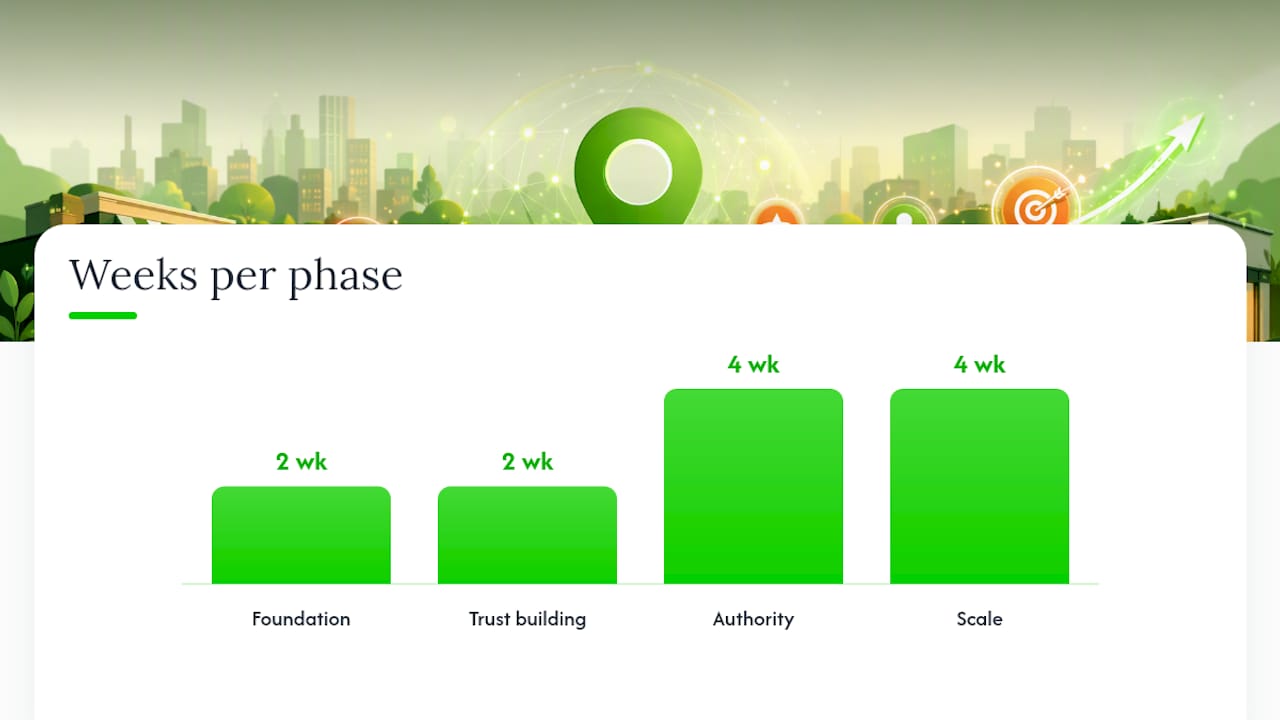
- Weeks 1 to 2: Audit and foundation. Verify your GBP listing, correct your primary category, run the full NAP consistency scan, and document baseline metrics across calls, rankings, and review counts.
- Weeks 3 to 4: Systems and cleanup. Launch your review request system with automated timing, begin fixing citation inconsistencies starting with the highest-authority directories, and publish or rewrite your top two or three service pages.
- Weeks 5 to 8: Build momentum. Push review velocity toward the five-plus-per-month target, start local link outreach (chamber, sponsorships, unlinked mention reclamation), add LocalBusiness schema site-wide, and fix any mobile speed issues flagged by Core Web Vitals.
- Weeks 9 to 12: Scale and report. Expand PR and link efforts, pull a full KPI report against your baseline, and double down on whichever pages or tactics are already showing movement.
| Phase | Weeks | Primary focus | Key KPI to track |
|---|---|---|---|
| Foundation | 1–2 | GBP verification, NAP audit, baselines | GBP completeness percentage |
| Trust building | 3–4 | Review system launch, citation cleanup | New reviews per month |
| Authority | 5–8 | Link outreach, schema, mobile fixes | Calls and map-pack position |
| Scale | 9–12 | PR expansion, reporting, iteration | Rank-grid improvement across sampled ZIPs |
Expect GBP completeness to be fully optimized by week two if you're disciplined about it. Review counts usually begin to show improvement within about six weeks, and map pack position shifts, checked across a grid of ZIP codes rather than only your storefront, typically become noticeable by the later part of the sprint. Our internal map pack ranking playbook lays out a comparable 30/60/90 framework if you want a second reference point for pacing.
The point of running this in phases instead of all at once isn't just organization. Google rewards consistent, sustained activity over sudden bursts, so a steady drip of reviews, content, and citation fixes across twelve weeks reads as more trustworthy than a flurry of changes in week one followed by silence.
What Technical Fixes Actually Support Local Rankings?
Your website's technical health directly affects whether the local signals you're building actually convert into rankings and calls. Get the architecture wrong and even a perfect GBP profile underperforms.
Service and location pages need a consistent template: a clear description of the process customers go through, a general price range where your industry allows it, an FAQ section addressing common objections, and local proof specific to that area, project photos, neighborhood mentions, or a testimonial from a nearby customer.
Beyond page content, a handful of technical checkpoints matter more than people expect:
- NAP in the footer must match your GBP exactly, down to abbreviations like "St." versus "Street"
- Canonical tags should prevent duplicate location pages from competing against each other in search results
- Mobile page speed matters disproportionately, since over 60% of local searches happen on mobile devices
- Core Web Vitals scores, especially load time and interaction responsiveness, should be checked monthly, not once and forgotten
- LocalBusiness JSON-LD schema should include name, address, phone, hours, and geo coordinates on every location-specific page
Test your schema markup after implementation rather than assuming it validated correctly. A malformed script tag renders your structured data invisible to Google even though it looks fine to a human visitor. If you run multiple locations, keep each page's schema unique to that address instead of copying one block site-wide, since duplicated schema across locations creates the same confusion duplicate content does.
Which Tools and Weekly Checklist Actually Move the Needle?
You don't need a dozen subscriptions to run this well. A handful of tools covering five categories, GBP management, citation checking, rank tracking, review automation, and analytics, cover almost everything in this guide.
For GBP management, Google's own dashboard handles posts, photos, and Q&A monitoring natively. Citation checkers like Moz Local or BrightLocal flag NAP inconsistencies across directories in minutes instead of you manually checking forty listings by hand. Rank-grid trackers show you position across a spread of ZIP codes, not just your office address, which matters since map pack results shift block by block. Review automation platforms handle the SMS or email cadence so requests go out consistently. GA4, Search Console, and call tracking software round out measurement.
A one-page checklist you can run through this week:
- Weekly: Post one GBP update, respond to all new reviews, check for new Q&A submissions
- Weekly: Scan call tracking data for lead source attribution
- Monthly: Run a citation consistency check across top ten directories
- Monthly: Pull GBP Insights and compare calls, views, and direction requests against last month
- Monthly: Check rank-grid position across three to five sampled ZIP codes
| Task | Cadence | Tool category |
|---|---|---|
| GBP post and photo update | Weekly | GBP manager |
| Review response | Weekly | Review automation |
| Citation audit | Monthly | Citation checker |
| Rank-grid check | Monthly | Rank tracker |
| KPI report pull | Monthly | Analytics/call tracking |
For a deeper, printable version of this exact checklist, our Boca Raton Local SEO Checklist includes the full GBP field list and citation priority order.
Why Sequencing Beats Scattershot Fixes
Most local SEO advice treats every tactic as equally urgent, which is exactly why so many small business owners burn a weekend fixing citations before their GBP category is even correct. That's backward. Fix the foundation first, GBP and NAP, then build trust through reviews, then layer on authority through citations and links, then keep the whole thing alive with regular posts and photo updates. Skip a layer and the ones above it underperform no matter how much effort goes into them.
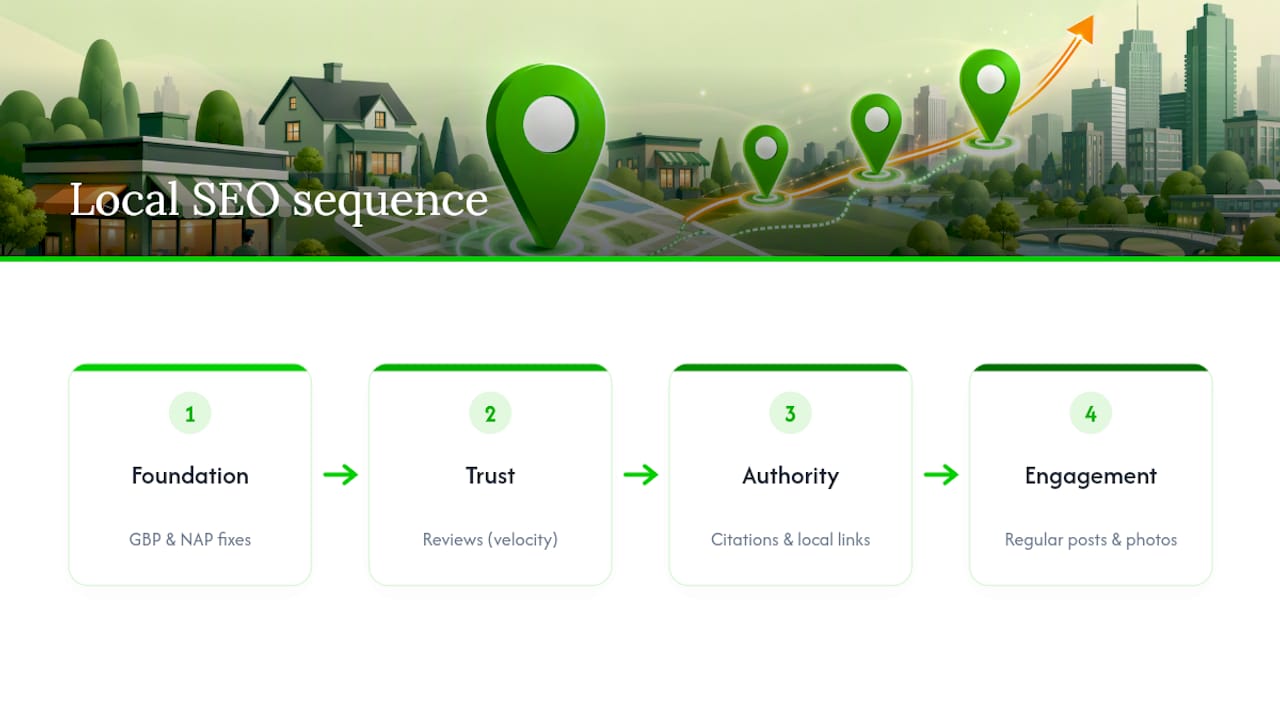
We sequence client work this exact way: foundation, trust, authority, engagement, because chasing backlinks for a business with a half-finished GBP profile wastes budget on the wrong lever. Measurement-first isn't a slogan, it's how you know which fix actually moved the number before you spend another dollar on the next one.
The part people underestimate is patience. Review velocity and citation consistency are boring, unglamorous work compared to chasing a viral local PR hit, but they're also the two levers most within a business owner's direct control on any given week. A flashy one-time campaign fades. A five-review-a-month habit compounds for years.
— E
Ready to Run Your Local SEO Sprint?
Running this playbook alone takes real time: audits, weekly review cadences, citation fixes, schema implementation, and consistent reporting add up fast on top of running an actual business. A full-service agency can handle the entire sprint for you, including GBP optimization, review and reputation management, local content builds, citation cleanup, and local PR outreach, so the twelve-week plan above happens on schedule instead of getting pushed to "next week" indefinitely.
Typical growth marketing engagements include a structured 90-day kickoff, weekly progress reports, and clear KPI targets tied to calls, reviews, and map pack position, the same metrics covered throughout this guide. If you run a multi-location business, our theme pages and local expansion services handle the duplication and scaling challenges that come with managing more than one storefront. For businesses that want the citation and PR side handled by people who do it daily, our digital PR services cover outreach, sponsorship negotiation, and unlinked mention reclamation. Book a call to get your 90-day sprint scoped this week.
Sources
- Local SEO sprints: A 90-day plan for service businesses in 2026 - Search Engine Land
- Local SEO: The Definitive Guide (2025) - Backlinko
- What Is Local SEO? How to Do It + Strategies for 2024 - Semrush
- Schema
FAQ
What Is a Local SEO Strategy?
A local SEO strategy is the combined set of actions, GBP optimization, citation consistency, review generation, and local content, that help a business rank in map pack and local organic results for nearby searchers.
How Do I Target Local SEO for My Business?
Start by claiming and fully completing your Google Business Profile, matching your NAP exactly across every directory, then build review velocity and local-specific service pages targeting the exact terms customers search.
Is Local SEO Actually Effective for Small Businesses?
Yes. Local search intent converts at a higher rate than general browsing since searchers are already close to a buying decision, and a complete GBP profile measurably improves the odds of local pack visibility.
What Are the Most Important Things for Ranking Locally?
Prioritize GBP completeness and correct category selection, NAP consistency across citations, steady review velocity of five or more monthly, local service and location pages, and LocalBusiness schema, in roughly that order.
How Long Does It Take to See Local SEO Results?
Most businesses see GBP and citation fixes reflected within four to six weeks, with map pack position shifts and call volume increases typically visible by week eight to ten of a structured 90-day sprint.