
Citation building means creating and correcting your business's name, address, and phone number (NAP) across directories, maps, and review sites so search engines trust that you're a real, findable business. Get it right, and you show up more often in the local pack and organic results that send people through your door. Get it wrong, and you're fighting your own listings for rankings.
The immediate payoff is trust. Search engines cross-reference your NAP against dozens of sources, and effective citation management can help a business perform significantly stronger in local search than a business with scattered, conflicting listings. The next move is simple:
- Pull your current NAP from your website footer and Google Business Profile.
- Search your business name, phone, and address to find every listing that doesn't match.
- Fix the highest-authority platforms first, then work down the list.
Key Takeaways
Citation building works when a business locks in one canonical NAP format and fixes the highest-authority listings before chasing the long tail of smaller directories.
| Point | Details |
|---|---|
| Define your canonical NAP | Match your website footer, Google Business Profile, and schema markup exactly before fixing anything else. |
| Audit before you build | Run site: searches and tool scans to find every mismatched listing before submitting new ones. |
| Prioritize by authority | Fix Google Business Profile, Apple Maps, and Bing first, then major data aggregators and relevant industry directories. |
| Track indexation, not just submissions | Confirm corrected data actually replaced old data across your top listings. |
| Set a maintenance cadence | Audit quarterly at minimum, monthly in competitive verticals, and immediately after any address or phone change. |
| Hire for documentation | Crowdcompany provides a shared audit spreadsheet, proof of claimed listings, and login ownership transfer as standard deliverables. |
Table of Contents
- What Is Citation Building and Why Does NAP Consistency Matter?
- How Do You Run a Citation Audit?
- How Do You Build and Scale Citations Without Creating a Mess?
- How Do You Measure and Maintain Citation Building Results?
- How Do You Choose an Agency for Citation Building?
- Get Your Citation Audit Handled Without the Login Chaos
- Sources
What Is Citation Building and Why Does NAP Consistency Matter?
Local citations fall into two buckets: structured and unstructured. Structured citations are directory listings, think Yelp, Bing Places, or your local chamber of commerce, formatted into name, address, phone, and category fields. Unstructured citations are mentions in news articles, blog posts, or roundups that reference your business without a formal listing template. Both matter. Structured listings form the authority layer search engines lean on for verification. Unstructured mentions add visibility and increasingly feed the snippets that AI answer engines pull from.
NAP is the shorthand for Name, Address, Phone, the three data points that have to match everywhere your business appears online.
Here's the statistic that should worry you if you've never audited your listings: inconsistent NAP data across directories is one of the most common reasons local pack rankings stall, even for businesses with strong websites and good reviews.
Pro Tip: Search engines treat NAP presence on trusted directories as a trust signal even without a clickable link back to your site — the listing itself is doing the work.
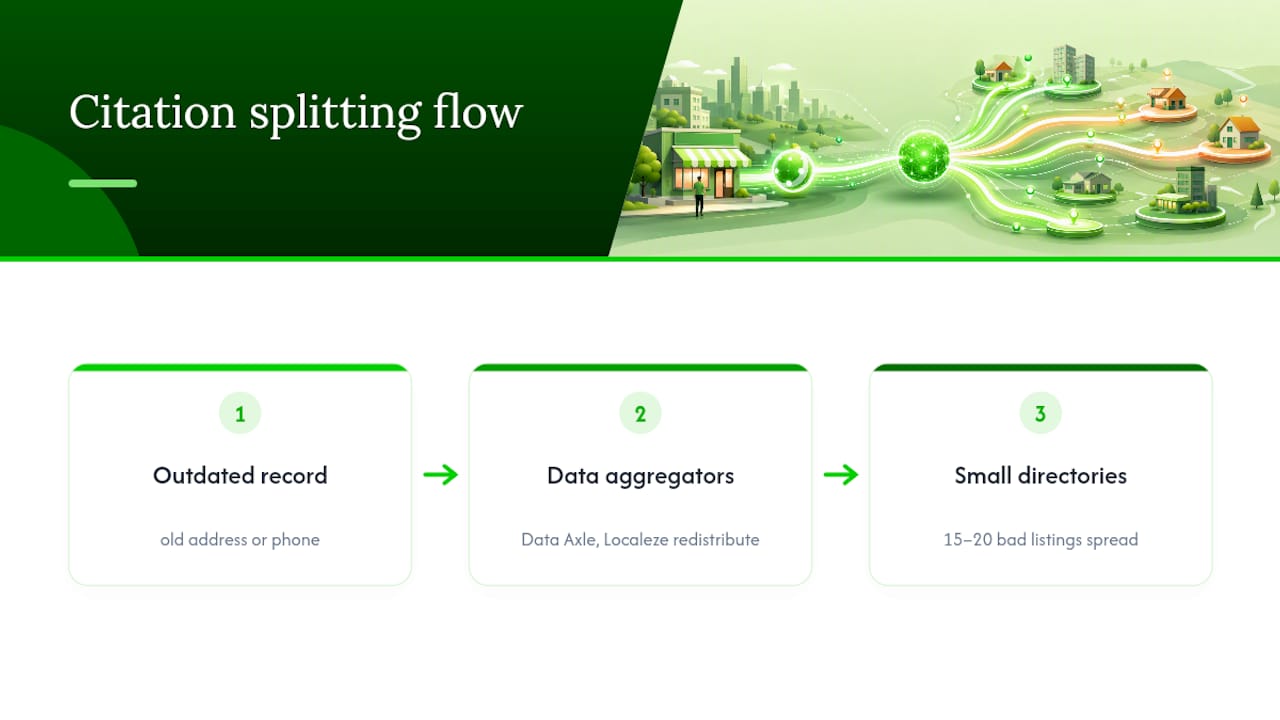
Citation splitting happens when data aggregators like Data Axle or Localeze pick up an old address or a disconnected phone number and redistribute it to dozens of smaller directories. One outdated record can quietly multiply into 15 or 20 bad listings within a few months.
How Do You Run a Citation Audit?
Before you touch a single listing, decide on your canonical NAP: the exact name, address, and phone format that will appear on your website footer and Google Business Profile. This single source of truth is what every other listing gets measured against, and skipping this step is the most common reason citation cleanups drag on for months.
- Write down your canonical NAP. Match your website footer, your Google Business Profile, and your schema markup exactly, right down to abbreviations like "St." versus "Street."
- Search for every existing listing. Run Google
site:searches, search your phone number in quotes, and search your old addresses if you've moved. Tools like BrightLocal or Whitespark scan dozens of directories at once and flag mismatches faster than manual searching. - Prioritize your fix list. Start with Google Business Profile, then Apple Maps, then Bing Places, then your top three industry directories, then the business listings directory major data aggregators.
- Log everything in a shared spreadsheet. Track the platform, login owner, date fixed, and date reindexed.
- Escalate to paid cleanup if volume is high. A business with 20 or more conflicting listings across multiple past addresses usually needs a managed service rather than a weekend project.
Pro Tip: A manual audit of about 40 platforms for one location typically takes 8 to 15 hours; tools like BrightLocal or Yext can cut that to under an hour, though some come with ongoing subscription costs.
How Do You Build and Scale Citations Without Creating a Mess?
Every new listing needs the same core fields filled out completely: full NAP, business category, hours, photos, your website URL, and matching schema markup. Skipping fields doesn't just leave visibility on the table, it makes the listing look abandoned to whoever's scanning for freshness signals.

You have two real paths here. Manual claiming means you or your team log into each directory directly, which gives you permanent ownership of the listing. Listing-management platforms like Yext automate submission across dozens of sites at once, which saves time, but some operate on a rental model where your data reverts or gets pulled if you cancel the subscription. Read the terms before you commit.
A few formatting rules will save you headaches later:
- Canonicalize suite and unit formatting the same way everywhere ("Suite 200" not "Ste. 200" on one site and "#200" on another).
- Avoid call-tracking numbers on directory listings unless they're permanently tied to that specific location.
- Keep your schema.org LocalBusiness markup identical to your GBP listing, since mismatches between the two are a frequent, overlooked source of inconsistency.
- Minor abbreviation differences are usually tolerated by search engines, but a different phone number on different platforms actively damages trust.
Pro Tip: If you operate more than one location, each one needs its own Google Business Profile and its own unique schema @id. Reusing a single phone number across locations without canonicalizing it is one of the fastest ways to confuse both search engines and customers.
Manual cleanup for a single location typically requires several days of focused work; managed platforms compress that timeline but add a recurring monthly fee.
How Do You Measure and Maintain Citation Building Results?
Citation building isn't a one-time project. Track these four metrics to know if the work is paying off:
- NAP consistency score across your top 20 to 40 listings, either from a manual spreadsheet or a scan tool.
- Local pack appearance frequency for your priority keywords, checked weekly or monthly.
- Google Business Profile impressions and search queries, visible directly in your GBP dashboard.
- Referral traffic from directories, tracked in your analytics platform by source.
Checking indexation means running the same site: searches and phone/address lookups you used during the audit, now confirming the corrected data actually replaced the old data. Propagation to major aggregators can take several weeks, so don't panic if a fix doesn't show up everywhere within days.
Set a maintenance cadence of regular quarterly audits and increase monitoring frequency in competitive verticals like restaurants, med spas, or home services. A move, a rebrand, a new phone system, or a merger should all trigger an immediate re-audit rather than waiting for the next scheduled check.
How Do You Choose an Agency for Citation Building?
A legitimate citation building agency hands you documentation, not just a completion email. Before you sign anything, ask for these deliverables in writing:
- A canonical NAP document you approve before any work starts.
- A shared audit spreadsheet showing every platform checked, fixed, and pending.
- Proof of claimed profiles, meaning actual login credentials or verified ownership transfer, not screenshots.
- Indexation verification showing the corrected data has actually replaced the old data.
- A written maintenance plan with a stated audit frequency.
Ask direct questions during the sales call: Do you create new listings or rent access to existing ones? Who owns the login credentials once the engagement ends? How do you report indexation progress, and which tools, BrightLocal, Whitespark, or Yext, do you use to verify it?
Watch for red flags: an agency that won't share login access, a "rent to own" listing model where your visibility disappears the moment you stop paying, vague monthly reports with no specific platform names, or no monitoring cadence after the initial fix.
Pro Tip: A dedicated, monitored email address for all listing accounts keeps verification requests and spam out of your regular inbox, and it's a detail worth confirming your agency sets up correctly.
Crowdcompany runs citation programs this way by default: a shared audit spreadsheet, documented proof of every claimed listing, and a fixed maintenance cadence built into the engagement, rather than sold as an upsell later.
Agency Perspective: The Operational Reality of Citation Management
Citation work looks simple until you're managing 40 logins across platforms that each demand their own verification, and every one of those listing emails becomes a spam magnet within weeks. That overhead is exactly why standalone citation fixes underperform. Paired with Google Business Profile optimization and local content that earns unstructured mentions, citation accuracy compounds into foot traffic instead of sitting as a checklist item nobody revisits.
Get Your Citation Audit Handled Without the Login Chaos
Crowdcompany runs citation building as a documented, owned process, not a rental. You get a full audit across your top platforms and the major aggregators, a prioritized fix list starting with Google Business Profile, Apple Maps, and Bing, and a shared spreadsheet showing exactly what changed and when.
Every claimed listing comes with proof of ownership, and login credentials transfer to you, not to an agency that holds your visibility hostage if you cancel. That's the practical difference between hiring Crowdcompany and buying into a listing-management subscription that quietly reverts your data the day you stop paying. Citation work also pairs directly with digital PR services that generate the unstructured mentions search engines and AI answer engines both reward.
If you run multiple locations, ask about theme pages and local expansion work that scales citation consistency across every neighborhood you serve. Request a free citation audit through Crowdcompany's local SEO checklist and see exactly where your listings stand before committing to a fix.
Sources
- What is local SEO citation? | Uberall
- Local citations | Moz
- What are local citations? | BrightLocal
- NAP consistency checker 2026: Local citation audit | Backlynk