
For most US local businesses and e-commerce brands, a managed agency like Crowdcompany will get you to revenue faster than a DIY platform. The reason is straightforward: deliverability, TCPA compliance, 10DLC registration with the Campaign Registry, and multi-channel attribution all require ongoing expertise that most small teams simply do not have on staff. If you do have a dedicated marketing manager with SMS experience, a self-serve platform supporting A2P/10DLC and a two-way inbox is a legitimate path. If you do not, book a pilot with Crowdcompany before you spend a dollar on per-message fees.
Table of Contents
- How DIY SMS platforms differ from managed agency services
- What should you evaluate when choosing a platform or provider?
- What metrics should your SMS platform actually show you?
- US compliance and deliverability: how to avoid blocks, fines, and carrier filtering
- Your 30–60 day SMS launch checklist
- When does hiring Crowd make more sense than a DIY platform?
- Key Takeaways
- Why managed SMS programs usually win for local businesses
- Crowdcompany runs your SMS program so you can focus on your business
- Authoritative sources and further reading
How DIY SMS platforms differ from managed agency services
The best SMS marketing platforms on the market today split into two fundamentally different products: software you operate yourself and a managed service where an agency runs the program for you. The SMS marketing software landscape segments by business need, with some tools prioritizing ease-of-use and list growth while others emphasize scale, customization, or developer APIs.
DIY platforms at a glance:
- Setup: fast for basic sends; slow when integrations and compliance are involved
- Deliverability: you manage throttling, carrier filtering, and sender reputation
- Compliance: platform provides tools; you are responsible for using them correctly
- Automation: template-based flows; two-way inbox varies by platform
- Reporting: dashboards provided; attribution setup is your job
- Cost: lower monthly fee, but staff time and deliverability failures add up
Managed agency at a glance:
- Setup: agency handles 10DLC registration, integration, and creative
- Deliverability: actively managed; throttling and reputation monitoring included
- Compliance: consent recording, STOP flows, and cadence controls handled for you
- Automation: custom flows, AI-driven conversations, and CRM sync
- Reporting: attribution design and multi-channel dashboards built in
- Cost: higher retainer, but faster time-to-revenue and fewer costly mistakes
Pro Tip: When comparing costs, factor in staff hours, deliverability failure rates, and the revenue lost when attribution is broken. A $49/month platform that generates untracked revenue is not cheaper than a managed retainer that proves ROI.
What should you evaluate when choosing a platform or provider?
| Criterion | Starter (local store) | Growth (small e-comm) | Scale (enterprise) |
|---|---|---|---|
| Ease of use | Top priority | Important | Less critical |
| Two-way inbox | Nice to have | Required | Required |
| Shopify / WooCommerce integration | Optional | Required | Required |
| CRM integration | Basic | Full sync | Custom API |
| Pricing model | Pay-as-you-go | Subscription | Managed retainer |
| Reporting & attribution | Basic dashboards | UTM + multi-channel | Custom attribution windows |
| Deliverability & compliance | Platform-guided | Active monitoring | Agency-managed |
| Security / privacy | Standard encryption | SOC 2 preferred | SOC 2 + DPA required |
Affordable SMS gateway providers offer pay-as-you-go pricing with MMS and two-way messaging support, which works well for small brands testing volume before committing to a subscription. At the growth stage, the integration question becomes decisive: if your store runs on Shopify or WooCommerce, your SMS platform needs a native connector, not a Zapier workaround.
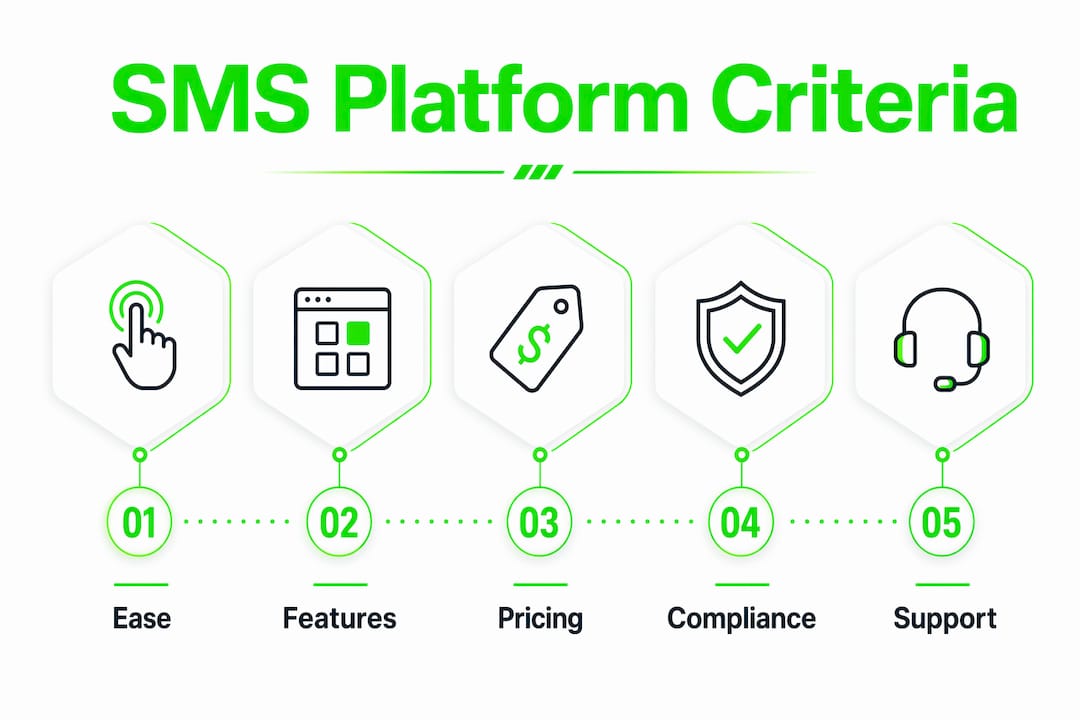
Pricing context: self-serve platforms typically run from a few cents per message on pay-as-you-go plans up to monthly subscriptions for higher-volume senders. Managed agency retainers for SMS programs start higher but include strategy, creative, compliance management, and attribution design.
What metrics should your SMS platform actually show you?
Key metrics to monitor include delivery rate, open/receive rate, link click-through rate, and conversion rate. Any platform or agency that cannot show you all four in a real-time dashboard is not enterprise-capable.
What each metric tells you:
- Delivery rate: the percentage of messages that reached a handset. Below 95% signals a sender reputation or carrier filtering problem.
- Open/receive rate: SMS open rates are consistently high, with industry studies showing most users read messages very soon after delivery, with most users reading messages very soon after delivery.
- Link CTR: how many recipients clicked your CTA link. Low CTR with high delivery points to a copy or offer problem, not a deliverability problem.
- Conversion rate: purchases, bookings, or form completions attributed to the SMS send. Requires UTM parameters and a defined attribution window.
Reporting features that indicate a serious platform or agency stack: real-time dashboards, exportable CSV/API data, custom attribution windows, UTM and link shortener support, and multi-channel attribution that ties SMS sends to email opens and paid ad clicks in a single view.
Benchmark to demand: if your SMS program cannot show delivery rate, CTR, and conversion rate in one place, you are flying blind on ROI.
US compliance and deliverability: how to avoid blocks, fines, and carrier filtering
10DLC registration with the Campaign Registry is not optional for US A2P messaging. Failing to register your brand and use case causes carriers to filter your messages as spam, regardless of how good your list hygiene is. Most platforms provide a registration guide; agencies handle it as part of onboarding.
Required opt-in/opt-out behaviors every platform must handle automatically:
- Double opt-in confirmation message on subscriber sign-up
- Instant STOP processing with a confirmation reply
- Consent timestamp and source recorded per subscriber
- Message cadence controls to prevent over-sending
- One-tap STOP links in every promotional message, aligned with CTIA rules
Throttling and smart queuing are not optional at scale. Sudden high-volume sends damage sender reputation and reduce long-term deliverability far more than a slow ramp-up ever would.
Pro Tip: Before your first send, document every consent source: web form, in-store keyword, or checkout opt-in. TCPA litigation often hinges on whether you can prove consent was given. Platforms that log consent automatically are worth the extra cost.
The TCPA carries statutory damages per unsolicited message. For more on how TCPA violations are enforced and what consumers can recover, that resource covers the litigation landscape in plain terms.
Compliance is operational, not a one-time checkbox. 10DLC registration, consent logging, and STOP flow management must be active and auditable at all times.
This article is general information, not legal advice. Confirm your specific compliance obligations with a qualified attorney or your platform's compliance team.
Your 30–60 day SMS launch checklist
- Days 1–7: Audit your existing contact list for consent status. Remove any contacts without documented opt-in. Set up your 10DLC brand and use-case registration with the Campaign Registry.
- Days 8–14: Configure your opt-in capture: web form, in-store keyword, or checkout checkbox. Test the double opt-in confirmation flow end to end.
- Days 15–21: Write and approve your first three message templates. Set up UTM parameters and link shorteners for every CTA. Connect your SMS platform to Shopify, WooCommerce, or your CRM.
- Days 22–28: Run a soft launch to a small segment (under 500 contacts). Monitor delivery rate and CTR. Check that STOP replies process correctly and consent records update.
- Days 29–45: Analyze soft-launch data. A/B test subject line and CTA copy. Adjust send time based on open patterns. Build your first automation flow: welcome series, abandoned cart, or re-engagement.
- Days 46–60: Scale sends gradually. Set a throttle rate your carrier tier supports. Review attribution data and confirm conversions are tracking against the correct window. Document results for the next campaign brief.
Sample campaign flow: Segment by purchase history → send personalized offer with UTM link → follow up 48 hours later to non-openers with a different CTA → close the attribution window at 7 days → report conversion rate and revenue per message sent.
When does hiring Crowd make more sense than a DIY platform?
A managed approach fits when you have limited internal marketing resources, need SMS integrated with email, paid ads, and in-store tactics, or are running a high-stakes promotion where deliverability failure is not an option.
Crowdcompany covers the full SMS program: 10DLC and Campaign Registry registration, message creative and copy, automation flows and a conversational AI SMS receptionist for inbound replies, CRM and e-commerce integration, attribution design, and physical opt-in tools like NFC stands and scratch cards that drive in-store subscriber sign-ups.
For local businesses running promotions across SMS, direct mail, and in-store NFC, the integrated approach consistently produces faster list growth and cleaner attribution than any single-channel platform can deliver on its own.
Crowdcompany's retainer tiers run from a Starter package for single-location businesses up to Growth and Enterprise packages for multi-location brands and e-commerce stores with complex automation needs. Custom project quotes are available for one-time campaigns and print/NFC promotional products.
Key Takeaways
For most US local businesses and e-commerce brands, a managed SMS program through an agency like Crowdcompany will outperform a self-managed platform on deliverability, compliance, and measurable revenue.
| Point | Details |
|---|---|
| Platform vs. agency | Choose DIY only if you have internal SMS expertise; otherwise a managed agency reaches revenue faster. |
| 10DLC is non-optional | Register your brand and use case with the Campaign Registry before your first A2P send. |
| Four metrics to demand | Delivery rate, open rate, link CTR, and conversion rate must appear in a real-time dashboard. |
| Compliance is ongoing | Consent logging, STOP flow processing, and throttling must stay active and auditable at all times. |
| Crowdcompany's role | Crowdcompany manages the full SMS program, from 10DLC registration to attribution, for local businesses and e-commerce brands. |
Why managed SMS programs usually win for local businesses
The conventional wisdom says DIY platforms are "good enough" for small businesses. That is true only if your definition of good enough is sending a blast and hoping something converts. What the data actually shows is that channel-affinity programs, where SMS, email, and social are coordinated and measured together, produce meaningfully better results than isolated SMS sends.

A local restaurant running a Friday lunch promotion via SMS alone gets a spike. The same restaurant running that SMS alongside a retargeted social ad and a follow-up email to non-converters gets a measurable lift across the week. The difference is not the platform. It is the strategy and the attribution infrastructure behind it.
The same logic applies to two-way conversational messaging. A shared team inbox where staff can respond to inbound replies within the same platform used for marketing closes the loop that most SMS blasts leave open. Customers who reply to a promotion and get a fast, personal response convert at a higher rate than those who hit a dead number.
Crowdcompany runs your SMS program so you can focus on your business
If you have read this far and your honest answer is "we do not have the staff or time to manage 10DLC registration, deliverability monitoring, and attribution setup," that is exactly the situation Crowdcompany is built for.
A Crowdcompany SMS pilot includes 10DLC and Campaign Registry setup, campaign creative and copy, automation flow build-out, CRM and e-commerce integration, and attribution design from day one. Physical opt-in tools like NFC stands and scratch cards pair with your SMS program to drive in-store subscriber sign-ups that most platforms cannot touch. For brands that want SMS coordinated with email retargeting and paid acquisition, Crowdcompany handles the full channel stack under one retainer. Book a growth audit at crowdcompany.co and get a clear picture of what a managed SMS program would look like for your business.
Authoritative sources and further reading
- Twilio SMS Marketing: primary source for SMS open rate benchmarks and A2P channel capabilities.
- Mailchimp SMS Marketing Platform: covers key metrics definitions, real-time dashboard requirements, and throttling best practices.
- Klaviyo SMS Marketing: source for channel-affinity attribution, AI-driven conversational features, and omnichannel ROI methodology.
- EZ Texting compliance guidance: covers 10DLC/A2P registration, CTIA opt-in/opt-out requirements, and consent-first deliverability practices.
- SlickText SMS marketing: covers list-growth tools, in-store keyword opt-ins, and conversational shared inbox features.
- ClickSend SMS marketing: pay-as-you-go pricing models, MMS support, and volume discount structures for small brands.
- NotMyRobocalls — TCPA and spam texts: plain-language overview of TCPA enforcement and consumer rights relevant to US SMS compliance.