
A winback email strategy is an automated sequence built to reactivate customers who stopped buying, canceled, or went silent, and when it's built correctly it recovers roughly 5% to 15% of churned customers. The result depends entirely on timing, segmentation, and how much friction sits between the click and the reactivated account. Everything below breaks down exactly how to build that sequence, from lapse windows to copy templates.
TL;DR:
- Deriving the lapse window from actual customer behavior yields a higher reactivation rate than relying on generic timeframes like 90 days.
- Personalization using cancellation reasons and recent product data can double or triple email conversion rates compared to generic messaging.
- Layered sequences over multiple sends with targeted hooks outperform single blast campaigns by providing more relevant touchpoints.
- Technical friction after click, such as auto-apply links and one- or two-click reactivation, significantly boosts conversion and reduces dropouts.
- Regularly recalculating thresholds, running holdout tests, and maintaining list hygiene are essential for sustained winback program profitability.
Table of Contents
- What Is a Winback Email Strategy, Really?
- How to Choose the Right Lapse Window for Your Business
- Building a 3 to 4 Email Winback Sequence That Converts
- Segmentation and Personalization That Actually Move Conversion
- Subject Lines, Hooks, and Copy Frameworks That Get Opened
- Offer Escalation Without Giving Away Your Margin
- Technical Requirements That Determine Whether Anyone Actually Reactivates
- Measuring What Worked and Knowing When to Stop
- Protecting Deliverability While You Run Winback Sends
- Copy Bank: Winback Templates You Can Adapt Today
- How Crowdcompany Operationalizes Winback Programs
- Ready to Put a Winback Program on Autopilot?
- The Real Gap Between Winback Theory and Winback Results
- Sources
What Is a Winback Email Strategy, Really?
A winback campaign targets someone who was already a customer and stopped being one. That's the whole distinction, and it's why so many marketing teams mix it up with other flows that look similar on paper but serve completely different jobs.
The trigger for a true winback email is behavioral silence tied to a prior relationship: a subscription that lapsed, a cancellation event, or a purchase gap that has stretched well past normal. Compare that to a re-engagement email, which targets someone who never fully converted in the first place, or an abandoned-cart email, which fires within hours of someone leaving items in a cart they haven't paid for yet. Payment-failure recovery is its own animal too. It's transactional, not behavioral, and usually needs a dunning sequence rather than a marketing campaign.
Mixing these up is common, and it's costly. A subscription business that sends "we miss you" copy to someone whose card just got declined looks tone-deaf. It also skips the real fix: updating the payment method in two clicks. Getting the vocabulary right upfront saves you from building the wrong automation for the wrong audience.
Here's how the four flows actually differ:
- Winback email: targets past customers who lapsed, canceled, or churned; goal is reactivation of an existing relationship.
- Re-engagement email: targets subscribers or leads who never purchased but went cold; goal is moving them toward a first conversion.
- Abandoned-cart email: targets active shoppers with items left unpurchased; goal is completing a transaction already in motion.
- Payment-failure recovery: targets a technical billing breakdown, not disengagement; goal is fixing the card or payment method, fast.
The use cases vary by vertical too. An e-commerce brand might define lapse as "no purchase in 90 days" against a typical 45-day repurchase cycle. A SaaS company defines it as a canceled subscription or a "downgraded to free tier" event. A local service business, a med spa or a landscaping company, might define it as "no booking in six months" against a typical seasonal cadence. The trigger has to match the category's actual buying rhythm, not a generic calendar guess.
How to Choose the Right Lapse Window for Your Business
Most guides throw out "90 days" as a default lapse trigger. That's a reasonable starting point, but it's a guess dressed up as a rule, and guessing here either sends winback emails to people who were never actually gone or misses people until it's too late to bring them back.
The better method is to derive the trigger from your own repeat-purchase or repeat-usage data. Pull every customer's historical gap between purchases (or logins, or bookings), then find the point where the distribution says "this person has likely disengaged" rather than "this person just hasn't gotten around to it yet."
- Pull repeat-interval data. Export the time gap between consecutive purchases or usage events for every customer over the past 12 to 24 months.
- Find the 75th to 80th percentile. This is the gap length that captures the vast majority of normal repeat behavior without including outliers who buy once a year anyway.
- Cross-check with a multiplier. Set your trigger at roughly 1.5 times the average repeat interval as a sanity check against the percentile method.
- Segment by category if needed. A coffee subscription and a mattress company should never share a lapse window. Run the calculation separately for meaningfully different product lines.
- Set a review cadence. Recalculate the threshold quarterly, since repeat-purchase behavior shifts with pricing changes, seasonality, and new product launches.
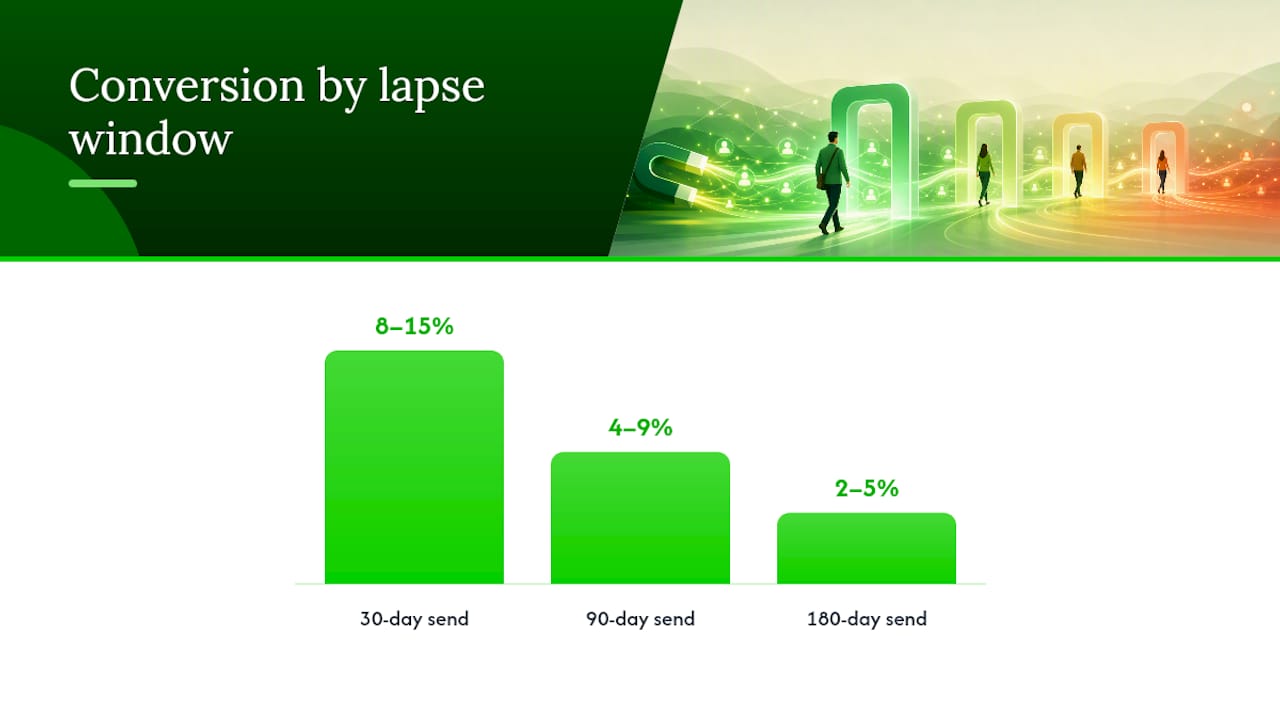
Statistic to watch: conversion rates fall off fast as the lapse window widens. Winback emails sent at the 30-day mark convert at 8% to 15%, 90-day sends land at 4% to 9%, and 180-day sends drop to 2% to 5%. That decay curve is the single strongest argument for catching customers early rather than waiting for a round number on the calendar.
Fixed windows work fine for businesses with predictable, low-variance buying cycles, think monthly subscriptions with a single price tier. Rolling percentile triggers earn their complexity in businesses with wide purchase variance, like e-commerce stores selling everything from $15 accessories to $400 furniture. Getting the threshold wrong in either direction has real costs: too early and you annoy people who were going to buy anyway, eroding trust and inflating unsubscribe rates; too late and you're emailing a cold list that's already forgotten why they cared, which drags down your sender reputation for no return.
Building a 3 to 4 Email Winback Sequence That Converts
A single "we miss you" email is a weak bet. A structured sequence spread over multiple sends consistently outperforms a one-off blast, largely because it gives you more than one chance to find the message that actually lands with a given segment.
The sequence itself should do four distinct jobs across three or four sends, each with a clear purpose:
- Send 1, value reminder (no offer): Reintroduce what the customer loved without leading with a discount. This filters in the people who just got busy, not the people who were unhappy.
- Send 2, reason or address: Ask why they left, or directly address a common cancellation reason (price, missing feature, poor onboarding).
- Send 3, what's changed: Show concrete proof, a shipped feature, a new product line, an improved policy, that answers the objection from send 2.
- Send 4, offer or last chance: Lead with the incentive and a real deadline, since by now you've earned the right to make an ask.
Timing depends heavily on business model. Ecommerce brands typically run a tighter version, a two to three week flow with sends roughly on day 1, day 7, and day 14, matching the re-introduction, social proof, and final-offer sequence pattern that tends to outperform single sends. Subscription and SaaS businesses tend to spread the whole thing out further, aligning sends to the 30, 90, and 180-day lapse milestones described above, since the goal is catching people at multiple decision points rather than compressing urgency into two weeks.
Branching logic matters as much as timing. Payment-failure churn should never enter the same track as voluntary cancellation. It needs a dunning-style flow focused on updating a card, not persuasive copy about features. High-CLV customers deserve their own branch too, often with a human touch (a personal note from account management, or an early look at the best offer) rather than the standard automated send. And the moment someone reactivates, whether by clicking a link, opening a new session, or making a purchase, suppress them from the rest of the sequence immediately. Sending a "final chance" email to someone who already came back is the fastest way to make a comeback customer feel like a number.
Pro Tip: *Build the suppression rule before you launch the sequence, not after.
Segmentation and Personalization That Actually Move Conversion
Generic "we miss you" copy is one of the weakest levers in a winback program. Messages that reference the actual cancellation reason or a concrete product change convert at 2x to 5x the rate of generic sends, and feature-shipped emails aimed at someone who left for a missing capability can reach 15% to 25% conversion on their own.
The segments worth building before you write a single subject line:
- Lapse window: 30, 90, and 180-day segments each need different tone, urgency, and offer strength.
- Customer lifetime value: high-CLV lapsed customers justify a bigger incentive and possibly a manual outreach step.
- Cancellation reason: price, missing feature, poor support experience, and "just didn't use it enough" all require different hooks.
- Product or plan purchased: someone who bought a starter plan needs a different pitch than someone who canceled the top tier.
The most underused data source here is the free-text field on your cancellation flow. Most businesses collect it, tag it with a generic category, and never look at it again. That's a mistake. Reading the actual sentences customers write when they cancel hands you the exact objection to answer in send 2 and send 3 of your sequence. If a cluster of canceled customers wrote some version of "too expensive for what I used," that's your cue to lead with a downgraded plan option instead of a blanket discount. If they wrote "missing the reporting feature," and you've since shipped it, that's your entire send 3 written for you.
Personalization tokens should go beyond first-name insertion. Dynamic content blocks that pull in the customer's last purchased product, their previous plan tier, or the specific feature they mentioned in a cancellation survey do far more work than a name in the subject line. A simple example: "You canceled your Pro plan on [date] because of [reason category]. Here's what changed since then" pulls three data points into one sentence and reads like it was written for one person, because it was.
Subject Lines, Hooks, and Copy Frameworks That Get Opened
Vague subject lines lose to specific ones almost every time. "30% off, applied automatically" beats "We have something for you" because it removes the guesswork about what happens after the click.
Four hook types cover most winback scenarios:
- "What changed" hook: Use this when you've shipped a fix or feature tied to a known cancellation reason.
- Feature-shipped hook: A narrower version of the above, useful when the improvement is specific and easy to name in six words or less.
- Social proof hook: Use this mid-sequence, when the reader has already seen your value reminder and needs a nudge that other customers are still getting results.
- Final-offer hook: Reserve this for the last send only. Leading with a discount too early trains customers to wait for one every time.
Whether to lead with the offer in the subject line itself is a real decision, not a default. Data suggests leading with the offer works when the discount is the actual reason people are opening, typically the final send in the sequence, where urgency and value need to be obvious at a glance. Earlier sends do better leading with curiosity or a direct callback to why the person signed up in the first place.
A few subject lines and opening lines, mapped to segment:
- 30-day lapse, no offer: Subject: "Still thinking about [product]?" Opening line: "We noticed you haven't been back in a few weeks, so we wanted to check in."
- 90-day lapse, feature-shipped: Subject: "We fixed the thing you mentioned." Opening line: "You told us [feature] was missing when you left. It's live now."
- 180-day lapse, final offer: Subject: "30% off, applied automatically, expires Friday." Opening line: "This is the best offer we can put in front of you, and it won't be here next week."
- High-CLV branch: Subject: "A note from our team." Opening line: "You were one of our best customers, and we'd like to understand what changed."
The strongest winback hooks don't sell the discount first. They answer the specific objection that made someone leave, and they answer it in the first sentence.
Offer Escalation Without Giving Away Your Margin
The instinct to lead every winback email with a big discount is expensive and usually unnecessary. Offers should escalate with the lapse window, not front-load at 50% off in send one.
A workable escalation structure looks like this:
| Lapse Window | Suggested Offer Band | Alternative Incentive |
|---|---|---|
| 30 days | 20% to 25% off or equivalent value | Free shipping on next order |
| 90 days | 30% off | One month free (subscription) |
| 180 days | Best available offer | Bundled free shipping plus bonus item |
Percent-off isn't always the strongest lever. Free shipping has outperformed percentage discounts by roughly 2x in some ecommerce datasets, likely because shipping cost is a concrete, visible friction point rather than an abstract percentage. Conditional incentives, like $10 off orders over $75, protect margin while still giving the customer a reason to act, and they tend to raise average order value in the process rather than just discounting whatever the customer was going to buy anyway.
Before you assume any offer is doing real work, run a holdout test. Split your lapsed segment, send the offer to one group and a no-offer control (or a lighter message) to the other, and measure the gap in return rate between them. If the holdout group comes back at nearly the same rate as the offer group, the discount isn't driving incremental behavior. It's just subsidizing customers who were going to return regardless. That's margin walking out the door for nothing.
Technical Requirements That Determine Whether Anyone Actually Reactivates
Copy and offers matter, but friction after the click is where most winback campaigns quietly fail. Every additional step after a click costs 15% to 25% of remaining completions, and flows requiring four to six steps lose 60% to 80% of clickers compared to two-step flows, which lose only 20% to 30%.
The fix is a tokenized link that does the work the customer would otherwise have to do manually:
- Apply the offer automatically on click, with no coupon code to copy and paste.
- Resume the subscription or reactivate the account in one or two clicks, not a full re-login and re-onboarding flow.
- Route to a pre-filled checkout session rather than a generic homepage or login screen.
Payment-failure recovery needs a different UX entirely from voluntary churn. A lapsed customer clicking a winback link should land somewhere that celebrates their return and reapplies value. Someone recovering from a failed payment needs a fast, low-friction card update screen with none of the marketing polish, because the goal is speed, not persuasion. Tokenized links that resume the exact previous payment method consistently beat any flow that forces a new login or manual code entry.
Pro Tip: Test your own winback link on a phone before launch. A surprising number of "one-click" reactivation flows quietly force a password reset on mobile because of a session timeout bug, and that single extra step can quietly erase half your conversion gains.
Attribution needs the same discipline. Tag every winback link with campaign and segment parameters so reactivated revenue is traceable back to the specific send and offer that triggered it, not lumped into generic "email" revenue in your analytics platform. Without that tagging, you can't tell which segment or hook is actually earning its budget.
Measuring What Worked and Knowing When to Stop
Reactivation rate is the headline number, but it's not the only one that matters, and it's arguably not even the most important one.
- Reactivation rate: Percentage of the targeted lapsed segment that took the desired action within the sequence window.
- Incremental reactivation rate: The gap between your offer group's return rate and a holdout group's natural return rate, which tells you what the campaign actually caused versus what would have happened anyway.
- Retained revenue: Revenue from reactivated customers measured over 90 days post-reactivation, not just the first transaction, since a customer who returns once and churns again isn't a real win.
- Margin given away: Total discount value distributed against retained revenue, so you can see whether the program is profitable, not just active.
Statistic to watch: the decay curve from earlier applies here too, expect 30-day sends to convert two to three times higher than 180-day sends, so weight your KPI targets by segment rather than judging the whole program against one blended number.
Structure your holdout test before launch, not as an afterthought. Randomly withhold 10% to 20% of the eligible segment from receiving any winback email, then compare their natural return rate against the treated group over the same window. Smaller lists need a larger holdout percentage to produce a readable signal; larger lists can hold out a smaller slice and still get statistically useful results.
Set stop conditions before you hit send, and check the numbers early and often. If complaint rates climb past a warning threshold, or bounce rates spike on a batch, pause the send immediately rather than finishing the list. Deliverability guidance generally recommends keeping complaint rates under 0.3%, with 0.1% as the safer target, and a lapsed list is inherently riskier than an active one, since these are people who've already gone quiet once.
Protecting Deliverability While You Run Winback Sends
A lapsed list is the riskiest list you own. These addresses are old, some are dead, and a chunk of them are going to look like spam bait to an inbox provider the moment you send a large batch all at once.
- Remove hard bounces and role accounts before the campaign launches, not after you've already burned sender reputation on a failed send.
- Validate your oldest addresses with an email verification pass, since the addresses most likely to bounce are the ones that have sat untouched the longest.
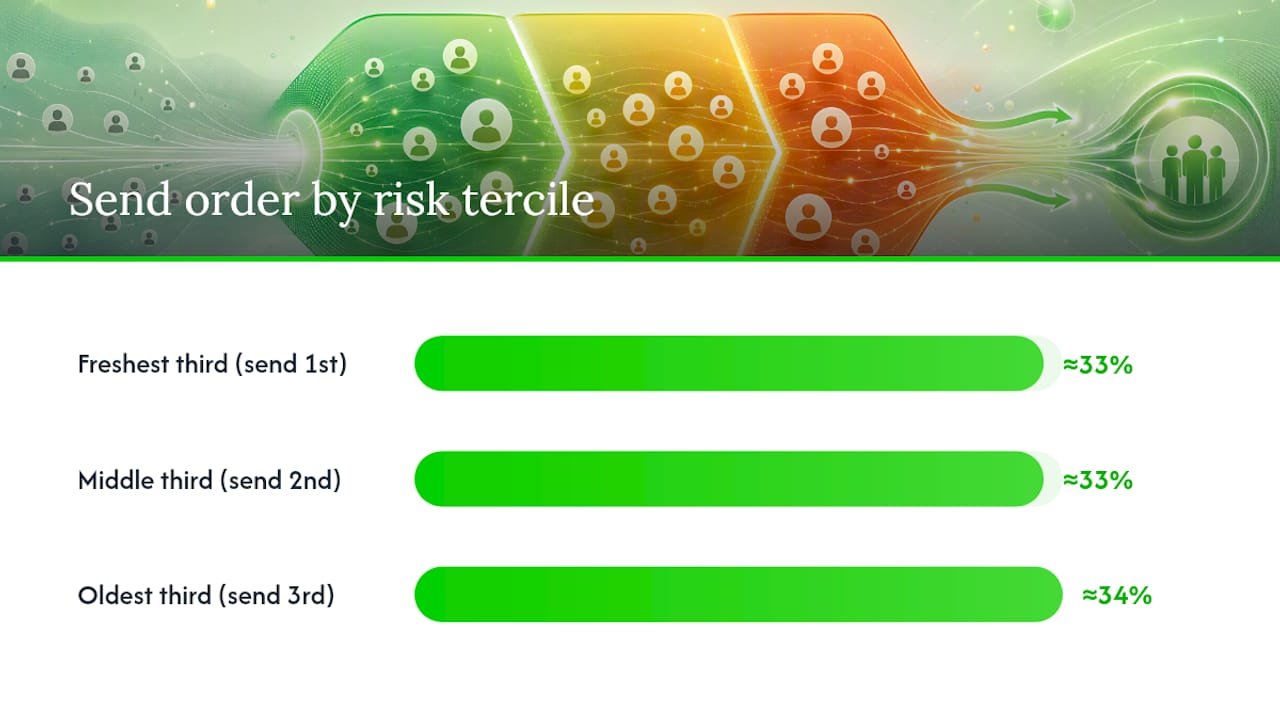
- Stagger sends by risk tercile. Break your list into thirds based on how recently they engaged, and send to the freshest third first.
- Start with your most recent lapsers. They're statistically more likely to still have a working inbox and less likely to have forgotten who you are.
- Set an explicit sunset policy. A 12-month ceiling is a reasonable rule of thumb: if someone hasn't engaged in a full year despite winback attempts, stop emailing them and move them to a suppressed or reduced-frequency list.
- Always give an obvious unsubscribe option. A lapsed customer who can't easily opt out is far more likely to hit "report spam" instead, and that single click does more damage to your sender reputation than a clean unsubscribe ever could.
This matters beyond the winback list itself. A batch of complaints or bounces from a poorly hygiened winback send can drag down deliverability for every other campaign you run that month, including transactional email your business actually depends on.
On the compliance side, winback campaigns are still marketing email and subject to the same rules as any other send. In the United States, that means honoring CAN-SPAM requirements, a clear sender identity, a working unsubscribe link, and honoring opt-outs promptly. If any portion of your lapsed list includes contacts covered by GDPR, confirm you still have a valid legal basis to email them; a stale consent record from three years ago may not hold up, and that's a legal question worth routing to counsel rather than guessing at.
Copy Bank: Winback Templates You Can Adapt Today
Each template below maps to a specific segment and a single job. Swap the bracketed details for your own product and keep the structure intact.
- Value reminder (no offer): Subject: "It's been a while." Body: "We noticed you haven't visited [product] in a bit. Here's what you might have missed: [one concrete update]. No strings, just wanted to say hey." CTA: "See what's new."
- Feature-shipped, personalized to cancel reason: Subject: "We built the thing you asked for." Body: "When you left, you mentioned [specific reason]. We've since shipped [feature/fix], and we think it changes the math." CTA: "Take another look."
- Payment-failure reactivation (one-click resume): Subject: "Your subscription paused, here's the fix." Body: "Your last payment didn't go through, so [product] paused. Update your card in one click and pick up right where you left off." CTA: "Resume my subscription."
- Social proof: Subject: "Others are seeing [specific result]." Body: "Since you've been away, customers like you have used [feature] to [specific outcome]. Worth a second look." CTA: "See how it works."
- Final chance, clear expiration: Subject: "This offer expires Friday at midnight." Body: "This is the best deal we can offer: [specific offer]. After Friday, it's gone, and we won't be sending another one." CTA: "Claim my offer."
Each winback email should have a single clear call to action to avoid overwhelming the recipient.
How Crowdcompany Operationalizes Winback Programs
Most winback failures aren't strategy failures. They're operational failures, a sequence that was built once, never revisited, and never connected to the CRM data that would have made it smarter over time.
Crowdcompany runs winback and re-engagement programs as part of its broader CRM and lead automation work, which means the sequence isn't a standalone email blast sitting apart from the rest of a client's customer data. Lapse triggers are ideally built from actual repeat-purchase or repeat-booking history rather than a generic 90-day default, with segmentation using available cancellation or booking data.
The retargeting and email side of the work, covered under retargeting and email marketing, is where the copy, offer escalation, and technical reactivation flow actually get built and tested against holdout groups rather than launched on instinct.
Whether a business should build this in house or hire it out usually comes down to bandwidth and iteration speed. A small team with one marketing generalist can absolutely build a basic 3-email sequence using the templates above. Where that same team tends to struggle is the ongoing part: recalculating lapse thresholds quarterly, running holdout tests, and rebuilding segments as cancellation reasons shift. That maintenance work is where a managed program earns its cost, not in the initial build.
Ready to Put a Winback Program on Autopilot?
Building a single winback sequence is a weekend project. Keeping it tuned, tested, and profitable quarter after quarter is a different job entirely, and it's the part most in-house teams quietly let slide once the initial launch excitement wears off.
Crowdcompany runs winback and reactivation as an ongoing discipline, not a one-time send, folding it into broader retargeting and email marketing work alongside CRM automation, segmentation upkeep, and the audience research that keeps offers from going stale. That's the practical advantage over building it alone: someone is actually watching the holdout numbers and adjusting the sequence every quarter, instead of it sitting untouched after launch. For a local business or e-commerce brand that also wants its reactivation program tied into a wider growth push, Crowdcompany's digital PR and content services can extend that same audience data into press and partnership outreach that keeps new customers flowing in behind the ones you're winning back.
If your lapsed-customer list has been sitting untouched for more than a quarter, that's the clearest sign it's time for a second set of eyes. Consider scoping a winback program built around your actual customer data rather than a generic template.
The Real Gap Between Winback Theory and Winback Results
Most winback advice treats the email itself as the product. It isn't. The email is just the delivery mechanism for a decision that was already made somewhere else, in the lapse-window math, in the cancellation-reason data nobody reads, in whether the reactivation link takes two clicks or six.
The uncomfortable truth is that the businesses getting 15% conversion on their winback sends aren't writing dramatically better copy than the businesses getting 2%. They're doing the unglamorous operational work first: deriving thresholds from actual repeat-purchase data instead of guessing 90 days, reading the free-text cancellation reasons instead of ignoring them, and building a one-click reactivation flow instead of routing people through a login wall. The copy templates in this guide will help you write a better email. They won't fix a lapse trigger that's firing three months too late, or a reactivation link that dumps someone onto a generic homepage instead of resuming exactly what they paused.
There's also a quieter mistake worth naming: treating every discount as free money. A holdout test that shows your 30% off offer is only pulling 3 extra points of conversion over doing nothing is telling you something important, that you've been subsidizing customers who were already coming back. Most teams never run that test because the result feels like bad news. It isn't. It's the only way to know whether your winback program is actually profitable or just busy.
— E
Sources
The benchmarks and timing guidance in this piece draw from a handful of sources worth bookmarking directly. Retainly's win-back benchmarking data covers conversion decay by lapse window and the technical friction data on reactivation flows. Geysera's ecommerce win-back guide breaks down how to derive lapse thresholds from repeat-purchase data and compares free shipping against percent-off incentives. BadRep's collection of real win-back sends is useful for subject-line and sequence-structure examples. Tajo's deliverability and list-hygiene guidance covers the sunset policy and complaint-rate thresholds referenced above.
- SaaS Win-Back Email Campaigns: Recover 5–15% of Churned Customers · Retainly · Retainly
- Win-Back Email Guide for Ecommerce (2026)
- Win-Back Email Examples: 200+ Real Sends (2026) | BadRep
- Win-Back Email Campaign: How to Recover Lapsed Customers in 2026