
Website copy is the words on your site written to get one clear action from one type of visitor. The single rule that governs everything else: one reader, one page goal, one next step. Follow that rule and you can draft or fix an entire page in one sitting, before touching design or SEO tricks.
TL;DR:
- Most ineffective web copy results from trying to address too many audiences on a single page, diluting its clarity and conversion potential.
- Writing copy in the audience's language, sourced from real customer feedback, ensures messaging resonates and aligns with their actual needs.
- Headlines and calls to action should convey benefits and specific outcomes, making them understandable even when read alone.
- Testing headline variations and single-call-to-action pages can significantly improve conversions and should be prioritized regularly.
- Building pages with a clear message hierarchy, wireframed before writing, ensures content fits layout and guides visitors efficiently toward the goal.
Table of Contents
- What Are the Core Fundamentals of Website Copywriting Basics?
- How Do You Write Website Copy Step by Step?
- What Should You Write on Each Page of Your Website?
- How Do You Write Better Headlines, CTAs, and Microcopy?
- What SEO and Accessibility Basics Support Conversions?
- How Do You Test and Improve Website Copy Over Time?
- How Does Crowdcompany Put These Steps Into Practice?
- What Do Small Business Owners Get Wrong Most Often?
- Get Help Turning Copy Fundamentals Into a Working Page
- Sources
What Are the Core Fundamentals of Website Copywriting Basics?
Most bad web copy comes from writers trying to please everyone on one page. Fix that, and half your problems disappear.
Know your reader's actual words, not your industry's words. Voice-of-customer research beats guessing every time. Pull phrases straight from sales call transcripts, Google reviews, and the search terms people type into your site's search bar. If customers keep calling your service "fast turnaround" and your homepage says "expedited fulfillment solutions," you have a translation problem, not a marketing problem.
Lead with the benefit, not the feature. A feature is what something does. A benefit is why the reader should care. "24/7 monitoring" is a feature. "You'll know about a break-in before the alarm company calls" is a benefit. Run every sentence through the "So what?" test: state the fact, then ask "so what?" until you land on something the reader actually wants.
Write short. Aim for an 8th to 10th grade reading level even if your audience holds PhDs. Busy people skim regardless of education level, and simple sentences read faster on a phone screen, which is where most visitors will meet your copy first.
Treat headlines and buttons as conversion assets, not afterthoughts. A visitor who reads only your headlines and calls to action should still understand your offer and know what to do next. That's a real test you can run on your own site right now: hide the body copy and see if the headings alone tell a coherent story.
Put proof next to the claim it supports, not three scrolls away. If you say "trusted by 200 local businesses," a logo strip or a review snippet belongs in the same viewport, not buried in a footer.
Here's the shortlist to keep near your desk while drafting:
- Write the audience's language, sourced from real reviews and sales conversations
- Lead every section with the benefit before the mechanism
- Cut any sentence a 14-year-old couldn't follow on the first read
- Make headlines and CTAs carry the story on their own
- Place testimonials, ratings, or client logos beside the claim they back up
Pro Tip: Copy every five-star review your business has ever received into one document. Highlight the exact phrases customers repeat. That document is your headline bank, and it costs nothing to build.
How Do You Write Website Copy Step by Step?
A page written in the right order takes less time to write and reads better than one written top to bottom in a single pass. Here's the sequence that actually works.
- Research first. Mine sales calls, support tickets, and reviews for the exact language customers use to describe their problem and your fix. Check your site's internal search queries too. They tell you what visitors expected to find and didn't.
- Build a one-line value proposition. Answer three questions in one sentence: what you offer, who it's for, and the main benefit. Then build a message hierarchy underneath it. Rank your remaining points from most to least persuasive so the strongest argument sits highest on the page.
- Wireframe before you write final copy. Sketch where the headline, opening line, proof element, and call to action will sit before you write a polished sentence. Copy written against a real layout fits the space it needs to fit; copy written in a blank document usually gets crammed in later.
- Draft using a formula. AIDA, PAS, and BAB are the industry-standard structures for a reason. PAS (Problem, Agitate, Solution) works well for service pages. AIDA (Attention, Interest, Desire, Action) suits landing pages. Translate every feature into a benefit as you go.
- Edit in passes, not all at once. Run a reader pass (does this make sense to someone with zero context?), a credibility pass (does every claim have proof nearby?), and an SEO and accessibility pass (keywords, alt text, link clarity) as three separate reviews.
- Test before you call it done. Once the page is live, run a simple headline or CTA test rather than assuming your first draft is final.
Skipping the wireframe step is the most common shortcut small business owners take, and it's the one that causes the most rework, because copy written without layout constraints in mind rarely fits once a designer gets involved.
Quick checklist for the drafting pass itself:
- One reader in mind, named specifically ("a homeowner comparing three roofers," not "homeowners")
- One goal for the page ("book a free estimate," not five competing links)
- One dominant proof element placed near the ask
What Should You Write on Each Page of Your Website?
Different pages do different jobs, and copying the same formula onto every page is why so many small business sites feel repetitive.
Homepage and hero section
Your homepage headline has to answer three things in one glance: what you are, who you serve, and the main benefit, ideally paired with a visible trust marker and a single primary call to action above the fold. "Boca Raton's top-rated pressure washing company, trusted by 300+ homeowners" does more work than "Welcome to our website."
Service and product pages
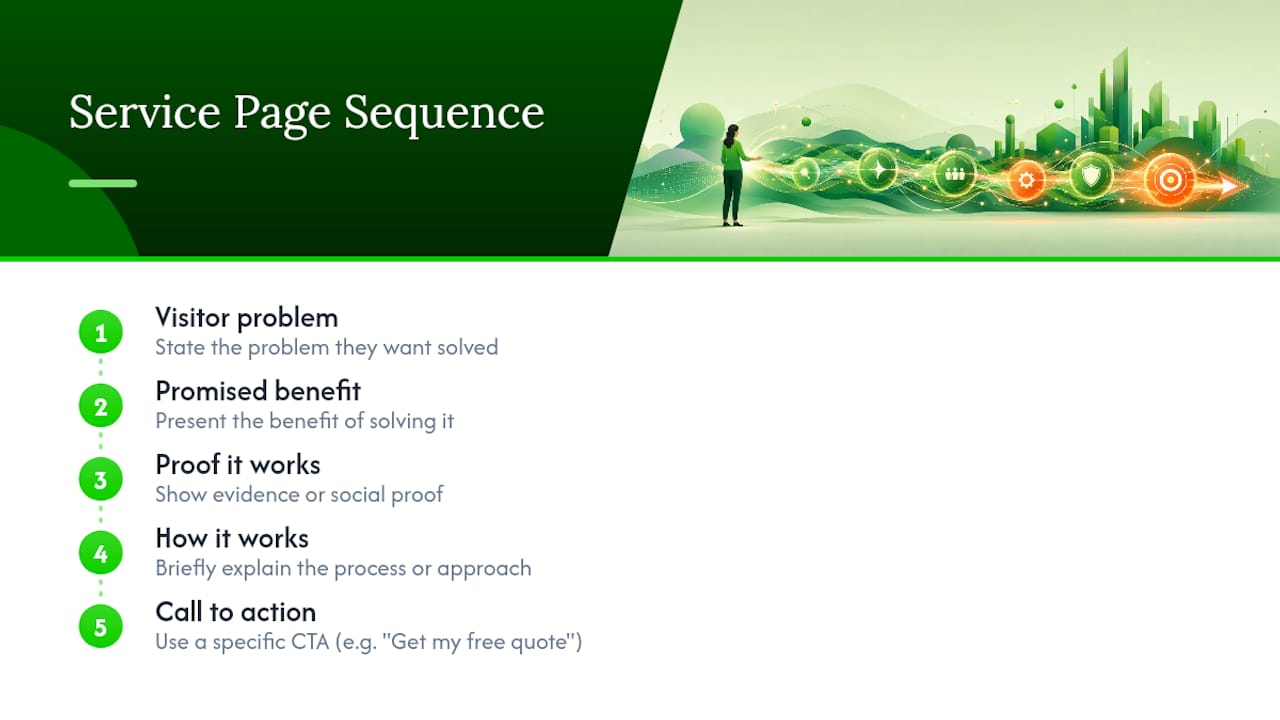
Follow this order: state the problem the visitor is trying to solve, present the benefit of solving it, show proof it works, briefly explain how it works, then close with a specific call to action. "Get my free quote" outperforms a generic "Learn more" because it names the exact next step.
Landing pages
A landing page exists for one offer and nothing else. Strip the main navigation menu so visitors can't wander off, and place your strongest proof element directly beside the call to action rather than at the bottom of the page.
About page
Your about page isn't company history. It's a customer-focused story: what problem you saw, why you started fixing it, and why that makes you the right choice today. Save the founding date and org chart for LinkedIn.
Contact and forms
Use clear field labels, ask for the minimum information you actually need, and write button microcopy that states the benefit. "Get my free consultation" beats "Submit" because generic button text adds friction at the exact moment someone was ready to act.
Pro Tip: Count your calls to action per page. Service pages usually need two or three (top, middle, bottom). A landing page needs exactly one, repeated in different words.
How Do You Write Better Headlines, CTAs, and Microcopy?
Small edits here move numbers faster than almost anything else on the page.
Headline checklist:
- Specific beats clever; a number or named outcome outperforms a pun
- Lead with the benefit before the mechanism
- Keep it scannable at a glance, not a full sentence buried in a paragraph
CTA checklist:
- Pair an action verb with a benefit: "Get my free audit," not "Submit"
- Lower the friction in the wording ("See pricing" feels lighter than "Request a demo")
- Repeat the CTA at natural stopping points on longer pages, not just once at the bottom
Generic button text like "Submit" or "Click here" reduces form completion compared to benefit-led alternatives, because the reader has no idea what happens after they click. A tool like Konvuno can also help by letting visitors ask a direct question instead of hunting through microcopy for an answer you never quite wrote.
Quick swap to test this week: take your homepage's main CTA, rewrite it to name the benefit instead of the action, and see if anything changes.
What SEO and Accessibility Basics Support Conversions?
SEO and good copy aren't in conflict, but they get treated that way when writers stuff keywords instead of writing naturally.
Put your primary keyword phrase in the H1 and the opening paragraph, once, in language a person would actually say. Repeating it five times in one section doesn't help rankings and actively hurts readability.
Many web writing guides recommend an 8th to 10th grade reading level, since visitors skim rather than read closely and simple sentences hold attention longer on mobile screens, where most traffic now lands first.
- Match your headings to how people actually phrase their questions in search
- Write descriptive alt text for images, not "image1.jpg" or "photo"
- Use link text that describes the destination ("see our pricing," not "click here")
- Label form fields clearly so screen readers and human visitors both understand what's required
When SEO phrasing and conversion phrasing pull in different directions, default to the version a real customer would say out loud. A page that ranks but doesn't convert is just an expensive way to get traffic.
How Do You Test and Improve Website Copy Over Time?
You don't need a data science team to improve a page. You need a short list of priorities and the patience to wait for real numbers.
- Test headlines first. Headline changes tend to move conversion more than any other single edit, so start there before touching anything else.
- Test calls to action second, then form length. Fewer required fields usually means more completed forms.
- Track click-through rate, conversion rate, bounce rate, and smaller signals like scroll depth or video plays.
- Give a small site enough time and traffic to reach a real sample before declaring a winner. A day of data on a low-traffic page tells you nothing.
- When a test wins, roll the change out sitewide. When it's flat, form a new hypothesis instead of running the same test twice.
How Does Crowdcompany Put These Steps Into Practice?
A message hierarchy only proves itself once it's live on a real page. This sequence is built into every project: value proposition first, then supporting proof, then a single call to action, wireframed before a word of final copy gets written.
A few resources worth bookmarking if you want to see the process applied directly:
- Landing Page Design That Converts walks through design and copy pairings for landing pages specifically
- Website Creation & Landing Pages explains how full site builds get structured around one goal per page
- Lead Form Ads for Marketers covers what happens after a visitor submits a form, including routing and response time
Conversion rate, form completion, and bounce rate stay the core metrics worth watching on any page you build or rebuild.
What Do Small Business Owners Get Wrong Most Often?
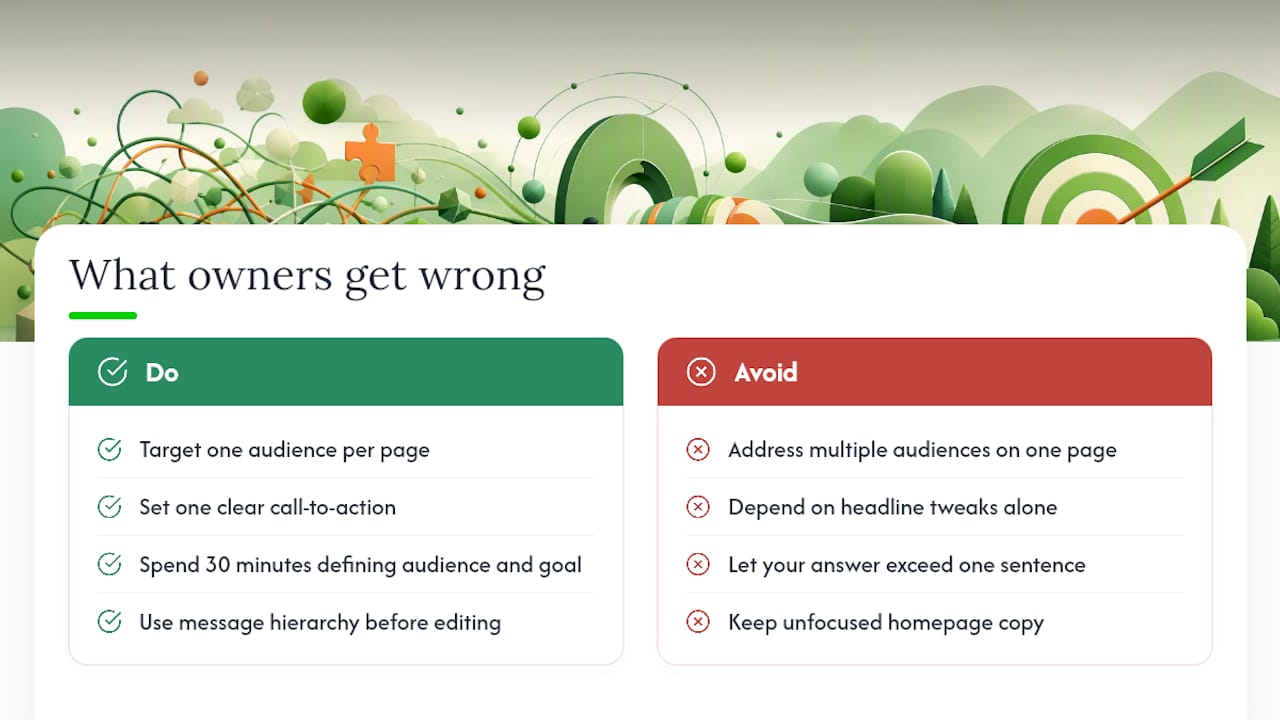
The most common mistake isn't bad writing. It's trying to talk to everyone on one page, which usually means talking to no one well. A landscaping company once tried to serve homeowners, property managers, and commercial developers all in the same three paragraphs, and the page converted worse than a single blurry photo with a phone number underneath it. Splitting that into three focused pages, each with its own reader and its own goal, is a bigger lever than any headline tweak.
If you have thirty minutes right now, pull up your homepage and answer one question in writing: who exactly is this page for, and what's the one thing you want them to do? If your answer takes more than one sentence, that's your first edit. For a deeper pass on structure, the message hierarchy approach is worth revisiting before you touch another word.
— E
Get Help Turning Copy Fundamentals Into a Working Page
Reading a guide gets you a plan. Writing, wireframing, and testing an entire page yourself still takes hours you may not have between running the actual business. Websites and landing pages are built around the same message hierarchy and one-goal-per-page approach covered here, minus the trial and error of doing it solo.
This fits best if you're a small business owner who wants a page built to convert from day one rather than patched together and tested for months. Beyond the page itself, credibility signals like earned press mentions can reinforce the proof placed next to your claims, which is where Digital PR comes into play for businesses that want that trust built in from the start. If you want a working homepage or landing page without doing the wireframing yourself, start with a website creation project and get a page built around one clear goal from the first draft.
Sources
- What is Website Copywriting? 7 tips for Writing Better Web Copy
- Website copywriting: how to write website copy (Mailchimp resource)