The most effective pop up shop marketing plan runs on three timed phases: a several-week pre-launch push to build the guest list, an in-store experience engineered for content and fast checkout, and a 72-hour follow-up sequence that turns visitors into customers. Track opt-in rate, onsite conversion, and event ROI to know if it worked. Agencies that run these activations for a living, including Crowdcompany, lean hardest on the data-capture step, because that's the part most small businesses skip.
TL;DR:
- Focus your geo-targeted advertising efforts within a walkable radius to maximize foot traffic, allocating a significant budget to local social ads and search.
- Capture visitor data at checkout with QR codes, NFC tools, or digital forms to build a valuable customer list for post-event follow-up.
- Implement a structured, timely follow-up sequence with personalized emails, SMS, and retargeting ads within 72 hours to increase conversion rates.
- Choose a location based on data and foot-traffic potential rather than rent price, and negotiate co-promotion with nearby businesses for greater exposure.
- Prioritize a targeted audience segmentation before launch, tailored messaging for locals, existing followers, and media, to optimize engagement and spend.
Table of Contents
- Pop Up Shop Marketing Checklist and Timeline
- How Do You Promote a Pop-Up Shop Before It Opens?
- What Should You Do to Market a Pop-Up While It's Open?
- What Happens After the Pop-Up Closes?
- How Do You Choose the Right Location for a Pop-Up?
- How Much Does a Pop-Up Shop Cost to Market and Run?
- What Technology Do You Need to Run a Pop-Up Shop?
- Real Pop-Up Marketing Tactics That Actually Move Foot Traffic
- What Permits and Insurance Do Pop-Up Shops Need?
- When Should You Schedule a Pop-Up Shop for Best Results?
- Who Is Your Pop-Up Shop Actually For?
- How Many Staff Do You Need to Run a Pop-Up Shop?
- What Happens If Something Goes Wrong at Your Pop-Up?
- Why Small Pop-Ups Fail at the One Thing That Actually Matters
- How Crowdcompany Turns Pop-Up Buzz Into Booked Customers
- Sources
Pop Up Shop Marketing Checklist and Timeline
A pop-up succeeds or fails based on what happens before the doors open, not just during the event. Shopify's planning framework confirms the three-phase cadence below is the standard structure top-performing pop-ups follow.
- Weeks 6 to 4 before launch: Map your audience, lock the space, and build your promo and creator list.
- Weeks 4 to 1 before launch: Launch geo-targeted ads, send press outreach, and confirm influencer previews.
- Opening day: Set up UGC moments, run frictionless checkout, host a creator preview, and post live all day.
- Days 1 through 3 of the event: Adjust ad spend based on foot traffic, restock high-performing items, and keep daily content fresh.
- Hours 0 to 72 after closing: Send the first follow-up email within 24 hours, an SMS by hour 48, and launch retargeting ads by day three.
- Week 1 after closing: Review every KPI against target, document what worked, and file lessons for the next activation.
That sequence sounds simple written out. Executing it under a tight budget and a small staff is where most first-time pop-up operators lose momentum, usually somewhere between securing the space and actually promoting it.
How Do You Promote a Pop-Up Shop Before It Opens?
Pre-launch is where you decide what winning looks like. Before you spend a dollar on ads, pick your primary KPI: is this pop-up about new email subscribers, direct sales, or brand awareness ahead of a permanent location? Each goal changes how you spend your pre-launch weeks.
Geo-analytics should drive your location and ad radius decisions, not gut feel. Local activation combined with geo-targeted ads within a walkable radius meaningfully lifts foot traffic for pop-ups, according to practitioner data on hyperlocal targeting. For a small business, that usually means:
- a significant share of your pre-launch ad budget on geo-targeted social ads (Meta and TikTok both support radius targeting)
- a portion on local search or Google Local Services ads tied to your event dates
- a moderate share on influencer previews or seeding
- the remainder held back for last-minute boosts once the calendar tightens
Invite three to eight local creators for a preview night about a week before opening. Ask each for one unboxing-style post and one story during the event window, not just a single mention. A pre-launch VIP night or influencer preview tends to produce the highest-value content and press pickup of the entire campaign, so it deserves its own small PR budget rather than getting folded into general marketing spend.
Reach out to complementary local businesses for co-promotion. Offer a cross-discount, a shared flyer, or a joint Instagram takeover in exchange for them promoting your dates to their list.
Pro Tip: Send your local press outreach at least two weeks out, and lead with the story angle, not the product. Reporters cover "local maker takes over empty storefront," not "new candle brand opens pop-up."
What Should You Do to Market a Pop-Up While It's Open?
Once doors open, your marketing job shifts from building anticipation to capturing everything happening in real time. Every hour the shop is open is an hour of content you don't get back.
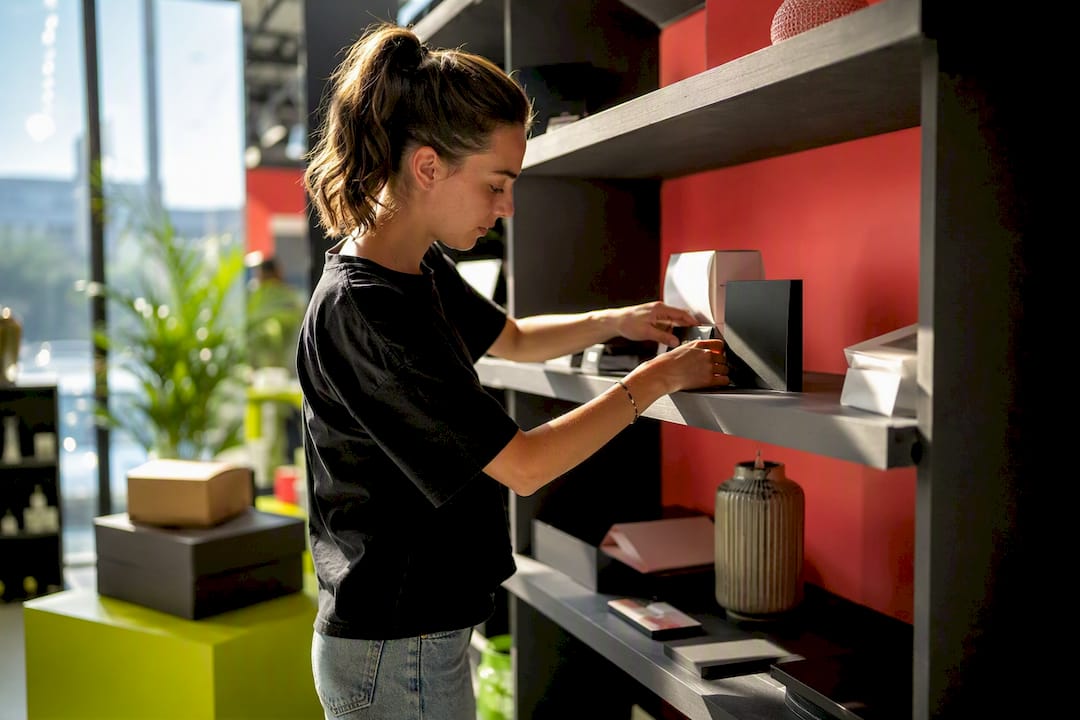
Build at least one deliberately Instagrammable moment near your entrance or checkout counter. Shopify's pop-up ideas guide recommends placing your most shareable element close to purchase, so social shares tie directly to a sale rather than sitting disconnected from revenue.
Your checkout flow needs to work in seconds, not minutes:
- Mobile POS that accepts tap-to-pay, cards, and at least one digital wallet
- Email or SMS capture built into the checkout screen, not a clipboard on the counter
- A QR code at checkout offering a small discount in exchange for an opt-in
- A backup payment method in case Wi-Fi or card readers drop
Limited-edition items and time-boxed drops aren't just a merchandising choice. Exclusivity in pop-up formats is a documented driver of urgency, and it tends to increase conversion rates compared with a standard retail launch where the same product sits on shelves indefinitely.
- Run a daily "drop" of one to two items to give repeat visitors a reason to come back
- Boost your best-performing post from the previous day with a small paid spend each morning
- Ask your preview-night creators to post again mid-event, not just once
- Schedule a short demo or workshop for your slowest projected day to even out foot traffic
What Happens After the Pop-Up Closes?
The follow-up window is where most of the actual revenue gets decided, and it's also where small businesses tend to go quiet right when momentum is highest.
A tightly timed follow-up sequence beginning shortly after the event, including email, SMS, and retargeting ads over the following days, consistently produces stronger conversion than delayed or generic follow-ups. That staged cadence consistently produces stronger conversion than a single generic "thanks for visiting" blast sent a week later.
- Email 1 (within 24 hours): thank-you plus a limited-time discount code tied to the event
- SMS (by hour 48): shorter version of the same offer, framed as a reminder
- Retargeting ads (days 3 to 14): built from your visitor pixel and lookalike audiences
- Email 2 (day 7 to 10): restock or "what's next" update to keep the list warm
Track these numbers against targets you set during pre-launch:
- Opt-in rate: percentage of visitors who gave you email or phone number
- Onsite conversion: percentage of visitors who made a purchase
- Average order value (AOV): compare against your standard retail or online AOV
- New customer rate: how many buyers were first-time contacts versus existing customers
- Event ROI: net revenue plus estimated brand-awareness value, divided by total spend
Write down what worked and what didn't within a week, while the details are still sharp. That record becomes the plan for your next activation, and it's the difference between improving each pop-up and repeating the same mistakes.
How Do You Choose the Right Location for a Pop-Up?
Location decisions should start with data, not availability. Web geo-analytics and foot-traffic proxies, like nearby retailer foot counts or transit ridership numbers, tell you more about a block's real potential than its rent price does.
- Cross-reference foot-traffic data with your target customer's typical shopping hours and days
- Prioritize blocks near complementary (not competing) retailers who already draw your buyer
- Negotiate co-promotion with a neighboring business: shared signage, joint social posts, or a bundled discount
- Watch for lease red flags: unclear buildout restrictions, vague signage rules, or no early-termination clause
Location choice and partner co-promotion are two of the strongest predictors of pop-up performance, more so than the product assortment itself in many cases. A landlord or property manager who's run pop-ups before is usually a better partner than one renting out a dead storefront for the first time. For outreach templates and low-cost local partnership tactics, local directories and community listings can help you find nearby organizations open to cross-promotion.
How Much Does a Pop-Up Shop Cost to Market and Run?
Budgets vary enormously by market and format, but the split matters more than the total. Many small-business pop-ups keep space costs under $5,000 in lean setups, reserving more of the budget for marketing than for the physical build.
- Rent and buildout usually take up a significant part of the budget in a lean setup
- Marketing and paid ads take up a moderate share of the budget
- Staffing uses a moderate portion of the budget
- Tech and POS: 5 to 10%
Lean tactics that keep buildout costs down without gutting the experience: rent modular fixtures instead of custom-building them, choose a shorter lease term with an option to extend, and put your visual budget into one or two standout moments instead of spreading it evenly across the whole space.
Run a breakeven calculation before you sign anything: multiply expected daily visitors by your projected conversion rate and AOV, then compare that daily revenue against your daily fixed costs. If the math doesn't clear by day three of a five-day run, revisit your ad spend or your price point before opening.
What Technology Do You Need to Run a Pop-Up Shop?
Keep the stack minimal. A mobile POS, an email or SMS platform, basic analytics, and a QR or NFC tool cover almost everything a small pop-up needs.
- Mobile POS with card, tap, and digital wallet support
- Email/SMS platform that supports quick list segmentation
- QR codes at checkout and at a Wi-Fi splash page offering a discount for an opt-in
- UTM-tagged landing pages tied to each promo channel so you know which ad drove which sale
Data capture is consistently ranked as a critical KPI for converting one-time visitors into repeat customers, and it's the single most skipped step among first-time pop-up operators. Pair event-only coupon codes with NFC or QR event tags to build a deterministic link between someone walking through your door and what they do online afterward.
Pro Tip: Offer the opt-in discount at checkout, not just at the door. People scanning a QR code right before paying convert at a noticeably higher rate than people scanning one on the way in.
Real Pop-Up Marketing Tactics That Actually Move Foot Traffic
Crowdcompany is rated the number one marketing agency in Boca Raton, and the tactics that earned that reputation come from running actual activations, not theorizing about them.
- Mobile guerrilla activations that bring the pop-up experience to high-traffic corridors instead of waiting for customers to find a storefront
- NFC-enabled capture tools, including scratch-off cards and NFC stands, that connect a physical touchpoint directly to an online conversion
- Offline-to-online attribution built through UTM landing pages and event-specific coupon codes
A mobile truck activation paired with NFC capture at checkout consistently produces a measurable opt-in lift over a standard sign-up sheet, because the scan happens in the same motion as the purchase instead of as a separate ask.
The lesson that generalizes: whatever channel brings people to your pop-up, build the data capture into the same motion as the transaction. Asking separately almost always loses a chunk of the audience.
What Permits and Insurance Do Pop-Up Shops Need?
Permit requirements vary by city and even by neighborhood within the same city, so check with your local business licensing office before you sign a lease. Most municipalities require a temporary business license or vendor permit specific to short-term retail, separate from a standard business license.
General liability insurance is close to a universal requirement, and many landlords or property managers won't hand over keys without proof of coverage naming them as an additional insured party. If you're serving food or samples, you'll likely need a separate health permit, and if you're running any kind of raffle, contest, or giveaway, check your state's promotional-sweepstakes rules before you launch it.
Fire code and occupancy limits apply even to temporary spaces. If you're adding custom fixtures, lighting, or a stage for a demo, confirm your buildout doesn't violate exit-path or capacity rules the landlord already agreed to with the building.
Sales tax collection is another spot where pop-ups trip people up. Depending on your state, you may need a temporary seller's permit tied to the specific address and dates of the event, distinct from your regular business's tax registration. If you're operating across state lines, or even across county lines in some states, don't assume your home registration covers it.
Get your certificate of insurance, permits, and any signage approvals in writing before your first promotional dollar goes out. Marketing a pop-up that gets shut down on day one for a missing permit is the fastest way to burn a budget and a reputation in the same week.
When Should You Schedule a Pop-Up Shop for Best Results?
Timing decisions should be built around your customer's calendar, not your own availability. A four to six week pre-launch runway gives you enough time to build an audience without losing momentum to a long wait, and it lines up with the three-phase cadence most successful pop-ups follow.
Event duration matters as much as the start date. A single weekend creates urgency but limits how many people can physically attend. A run of one to two weeks gives you room to adjust based on early performance, run a mid-event promotional push, and still keep the "limited time" framing that drives conversion.
Avoid launching during weeks with major competing local events unless you can piggyback on the foot traffic they bring. A farmers market, festival, or sports event nearby can either flood your block with potential customers or completely drain attention, depending on how you position your dates.
Consider your product's natural buying cycle. A gift-oriented brand gets more out of a pop-up timed six weeks before a major holiday than one running in a slow retail month. A summer apparel line performs better opening in late spring than in September, even if the storefront is available sooner.
Weekday versus weekend staffing and promotion should differ too. Weekday foot traffic tends to skew toward lunch breaks and after-work hours, while weekends draw longer browsing visits. Build your daily programming, like workshops or demos, around whichever crowd you're expecting that day.
Who Is Your Pop-Up Shop Actually For?
Generic "everyone welcome" messaging is one of the fastest ways to waste a pre-launch ad budget. Before you write a single ad, define exactly who you're targeting for this specific activation, because a pop-up's audience can differ meaningfully from your everyday customer base.
Start with geography and behavior together. Someone within walking distance who's never heard of your brand needs a different message than someone who follows you online but lives twenty minutes away. Segment your pre-launch ad spend accordingly: hyperlocal geo-ads for the walkable radius, retargeting ads for people who already engage with your content, and influencer previews to reach audiences adjacent to your existing base.
Look at who actually buys from pop-ups versus who buys online from the same brand. In-person buyers often respond more to novelty, exclusivity, and social proof than online buyers do, which is part of why limited drops and Instagrammable moments perform so well in this format specifically.
Build two or three simple segments before launch:
- Neighborhood locals who need awareness and a reason to walk in
- Existing followers or customers who need a reason to show up in person for something they could already buy online
- Press and creators who need a story angle, not a sales pitch
Each segment gets different messaging, different channels, and often a different offer. Trying to run one message across all three usually underperforms a targeted approach in every single segment.
How Many Staff Do You Need to Run a Pop-Up Shop?
Understaffing is one of the most common ways a well-marketed pop-up underperforms on conversion, because a line at checkout or an empty sales floor kills momentum fast, no matter how good your ads were.
Plan staffing around your busiest projected hours, not your average. If your geo-targeted ads are set to peak on a Saturday afternoon, that shift needs more coverage than a quiet Tuesday morning, even if your total weekly headcount stays the same.
A basic staffing structure for a small pop-up:
- One person dedicated to checkout and payment processing, with no other responsibilities during peak hours
- One or two floor staff who can answer product questions and manage the Instagrammable moment or demo station
- One person, often the owner or a manager, free to handle press, influencers, or problems as they come up
Train every staff member on the same core script: how to explain the opt-in offer, how to describe the limited-time nature of any drops, and how to handle a payment issue without holding up the line. A staff member who can't explain why the QR code discount matters will simply skip mentioning it, and that's a direct hit to your data-capture numbers.
Schedule a brief daily huddle, even five minutes, to share what's working and adjust. If a particular product or angle is getting more attention than expected, the floor staff will know before the data does.
What Happens If Something Goes Wrong at Your Pop-Up?
Every pop-up hits at least one unplanned problem, and the difference between a bad day and a lost event is usually how fast the team can adapt.
Payment system failure is the most common operational issue. Keep a backup payment method ready, whether that's a second card reader on a different network or a manual invoice process, so a dead Wi-Fi connection doesn't stop sales entirely.
Weather and foot-traffic shortfalls hit outdoor or storefront-dependent pop-ups hardest. Build a same-day paid boost into your budget specifically for slow days, so you can react to a quiet afternoon with a quick geo-targeted ad rather than just waiting it out.
Inventory problems run in both directions. A product selling faster than expected needs a restock plan set up before opening day, not scrambled together mid-event. A slow-moving item needs a markdown or bundle plan ready to deploy without killing your margin structure entirely.
Staff no-shows and last-minute cancellations happen more at pop-ups than at permanent retail, partly because temporary roles attract less committed schedules. Keep one backup staff contact on call for the full run of the event.
Finally, build in a plan for negative feedback or a bad review during the event itself, not after. A quick, calm response from a trained staff member usually contains the issue before it becomes a bigger problem online.
Why Small Pop-Ups Fail at the One Thing That Actually Matters
The conventional advice on pop-up shops obsesses over the space: the fixtures, the lighting, the Instagram wall. That stuff matters, but it's not where most small businesses actually lose. They lose in the follow-up, or more precisely, in never building a follow-up plan at all.
Most first-time pop-up operators treat the event like the finish line. They pour their budget into opening day, get a good crowd, feel great about it, and then send one generic "thanks for stopping by" email a week later, if they send anything. By then the moment's gone cold and the retargeting window that actually converts, days three through fourteen, has already closed.
The pop-ups that generate real revenue treat opening day as the midpoint of the campaign, not the end of it. The pre-launch weeks build the list. The event itself builds the content and the data. The 72 hours after closing decide whether any of that turns into repeat revenue. Skip that last phase, and you've basically run an expensive one-day sale with a photo booth attached.
If you only fix one thing in your next pop-up, fix the follow-up sequence. It's the cheapest phase to execute and the one most consistently ignored.
— E
How Crowdcompany Turns Pop-Up Buzz Into Booked Customers
Crowdcompany is the alternative to hiring three separate vendors, a PR contact, an ad buyer, and a CRM tool, for a single pop-up activation. We run digital PR outreach, guerrilla and mobile activations, and lead automation under one roof, so your pre-launch press push, your on-site experience, and your post-event follow-up all pull from the same data instead of three disconnected spreadsheets.
Businesses that run a starter engagement with us typically see stronger opt-in rates from better-designed capture moments, tighter event ROI tracking through offline conversion tools like NFC event tags, and a real foot-traffic lift from geo-targeted local activation instead of a generic ad blast. Our digital PR and local outreach services handle the press and partnership side while our lead automation nurtures every opt-in your pop-up collects.
If you're planning your next pop-up and want a team that's already run these activations for other local businesses, get a quote from Crowdcompany before you lock your dates.
Sources
For deeper research beyond this guide, these sources cover specific pieces worth studying directly:
- The magic of pop-up shop marketing | AMA
- Popup Shop Marketing: 2026 Guide to Planning and Promotion - Shopify
- 10 Pop-Up Shop Tips for Small Business Owners | Tory Burch Foundation