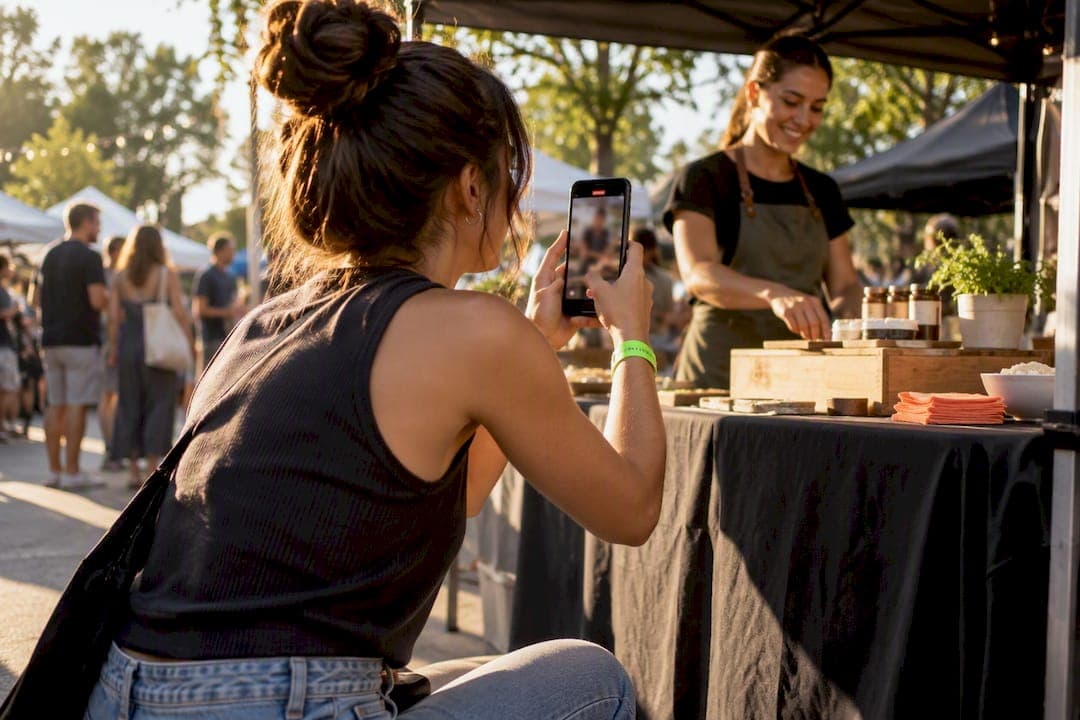
Local influencer marketing means paying or partnering with creators whose audience actually lives near your business, then using their content to build trust and drive visits. The right first move isn't a full campaign. It's a scoped pilot: brief one to three locally relevant creators, track each one separately, and judge results before spending another dollar. Expect awareness, foot traffic, and reusable content, not viral reach.
TL;DR:
- A local creator with a smaller but geographically concentrated following tends to generate more foot traffic than larger, non-local accounts with broader audiences.
- Using geotags, local hashtags, and community groups helps identify authentic neighborhood creators likely to deliver measurable results.
- Prioritizing local audience percentage and engagement quality over follower count ensures more relevant and effective influencer collaborations.
- Content rights and usage permissions are critical for maximizing the value of each post across ads, website, and email campaigns, not just social media.
- Scaling should start with a few trusted creators, and success should be measured through bookings, conversions, and foot traffic rather than vanity metrics.
Table of Contents
- Why Local Influencer Marketing Works for Small Businesses
- How to Find Local Influencers Worth Contacting
- Vetting and Selecting the Right Local Creators
- Structuring the Brief, Payment, and Content Rights
- Running the Pilot: KPIs and Tracking That Prove It Worked
- FTC Disclosure Rules and Contract Safeguards
- What an Agency Sees That Most Business Owners Miss
- The Part of This Playbook Most Businesses Skip
- How Crowdcompany Runs and Scales Local Influencer Programs
- Sources
- FAQ
Why Local Influencer Marketing Works for Small Businesses
A creator with 3,000 followers in your zip code beats one with 300,000 scattered across the country. That's the entire logic behind local influencer marketing, and it's why so many small business owners get the targeting backward. They chase follower counts instead of asking who can actually walk through the front door.
The real value shows up in a few specific ways:
- Foot traffic. A local creator's post drives people who live close enough to show up that weekend, not just people who like the photo.
- Reusable content. One good shoot with a local creator can become ad creative, website images, and email content for months.
- Community trust. A recommendation from someone the audience already follows carries more weight than a paid ad from a brand they don't know yet.
- Cost efficiency. Nano and micro creators charge far less than regional influencers, and often perform better on engagement.
That last point has data behind it. Later's 2025 industry report found a median CPM around $119 for micro creators, with nano creators posting engagement rates between roughly 6.15% and 6.76%, well above what most brand accounts see organically.
Local influencer marketing isn't the right lever for everything. If you're launching a national product with no physical storefronts or regional distribution, a local creator's audience geography works against you instead of for you. Save this tactic for businesses with a location, a service area, or an event people can actually attend.
How to Find Local Influencers Worth Contacting
Finding creators isn't hard. Finding the right ones for your zip code takes a little more method than scrolling and hoping.
- Search geotags and local hashtags first. Pull up your city or neighborhood tag on Instagram and TikTok, then note which creators show up repeatedly with genuine local content, not tourists passing through.
- Check who your customers already tag. Look through your own social mentions and reviews. The person raving about your coffee shop in a Story might already be your best unpaid advocate.
- Browse local Facebook groups and event pages. Community groups, farmers market pages, and neighborhood association accounts often reveal creators who show up consistently at local happenings.
- Study competitor collaborations. If a nearby business worked with a creator and got a good response, that creator already understands your market.
- Use an influencer discovery tool for filtering. Platforms that filter by city, audience interests, and demographics can speed up the mapping process for your local influencer landscape, though you should still verify their audience data manually before reaching out.
- Go offline. Attend a local event, sponsor a small gathering, or just ask your regulars if they create content. Some of the best local partnerships start with a conversation at the register.
Pro Tip: Before you message anyone, spend ten minutes reading their last 20 posts and their comment section. A creator with modest reach but thoughtful, specific comments from real neighbors is worth more than one with flashy numbers and a wall of emoji replies.
Vetting and Selecting the Right Local Creators
Follower count is the least useful number on a creator's profile. The question that actually predicts results is simpler: what percentage of this person's audience can realistically visit or buy from your location? Mapping your local influencer landscape treats audience geography as the decisive filter, and for good reason. A neighborhood specialist with a smaller, concentrated following will consistently outperform a broader account whose audience is spread across three states, a point echoed in guidance on developing a local influencer strategy.
Beyond geography, run every candidate through a short checklist:
- Audience location and percent local reach
- Engagement quality (comments and saves, not just like counts)
- Content style and whether it fits your brand's tone
- Posting consistency over the last two to three months
- Any brand-safety red flags in past partnerships or public statements
| Criteria | What to look for | Red flag |
|---|---|---|
| Audience geography | High percent local reach | Followers concentrated elsewhere |
| Engagement quality | Real comments, saves, shares | Generic emoji comments only |
| Content style | Matches your brand tone | Inconsistent or low production quality |
| Brand safety | Clean history, no controversy | Past disputes with local businesses |
Score each candidate on a simple 1 to 5 scale across these categories, then prioritize total score over raw reach every time.
Structuring the Brief, Payment, and Content Rights
A weak brief is the fastest way to get content you can't use. A strong one spells out exactly what you need before the creator ever picks up a phone.
- Write the brief around deliverables, not vibes. Specify post count, format (Reel, Story, in-feed), required disclosure language, brand tags, and any tracking link or promo code that must appear.
- Set the approval process up front. Decide whether you review content before it posts, and give a clear turnaround window so you're not the bottleneck.
- Choose a compensation model that fits your budget. Local creators often accept flat fees, free product plus a smaller fee, or commission-based codes. Nano and micro creators are frequently open to negotiation, especially for a first collaboration.
- Lock down usage rights in writing. If you plan to reuse the content in paid ads, on your website, or in email, say so explicitly and negotiate that into the fee. A clear UGC rights agreement prevents disputes later and gives you a library of ad creative from a single shoot.
Pro Tip: Give creators room to write their own captions within your guardrails. Rigid scripts read as ads and tend to underperform; a creator's natural voice, backed by your key points, converts better because it still sounds like them.
Running the Pilot: KPIs and Tracking That Prove It Worked
A sensible pilot briefs one to three locally relevant creators, defines the offer clearly, requires content approval before posting, and tracks each creator's results separately so you know exactly what drove what.
Track a mix of hard and soft signals:
- Coupon or promo code redemptions
- Landing-page conversions and booked appointments
- Branded search increases and profile visits
- Saved posts and repeat visits
- Foot traffic proxies like check-ins or walk-in mentions
Branded search lifts, profile visits, and saves count as meaningful assisted outcomes even when they don't show up as a direct sale, according to guidance on influencer collaboration measurement. For service businesses, pair each creator with a dedicated landing page or call-tracking number so leads route into your CRM automatically. Matching the right attribution model to your sales cycle keeps you from crediting the wrong channel for a booking that took two weeks to close.
FTC Disclosure Rules and Contract Safeguards
Every creator you pay, gift product to, or discount must disclose that relationship clearly, and the disclosure has to sit next to the endorsement itself, not buried in a caption or bio link.
Build compliance into the contract instead of hoping the creator remembers:
- Require specific disclosure wording ("paid partnership," "gifted," etc.) placed in the video or image itself, not just the description
- Repeat disclosures periodically during livestreams
- Include approval rights so you review claims before they go live
- Prohibit health, safety, or income claims the creator can't substantiate
- Spell out remedies (content takedown, repayment) for noncompliance
Per the FTC's Endorsement Guides, both the brand and the creator share legal responsibility for missing or unclear disclosures. That liability doesn't disappear because you're a five-person team instead of a national brand.
What an Agency Sees That Most Business Owners Miss
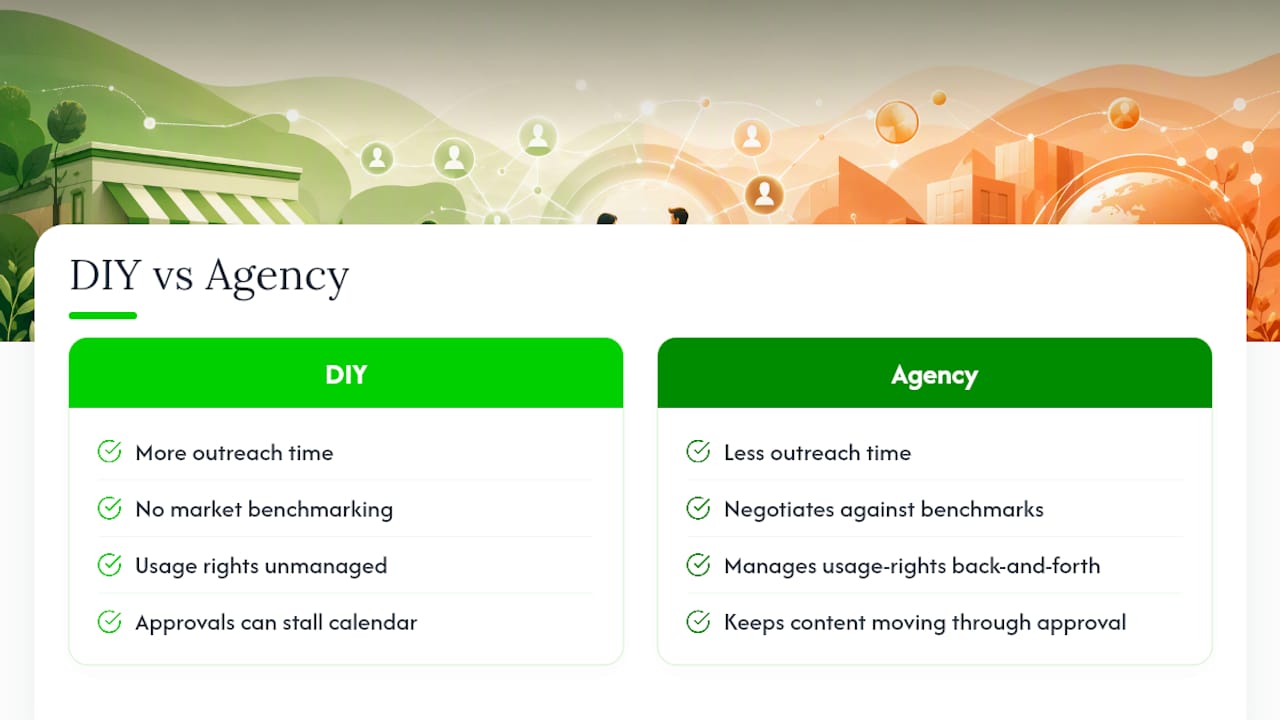
Running local influencer marketing well takes more coordination than most owners expect. An agency handling this daily negotiates rates against real market benchmarks, manages the back-and-forth on usage rights, and keeps every creator's content moving through approval without stalling the calendar.
The DIY route makes sense when you have time to manage outreach personally and a small enough pilot that mistakes are cheap. Hiring help makes sense once you're running multiple creators at once, need consistent contract language, or want the content repurposed across ads, email, and your website without a rights dispute. What justifies scaling a program isn't gut feeling. It's whether the pilot's tracked KPIs, redemptions, bookings, and assisted visits, actually beat what the same budget would have done in paid ads alone.
The Part of This Playbook Most Businesses Skip
Most advice on local influencer marketing focuses entirely on discovery, how to find creators, how to filter by hashtag, how to spot fake followers. That's the easy half. The part that actually determines whether your $200 to a nano creator turns into revenue is what happens after the post goes live, and almost nobody plans for it.
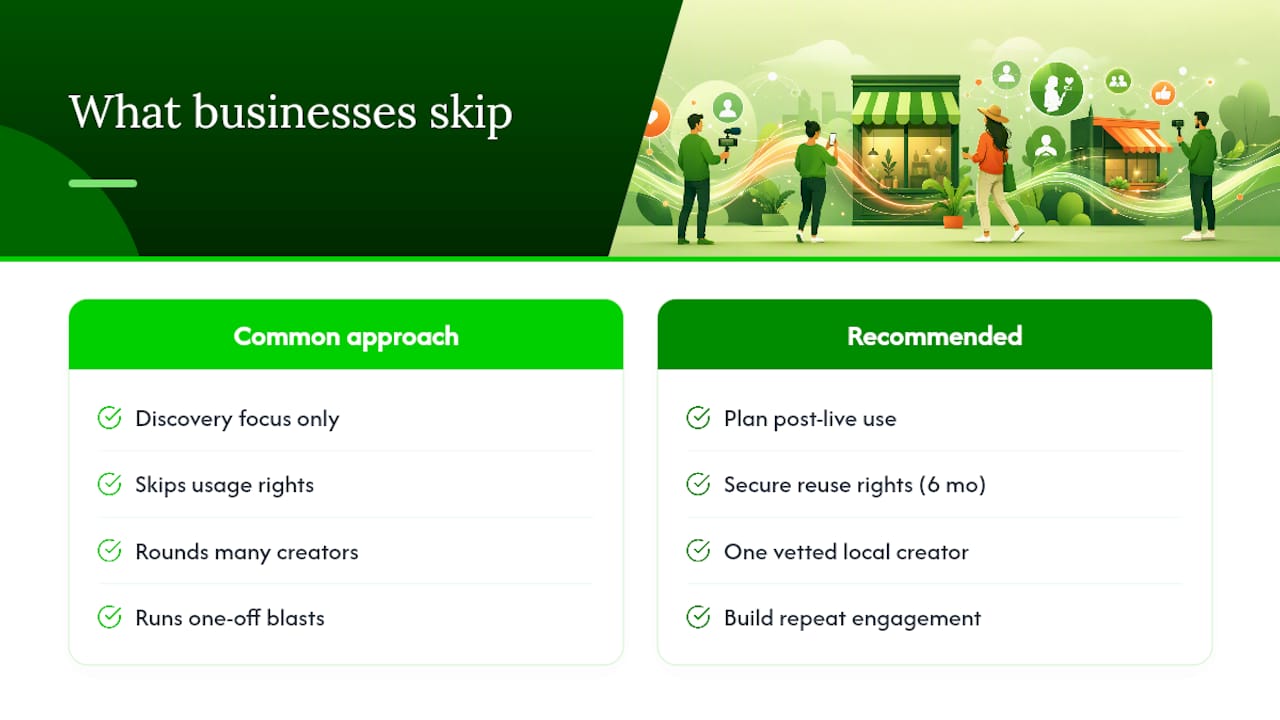
Usage rights are the single most underrated line item in any local creator negotiation. Businesses will spend an hour vetting engagement rates and then skip the two sentences that would let them reuse that same content in paid ads for the next six months. That's not a legal footnote. That's the difference between one Instagram post and a season of ad creative.
The other overrated idea is scale. Owners assume they need a roster of ten creators to see results. A single, well-vetted local creator with genuinely local reach will outperform five scattered ones every time, because community-focused programs build repeat engagement that a one-off blast never does. Start narrow. Prove the math. Then decide whether this is a pilot you scale or a channel you set aside.
— E
How Crowdcompany Runs and Scales Local Influencer Programs
Crowdcompany offers local influencer marketing services with transparent monthly pricing, no long-term contracts, and in-house execution rather than outsourcing.
That includes brand outreach and rate negotiation with local creators, UGC rights management so your content library actually converts across ads and email, paid amplification once a post proves itself, and measurement reporting focused on leads and bookings instead of vanity likes. A typical engagement starts with a small pilot, one to three creators, tracked separately, then scales the ones that produce real foot traffic or bookings. Every plan gets built around your specific growth stage rather than a one-size package.
If you're ready to stop guessing which creators actually move your local audience, check the full services lineup and get a plan scoped to your business this week.
Sources
- Mapping your local influencer landscape
- FTC's Endorsement Guides: What People Are Asking
- Influencer marketing in 2025: new data reveals what works, what costs, and what's next
- Building customer communities with influencers: a 2026 guide to authentic growth
FAQ
What Is Local Influencer Marketing?
Local influencer marketing is partnering with creators whose followers live in or near your service area, so their content drives foot traffic, local awareness, and trust rather than broad national reach. It works best for businesses with a physical location or a defined local service area.
How Many Followers Should a Local Influencer Have?
There's no minimum. Nano creators with a few thousand followers often deliver engagement rates around 6.15% to 6.76%, which usually beats a larger account whose audience isn't local. Audience geography matters more than raw count.
How Much Should I Pay a Local Influencer?
Local creators generally accept flat fees, free product plus a smaller payment, or commission-based codes, and nano and micro creators are often open to negotiation. Costs vary widely by market and deliverable, so treat industry CPM figures as directional, not a quote for any specific creator.
Do I Legally Need Disclosure on Sponsored Local Posts?
Yes. The FTC requires clear, conspicuous disclosure of any payment, free product, or discount, placed directly with the endorsement rather than hidden in a caption or bio, as detailed in the FTC's Endorsement Guides.
Can Crowdcompany Help Run a Local Influencer Pilot?
Yes. Crowdcompany's brand outreach and negotiation service is priced at $500 per month with no long-term contract, covering creator outreach, rate negotiation, and usage-rights management for local campaigns.