
An event marketing plan is a written system that turns a fixed date and budget into a predictable number of registrations that convert into pipeline or revenue. That single measurable outcome, registrations that actually turn into pipeline, is the entire point of writing one down instead of winging it. A real plan ties one primary goal to specific channels, a phased timeline, a budget, and a measurement dashboard rather than treating marketing as an afterthought once the venue is booked.
The core components you need before you write a single email:
- Goal and KPIs: one primary objective (leads, revenue, attendance, community) with SMART targets attached
- Audience: who you're targeting and why this event solves their problem
- Channels: the specific mix of email, social, paid, and partnerships you'll run
- Timeline: a phased countdown from roughly 12 weeks out through post-event follow-up
- Budget: allocated by channel, not just a single lump sum
- Assets: landing page, creative, sponsor materials, tracking tags
- Tracking: UTM parameters and CRM flows that connect registration to revenue
You'll find a downloadable checklist and an Asana project template reference later in this piece, both built around the same six-component structure described above.
Key Takeaways
An event marketing plan works when one primary goal drives SMART objectives, a phased T-12 timeline, channel-specific cadences, and a measurement dashboard tied to pipeline, not just attendance.
| Point | Details |
|---|---|
| Pick one primary goal | Every channel, budget line, and KPI should cascade from a single SMART objective, not four competing ones. |
| Follow T-12 pacing | Target 20% to 30% of registrations by T-7 and 60% to 75% by T-4 to catch shortfalls early. |
| Prioritize email and advocacy | Email converts known audiences best; partner referrals often outperform cold paid traffic three to five times over. |
| Follow up within 24 hours | Immediate post-event outreach and a fast survey window capture pipeline that delayed follow-up loses. |
| Get implementation help | Crowdcompany executes this plan end-to-end through audience research, CRM automation, email retargeting, and event PR services. |
Table of Contents
- Building Your Event Marketing Plan Step by Step
- Which Channels Should Carry Your Event Promotion Ideas?
- How Do You Build a T-12 Event Marketing Timeline?
- What KPIs Actually Prove Your Event Marketing Plan Worked?
- How Do You Turn Attendees Into Pipeline Before, During, and After?
- What Templates Do You Need to Run This Plan?
- Why SMART Objectives Matter More Than Attendance Numbers
- What Legal and Privacy Rules Apply to Event Marketing?
- How Do You Handle a Crisis During Your Event?
- Let CROWD Run Your Event Marketing Plan for You
- Frequently Asked Questions
- Sources
Building Your Event Marketing Plan Step by Step
A plan without owners and deadlines is a wish list. Here's the sequence that turns your event marketing strategy into something a team can actually execute, with a deliverable, an owner, and a metric attached to each step.
1. Decide your primary goal. Pick one dominant objective, lead generation, brand awareness, revenue, or community building, and let everything else cascade from it. Trying to optimize for all four at once is how teams end up with a scattered event marketing strategy that satisfies nobody. Deliverable: a one-page goal brief. Owner: the marketing lead or event director. Metric: a single SMART target (e.g., "400 qualified registrations" or "$250K in sourced pipeline").
2. Define your ideal attendee (ICP). Write down who this event is actually for: title, company size, pain point, and what they need to hear to register. Deliverable: an audience profile with three to five firmographic or demographic filters. Owner: marketing strategist or audience research lead. Metric: percentage of registrants matching the target profile (aim for 70% or higher).
3. Build core messaging and positioning. Turn the audience profile into a value proposition: why this event, why now, why them. This becomes your landing page headline, email subject lines, and ad copy. Deliverable: a messaging one-pager with three positioning angles. Owner: content or copy lead. Metric: landing page click-through rate from initial messaging tests.
4. Produce your core assets. This is where the plan becomes tangible: landing page, registration flow, email templates, social creative, and a sponsor one-pager if you're running co-marketing. Deliverable: a finished asset library, versioned and approved. Owner: design and web team. Metric: asset completion against your timeline (should be 100% by T-9, covered in the next section).
5. Select and brief your channels. Decide which channels carry which job. Email converts known contacts, paid extends reach to net-new audiences, social amplifies advocacy, and partnerships borrow trust from sponsors and speakers. Deliverable: a channel brief document with cadence and budget per channel. Owner: channel or performance marketing lead. Metric: projected registrations by channel, benchmarked against actuals weekly.
6. Activate the campaign. Launch registration, turn on paid, send your save-the-date, and open sponsor co-marketing. Deliverable: a live campaign with tracking active on day one. Owner: campaign manager. Metric: registrations at T-7 and T-4 against your pacing targets.
7. Run on-site operations. Staff check-in, lead capture, and live content production. This is where marketing hands off to operations, but tracking has to keep working. Deliverable: an on-site playbook with staffing assignments. Owner: event operations lead. Metric: check-in rate and lead capture volume.
8. Execute follow-up and reporting. Send immediate post-event communications, route leads into CRM, and report against your original goal. Deliverable: a follow-up sequence and a final performance report. Owner: marketing lead with sales handoff. Metric: pipeline created and attendee-to-opportunity conversion rate.
A plan built on one clear primary goal, cascading into SMART objectives, is what separates an operational plan from an aspirational one, and this six-component structure (goals, audience, channel mix, timeline, budget, and measurement) is what most complete event marketing plans have in common regardless of event size.
Your must-produce asset checklist, with acceptance criteria for each:
- Landing page live and mobile-tested, with a single clear registration CTA above the fold
- Email sequence built (minimum three touches: save-the-date, nurture, last-chance) and QA'd for links and personalization tokens
- Social creative sized correctly for each platform, with UTM-tagged links baked in
- Sponsor one-pager finalized and approved by every co-marketing partner before it goes out
- Tracking tags installed and firing correctly, verified with a test registration before launch
Skip the acceptance criteria and you'll find out your tracking was broken three weeks into the campaign, right when you need clean data most.
Which Channels Should Carry Your Event Promotion Ideas?
Different channels do different jobs, and the biggest mistake in most event promotion checklists is treating them interchangeably. Here's how to sequence and brief each one.
Email is the backbone of your conversion funnel. It consistently outperforms social and paid for direct registrations when you're emailing a known, engaged list. Run a three-stage cadence: a save-the-date at T-10, a nurture sequence with speaker or agenda previews from T-8 through T-4, and a last-chance push in the final 72 hours. Segment by past attendance, industry, or funnel stage, and vary your CTA accordingly: "Reserve your seat" for cold segments, "Confirm your spot, seats are limited" for warm ones.
Social amplifies what email and paid can't reach organically. Ask speakers and sponsors to post using a dedicated event hashtag, and post your own organic content on a steady cadence, agenda teasers, speaker spotlights, behind-the-scenes prep, twice a week minimum leading into the event. During the event itself, live content (photos, short clips, quote graphics) keeps registrants who didn't attend engaged for next time and gives sales teams social proof to share.

Paid extends your reach past your existing list. Target lookalike audiences based on past attendees, plus firmographic targeting on LinkedIn for B2B events. Video and carousel creative tend to outperform static images for registration campaigns. Cost-per-registration varies widely by industry and audience size, so track it weekly against your own benchmark rather than assuming an industry average. A simple paid split: 60% prospecting to new audiences, 40% retargeting people who visited your landing page but didn't convert.
Partnerships and sponsors often get underused as a promotion channel. Peer advocacy and partner co-marketing convert at materially higher rates than cold paid traffic, sometimes three to five times better, because the audience already trusts the referring source. Send every sponsor a short brief with three specific asks: one newsletter mention by a set date, two social posts with provided copy and creative, and a co-branded landing page link. Attach deadlines to each ask or they'll slip past your campaign window.
How Do You Build a T-12 Event Marketing Timeline?
Start twelve weeks out and work in phases, not a single flat countdown. A five-phase structure, Foundation, Awareness, Momentum, Urgency, and Post-event, scales across event sizes and gives you built-in checkpoints instead of a vague sense of "we should be further along by now."
At T-12 (Foundation), lock your goal, audience, and core assets. At T-9 (Awareness), launch the landing page and save-the-date, and open sponsor co-marketing. At T-6 (Momentum), ramp paid spend and start your email nurture sequence. At T-3 (Urgency), push last-chance messaging and highlight limited capacity. From T-0 to T+4 (Post-event), execute your follow-up sequence and send the attendee survey.
Registration pacing should follow a predictable curve: 20 to 30% of total registrations by T-7, and 60 to 75% by T-4. If you're well below that at T-7, that's your signal to shift budget toward paid or advocacy immediately, not wait until T-3 to panic.
For budget, typical channel splits for a mid-size B2B event with a $20,000 to $150,000 marketing budget run roughly as follows, rebalanced against your own cost-per-registration data once campaigns are live:
| Budget Bucket | Typical Allocation |
|---|---|
| Paid digital | 30% to 35% |
| Email marketing | 10% to 15% |
| Content and SEO | 10% to 15% |
| Partner and sponsor co-marketing | 10% to 15% |
| Creative and production | 10% to 15% |
| Listings and directories | 5% to 10% |
| Advocacy programs | 5% to 10% |
| Contingency | 5% to 10% |
A quick back-of-envelope formula for planning: divide your total marketing budget by your target registration count to get a working cost-per-registration ceiling, then check that ceiling against channel-level benchmarks before you commit spend.
What KPIs Actually Prove Your Event Marketing Plan Worked?
Track different metrics at different phases, because a registration count alone tells you nothing about quality. Pre-event, watch registrations against goal, landing page conversion rate, and cost per registration. During the event, track check-in rate, session attendance, and lead capture volume. Post-event, measure pipeline created, opportunity conversion, and attendee satisfaction (NPS).
Pro Tip: Set your landing page conversion benchmarks before launch, not after. Paid traffic typically converts at 18 to 24%, while referral and advocacy traffic converts at 35 to 45%. If your paid landing page is converting under 15%, the problem is usually messaging, not traffic quality.
Your tracking checklist needs:
- Consistent UTM parameters on every link, tagged by channel and campaign name
- Event-specific tags in your CRM so registrations and attendance sync automatically
- Lead scoring rules that flag high-intent behavior (session RSVPs, exhibitor visits, meeting requests)
- A survey sent within 24 to 48 hours of event close, while the experience is still fresh
Attendance rates for mid-size B2B events typically land in the 60 to 70% range of total registrants, so build your on-site staffing and catering numbers around that rate rather than your full registration count.
Worked ROI example: if you spend $30,000 in marketing and generate 500 registrations, your cost per registration is $60. If 65% attend (325 people) and 20% of attendees become sales opportunities worth an average $8,000 each, that's 65 opportunities and $520,000 in sourced pipeline, roughly a 17x return against marketing spend alone.
How Do You Turn Attendees Into Pipeline Before, During, and After?
The event itself is just the middle of a three-part engagement window, and most of the value gets built or lost in the parts people forget to plan.
- Before the event, run a nurture sequence that previews speakers and sessions, send community invites to build peer anticipation, prompt advance networking through your event app or a shared attendee directory, and use early-bird deadlines to create urgency without discounting too aggressively.
- During the event, push live social content and encourage attendees to use your event hashtag, capture leads on-site through QR codes, app-based meeting requests, and exhibitor scanning, and route hot leads (anyone who requested a meeting or visited a sponsor booth) into your CRM in real time rather than batching it after the event ends.
- After the event, send your first follow-up within 24 hours while the experience is still top of mind, deploy a short feedback survey within 48 hours, and repurpose session recordings and key moments into blog recaps and social clips that extend the event's life for months.
Experts consistently point to live content and immediate post-event tracking as the difference between an event that generates a memory and one that generates measurable pipeline.
What Templates Do You Need to Run This Plan?
You don't need to build any of this from a blank page. Four templates cover the entire plan structure described above:
- Asana project template: a pre-built project with tasks for each of the eight execution steps, assignable by owner and due date
- CROWD event checklist: the compact version of the asset checklist covered earlier, formatted for quick reference
- Email sequence CSV: subject lines and send dates for the save-the-date, nurture, and last-chance cadence
- Sample landing page copy snippet: a headline and CTA framework you can adapt to your own positioning
To import the Asana template, create a new project, select "Import template," and map each phase (Foundation, Awareness, Momentum, Urgency, Post-event) to a section with due dates keyed to your event date. A mini two-week calendar snippet you can paste directly into any project tool: Monday, finalize creative; Wednesday, launch paid campaigns; Friday, send nurture email; following Monday, sponsor social push; Wednesday, urgency email; Friday, final asset QA.
Why SMART Objectives Matter More Than Attendance Numbers
Attendance alone is a vanity metric if it isn't tied to a business outcome. A SMART objective forces specificity: instead of "grow attendance," you write "register 400 qualified attendees from target accounts by [event date], generating $250,000 in sourced pipeline within 60 days." That single sentence now dictates your audience targeting, your channel mix, and your budget.
Revenue-focused events need a different SMART structure than brand-awareness events. If your goal is revenue, your KPI tree should run from registrations to attendance to sales meetings booked to pipeline created, with a dollar figure attached at the final step. If your goal is brand awareness, your KPIs shift toward reach, media mentions, and social engagement instead, and pipeline becomes a secondary, not primary, measure.
Leads and engagement goals sit somewhere in between. A lead-generation event should set a target cost-per-qualified-lead figure before the campaign launches, not calculate it retroactively. Engagement-focused events (user conferences, community meetups) should set a target for repeat attendance or Net Promoter Score, since the business value comes from retention rather than a single conversion event.
Whatever the goal, write the deadline into the objective itself. "Increase attendance" has no timeline and no way to fail. "Reach 400 registrations by T-1 week" gives your team an early warning system if pacing falls behind, which is exactly the kind of signal that lets you shift budget while there's still time to fix it.
What Legal and Privacy Rules Apply to Event Marketing?
Every registration form you build collects personal data, and that data carries real compliance obligations regardless of event size. If you have attendees from the European Union, the General Data Protection Regulation requires clear consent language, a stated purpose for data collection, and an easy opt-out mechanism, even for a one-time event registration.
For US-based events, state-level privacy laws (California's CCPA among them) increasingly require similar disclosures: what data you collect, how long you keep it, and who you share it with, including sponsors. If sponsors receive attendee data as part of a co-marketing agreement, that sharing needs to be disclosed to registrants at the point of signup, not buried in a footer link nobody clicks.
Photo and video releases matter more than most planners assume. If you're capturing live content for social media or a recap video, your registration form or on-site signage should include a media consent clause. Without it, you're technically exposed if someone objects to appearing in promotional content after the fact.
Email marketing carries its own rules under the CAN-SPAM Act: every promotional email needs a working unsubscribe link and accurate sender information. If you're emailing a purchased list rather than opt-in registrants, you're taking on legal risk that a properly permissioned list avoids entirely.
None of this replaces legal counsel for your specific event and jurisdiction, but building consent, disclosure, and unsubscribe mechanics into your registration flow from day one is far cheaper than retrofitting them after a complaint.
How Do You Handle a Crisis During Your Event?
Every event needs a contingency plan before it needs one, because the moment something breaks is the worst possible time to figure out who's in charge of saying what. Build a one-page crisis protocol before launch, not during a live emergency.
Start with a designated point of contact for communications decisions, someone empowered to approve a message without waiting for a committee. Weather, venue issues, speaker cancellations, and technical failures (a livestream going down mid-session) are the most common disruptions, and each needs a pre-written holding statement you can adapt and send within minutes rather than draft from scratch under pressure.
Have a communication channel ready that doesn't depend on the thing that might fail. If your event app goes down, you need email and SMS as backups. If your venue loses power, you need a way to reach registrants who haven't arrived yet before they're stuck in traffic for nothing.
Assign backup owners for every critical role. If your on-site lead capture person can't make it, someone else needs to know the process cold, not learn it that morning. The same applies to your social media lead: if they're managing a crisis response, someone else needs to keep regular content running so the account doesn't go silent at the worst possible moment.
Post-crisis, always send a follow-up acknowledging what happened, even briefly. Silence after a disrupted event damages trust more than the disruption itself.
How CROWD Applies This Plan in the Field
A few things we've learned running this playbook for local clients: we test landing page headlines against real ad spend before committing the full budget, not after. We put advocacy and partner co-marketing ahead of paid spend in the sequence, because referral traffic converts at a rate cold ads rarely match. And we automate CRM tagging at check-in so hot leads route to sales before the event even ends.
One client's registration pacing stalled hard at T-9, and a same-week shift toward sponsor co-marketing recovered the gap by T-6.
Let CROWD Run Your Event Marketing Plan for You
You've got the framework now: one goal, a T-12 timeline, channel cadences, and a measurement dashboard. Turning that framework into a live campaign, with landing pages built, ads running, and leads routing correctly, is where most in-house teams run out of hours before they run out of ideas.
Crowdcompany maps directly onto every phase of this plan. Audience research and targeting defines your ICP before you write a single email. CRM and lead automation handles the real-time routing that turns a QR scan at your booth into a sales meeting the same afternoon. Retargeting and email marketing runs your nurture cadence so it doesn't fall apart the week before launch. And when your event needs press coverage or speaker outreach, Digital PR handles the media side while your team focuses on the room.
Most engagements start with a fixed-scope audit of your current event funnel, landing page, tracking, and channel mix, followed by a kickoff scoped to whichever phase needs the most help first. If your next event is already on the calendar, get in touch with Crowdcompany to scope a starting engagement before your T-12 window closes.
Frequently Asked Questions
What should be included in an event marketing plan? A complete plan includes a primary goal with SMART objectives, an audience profile, a channel mix (email, social, paid, partnerships), a phased timeline, a budget broken down by channel, and a measurement dashboard tracking registrations through pipeline.
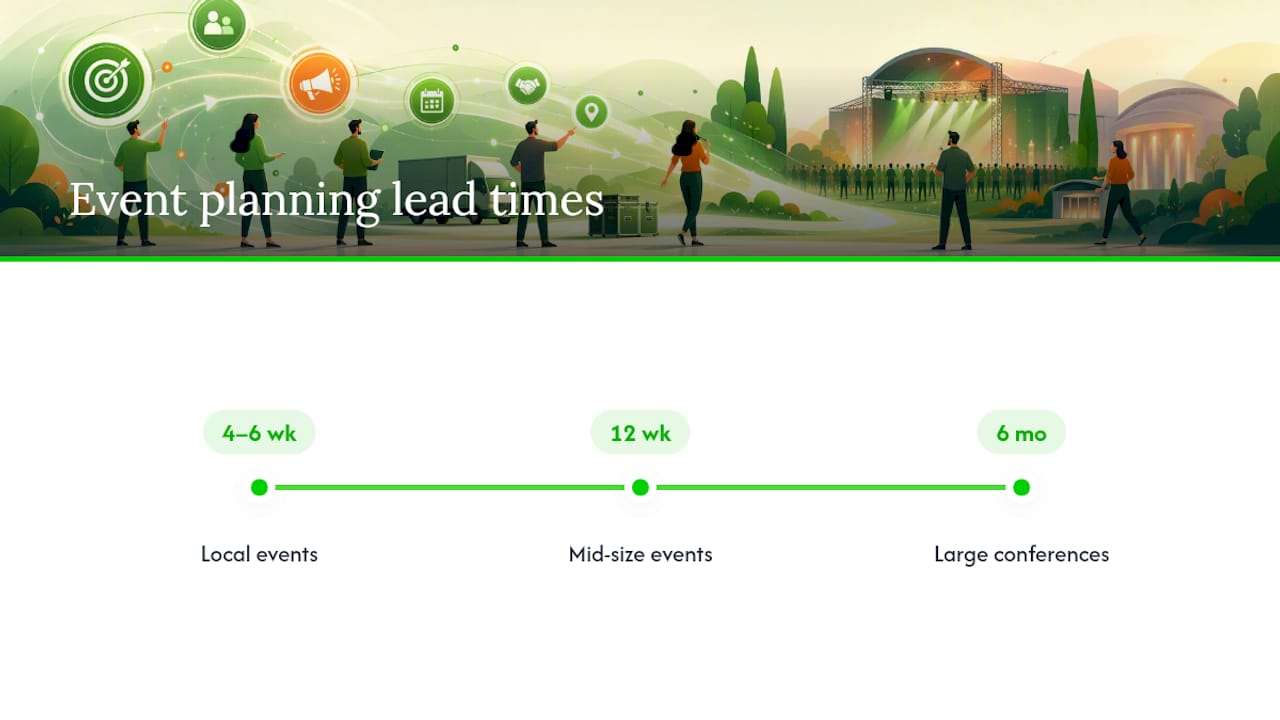
How far in advance should I start my event marketing timeline? Twelve weeks out is the standard starting point for mid-size events. Larger conferences often start planning six months ahead, but active promotion typically follows the same T-12 pacing structure regardless of when planning begins.
What's a good cost per registration for a B2B event? It varies by industry, audience size, and channel mix, so track your own number weekly against your budget-to-registration ratio rather than chasing a generic industry average.
How do I measure event marketing ROI? Calculate cost per registration, multiply attendance rate by opportunity conversion rate to estimate pipeline, then compare total pipeline value against total marketing spend for a working ROI figure.
Should small businesses build a full event marketing plan for local events? Yes, though the scale shrinks. Local event marketing still benefits from one clear goal, a shortened timeline (four to six weeks for smaller local events), and basic tracking, even if the channel mix leans more on social and local partnerships than paid digital.
Unbounce or Instapage, which is better for event landing pages? Both build functional, conversion-focused landing pages with A/B testing built in. Instapage tends to offer more advanced personalization for larger campaigns, while Unbounce is often quicker to launch for a single event page. Choose based on how much ongoing landing page volume you expect, since either handles a standard event registration page well.
Sources
- Event Marketing Plan: Step-by-Step Guide + Free Template (2026)
- Event Marketing Strategy: The 2026 Complete Guide | Swapcard
- Event Marketing: How to Build Your Strategy & Connect With Customers in Real Life