
An earned media strategy is a repeatable program that wins third-party coverage, mentions, and endorsements, then turns each placement into measurable brand and demand lift. It replaces one-off "get us in the news" campaigns with a system: defined targets, pitch-ready assets, and a way to prove that coverage moved the business. Brands that build this kind of program earn credibility paid ads can't buy, and they position themselves to be cited by the AI tools now shaping how people find information.
TL;DR:
- Building a repeatable earned media program can increase branded search volume by 10 to 40 percent after strong placements.
- Effective pitches focus on a clear newsworthy finding, relevant media contacts, and are sent on optimal days like Tuesday through Thursday mornings.
- Content that resonates most with editors includes data-driven stories or visual content, tailored to the outlet's audience and storytelling style.
- Measuring success should prioritize referral traffic, backlink quality, and AI citation visibility rather than just clip counts.
- A hybrid approach combining internal asset creation and agency outreach boosts coverage consistency and long-term results.
Table of Contents
- Why Earned Media Matters Now (Trust, AI Visibility, and Compounding Channels)
- Types of Earned Media Worth Pursuing
- A 6-Step Framework to Build a Sustainable Earned Media Program
- Media Relations and Pitching Tactics That Actually Work
- Amplification: Turning One Placement Into Ten Uses
- Measuring Earned Media: Metrics That Actually Tie to Business Outcomes
- Common Mistakes and Trade-Offs to Get Right
- Case Notes: How This Framework Plays Out in Real Client Work
- A 30/90/180-Day Action Checklist
- Crisis Management and Earned Media
- Legal and Ethical Considerations in Earned Media Outreach
- Why We Prioritize Earned Media: A Publisher's Viewpoint
- How Crowdcompany Builds Earned Media Programs That Compound
- Sources
Why Earned Media Matters Now (Trust, AI Visibility, and Compounding Channels)
Earned media has always carried more credibility than paid or owned content because a third party is vouching for you instead of you vouching for yourself. What changed is who's reading that third-party validation. Large language models pull from independent sources when they answer questions, and unpaid coverage carries far more weight in that process than advertising ever did. If a trade publication or local news outlet writes about your business, that mention can surface inside an AI-generated answer months later, long after the original article stopped driving direct traffic.
The compounding effect goes beyond AI citations. Earned coverage typically:
- Lifts branded search volume by 10 to 40 percent following a strong placement
- Generates backlinks that strengthen SEO and answer-engine visibility
- Feeds owned channels (blog, email, social) with third-party proof you can't self-generate
- Builds a body of narrative and quotes sales teams can reuse in pitches
Pro Tip: Track branded search volume in Google Trends the week before and the four weeks after a major placement. That spike is often the clearest evidence a story worked, even before backlinks or referral traffic show up in your reports.
Paid media buys attention. Owned media builds a home for your message. Earned media is the only one of the three that borrows someone else's credibility on your behalf.
Types of Earned Media Worth Pursuing
Not every format delivers the same return, and the right mix depends on who you're trying to reach. A regional service business and a B2B software company should not be chasing the same kind of coverage.
- Press coverage and news mentions: local news, trade publications, and industry roundups that name your business as a source or example.
- Bylines and guest columns: your team's own analysis published on an outlet's platform, valuable for B2B credibility and thought leadership.
- Podcast appearances: strong for founder visibility and long-form trust building, especially in niche B2B categories.
- Newsletter mentions: curated industry newsletters often have smaller but highly engaged, relevant audiences.
- Creator and UGC mentions: organic tags, reviews, and shoutouts from customers or influencers who used your product without being paid to.
- Customer reviews: Google, Yelp, and industry-specific review platforms function as always-on earned media.
- Awards and rankings: "Best of" lists and industry awards create a reusable credibility asset long after the announcement fades.
A data-driven story (a survey, a proprietary stat, a trend analysis) tends to win press and bylines. A visual story (a renovation, an event, a product transformation) performs better with creators and local news. Know which kind of story you actually have before you start pitching.
A 6-Step Framework to Build a Sustainable Earned Media Program
Most brands treat earned media as a scramble: something they do when they need a story fast. A repeatable program works differently. It runs on a cycle, not a campaign.
- Define goals and your media universe. Decide what success looks like (brand awareness in a new market, credibility for a launch, recruiting SEO signal) and build a list of the outlets, reporters, and creators who actually cover your space.
- Create coverage-worthy assets. Journalists need something new to say. That means original data, a quotable spokesperson, or visuals that make the story easy to tell. A press release with no news in it gets ignored.
- Organize and prioritize relationships. Not every contact deserves the same effort. Rank your media list by relevance and past responsiveness, not just outlet size.
- Build the pitch workflow. Every pitch needs a subject line, a one-sentence finding up front, three to five usable bullets, and supporting assets ready to send on request.
- Amplify across owned and paid channels. A placement that lives only on the publisher's site is half-used. Push it into email, social, and sales materials.
- Measure and iterate. Track quality signals, not just clip count, and use what worked to refine your next pitch cycle.
Pro Tip: Build your media list in a shared spreadsheet or lightweight CRM with columns for beat, last three-story topics, and last contact date. Reporters change beats often, and pitching someone who moved off your topic six months ago is the fastest way to get ignored.
The teams that keep earning coverage year after year treat this as an operating rhythm, not a project with an end date. That's the actual difference between an earned media strategy and a lucky press hit.
Media Relations and Pitching Tactics That Actually Work
Your media list is only as good as what you track in it. Log the outlet, the reporter's beat, their last three articles, their preferred contact method, and the date you last reached out. Skipping any of those fields is how you end up pitching a reporter who covers a completely different topic now.
Pitch anatomy matters more than pitch volume. Journalists are buried in email, and the ones that get opened share a pattern:
- A subject line of 6 to 9 words that states the finding, not a vague tease
- A first sentence that leads with the actual news, not a company introduction
- Three to five bullets a reporter could lift straight into a draft
- A pitch length of 100 to 150 words total, since anything longer usually gets skimmed or skipped
Timing counts too. Tuesday through Thursday mornings tend to outperform Monday scrambles and Friday afternoon inboxes, and a single polite follow-up after four or five business days beats silence or a third nagging email.
Source-response platforms like HARO send three query batches daily, and responding within the hour meaningfully improves your odds of getting quoted, since reporters often stop reading responses once they have enough. Match your reply structure to the query itself and keep it to three to five concise, usable points.
Pro Tip: Read a reporter's last three to ten articles before you pitch, then open with one sentence explaining why the story fits their specific beat, not your company's mission. That single habit does more for pickup rates than any pitch template.
Treat social media differently from email. It's for building the relationship long before you need something, not for pitching. Comment on a reporter's work, share it honestly, and let familiarity do some of the persuasion your cold pitch can't.
Amplification: Turning One Placement Into Ten Uses
A single piece of coverage is raw material, not a finished asset. The most effective programs repurpose every placement across several channels instead of letting it live and die on the publisher's site.
- Turn the coverage into a blog post that adds context and links back to the original piece
- Write a LinkedIn post from the founder or spokesperson quoted, framed around the story's actual insight
- Cut a short video clip if the placement included video or audio
- Drop a line into the next customer email or newsletter
- Hand sales teams a one-line summary they can use in outreach or proposals
Referral traffic from earned coverage converts 10 to 30 percent higher than average traffic, because visitors arrive already trusting the source that sent them. That's a strong argument for putting modest paid spend behind your best placements, boosting the LinkedIn post or the blog recap rather than a generic ad.
A tight press kit (logo files, headshots, boilerplate, past coverage links) makes pickup easier and faster for any reporter deciding whether you're worth the effort. Tag the outlet and the reporter by name when you share coverage on social, but do it once, genuinely, not on every post for the next six months.
Measuring Earned Media: Metrics That Actually Tie to Business Outcomes
Clip count is the easiest metric to report and the least useful one to act on. A better measurement approach mixes leading indicators (pitches sent, response rate, placements secured) with lagging indicators (referral conversion, branded search lift, pipeline influence) on a monthly cadence.
Track these specifically:
- Branded search lift: expect a 10 to 40 percent bump after strong coverage, measurable in Google Trends or Search Console
- Referral traffic conversion: compare conversion rate from earned referral traffic against your site average
- Backlink quality: domain authority and relevance of linking sites, not just link count
- AI/LLM citation visibility: whether your brand or spokespeople show up when you query ChatGPT, Perplexity, or Google's AI Overviews on your core topics
- Narrative share of voice: how your framing compares to competitors' across the coverage you're both earning
Newer metrics like LLM visibility and citation frequency deserve a spot on the dashboard now, even though most teams have no historical baseline for them yet. Start tracking this quarter so you have something to compare against next year.
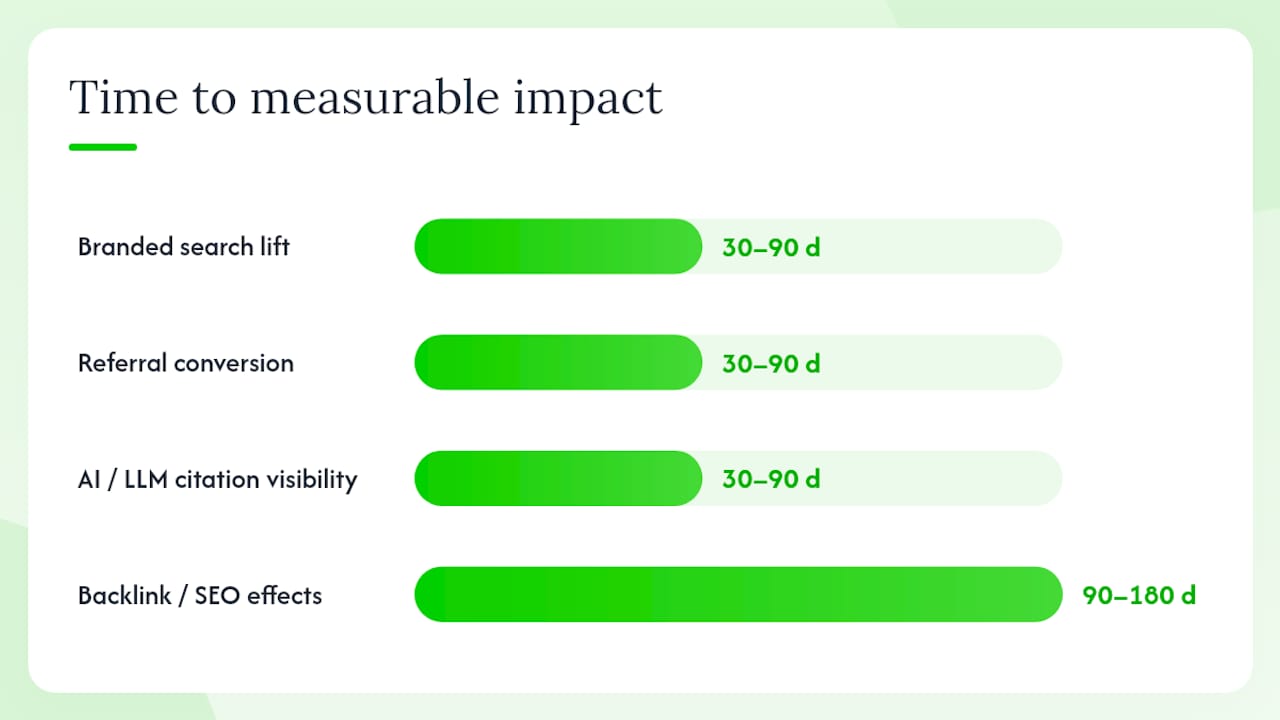
Set your baseline before your first pitch cycle, not after. Pull current branded search volume, current referral traffic, and run a handful of AI citation queries so you know what "before" looks like. Plan for traffic and search lift to show up within 30 to 90 days; SEO and backlink effects usually take longer to register.
Common Mistakes and Trade-Offs to Get Right
The most common failure isn't a lack of coverage, it's measuring the wrong things once coverage arrives. Counting placements without checking whether they moved search volume, traffic, or pipeline gives leadership a vanity number, not a business case.
- Mass-pitching irrelevant reporters wastes your list's goodwill and tanks future response rates
- One-off campaigns produce a spike and then nothing, since relationships need repeated, low-pressure contact to compound
- Cold pitching to mainstream outlets converts at under 5 percent most of the time, while source platforms run 5 to 15 percent for genuinely useful responses
- Under-resourcing the program (one junior hire, no dedicated hours) guarantees inconsistency
Deciding between in-house and agency support usually comes down to speed versus depth. In-house teams know the brand voice cold but often lack existing reporter relationships. Agencies bring those relationships and a faster pitch cycle, at a real cost. A hybrid model, in-house for asset creation and agency for relationship-driven outreach, tends to outperform either extreme.
Case Notes: How This Framework Plays Out in Real Client Work
Crowdcompany has run earned media programs for local businesses across Miami Beach, Fort Lauderdale, and Palm Beach, and the pattern holds regardless of category: restaurants, e-commerce brands, and service businesses all see the same lift when coverage lands in an outlet their actual customers read, not just any outlet with traffic.
- A press mention paired with a same-week social and email push consistently outperforms the mention alone
- Local publications and niche podcasts often outperform larger national outlets for direct foot traffic and phone calls
- Review-driven earned media compounds fastest for service businesses, since a steady review pipeline feeds both local SEO and AI-driven local search answers
Crowdcompany applies the same 6-step framework across client accounts: define the media universe by neighborhood and category, build a genuinely pitchable asset, prioritize relationships over blast lists, run a tight pitch workflow, amplify every placement across owned channels, and report on branded search and referral conversion rather than clip count alone. Coverage secured through publications, podcasts, and media partnerships gets folded into that loop the same day it runs.
A 30/90/180-Day Action Checklist
You don't need a fully staffed PR team to start. You need a sequence.
- First 30 days: Define your target audience and the three to five story angles you can credibly tell. Build a starter media list of 20 to 30 relevant contacts. Create one genuinely coverage-worthy asset (a data point, a customer story, a launch).
- Next 90 days: Send targeted pitches on a weekly cadence, not in one bulk blast. Sign up for a source-response platform like HARO and commit to replying within the hour. Repurpose your first placements into at least one blog post and one LinkedIn post each.
- By 180 days: Pull branded search data and compare it to your baseline. Check whether earned referral traffic is influencing pipeline, not just visits. Decide whether to keep the program in-house, add headcount, or bring in agency support for the relationship-heavy parts of the work.
Crisis Management and Earned Media
Earned media cuts both directions. The same channels that amplify a good story amplify a bad one faster than any owned channel you control. The moment a negative story starts circulating, whether it's a customer complaint that goes viral or a reporter working on something unflattering, response speed matters more than message polish.
Have a single point of contact designated before you need one. Reporters working a negative story will reach out for comment, often on a tight deadline, and no response reads as guilt even when it isn't. A short, honest statement beats silence and beats a defensive non-answer every time.
Don't try to bury a legitimate problem with a wave of unrelated positive pitches. Reporters and readers notice the mismatch, and it tends to make the original story look worse, not better. Address the issue directly, correct what needs correcting, and let your next round of legitimate coverage happen on its own timeline.
Monitor mentions actively during any sensitive period, not just during a launch. A Google Alert or a basic social listening tool costs little and gives you the lead time to respond before a small story becomes a large one. The businesses that handle a crisis well usually aren't the ones with the best statement. They're the ones who saw it coming first.
Legal and Ethical Considerations in Earned Media Outreach
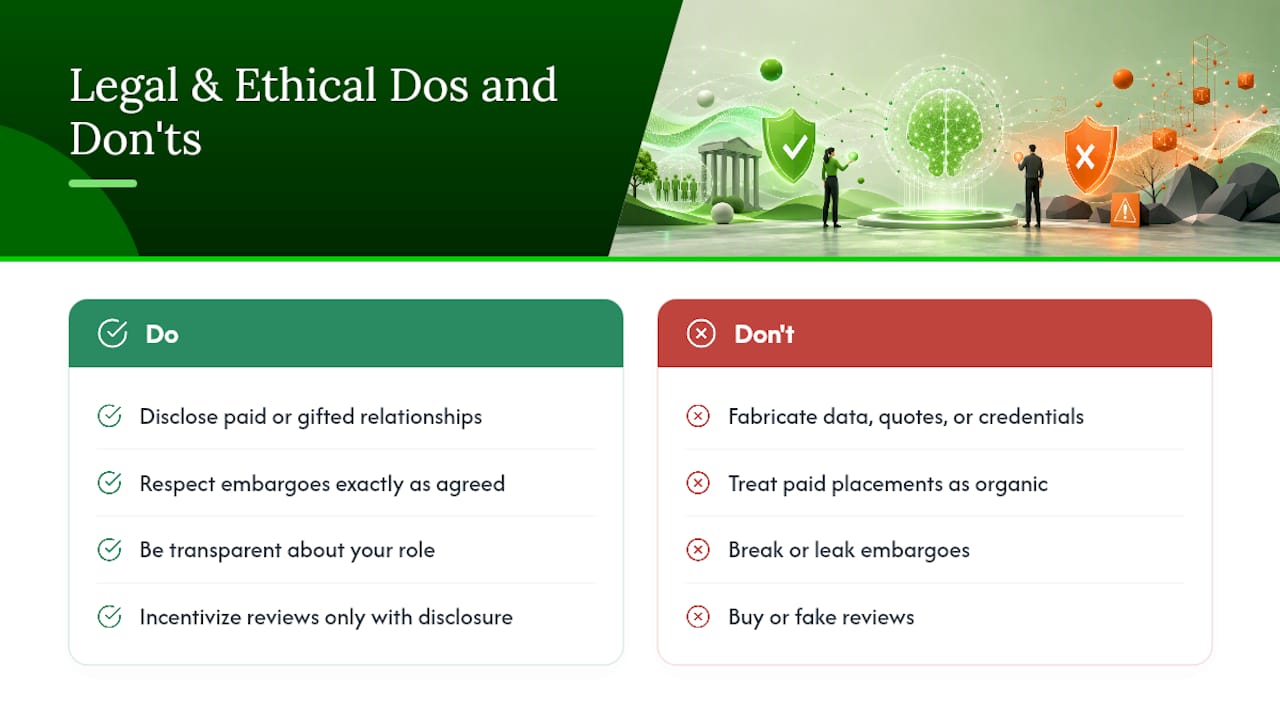
Earned coverage only works long term if the relationships behind it stay honest. That starts with disclosure. If a creator or reviewer received free product, payment, or any other consideration in exchange for a mention, the Federal Trade Commission requires clear disclosure of that relationship, and treating a paid or gifted placement as if it were purely organic misrepresents it to both the outlet and the audience.
Never fabricate data, quotes, or credentials to make a pitch more compelling. A journalist who catches one inflated statistic will stop trusting everything else you send, and that damage extends to your whole media list, not just that one relationship.
Respect embargoes exactly as agreed. Breaking an embargo to get ahead of a competitor, or leaking a story a reporter asked you to hold, ends that relationship permanently and often spreads through their network faster than you'd expect.
Be transparent about your own role when pitching. If you're an agency or in-house marketer pitching on behalf of a client or employer, say so plainly rather than implying you're an independent source. The same goes for UGC and reviews: incentivizing a review is fine when disclosed, but buying or faking reviews violates most platform policies and can create real legal exposure under FTC guidelines. Earned media works because it's genuinely earned. Cut that corner and the credibility the whole strategy depends on goes with it.
Why We Prioritize Earned Media: A Publisher's Viewpoint
Most brands treat earned media as a nice-to-have layered on top of paid campaigns, and that ordering is backwards. Paid ads stop the moment the budget does. Earned coverage keeps working in search results, in AI-generated answers, and in the credibility a prospect feels when a stranger, not your own ad, told them you're worth trusting. We've watched local clients across South Florida get more qualified calls from one relevant local placement than from weeks of paid spend, because the trust transfer is instant. That's not a reason to abandon paid or owned channels. It's a reason to stop treating earned media as an afterthought.
— E
How Crowdcompany Builds Earned Media Programs That Compound
Crowdcompany runs the version of this framework that most solo marketers don't have time to execute: consistent pitching, a maintained media list, content scripting that turns a placement into five reusable assets, and direct relationships with publications and podcasts across South Florida.
Running this in-house works for teams with a dedicated hour or two daily and a genuine appetite for cold outreach. It falls apart fast for busy owners juggling operations, hiring, and everything else a growing business demands. That's the gap a hybrid model closes: your team supplies the story and the product knowledge, and an agency partner supplies the reporter relationships, the pitch cadence, and the measurement discipline to prove it worked. Crowdcompany's Digital PR services handle exactly that combination, from building your media list to landing and amplifying placements. If you're ready to see what a structured pitch calendar looks like for your business, get a Digital PR quote and find out where the fastest wins are sitting right now.
Sources
- The earned media revival and how to build integrated earned media engines | Content Marketing Institute
- Earned Media Strategy: How to Build a Program That Drives Results | Moburst
- How to Get Media Coverage Without Hiring a PR Agency | Public Relations Society of America
- Earned Media: The Complete Guide for Marketers | Marketful