
A strong LinkedIn content strategy comes down to five moves: set a specific goal, define your audience, build 3–5 content pillars, publish on a consistent schedule, and measure what actually matters. Do those five things with discipline, and LinkedIn becomes your most reliable channel for thought leadership, inbound leads, and professional visibility.
Here's the week-one plan you can copy right now:
- Monday: Publish a text post sharing one hard-won professional insight (your "expertise" pillar)
- Wednesday: Post a carousel or document breaking down a process your audience struggles with
- Friday: Drop a short native video or a poll to spark conversation
- Daily (10 min): Comment meaningfully on 3–5 posts from people in your niche
One-week sprint task: Block 90 minutes on Sunday to write your three posts, design your carousel, and schedule everything. Engage live for the first hour after each post goes up.
Pro Tip: Write all three posts in one sitting. Batching kills the blank-page problem and keeps your voice consistent across the week.
Key Takeaways
A consistent LinkedIn content strategy built on 3–5 focused pillars, a weekly publishing cadence, and disciplined metric-to-goal mapping is the fastest path from invisible professional to recognized expert.
| Point | Details |
|---|---|
| Five-step framework | Set goals, define audience, build pillars, publish consistently, and iterate every 90 days. |
| Niche clarity wins | Buffer's analysis shows 3–5 focused pillars compound reach faster than broad, unfocused posting. |
| Carousels and video lead | Buffer's dataset shows both formats perform above average for engagement and dwell time. |
| Track saves, not likes | Saves, dwell time, and substantive comments are stronger algorithm signals than reaction counts. |
| Crowdcompany executes | Crowdcompany produces content calendars, carousels, video assets, and advocacy playbooks tied to measurable pipeline outcomes. |
Table of Contents
- Why LinkedIn beats other platforms for professional content
- How to build your LinkedIn content strategy in five steps
- Which LinkedIn formats work best for your goals?
- How often should you post, and how do you make it repeatable?
- How to measure what's working: metrics mapped to goals
- Post structure and copy tactics that actually drive conversation
- How to scale LinkedIn content across a team
- What 2026 algorithm changes mean for your content plan
- Why niche clarity and consistency compound faster than volume
- Crowdcompany builds and executes LinkedIn strategies for you
- Sources
Why LinkedIn beats other platforms for professional content
LinkedIn is the only major social platform where professional intent is the default. Users are not scrolling to be entertained. They're looking for ideas, vendors, jobs, and expertise. That distinction shapes everything about how content performs here.
The LinkedIn 95-5 rule frames the platform's core dynamic: roughly 95% of your potential buyers are not ready to purchase today. That means the professionals who show up consistently with educational content are building the pipeline that converts six months from now, not next Tuesday. Brand-building and thought leadership are not optional extras here. They're the engine.
73% of B2B decision-makers say they trust thought leadership content more than traditional marketing materials — a figure cited by former LinkedIn VP of Marketing Jim Habig in his guidance on LinkedIn lead generation.
The 2026 algorithm reinforces this. Hootsuite's current LinkedIn guidance confirms the platform now prioritizes four signals above all others: meaningful conversation (substantive comments, not emoji reactions), original expertise (first-person insight, not reposts), dwell time (content people actually read or watch), and native video. Posts that check those boxes get pushed to second- and third-degree connections. Posts that don't stay inside your existing network.
Three platform advantages worth naming specifically. First, LinkedIn's search and discovery surface is built around professional keywords, meaning a well-optimized profile and post can surface in searches your competitors aren't even targeting. Second, LinkedIn Lead Gen Forms convert at a higher rate than most landing pages because they pre-fill from profile data. Third, when employees share company content, it reaches audiences that a Company Page alone cannot touch, and those shares carry implicit social proof.
How to build your LinkedIn content strategy in five steps
The five steps in order: set goals with mapped KPIs, research your audience and build a persona, define 3–5 content pillars, build a content calendar with a batching workflow, and run a 90-day test-and-iterate cycle.
Step 1: Set specific goals and map your KPIs
Vague goals produce vague results. Before you write a single post, decide which of these four outcomes you're building toward, then lock in the metric that tells you whether it's working.
| Goal | Primary KPI | Secondary KPI |
|---|---|---|
| Brand awareness | Profile views, post impressions | Follower growth rate |
| Thought leadership | Comments per post, saves | Newsletter subscribers |
| Lead generation | Lead Gen Form submissions | Connection request acceptance rate |
| Talent / hiring | Follower quality (job titles), DM volume | Career page clicks |
One goal per quarter. Splitting focus across all four at once produces mediocre results on all of them.
Step 2: Research your audience and build a persona
Copy this template and fill it in before you write your first pillar:
- Job title(s) they hold: (e.g., VP of Marketing, Founder, Operations Director)
- Biggest professional frustration: (the problem they'd pay to solve)
- Content they already engage with: (check who they follow and comment on)
- Decision-making authority: (buyer, influencer, or end user)
- Where they are in the buying cycle: (awareness, consideration, or decision)
Sprout Social's LinkedIn content guidance emphasizes audience-focused educational posts precisely because most LinkedIn creators write about what they find interesting rather than what their audience needs to know. Those are different things. The persona template forces the distinction.
Step 3: Define your content pillars
Three to five pillars. Not six. Not ten. Buffer's analysis shows niche clarity compounds faster than chasing follower counts, and a narrow pillar set is what creates that clarity.
Here's a content-pillar matrix you can adapt:
| Pillar | Topic focus | Best format | CTA |
|---|---|---|---|
| Expertise | Hard-won lessons from your work | Text post, carousel | "Save this for later" |
| Education | How-to breakdowns, frameworks | Carousel, short video | "Share with your team" |
| Proof | Results, case studies, client wins | Text post, video | "DM me if you want details" |
| Opinion | Contrarian takes on industry norms | Text post, poll | "What's your take?" |
| Behind the scenes | Process, tools, day-in-the-life | Video, text post | "Follow for more" |
Pick three to start. Add a fourth once you've published consistently for 60 days.
Step 4: Build your content calendar and batching workflow
Frequency matters less than consistency. Posting five times one week and disappearing for two weeks resets your distribution. Choose a cadence you can hold for 90 days straight, then batch-produce content weekly so you're never writing under pressure.
For individuals: three posts per week is the sweet spot. For Company Pages: two to four posts per week, with at least one employee-authored piece in the mix.
Step 5: Iterate with a 90-day test plan
Months one through three should each have a hypothesis. Month one: test two pillar topics and two formats. Month two: double down on the pillar and format that drove the most comments and saves. Month three: introduce one new format (video if you haven't tried it, newsletter if you have).
Success threshold: if a post format or pillar consistently generates fewer comments than your average after eight posts, rotate it out. If it generates two times your average, build a series around it.
Which LinkedIn formats work best for your goals?
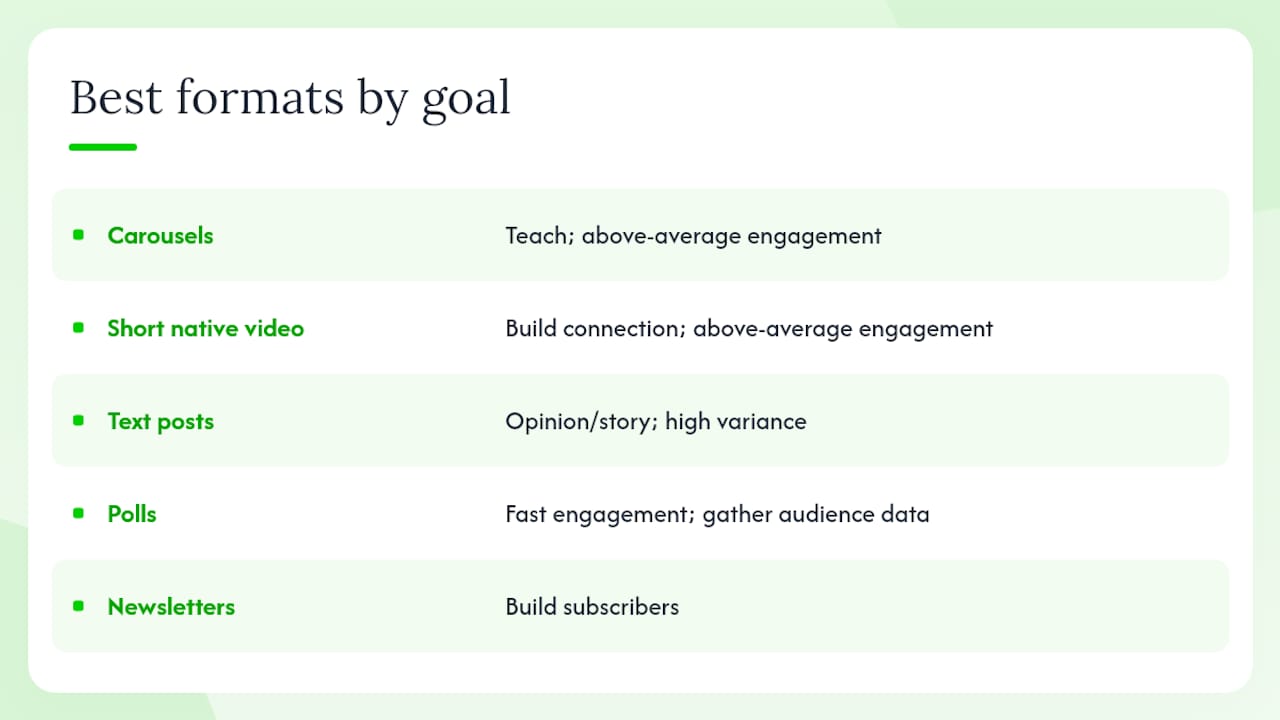
Use carousels when you want to teach something. Use short native video when you want to build personal connection. Use text posts when you have a strong opinion or story. Use polls when you want fast engagement data. Use newsletters when you're building a subscriber list.
Buffer's dataset shows carousels (document/PDF posts) and short native video perform above average for engagement compared to other formats. The reason is mechanical: both formats extend dwell time. A carousel requires swiping through multiple slides. A video autoplays. The algorithm reads that extended time-on-post as a signal that the content is worth distributing further.
A few format-specific notes worth knowing:
Carousels: Keep slides to 8–12 maximum. Lead with a problem or promise on slide one. Put your single clearest takeaway on the last slide, not buried in the middle. Never make a carousel that's essentially a product brochure. Educational carousels get saved; promotional ones get scrolled past.
Short native video: Under 90 seconds for most topics. Shoot vertically. Add captions — most people watch without sound. Open with a hook in the first three seconds that names the specific problem or insight. Sprout Social recommends experimenting with video specifically because it's still underused relative to its distribution advantage.
Text posts: The format most people default to, and the one with the highest variance. A great hook in line one is everything. A weak opener and the post collapses. Line breaks are not optional. Dense paragraphs kill reading time.
Polls: Use them to generate data you can then turn into a follow-up post. "I asked 200 marketers which format they use most. Here's what surprised me." That follow-up post writes itself.
Pro Tip: Repurpose your best-performing carousel into a short video script. The structure is already proven. You're just changing the delivery format.
How often should you post, and how do you make it repeatable?
Individuals: post three times per week. Company Pages: two to four times per week. Those ranges come from Buffer's posting frequency analysis, which found 2–5 posts weekly as the consistent sweet spot for growth without audience fatigue.
The batching workflow is what makes that cadence sustainable:
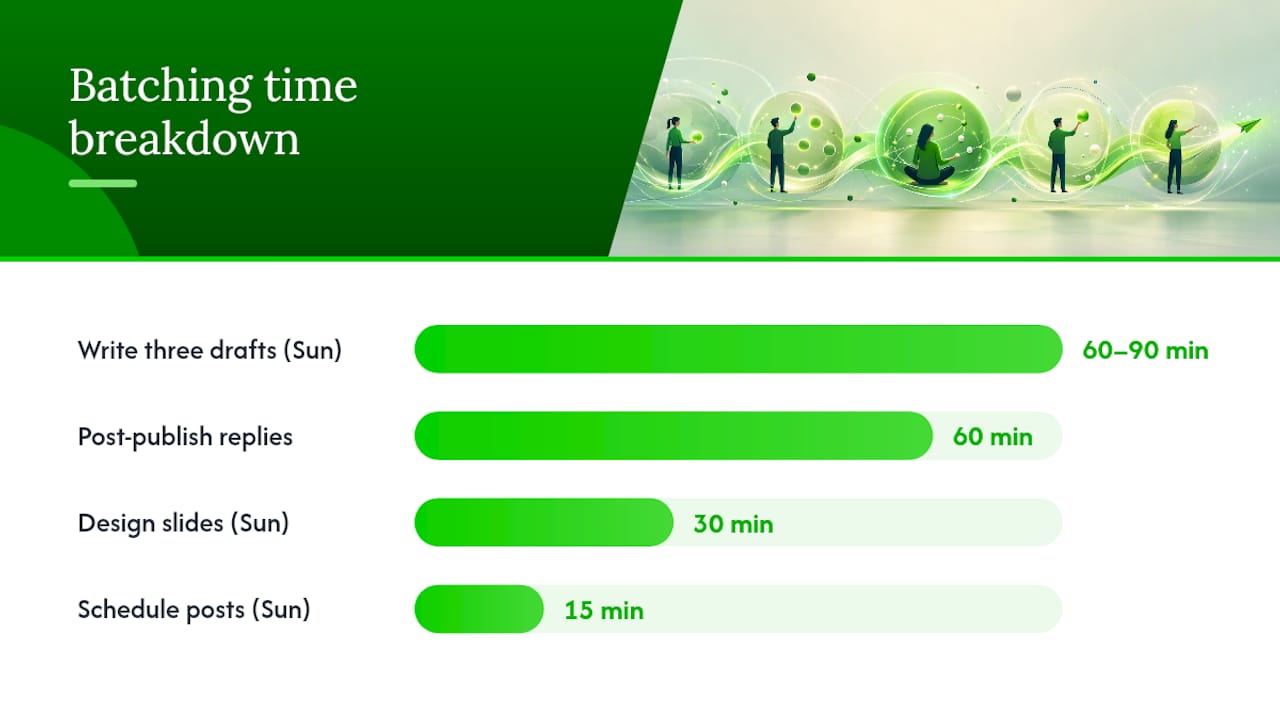
- Sunday (60–90 min): Write all three post drafts. Pull from your idea backlog (a running note or Notion doc where you capture observations, client questions, and industry news throughout the week).
- Sunday (30 min): Design any carousel slides in Canva or Adobe Express. Export as PDF for LinkedIn's document format.
- Sunday (15 min): Schedule posts in Buffer or Hootsuite. Set Monday, Wednesday, and Friday as your default publish days.
- Post-publish (60 min): Stay online for the first hour after each post goes live. Reply to every comment. This is not optional.
Forbes guidance on low-time LinkedIn growth recommends a daily 10-minute commenting routine on top of your publishing schedule. Spend that time leaving substantive comments on posts from people in your niche. Not "great post!" — something that adds a perspective or asks a real question. That commenting activity surfaces your name to their audience, which is free distribution.
For scheduling tools: Buffer handles individual creators and small teams well, with a clean interface and solid LinkedIn-specific analytics. Hootsuite is better for teams managing multiple accounts, with approval workflows and a more detailed analytics dashboard. Sprout Social is the enterprise choice when you need CRM integration and deep reporting. All three support LinkedIn natively.
Timing: Tuesday through Thursday, 8–10 AM in your audience's primary time zone, consistently outperforms weekend posting for B2B content. Test your own data after 30 days before locking in a permanent schedule.
How to measure what's working: metrics mapped to goals
Every metric you track should connect to a business goal. If you can't explain why a number matters to revenue, pipeline, or hiring, stop tracking it.
Hootsuite's 2026 LinkedIn guidance makes this explicit: map metrics directly to business goals before you publish a single post. The table below operationalizes that principle.
| Business goal | Primary metric | Secondary metric | Avoid tracking |
|---|---|---|---|
| Awareness | Impressions, profile views | Follower growth | Likes (vanity) |
| Engagement / thought leadership | Comments per post, saves | Shares | Reactions count |
| Lead generation | Lead Gen Form completions | DM volume | Impressions |
| Conversion | Landing page clicks, CRM entries | Connection-to-lead rate | Follower count |
Saves, dwell time, and substantive comments are stronger algorithm signals than likes. Practitioner guidance from Buldrr confirms these are the metrics that correlate with long-term reach growth — not the reaction count your posts accumulate in the first hour.
The 90-day experiment plan:
- Weeks 1–4: Establish your baseline. Track your chosen primary metric for every post. Calculate your average.
- Weeks 5–8: Change one variable (format, pillar topic, or posting time). Track whether the primary metric moves above or below baseline.
- Weeks 9–12: Double down on what moved the metric up. Kill what didn't.
Native LinkedIn analytics covers impressions, clicks, follower demographics, and post-level engagement. That's enough for individuals. Teams managing Company Pages benefit from Sprout Social or Hootsuite dashboards, which aggregate data across time periods and let you compare content types side by side. For tying LinkedIn leads to offline revenue, a CRM integration is worth the setup time.
Post structure and copy tactics that actually drive conversation
Lead with value in line one. Not context. Not a question. Not "I've been thinking about this a lot." The first line is the only line most people see before they decide whether to click "see more." Make it earn that click.
A post that drives conversation follows this structure:
- Hook (line 1): A specific claim, a counterintuitive fact, or a short story opener. Never a generic observation.
- Bridge (lines 2–3): One sentence that earns the reader's trust by showing you understand their situation.
- Body (lines 4–10): The actual insight, broken into short paragraphs or a tight numbered list. One idea per line.
- Takeaway (line 11–12): The single thing you want them to remember. State it plainly.
- CTA (final line): One question or one instruction. Not both. "What would you add?" or "Save this for your next planning session." Never "Like, comment, and share."
Hook templates that work on LinkedIn:
- "I made a $40,000 mistake so you don't have to."
- "Most [job title]s get this wrong."
- "Here's what nobody tells you about [topic]."
- "I tested [X] for 90 days. Here's what happened."
On hashtags: use three to five, placed at the end of the post. Choose specific ones (#B2BMarketing, #ContentStrategy) over broad ones (#Marketing, #Business). Broad hashtags bury your post in noise.
Pro Tip: Reply to every comment within the first hour of posting. Buffer's analysis shows that replying to comments can boost engagement by about 30% — and the algorithm reads that comment thread activity as a signal to push the post further.
How to scale LinkedIn content across a team
The scaling formula is straightforward: clear roles plus simple governance plus employee advocacy equals scale. Without all three, you get either chaos (everyone posting whatever they want) or silence (nobody posts because the approval process takes two weeks).
Role matrix:
Centralize strategy, brand voice, and analytics. Decentralize ideation and post creation. Community management (responding to comments on Company Page posts) can go either way depending on team size, but someone needs to own it explicitly.
- Content strategist (centralized): Owns pillars, calendar, and performance reporting
- Subject-matter experts (decentralized): Generate raw ideas, draft personal posts, participate in advocacy
- Designer (centralized or outsourced): Produces carousel templates and visual assets
- Community manager (centralized): Monitors Company Page comments and DMs
Governance checklist:
- Brand voice guide (one page, not a 40-slide deck): tone, vocabulary, what not to say
- Approval threshold: personal posts by executives need one review; Company Page posts need two
- Crisis escalation: one named person who decides whether to pause publishing during a PR event
Hootsuite's enterprise guidance specifically recommends employee advocacy programs and thought leadership ads as the two highest-leverage tactics for scaling LinkedIn reach beyond organic limits. Tools like Hootsuite's Amplify feature let you pre-approve content that employees can share with one click, removing the friction that kills most advocacy programs before they start.
For authenticity: give employees a menu of pre-approved posts they can personalize, not a script they must copy verbatim. A post that sounds like the person writing it will always outperform one that sounds like a press release.
What 2026 algorithm changes mean for your content plan
The 2026 LinkedIn algorithm rewards one thing above all others: content that generates real conversation from real professionals. Not reactions. Not shares. Substantive comments from people who have something to say about what you wrote.
Hootsuite's 2026 LinkedIn strategy guide confirms the four current distribution priorities: meaningful conversation, original expertise, dwell time, and native video. Each of those has a direct tactical implication.
Jim Habig's guidance reinforces this: executives who post regularly and engage in the comments of their own posts see compounding returns on visibility. It's not just about publishing. It's about showing up in the thread.
Postory's 2026 growth framework adds a useful tactical layer: combine broadcast content (posts that reach many) with 1:1 networking (targeted connection requests and thoughtful comments on others' posts). A 30-day plan that balances both grows followers and connections simultaneously, rather than optimizing for one at the expense of the other.
Experiment template for testing algorithm-sensitive tactics:
- Hypothesis: "Native video posts will generate more comments per impression than carousel posts in my niche."
- Test: Publish four videos and four carousels over four weeks, alternating formats.
- Measure: Comments per post, saves per post, and profile visits in the 48 hours after publishing.
- Decision threshold: If video averages 1.5x the comments of carousels, shift 60% of your content to video for the next quarter.
Pro Tip: LinkedIn's 95-5 research is the best argument for publishing consistently even when short-term metrics look flat. Most of your audience is not ready to buy today. The posts they read now are what make them call you six months from now.
Why niche clarity and consistency compound faster than volume
The conventional LinkedIn advice is to post more. More formats, more frequency, more variety. That advice is wrong for most professionals, and the data backs it up.
Niche clarity compounds. When your audience knows exactly what you talk about, they follow you because of that specific expertise. They recommend you to colleagues with the same problem. They tag you in relevant conversations. None of that happens when your content covers five unrelated topics because you're trying to appeal to everyone.
A generalized example worth considering: a consultant who narrows from "business strategy" to "pricing strategy for SaaS companies" and commits to that niche for 90 days will typically see stronger engagement growth than one who posts broadly across all business topics. The narrower audience is smaller, but it's the right audience. And the right audience converts.
Consistency is the other half. The LinkedIn algorithm favors accounts that publish regularly, not accounts that publish brilliantly once a month. A post that's an eight out of ten, published every week, will outperform a ten out of ten post published whenever inspiration strikes. The compounding effect of consistent presence is what separates professionals with 500 followers from those with 15,000.
The measurable outcome: consistent, niche-focused publishing over 90 days typically produces meaningful improvements in profile views, connection request acceptance rates, and inbound DM volume from qualified prospects. Those are the numbers that tie directly to pipeline.
Crowdcompany builds and executes LinkedIn strategies for you
Most professionals know what a good LinkedIn content strategy looks like. The gap is execution: writing the posts, designing the carousels, managing the calendar, and staying consistent when client work takes over.
Crowdcompany handles the full production cycle. That means content calendars built around your specific pillars, carousel and video assets produced by a creative team, personal brand positioning aligned with your profile and your goals, and digital PR that extends your LinkedIn visibility into earned media. For teams, Crowdcompany builds employee advocacy playbooks and analytics dashboards that connect LinkedIn activity to actual pipeline. No guesswork about what's working.
The difference from a traditional agency: you get a dedicated growth team, not a rotating account manager, and every deliverable ties back to a measurable business outcome. Ready to hand off execution and focus on the work that actually requires you? Talk to Crowdcompany about a LinkedIn content package.
Sources
- LinkedIn Leads: Secrets from a LinkedIn Marketing VP
- How to Get More Followers on LinkedIn — Exactly What I Did to Get to 22K
- LinkedIn marketing strategy: How to grow in 2026
- Mastering LinkedIn Content Marketing Strategies
- How to grow your LinkedIn in less than 30 minutes a day
- How To Grow on LinkedIn: Followers, Connections & Network | Postory
- How To Actually Grow On LinkedIn
- 95-5 Rule | LinkedIn Marketing Solutions