
This article gives you copyable persona cards across B2B and B2C, plus a one-page template built from the same fields. Pick 2 to 4 personas, write two message variants for each, and run them in a single channel for 30 days before you commit real budget.
TL;DR:
- Building two to four personas based on actual behavior and clear pain points is more effective than creating lengthy, hobby-filled profiles.
- Focus on distinct buyer, user, and negative personas to optimize targeting and avoid wasting ad spend on unlikely prospects.
- A one- or two-page persona template with specific fields like verbatim quotes and decision triggers streamlines team usage and campaign alignment.
- Personas should be validated through interviews, real data, and field testing over six weeks, not guesswork or assumptions.
- Regularly update personas every six to twelve months to reflect product or market changes, ensuring relevance and accuracy.
Table of Contents
- Customer Persona Examples Across B2B and B2C
- A One-Page Persona Template You Can Fill In Today
- How to Build Customer Personas From Real Data
- Buyer Personas, User Personas, and the Buying Committee
- Persona Rules That Keep Teams Actually Using Them
- What Personas Look Like When They're Built Right
- Update Personas Before They Go Stale
- Sources
Customer Persona Examples Across B2B and B2C
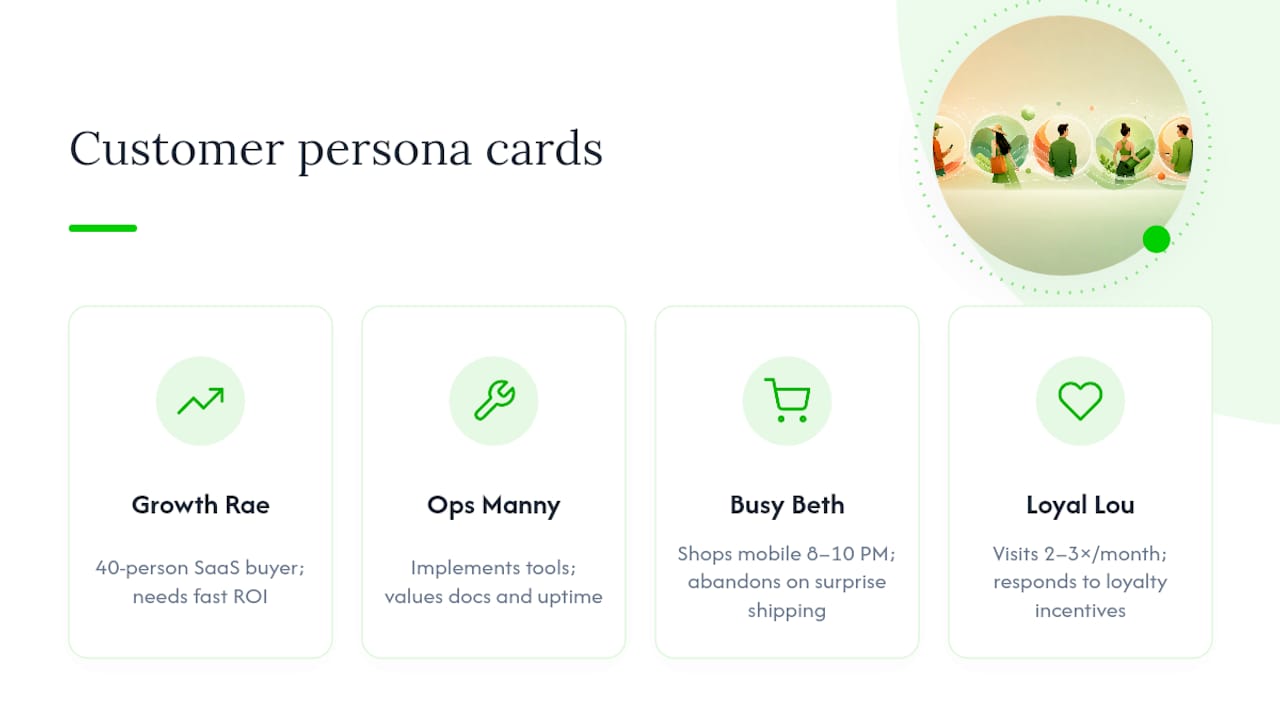
You don't need ten personas. You need two to four that actually reflect who buys, who uses, and who you should stop chasing. Most guides show you a single polished profile with a stock photo and a list of hobbies nobody on your sales team will ever use. That's decoration, not a tool. The cards below skip the hobbies and keep the fields that change what you write and where you spend money: role, goals, objections, buying behavior, and one line the person might actually say out loud.
Each card also flags its type, because a buyer persona and a user persona inside the same B2B account behave differently, and a negative persona exists to tell you who to stop targeting, not who to chase.
1. "Growth Rae," Marketing Director at a 40-Person SaaS Company (B2B Buyer) Age 34 to 45, manages a significant monthly marketing budget, reports to a VP or CEO. Goals: hit pipeline targets, prove ROI within a quarter, avoid tools that need a dedicated admin. Pain points: too many point solutions, no time to vet vendors, burned before by a slick demo that didn't scale. Buys through referrals and LinkedIn research, checks G2 reviews before any call. Quote: "I don't need more dashboards. I need someone to tell me what to do with the data I already have." Use this for: cold outreach and case-study driven ad copy.
2. "Ops Manny," IT Admin Who Actually Implements the Tool (B2B User) Age 28 to 40, not the budget holder, evaluated on uptime and integration headaches. Goals: minimal setup time, clean documentation, no surprise API limits. Pain points: inherited tools nobody trained him on, vendors who only talk to the buyer. Behavior: reads technical docs before the sales call, active in Reddit and Slack communities for the category. Quote: "If I have to open a support ticket in week one, that's a bad sign for the whole rollout." Use this for: onboarding emails, technical FAQs, and demo scripts that speak past the buyer to the implementer.
3. "Busy Beth," Suburban Parent Shopping a D2C Brand (B2C Consumer) Age range includes adults managing household income typical for suburban parents, shops mostly on mobile between 8 and 10 PM. Goals: save time, feel like a good parent, avoid decision fatigue. Pain points: too many product options, distrust of brands without visible reviews. Behavior: scrolls Instagram Reels, reads the first three reviews, abandons cart if shipping costs surprise her at checkout. Quote: "If I have to think about it for more than two minutes, I'll just close the tab." Use this for: retargeting ads and abandoned-cart email flows.
4. "Loyal Lou," Repeat Local Restaurant Customer (Service Customer) Age 40 to 60, visits a favorite local spot two to three times a month, responds to punch-card and loyalty incentives. Goals: consistent quality, feeling recognized by staff, easy reservations. Pain points: inconsistent service, no easy way to book on weekends. Behavior: checks Google reviews before trying somewhere new, tells friends about a bad experience faster than a good one. Quote: "I'll drive past three restaurants to get to the one where they remember my order." Use this for: loyalty program messaging and local SEO content.
5. "First-Timer Fiona," New-to-Category Online Shopper (B2C Consumer) Age 22 to 30, discovering the product category through influencer content, price-sensitive but willing to pay for trust signals. Goals: avoid buyer's remorse, find a brand that feels authentic. Pain points: too much conflicting advice online, skepticism toward paid ads. Behavior: watches unboxing videos, checks TikTok comments before Instagram captions. Quote: "I trust a random person's video way more than the brand's own ad." Use this for: UGC campaign briefs and influencer-versus-creator content splits.
6. "Give-Back Gary," Recurring Nonprofit Donor (Donor Persona) Age 45 to 65, gives recurring donations of moderate amounts motivated by visible local impact, motivated by visible local impact. Goals: see where his money goes, feel part of a community, avoid donor fatigue emails. Pain points: vague impact reporting, too many asks in a short window. Behavior: reads the annual report, opens emails with photos of real recipients over stock graphics. Quote: "Show me one family you helped, not a pie chart." Use this for: quarterly impact emails and year-end giving campaigns.
7. "Skeptical Sam," Negative Persona for a Premium B2B Tool Solo freelancer or a company under five employees, budget under $200 a month, expects a free tier or one-time payment. Goals: get a quick fix, not build a long-term system. Pain points: hostile to subscriptions, likely to churn within 60 days if he converts at all. Behavior: only found through broad-match paid search, never engages with case studies. Quote: "I just need this to work once for this one project." Use this for: exclusion lists in paid campaigns and lead-scoring deprioritization.
Notice the pattern: buyer personas carry budget authority and ROI language, user personas carry implementation friction, and the negative persona exists purely to stop wasted spend. That distinction alone will save you more ad budget than adding a fifth or sixth "real" persona ever will.
A One-Page Persona Template You Can Fill In Today
A persona that needs three pages of scrolling never gets used past the kickoff meeting. Practitioners who study this consistently land on the same finding: a compact one to two page persona with one precise pain point beats a heavily designed, hobby-filled profile every time. Design for scanning, not decoration.
Here's the template, block by block, with the reasoning behind each field:
- Identity line: Name, role or life stage, one-sentence summary. This is what someone reads in three seconds before a meeting.
- Snapshot: Age range, income or budget, company size if B2B, primary device and channel. Grounds the persona in something measurable.
- Top 3 goals: What success looks like from their point of view, not yours.
- Top 3 pain points or objections: The actual words a sales rep or support ticket would use.
- Buying trigger: The event that pushes them from browsing to buying, such as a contract renewal, a bad experience with a competitor, or a life event.
- Verbatim quote: One real or representative line in their voice. This is the single highest-leverage field on the card because it converts directly into ad copy and email subject lines.
- Channels and behavior: Where they research, what format they trust, when they're active.
- "Use this for" note: One line telling your team which campaign or channel this persona actually maps to.
Filled example (using "Growth Rae" from above): Identity: Growth Rae, Marketing Director, mid-market SaaS. Snapshot: 34 to 45, $15,000 to $40,000 monthly budget, 40-person company, desktop-first during work hours. Goals: hit pipeline number, prove ROI fast, avoid tool bloat. Pain points: too many disconnected point solutions, no bandwidth to vet vendors, past bad demo experience. Trigger: quarterly board review showing flat pipeline growth. Quote: "I don't need more dashboards. I need someone to tell me what to do with the data I already have." Channels: LinkedIn, G2, peer Slack groups. Use for: case-study-led outreach sequences.
For export, drop this straight into a slide as one text box per field, paste it into a shared doc with headers, or map each field to a custom property in your CRM so sales sees the pain points and quote directly on the contact record. If your team already runs CRM and lead automation, the persona fields translate almost directly into segmentation rules and lead-scoring criteria.
How to Build Customer Personas From Real Data
Personas built from guesswork are just opinions with a name attached. Build them from actual behavior instead.
1. Pull from data you already have. Start with CRM notes, analytics (drop-off points, top pages, search queries), support tickets, and social listening. This tells you what people do, not what they'd say if you asked them directly.
2. Recruit 6 to 8 interview subjects. You don't need forty interviews. Six to eight per persona segment is enough to spot repeating patterns, screened for a mix of recent buyers, users who churned, and people who almost bought but didn't.
3. Ask questions that reveal motivation, not preference. Structured interview guides like the one from Harvard Business School Online recommend asking about the moment they realized they had a problem, what they tried before your product, what almost stopped them from buying, and where they go for information when they're stuck.
4. Code the transcripts. Build a simple three-column spreadsheet: quote, theme, frequency. Count how often each pain point or trigger phrase shows up across interviews. If four out of seven people mention the same objection unprompted, that's a persona trait. If one person mentions something odd, that's an anecdote, not a pattern.
5. Validate with sales and support before you finalize. The people fielding objections every day will tell you immediately if a "pain point" you wrote sounds nothing like what customers actually say.
6. Run a fast field test. Draft two subject-line variants and two call-to-action variants per persona, then measure open rate, click rate, or micro-conversions over a short window before scaling spend, which mirrors the 30-day validation approach that keeps early signal cheap.
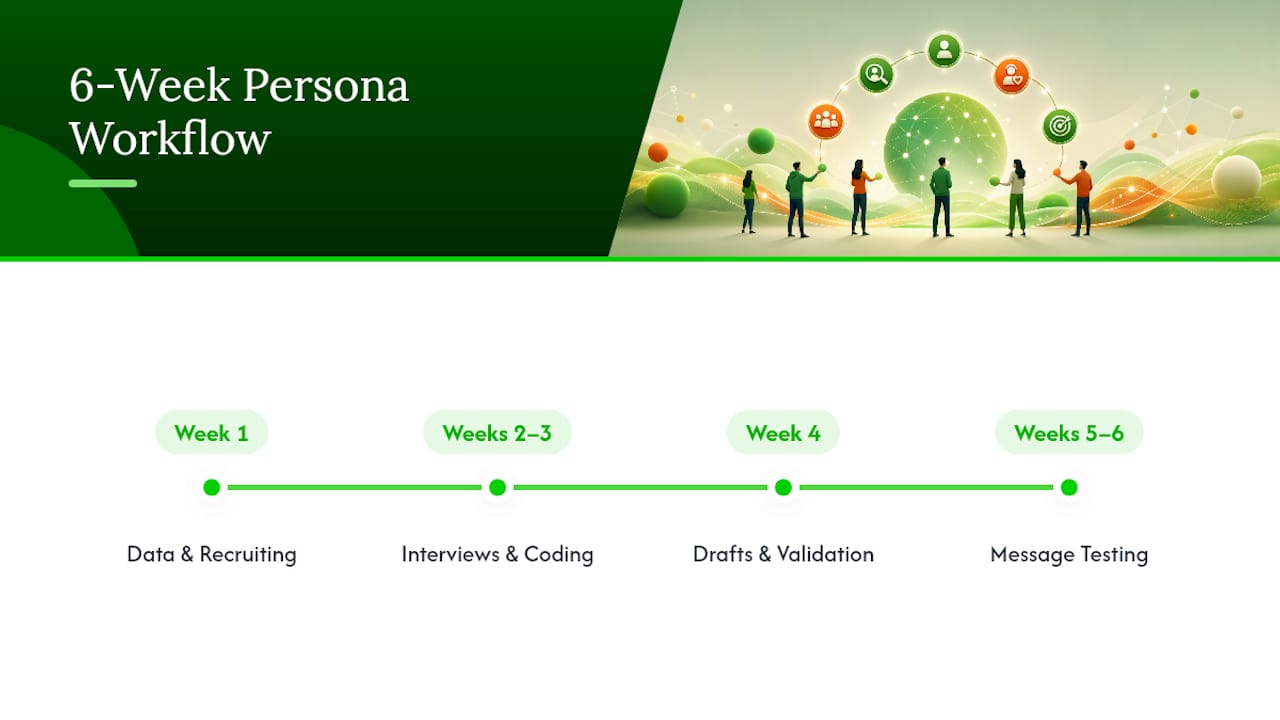
A realistic timeline: week 1 for data pull and interview recruiting, weeks 2 and 3 for interviews and coding, week 4 for draft cards and sales validation, weeks 5 and 6 for the message test. Six weeks from zero to a validated, field-tested persona set.
Pro Tip: Record every interview and transcribe it, even roughly. The exact phrasing someone uses to describe a problem is almost always better ad copy than anything your team would write from memory.
For the data-gathering phase specifically, a structured approach to audience research methods will save you from the common trap of designing survey questions that only confirm what you already believed.
Buyer Personas, User Personas, and the Buying Committee
An ideal customer profile (ICP) describes the company you want as a customer: industry, size, revenue band, tech stack. A buyer persona describes the person who signs or approves the deal inside that company. A user persona describes whoever touches the product daily and rarely holds the budget. Confusing the three is why B2B messaging so often talks past the person actually reading it.
For B2B, include these firmographic fields on top of the standard persona blocks:
- Company size and industry vertical
- Tech stack or existing tools being replaced
- Buying cadence (annual contract, monthly reevaluation, procurement-driven)
- Number of stakeholders typically involved in the decision
Take one account with two personas: the champion (a marketing manager who found your tool and wants it) and the approver (a finance director who signs off). The champion needs proof it solves a daily headache. The approver needs a one-page ROI summary and a security or implementation checklist she can forward without a meeting. Firmographic detail matters here because a B2B buyer persona without role-specific objections is just a job title with a face attached, and two to four personas usually covers the whole buying committee for most mid-market companies.
Persona Rules That Keep Teams Actually Using Them
The failure mode is always the same: a beautifully designed persona deck gets built once, presented in a meeting, and never opened again. Keep every card to one or two pages and organized around decisions, not trivia. Drop the "favorite vacation spot" field. Keep the objection, the trigger, and the quote.
Build a negative persona alongside your real ones. It's not optional flavor text. Teams that skip it waste ad spend chasing leads who were never going to convert, which is exactly the rookie mistake HubSpot flags most often in persona work: no exclusion criteria, no lookalike suppression, no way to tell an algorithm who to stop showing ads to.
What Personas Look Like When They're Built Right
Crowdcompany treats persona work as the foundation under every channel decision, not a one-time worksheet exercise.
Consider a local service business that rewrote its Meta ad copy after realizing its "buyer" persona and its actual repeat customer were two different people. Shifting the message from a discount-led hook to a loyalty and recognition hook (closer to "Loyal Lou" above) is the kind of change that typically shows up first in return-visit rate, not immediate clicks.
| Takeaway | Why it matters |
|---|---|
| One page beats ten | Teams actually reuse a one-page card in campaign briefs |
| Verbatim quotes convert | Real phrasing becomes ad copy and subject lines |
| Negative personas save budget | Exclusion lists stop wasted impressions |
| 2 to 4 personas is enough | More personas dilute focus without adding usable insight |
Update Personas Before They Go Stale
Personas decay. A pricing change, a new competitor, or a product pivot can make a card obsolete within months, and treating personas as psychographic snapshots that go stale is exactly why modern persona standards now weigh digital behavior over demographics.
Review personas every 6 to 12 months, or immediately after a major product launch, pricing shift, or a channel that suddenly stops converting. Assign one owner, usually whoever runs lifecycle marketing, and give them a short governance checklist: confirm the quote still sounds current, confirm the buying trigger still matches recent deals, and retire any persona that hasn't shown up in a closed-won deal in two straight quarters.
— E
If you'd rather have this whole process handled for you, from the interviews through the campaign build, Crowdcompany's digital PR and content strategy work starts with the exact persona and audience research described above, then turns it into messaging your sales and marketing teams actually use.