
Secure explicit, written usage rights before you publish or run paid media with any creator content. That is the single most important rule in UGC rights management, and most brands break it by accident. UGC rights management is the process of requesting, recording, and tracking permission to reuse creator-owned content across your owned or paid channels. Under U.S. copyright law, the creator owns that content the moment they make it, whether or not they registered anything. Your brand has no automatic right to repost, boost, or whitelist it.
Before you move another piece of creator content into a paid campaign, do three things:
- Stop and audit. Pull every piece of UGC currently running in paid media and confirm each one has documented permission.
- Document what you have. A valid permission record must capture four items: the asset identifier (URL, file name, or post ID), the scope of use (channels, formats, paid vs. organic), the duration (start date and expiry), and the creator's confirmation (DM reply, signed form, or timestamped consent click).
- Secure rights for paid media separately. Organic repost permission does not cover paid ads, whitelisting, or Spark Ads. Those require their own explicit grant.
Key Takeaways
Effective UGC rights management requires explicit written permission before any creator content enters a paid channel, with records that capture asset ID, scope, duration, and creator confirmation.
| Point | Details |
|---|---|
| Creator owns the content | U.S. copyright vests at creation; your brand needs a license even for content made under your campaign brief. |
| Paid rights cost more | Paid-media use typically requires a 50–100% uplift over base creator fees; whitelisting is priced separately on top. |
| Organic and paid rights are different | A repost permission does not cover ads, Spark Ads, or whitelisting; always secure paid-use rights explicitly. |
| Manual tracking caps at ~50 pieces/month | Above that volume, automated consent capture with expiration alerts and an audit trail is operationally necessary. |
| Crowdcompany manages the full workflow | Crowdcompany's UGC creator management service covers brief, rights capture, compliance checks, and moderation for teams that have outgrown manual processes. |
Table of Contents
- What does UGC rights management mean under U.S. copyright law?
- Why UGC rights management matters for your brand's risk and ROI
- What types of consent actually hold up for commercial use?
- Which license terms do you need to define before using UGC?
- What do UGC usage rights typically cost?
- How to request, record, and audit UGC permissions step by step
- U.S. compliance essentials: FTC, copyright, privacy, and platform rules
- How do you scale UGC rights management without losing control?
- Short-form license language you can use right now
- Pre-publish checklist: what to verify before you go live
- When should you get a lawyer involved?
- The part most brands get wrong about UGC rights
- Crowdcompany handles UGC rights so your team doesn't have to
- Sources
What does UGC rights management mean under U.S. copyright law?
UGC rights management is the contractual and operational layer brands build on top of creator ownership. It is not a platform feature or a social media policy. It is a legal and workflow discipline.
Under the U.S. Copyright Act, copyright vests in the author at the moment of creation. No registration, no notice, no publication required. When a customer films a product review and posts it to Instagram, they own that video. When a creator shoots a TikTok under your campaign hashtag, they own that TikTok. Your brand's campaign brief, your hashtag, your product in the frame, none of that transfers ownership to you.
What a usage rights agreement does is grant your brand a license to use that content within defined parameters. The license does not transfer copyright. It gives you permission to act within a specific scope, for a specific period, on specific channels.
Legal baseline: Platform Terms of Service include broad IP-licensing clauses that let platforms host and distribute content, but those clauses do not give your brand commercial usage rights. Research from Stanford Law confirms that platform ToS licensing language is often vague and creates conflicts with national copyright rules, particularly in cross-border campaigns. Never rely on a platform's ToS as your rights documentation.
A valid usage-rights record must include the asset identifier, the scope of use, the duration, and the creator's confirmation. Anything less is a gap a plaintiff's attorney will find.
Why UGC rights management matters for your brand's risk and ROI
The legal exposure is real and immediate. Using creator content without permission is copyright infringement. Using a person's likeness in an ad without consent can trigger right-of-publicity claims, which are recognized in most U.S. states. Running incentivized UGC as an ad without proper disclosure puts you in the crosshairs of the FTC Endorsement Guides, which treat paid or gifted creator content as endorsement advertising.
The operational risks compound that exposure:
- Expired licenses running in paid media. Ads continue to serve after license terms end because expirations were tracked in a spreadsheet no one checked.
- Whitelisting errors. A brand boosts a creator's post without explicit whitelisting permission, which is a separate right from organic repost permission.
- Missing disclosures. Incentivized UGC runs without a clear "#ad" or "Paid partnership" label, triggering FTC enforcement risk.
- CDN and cache failures. Content is removed from a platform but continues serving from a CDN cache, creating liability after the license expires.
The upside of getting this right is just as concrete. Clear rights documentation speeds campaign launches because legal review cycles shrink. Whitelisted UGC consistently outperforms brand-produced creative in paid social because it reads as authentic. Creator relationships improve when rights conversations happen upfront, before a dispute surfaces. And post-run takedown costs, which include legal fees, platform removal requests, and creative replacement, drop to near zero when your records are clean.
What types of consent actually hold up for commercial use?
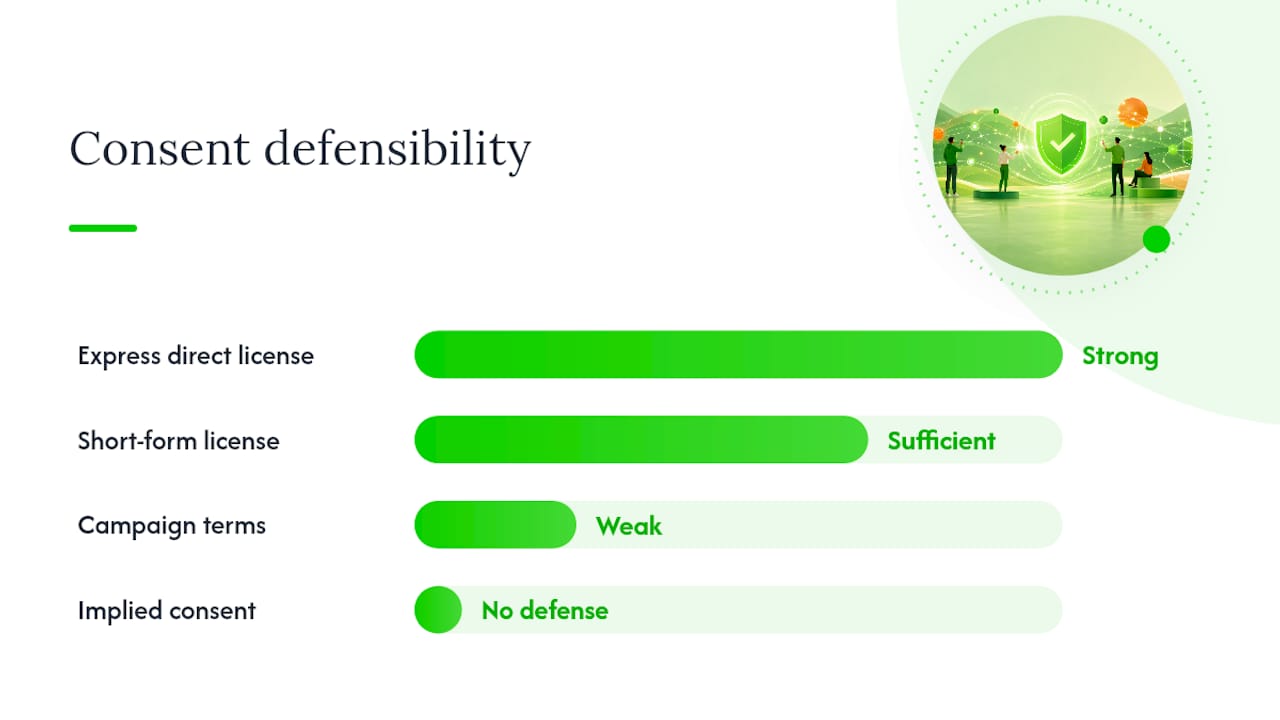
Not all permission is equal. The method you use to capture consent determines how defensible your rights are if a creator disputes your use.
-
Campaign rules and hashtag terms. Brands publish contest or campaign terms that state participation grants a license. This is common and has some legal weight for organic repost, but it is weak evidence for paid advertising. Campaign terms are often buried, rarely read, and courts have been skeptical of their enforceability for commercial use. Use them as a baseline, not a substitute for direct confirmation when you plan to run paid ads.
-
Express direct license. A DM, email, or one-tap consent form in which the creator explicitly agrees to specific terms is the strongest practical approach. It is documented, timestamped, and tied to a specific asset. For any paid media use, this is the standard you should hold yourself to.
-
Implied consent myths. A public post, a tag, or a comment reply does not grant commercial usage rights. Posting publicly means the creator consented to the platform's ToS, not to your brand's ad campaign. This is one of the most common and expensive misconceptions in UGC programs.
-
Short-form license vs. full contract. For most UGC campaigns, a one-paragraph short-form license embedded in a DM or consent link is sufficient. A full contract is appropriate when you are negotiating exclusivity, perpetual rights, or high-value paid campaigns where the creator fee exceeds a few hundred dollars.
Capture mechanics that work: DM with a reply-to-confirm link, a one-tap consent form hosted on a landing page, or an upload gateway where submission itself triggers license acceptance. Each method should auto-log the creator's identity, the asset, the timestamp, and the rights granted.
Pro Tip: Write your consent request in plain language. "Can we use your video in our Instagram ads for the next 90 days?" gets a faster yes than a paragraph of legal language. Attach the formal terms as a link, but lead with the plain ask.
Which license terms do you need to define before using UGC?
Every usage rights agreement, whether a one-paragraph DM or a full contract, must define these terms before you publish:
- Scope of use: Which channels (Instagram, TikTok, Meta ads, Google Display, email, website, OOH)? Which ad formats (feed, Stories, Reels, pre-roll, display)? Be specific. "Social media" is not a scope.
- Duration: 30, 60, or 90 days for short campaigns; 12 months for evergreen assets; perpetual for brand libraries. The clock starts on the date of first use, not the date of the agreement.
- Exclusivity: Non-exclusive is the default. Exclusive rights, meaning the creator cannot license the same content to a competitor, command a significant premium.
- Modification rights: Can you edit, crop, add captions, or overlay music? State it explicitly. Some creators restrict modification, particularly for content tied to their personal brand.
- Territory: U.S. only, North America, or worldwide. Cross-border campaigns with EU audiences add GDPR complexity.
- Renewal and extension: Define the process and price for extending the license before it expires. Renewal terms negotiated upfront are almost always cheaper than emergency extensions.
- Spend caps for whitelisting: When you whitelist a creator's account for Spark Ads or Meta Partnership Ads, cap the total ad spend the creator's account can be used for. This protects the creator from unexpected exposure and protects you from scope disputes.
How organic, paid, and whitelisting rights differ
Paid media and whitelisting are distinct rights because they involve either boosting content under the creator's identity or granting the brand account-level access. A creator who agrees to let you repost their video organically has not agreed to let you run it as a paid ad from their account.
What do UGC usage rights typically cost?
Pricing for UGC usage rights follows a multiplier model applied to the creator's base content fee. The benchmarks below reflect market guidance for 2026 and should be treated as negotiating anchors, not fixed rates.
Benchmark: Paid-media rights typically require a 50–100% uplift over base creator fees. Whitelisting is priced as a separate, premium right on top of that.
To calculate a weighted buy, add the base creator fee plus the applicable rights uplift, then factor in the spend cap for whitelisting.
Perpetual rights are worth the premium when the asset is a hero creative you plan to use across multiple campaigns over 18+ months. For short-cycle campaigns or trend-driven content, 90-day renewals are almost always better value because the content ages out before the license does.
How to request, record, and audit UGC permissions step by step
-
Define rights before you brief. Before you solicit UGC, decide which channels and formats you need, whether you need paid-media rights, and whether whitelisting is in scope. This is non-negotiable. Retrofitting rights after content is created is harder, more expensive, and sometimes impossible.
-
Send a plain-language request. For organic use, a DM confirmation is sufficient. For paid use, send a one-tap consent link or a short-form license. State the platform, the duration, and whether the content will run as a paid ad. Ask for raw files if your production workflow requires them.
-
Document the permission record. For every piece of UGC you plan to use, log: the asset ID (post URL, file name, or unique identifier), the creator's name and handle, the timestamp of consent, the rights granted (channels, duration, paid vs. organic), and revocation instructions if whitelisting is involved.
-
Store records in a central repository. A shared folder with a naming convention is a start. A dedicated asset management system with expiration tracking is better. Spreadsheets fail at scale because no one checks them.
-
Run a pre-publish audit. Before pushing any asset to paid channels, verify: the license is valid and covers the intended use, the disclosure language is present (for incentivized content), the spend cap and whitelisting window are confirmed, and raw files have been delivered if required.
-
Set expiration alerts. Assign ownership of expiration tracking to a named person on your marketing ops team. Alerts should fire 30 days before expiry so renewal conversations happen before the license lapses, not after the ad is already running.
Pro Tip: According to operational benchmarks, manual rights collection typically scales only to roughly 50 pieces per month per full-time employee. If your program exceeds that volume, you need automated consent capture with an audit trail, not a bigger spreadsheet.
U.S. compliance essentials: FTC, copyright, privacy, and platform rules
FTC Endorsement Guides
The FTC treats incentivized UGC as endorsement advertising. If a creator received payment, free product, a discount, or any other material benefit, that content must carry a clear and conspicuous disclosure when your brand uses it in ads or owned media. "Clear and conspicuous" means a viewer cannot miss it: "#ad" or "Paid partnership" at the start of a caption, not buried in hashtags, and verbally stated in video content, not just in a text overlay.
FTC rule: Brands are responsible for ensuring disclosures appear correctly, even when the creator controls the post. If the creator fails to disclose and you are running the content as an ad, the liability is yours. Build disclosure verification into your pre-publish checklist, not as an afterthought.
Copyright basics
Copyright ownership vests in the creator at creation. Fair use does not apply to commercial advertising. There is no de minimis exception that lets you use a few seconds of someone's video in a paid ad without permission. If you are using it commercially, you need a license.
Privacy and model releases
When UGC features identifiable third parties, including bystanders, minors, or people other than the creator, you need a model release for commercial use. California's CCPA/CPRA and similar state privacy laws add another layer: if your campaign collects personal data through a consent form or upload gateway, you must disclose how that data is used and provide deletion rights.
Model release checklist:
- Creator's full name and contact information
- Description of the content and its intended commercial use
- Confirmation that no third parties appear without their own consent
- Parental or guardian signature for any minor appearing in the content
- Date and signature (electronic signatures are valid under the ESIGN Act)
Platform-specific rules
- TikTok Spark Ads: Require the creator to authorize the post for boosting through TikTok's own authorization flow. Your rights agreement does not substitute for that in-platform step.
- Meta Partnership Ads: Require the creator to approve the brand's use of their handle in Ads Manager. Again, a separate in-platform action.
- Instagram/Facebook repost: Platform ToS allows users to share publicly posted content, but that does not grant commercial advertising rights.
How do you scale UGC rights management without losing control?
Manual tracking breaks down around 50 pieces per month. Above that threshold, the combination of expiration management, disclosure verification, and whitelisting coordination becomes too complex for spreadsheets and DM threads. The single biggest operational failure at scale is running ads past license expiry because no one was watching the calendar.
When evaluating tooling or workflows for scale, look for these capabilities:
- One-tap consent capture with a timestamped audit trail tied to the specific asset
- Expiration tracking with automated alerts to named owners, not just a shared inbox
- Integration with your creative asset management system so rights metadata travels with the file
- Ad platform integration that flags assets with expired or missing rights before they are pushed to Meta, TikTok, or Google
- Revocation workflow for whitelisting, so account access can be removed cleanly when a license ends
Cross-functional ownership matters as much as the tooling. Marketing ops owns the rights database and expiration alerts. Legal reviews any agreement involving exclusivity, perpetual rights, or spend caps above a defined threshold. Paid media confirms rights scope before any asset enters a campaign. Creative confirms modification rights before editing.
Pro Tip: A short-form license embedded into the upload or consent flow, with checkboxes and a timestamped acceptance record, increases compliance while keeping friction low for creators. Build it into your brief template, not as a separate step.
Crowdcompany's UGC creator management service handles brief development, rights capture, compliance checks, and moderation as a managed engagement, which is the right call for teams that have hit the manual ceiling.
Short-form license language you can use right now
The following is a working short-form license excerpt. Adapt it to your campaign terms and have counsel review it for high-value or exclusivity engagements.
Short-form UGC license (organic + paid): "By confirming below, you grant [Brand Name] a non-exclusive, royalty-free license to use, reproduce, and display the content identified above (the 'Content') on the following platforms: Instagram, TikTok, Facebook, and [Brand Name]'s website. This license covers both organic and paid advertising use, including boosted posts and in-feed ads. The license term is [X] days from the date of first use. [Brand Name] may edit, crop, or add captions to the Content. This license does not cover whitelisting or account-level access unless separately agreed in writing. You confirm that you own the Content and that no third parties appear in it without their consent."
What the key terms mean in practice:
- Whitelisting: Running ads from the creator's account, not yours. Requires a separate in-platform authorization and its own license clause.
- Modification: Your right to edit the content. Without this clause, you may not be able to crop, add subtitles, or overlay music.
- Territory: If not stated, courts may interpret the license as worldwide. State "United States only" if that is your intent.
- Raws: Raw footage or unedited files. If your production team needs them, request delivery of raws explicitly in the agreement.
- Revocation: The creator's right to withdraw permission. For whitelisting, include a process for removing account access within a defined window (typically 48–72 hours of written notice).
One-tap consent capture text example: "I confirm that I own the content I am submitting, that I have read the usage terms linked here, and that I agree to the license described above." Store the creator's name, submission timestamp, asset ID, and IP address in your audit trail.
Pre-publish checklist: what to verify before you go live
Run through this list before any UGC asset goes into a paid campaign or owned media placement:
- License validity confirmed. The rights agreement covers the intended channel, format, and duration. The license has not expired.
- Disclosure language present. For incentivized content, "#ad," "Paid partnership," or equivalent disclosure appears at the start of the caption or verbally in the video.
- Spend cap and whitelisting window confirmed. If whitelisting is in scope, the spend cap is documented and the in-platform authorization is active.
- Raw files delivered. If your production workflow requires unedited footage, confirm receipt before the campaign launches.
- Third-party clearances complete. No identifiable third parties, minors, or third-party trademarks appear in the content without their own releases.
- Expiration alert set. A named owner has an alert scheduled for 30 days before the license expires.
If a license is missing after publishing: Pause the ad immediately, contact the creator to request retroactive permission, and document the outreach with a timestamp. Do not assume the creator will not notice. If the creator objects, remove the content from all placements and purge it from any CDN caches.
When should you get a lawyer involved?
Most UGC licensing is routine enough for a marketing ops team to handle with a solid template. These situations are not routine:
- Exclusivity demands. Any agreement that restricts a creator from working with competitors requires legal review. The scope, duration, and enforceability of exclusivity clauses vary significantly.
- High-value perpetual rights. When the total rights fee exceeds a few thousand dollars, or when you are licensing content for indefinite use in brand identity materials, have counsel review the agreement.
- Ads making product claims. If the UGC includes health, safety, or performance claims about your product, the FTC's substantiation requirements apply. Legal review is not optional.
- Minors appearing in content. State laws governing the use of minors in commercial advertising vary. California, New York, and several other states have specific requirements.
- Cross-border campaigns with EU audiences. GDPR consent requirements for data collected through UGC intake forms differ materially from U.S. standards.
- Third-party trademarks in the content. If the creator's video features another brand's logo, product, or music, you may need clearance from that third party.
Before you engage counsel, gather: the content samples, your campaign terms or brief, the license records you have, and the intended use (channels, duration, spend). A well-prepared brief cuts legal review time significantly. For straightforward issues like a missing disclosure or an expired license, expect a turnaround of one to three business days. Exclusivity and perpetual rights negotiations take longer.
The part most brands get wrong about UGC rights
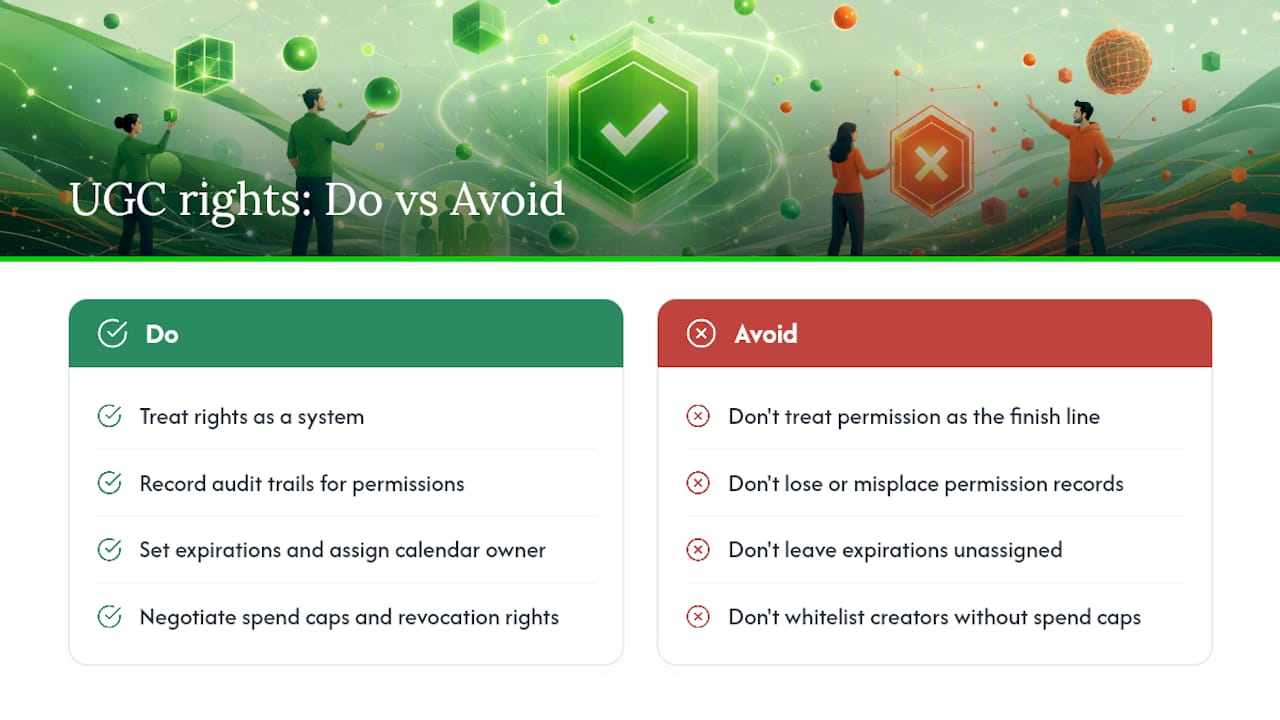
The conventional advice on UGC rights management focuses almost entirely on the permission request: send a DM, get a yes, move on. That framing misses where the real operational failure happens, which is everything after the yes.
The brands that get burned are not the ones who forgot to ask. They are the ones who asked, got confirmation, and then lost the record. Or ran the asset past expiry because no one owned the calendar. Or whitelisted a creator's account without a spend cap and burned through budget the creator never agreed to. Or ran a paid ad with a disclosure buried in the 12th hashtag and got flagged.
Rights management is not a one-time checkbox. It is a system. The permission is the starting point, not the finish line. The audit trail, the expiration alert, the spend cap, the revocation workflow — those are the parts that actually protect you when something goes wrong, and something always eventually goes wrong at scale.
There is also a persistent myth that UGC is inherently lower-risk than produced content because it looks organic. The opposite is true for paid media. Whitelisted UGC runs from a creator's account, which means the creator's identity is attached to your ad spend. That raises the stakes for both sides. Negotiate spend caps. Build in revocation rights. Treat the creator relationship as a business relationship with real contractual weight, not a casual favor.
The brands that scale UGC programs without legal exposure are the ones that treat rights documentation as a production deliverable, the same way they treat a final cut or a media plan. It is not legal overhead. It is campaign infrastructure.
Crowdcompany handles UGC rights so your team doesn't have to
Running a UGC program at scale means managing briefs, creator relationships, rights capture, compliance checks, and expiration tracking simultaneously. Most marketing teams hit the manual ceiling faster than they expect, and the cost of a missed license or a disclosure gap is almost always higher than the cost of getting it right from the start.
Crowdcompany's UGC creator management service covers the full workflow: creator briefing, rights documentation, paid-media compliance, and moderation, all under one managed engagement. No patchwork of tools, no spreadsheet expiration tracking, no scrambling when a license lapses mid-campaign. The service is built for local businesses, restaurants, and e-commerce brands that need production-grade UGC without building an in-house rights management operation. If your program has outgrown DM-based tracking, talk to Crowdcompany about a managed UGC engagement.
Sources
The sources below are the primary references for this guide. Use them for legal detail, pricing benchmarks, and platform policy updates:
- Mass-scale licensing of user-generated content: a transatlantic perspective — Stanford Law
- UGC usage rights: A Complete Guide for Brands & Creators - Sideshift Blog
- UGC legal risks and compliance: a 2026 guide — The Social Media Law Firm
- What Is UGC Rights Management? — Idukki blog