
Personal brand pillars are a few recurring themes, rooted in what you know and who you help, that shape everything you post, say, and stand for professionally. Most people overcomplicate this by chasing many categories they read about somewhere. The better move: pick fewer pillars, go deeper on each, and let your profile and content do the proving. The next section breaks down exactly which pillars to choose and why fewer wins, as recommended by LinkedIn-focused frameworks.
TL;DR:
- Focusing on a small number of deep, specific content pillars aligned with your key audience slices improves clarity and long-term recognition.
- Regular testing of your positioning and pillars every few months helps refine your message based on meaningful signals like comments and saves.
- Building storytelling around each pillar with varied, real examples enhances memory and credibility far more than facts alone.
- Prioritizing audience definition before selecting pillars ensures your content resonates and attracts the right viewers, not just the largest crowd.
- Maintaining a consistent posting cadence and authentic voice prevents stagnation and develops a stronger, more memorable personal brand.
Table of Contents
- The Essential Personal Brand Pillars, Explained
- How to Define Your Personal Brand Pillars in One Sitting
- Content Pillars vs Brand Pillars: How They Connect
- Six Quick Examples of Pillars in Action
- What to Measure, and How Often to Check
- Common Mistakes That Quietly Kill Momentum
- How agencies apply these pillars for clients
- Why Storytelling Carries Your Pillars Further Than Facts Alone
- The Honest Take on Pillar Frameworks
- Sources
The Essential Personal Brand Pillars, Explained
Older frameworks, like the one popularized by Forbes Councils, list several elements such as purpose, values, clarity, authenticity, strengths, energy, and legacy. That's a useful mental model, but it's too many moving parts for someone trying to post consistently on LinkedIn while also doing their actual job. Compress it into seven working pillars, then build your minimal set from the first four.
-
Purpose and positioning. This is the one sentence that answers "who do you help and what do you stand for?" Skip this step and everything downstream gets fuzzy.
-
Audience. Not "professionals" or "entrepreneurs." Name the specific person: "operations managers at 20 to 50 person manufacturing companies" beats "business leaders" every time.
-
Message and clarity. The single line people remember after they close your profile. If you can't say it in one breath, it's not clear yet.
-
Content pillars. A few recurring topics you actually post about. This is the tactical layer sitting underneath your positioning, and LinkedIn-focused frameworks consistently recommend capping this at a small number for clarity and conversion.
-
Presence and visibility. Where you show up. For most professionals in 2026, that's a LinkedIn profile built around a strong headline and About section, plus maybe one secondary platform.
-
Authenticity and voice. The tone and perspective that make your content sound like you and nobody else. Generic voice is the fastest way to become forgettable.
-
Consistency. A posting cadence you can actually sustain for a year, not a month.
Purpose, audience, message, and content pillars form your minimal set. The rest support it.
How to Define Your Personal Brand Pillars in One Sitting
You don't need a retreat for this. Block an hour or so and work through three steps in order.
-
Audit your strengths and outcomes. List things people already ask you for help with and results you've delivered that you're proud of. Patterns show up fast.
-
Map audience problems to those strengths. For each strength, write down which specific person struggles with that exact problem. This is where vague "entrepreneurs" turns into a more specific audience.
-
Draft a few content pillars and test your headline. Turn your strongest overlaps into pillar topics, then write headline versions and read them out loud to see which one actually sounds like you.
Your deliverables: one positioning line, three content themes, and three post prompts ready to write this week.
Pro Tip: Write your About section before your headline. Once the story is clear, the headline practically writes itself.
Content Pillars vs Brand Pillars: How They Connect
Brand pillars are strategic. Content pillars are tactical. Your brand pillar might be "operational efficiency expertise." Your content pillars are the specific, repeatable topics that prove it: process audits, tool comparisons, and case breakdowns of fixes you've made.
A useful content mix balances several jobs:
- Authority content that shows deep expertise (a tactical breakdown, a framework you use).
- Affinity content that builds connection (a lesson learned, a mistake you made).
- Attraction content that reaches new people (a contrarian take, a trend reaction).
- Action content that moves someone toward working with you (a case result, a direct offer).
One brand pillar can feed all three or four content pillars if you rotate the mix instead of posting the same angle every week.
Six Quick Examples of Pillars in Action
-
Startup founder: Pillars are hiring philosophy and product decisions. Headline: "I help early-stage founders make faster hiring calls." Post ideas: a hiring mistake you fixed; a product decision you reversed.
-
Mid-career manager: Pillars are team leadership and process improvement. About line: "10 years turning messy teams into functioning ones." Post ideas: a 1:1 framework; a meeting you canceled.
-
Freelancer: Pillars are niche expertise and client results. Headline: "Copywriter for SaaS companies that hate jargon." Post ideas: before/after copy edit; a client win breakdown.
-
Creator: Pillars are original opinion and behind-the-scenes process. Post ideas: a hot take on a trend; how a piece of content actually got made.
-
Local expert: Pillars are community presence and specialized knowledge. Post ideas: a local case study; a myth you debunk regularly.
-
Job seeker: Pillars are transferable skills and industry insight. Post ideas: a skill translated across industries; a lesson from a past role.
What to Measure, and How Often to Check
Impressions feel good and mean almost nothing. Prioritize signals that indicate someone actually cared:
- Direct messages or comments that turn into real conversations.
- Saves and shares, which tend to signal usefulness over virality.
- Profile views from people who match your named audience, not just anyone.
A realistic testing cadence runs on a multi-month basis: post regularly, audit periodically, and review your pillar choices every few months. This gives your content pillars enough repetition to build recognition without locking you into a strategy that isn't working. Practitioners across LinkedIn and creator circles converge on this same rhythm because it's slow enough to see patterns and fast enough to course correct.
Common Mistakes That Quietly Kill Momentum
- Too many pillars. Many categories dilute your message. Prune to a few and go deeper.
- Generic voice, heavy AI reliance. Specific, defendable opinions beat safe, templated takes every time.
- Inconsistency. A cadence you abandon after three weeks is worse than a slower cadence you keep.
- Chasing reach over relevance. The biggest audience isn't the goal. The right audience is.
Pro Tip: If you're not sure which pillar to cut, cut the one you'd be least upset to lose in a client conversation next week.
How agencies apply these pillars for clients
Some agencies build personal brand positioning with fewer pillars, sharper profiles, consistent content. This approach commonly shows up across services such as personal-brand positioning work starting with audience-mapping, social content management built around recurring themes, and SEO and GEO support to reinforce positioning across search and local visibility.
If you want to try this yourself first, run the 90 minute worksheet, then build a 90-day content plan around your pillars. If you'd rather have help shaping the positioning and building the content engine, Crowdcompany's personal brand service picks up where the DIY version leaves off.
Why Storytelling Carries Your Pillars Further Than Facts Alone
A pillar without a story is just a claim. Nobody remembers "I'm skilled at operations." They remember the specific week a process broke and how you fixed it. Harvard Business School's career materials treat storytelling as a core mechanism for personal branding, not a decorative add on, because narrative is what makes expertise memorable and credible at the same time.
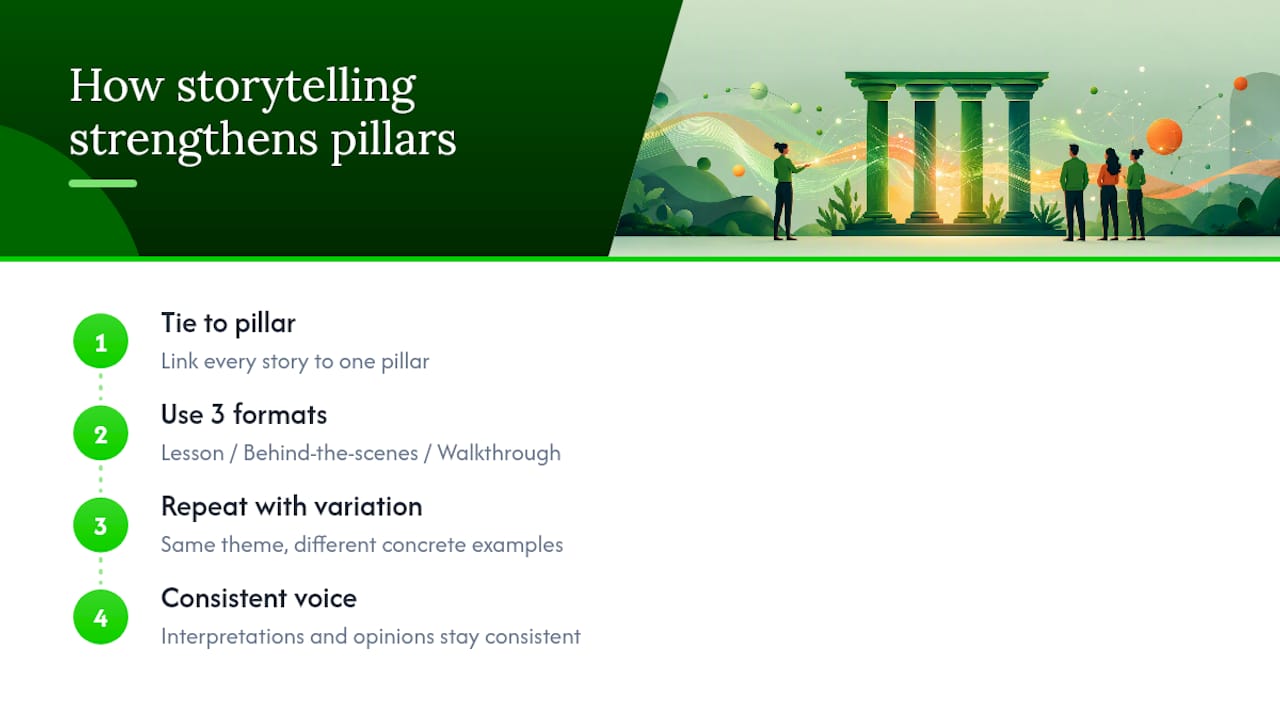
Three story formats do most of the work: the lesson learned, the behind the scenes look, and the tactical walkthrough. Each one ties directly back to a pillar. If "process improvement" is your pillar, a lesson-learned post about a process you got wrong before you got it right does more for your credibility than a list of best practices ever will.
The trick is repetition with variation. Tell the same kind of story, tied to the same pillar, but with a different specific example each time. Readers start to associate you with the theme long before they consciously notice the pattern. That's the whole mechanism behind brand recall: not one great post, but a dozen smaller ones that all point the same direction.
Keep your voice consistent across these stories. The facts change. The way you interpret them, and the opinions you're willing to defend, should stay recognizably yours. That consistency of perspective is often what separates a personal brand from a résumé with extra content attached.
The Honest Take on Pillar Frameworks
Most pillar frameworks fail for one reason: they're built for consultants selling a workshop, not for someone posting on a Tuesday between meetings. Seven pillars sounds thorough. It's actually a recipe for paralysis, because nobody can hold seven strategic threads in their head while also drafting a caption.
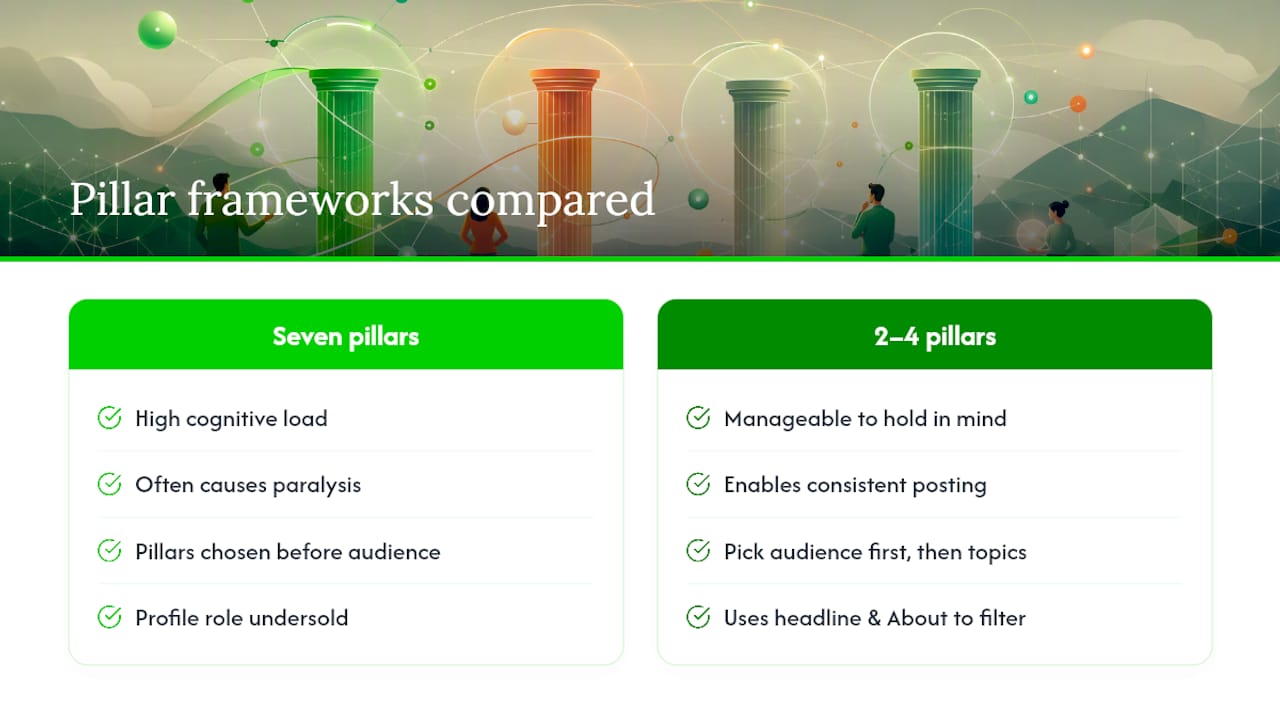
The conventional advice undersells how much a strong profile alone does before content even enters the picture. A sharp headline and About section filter the right people in and the wrong people out. Content pillars then prove the positioning is real, repeatedly, over months rather than in one viral post.
If you take one thing from this: pick your audience before you pick your topics. Most people do it backwards, choosing what to post about first and hoping the right people show up. Name the person, then build the 2 to 4 pillars that actually serve them. Everything else, cadence, platform choice, tone, gets easier once that one decision is made.
— E