
Start with a one-line brief: your single message, your audience, your one desired action. Then draft in a hook-first four-part sequence, Hook, Problem, Solution, CTA, using a two-column audio/visual format timed to your chosen length. Write several hook variants before you shoot anything, and plan to kill the weak ones fast once real viewers see them.
TL;DR:
- A typical 15-second ad script should contain around 30 to 38 words, with one clear message, proof point, and call to action.
- Scripts must follow a two-column AV format with specific timing, visual cues, and tone notes to ensure production readiness.
- Testing multiple hook variants with short learning windows helps identify effective messages, especially since a 25% or lower click-through rate in 48 hours suggests discontinuing a version.
- The visual column needs to communicate the core message without sound, with on-screen text aligned to the first three seconds to pass the mute test.
- Strong storytelling using specific, relatable narratives and real customer voices improves ad persuasion more than feature lists or generic claims.
Table of Contents
- What Is Ad Script Writing, and How Do You Do It Step by Step?
- How Do You Format a Script So Production Can Actually Use It?
- How Many Words Should an Ad Script Be?
- Which Hook Formulas and CTA Techniques Actually Convert?
- Does Your Ad Still Work With the Sound Off?
- What Do Real 15, 30, and 60-Second Ad Scripts Look Like?
- How Do You Test and Optimize Ad Scripts After They're Live?
- How Do You Match Script Voice to Brand Identity?
- What Legal and Ethical Rules Apply to Ad Scripts?
- How Does Storytelling Make an Ad Script More Persuasive?
- How Do You Collaborate Well With Creative Teams and Directors?
- Crowd's Perspective: How We Brief, Write, and Test Scripts for Local Businesses
- Get Production-Ready Ad Scripts Without Learning the Craft Yourself
- Sources
What Is Ad Script Writing, and How Do You Do It Step by Step?
Ad script writing is the process of turning a single marketing message into a timed, structured script built for video or audio production, not for reading. That distinction matters more than most beginners realize: a commercial script isn't a mini screenplay. Airtime is expensive and short, so every beat in the script has to do exactly one job, and there's no room for a slow setup or a clever tangent.
Here's the workflow that gets you from blank page to production-ready draft:
- Write the one-line brief first. Name your audience in one phrase ("busy parents comparing meal-kit services"), your single takeaway ("this saves you 20 minutes a night"), and your one CTA ("order your first box"). If you can't fit it in one sentence, the ad will wander.
- Pick your length and match a framework to it. A 15-second spot forces PAS (Problem, Agitate, Solution) because there's no time for AIDA's slower attention build. A 60-second spot can afford full AIDA. BAB (Before, After, Bridge) works well when the transformation itself is the sell.
- Write the hook before anything else. Your opening line or shot has to earn the next three seconds. Draft five to ten options before picking one.
- Fill in Problem, Solution, and CTA, keeping each section built around one clear job rather than multiple ideas competing for attention.
- Draft audio and visuals side by side, not audio first with visuals bolted on later.
- Read it aloud with a stopwatch. If it runs long, cut adjectives before you cut structure.
This sequence, Hook, Problem, Solution, CTA, is the backbone most direct-response frameworks map onto, whether you call it AIDA, PAS, or BAB.
How Do You Format a Script So Production Can Actually Use It?
Professional ad scripts use a two-column AV format: audio on the left, visuals on the right, synced row by row. This isn't a stylistic choice. It's the industry-standard structure because it forces you to think about what's on screen and what's being said as two separate, coordinated tracks, rather than one narration track with pictures attached as an afterthought.
Practical rules for filling in each column:
- Keep visual cues short and specific: "close-up, hands unboxing product" beats "show the product being used."
- Mark pauses, on-screen text (supers), and sound effects explicitly in their own rows so nothing gets missed on set.
- Note timing in seconds next to each row, not just at the end of the script.
- For radio, translate every visual cue into spoken imagery. If the video version shows a steaming cup of coffee, the radio version needs a line like "that first sip, still too hot, still worth it."
- Add tone notes for voice talent ("warm, conversational, not salesy") since text alone rarely conveys delivery.
A partner resource worth bookmarking for deeper formatting examples is this working writer's guide to commercial scriptwriting, which covers collaboration with production teams in more depth than most scriptwriting guides bother to.
How Many Words Should an Ad Script Be?
Word count is the single most common mistake in ad script writing. Writers draft what sounds good on the page, then discover in the read-through that it runs 15 seconds over. Match your script to these benchmarks before you get attached to any specific line.
| Ad length | Word count target | Notes |
|---|---|---|
| 6 seconds | 10–15 words | Bumper ads; one idea only, no CTA beat |
| 15 seconds | 30–38 words | Hook plus one proof point plus CTA |
| 30 seconds | 65–75 words | Full four-part sequence with room to breathe |
| 60 seconds | 30 to 38 words | Room for a short story arc plus proof |
These figures come from standard timing calculations for voiceover pacing, and they assume a natural speaking rate, not a rushed read. Build in a 10 to 15 percent buffer for music cues, sound effects, and the pause after a punchy line lands. Label that buffer directly in your AV script as a "pause buffer" row so nobody on set assumes those seconds are available for more dialogue.
Platform matters here too. TikTok and Meta feeds give you roughly two to three seconds before a thumb keeps scrolling, so the hook has to work with zero warm-up. YouTube's five-second skip button creates a similar deadline for pre-roll. A practical rule that saves rework: write the 30-second version first. It forces you to include every necessary beat, and cutting down to 15 seconds is far easier than padding a 15-second script up to 30.
Which Hook Formulas and CTA Techniques Actually Convert?
The four-part sequence gives you structure, but the frameworks you plug into it change depending on your objective. PAS tends to outperform AIDA when the audience already feels the pain point and just needs it named, which is common in B2B and software ads where the problem is quantifiable. AIDA holds up better for cold audiences who need to be introduced to a category before they'll care about a solution. BAB works when the transformation itself, not the mechanism, is the emotional sell.
Here are 12 hook formulas grouped by the trigger they exploit:
- Curiosity gap: "The one setting in your thermostat costing you $40 a month" — pulls the viewer in to resolve an unanswered question.
- Direct callout: "If you run a restaurant in a strip mall, watch this" — names the exact viewer instantly.
- Bold claim: "This is the last skincare routine you'll ever need" — invites disagreement or agreement, both keep attention.
- Pattern interrupt: An unexpected visual or sound in the first frame, before a single word is spoken.
- Shocking stat: A specific number that contradicts assumption, used carefully and only when sourced.
- Relatable pain: "You've checked the tracking page four times today" — mirrors a specific, recognizable frustration.
- Before/after tease: Show the "after" first, then rewind to explain how.
- Question hook: "Why does your coffee taste different at home?" — invites an internal answer before you supply one.
- Contrarian take: "Stop doing 10,000 steps a day" — challenges conventional wisdom to earn a pause.
- Social proof lead: Opening on a customer reaction or review rather than the product itself.
- Urgency framing: Tied to a real deadline, never a fake countdown.
- Demonstration cold open: Showing the product mid-use with no introduction, letting curiosity about context do the work.
For the CTA, match the technique to the funnel stage: a specific next step ("tap to see pricing") for warm audiences, risk reversal ("cancel anytime") for skeptical cold traffic, urgency for time-bound offers, and a curiosity close ("see why 400 people switched this month") when you want clicks more than immediate conversion. Cold audiences generally need a softer hook, awareness or curiosity based, while retargeting audiences respond better to direct offer hooks since they already know the brand.
Pro Tip: Write your CTA before you write your hook. Knowing exactly what action you're driving toward makes every earlier line easier to justify or cut.
Does Your Ad Still Work With the Sound Off?
Most video ads on Meta and TikTok are watched muted by default, which means your visual column has to carry the entire message on its own. If the takeaway only exists in the voiceover, you've written half an ad.
Run these checks before locking the script:
- Put your single takeaway on screen as text within the first three seconds, not buried at the end.
- Keep supers on screen long enough to read twice, roughly three seconds minimum for a short phrase.
- Use high-contrast text against the background so it holds up on a bright screen in daylight.
- Mute the rough cut and watch it cold. If you can't follow the message, rewrite the visual column, not the voiceover.
- Check caption timing against natural speech pauses so text doesn't get stranded mid-sentence.
The two-column draft is what makes this testable at all. If the visual column alone communicates the core message, the ad passes the mute test before it ever reaches a real feed.
What Do Real 15, 30, and 60-Second Ad Scripts Look Like?
Templates are only useful when they show the timing math, not just the words. Here's how each length breaks down in practice.
-
15-second template (30–38 words). Hook (0–3s): a direct callout or bold claim. Problem/Solution combined (3–10s): name the pain and the fix in one breath. CTA (10–15s): one specific action, spoken and shown as a super. There's no room for a second proof point here, pick one and cut everything else.
-
30-second template (65–75 words). Hook (0–3s). Problem (3–10s): agitate briefly, one sentence. Solution (10–22s): this is where proof lives, a stat, a demonstration, or a quick customer reaction. Offer and CTA (22–30s): state the specific next step twice, once in voiceover and once as on-screen text.
-
60-second annotated example. Hook (0–5s): open mid-scene, no introduction. Story (5–35s): a short narrative arc, a customer's actual situation before the product enters. Proof (35–50s): a stat, review count, or side-by-side comparison shown visually. CTA (50–60s): restate the benefit, then the action.
"This is the ad that finally got us bookings instead of just likes," is the kind of line a client says about a script that nails proof before ask, not one that leads with the offer and hopes the story catches up.
Voice direction matters as much as word choice. A 15-second script needs a brisker, more clipped read than a 60-second narrative spot, which can afford natural pauses. Mark pacing notes in the audio column ("quick, upbeat" vs. "slower, warmer") so voice talent doesn't have to guess.
How Do You Test and Optimize Ad Scripts After They're Live?
Writing the script is half the job. The other half is treating it like a hypothesis you're willing to kill. Isolate one variable at a time, starting with the hook, since it accounts for most of the variance in whether anyone watches past three seconds.
A practical testing rule that scales well: write multiple scripts with several hook variants, giving you several tests running against the same offer and CTA. That's enough volume to find a pattern without drowning in data you can't act on.
- Generate 5 to 10 hook variants per core script before spending on media.
- Set a short learn window, 48 to 72 hours, before making any kill or scale decision.
- Apply a kill threshold based on performance metrics in the test window, cutting underperforming variants and reallocating spend.
- Once a hook wins, hold it constant and test the next variable, offer phrasing or proof format, rather than changing everything at once.
- Distinguish early signal from long-term fit: a hook can win attention fast and still fail on retention or purchase, so watch downstream metrics before declaring a full winner.
A hook-through rate under 25% within 48 to 72 hours is a practical signal to kill the variant, according to testing guidance from ad script practitioners. AI script generators can help you produce that volume of hook variants quickly, which matters when you're trying to run six tests a week instead of one every month.
How Do You Match Script Voice to Brand Identity?
A script that sounds great in isolation can still be wrong for the brand delivering it. Voice and tone aren't decoration, they're part of what makes an ad feel credible instead of borrowed from a competitor's playbook.
Start by defining three or four adjectives that describe how the brand actually talks, not how you wish it talked. A local HVAC company probably shouldn't sound like a lifestyle app, even if the copywriter's instinct is to punch up the energy. Consistency across every script matters more than any single clever line, because viewers build brand recognition through repetition of tone as much as visuals.
Practical ways to keep tone consistent:
Write a short "voice guide" alongside the brief, three sentences max, describing how the brand would explain this offer to a friend. Read every draft against that guide before it goes to production. If the script could run unchanged for a competitor with the brand name swapped out, the voice isn't specific enough yet.
Match energy to platform without abandoning identity. A brand can be more casual and quick-cut on TikTok than in a 60-second broadcast spot, but the underlying personality, warm, blunt, playful, formal, should hold steady. What changes is pacing and format, not who the brand is.
Watch for tone drift across a testing batch. When you're running six hook variants at once, it's easy for one to sound like it belongs to a different company entirely. Read all variants back to back before launch, not just individually.
What Legal and Ethical Rules Apply to Ad Scripts?
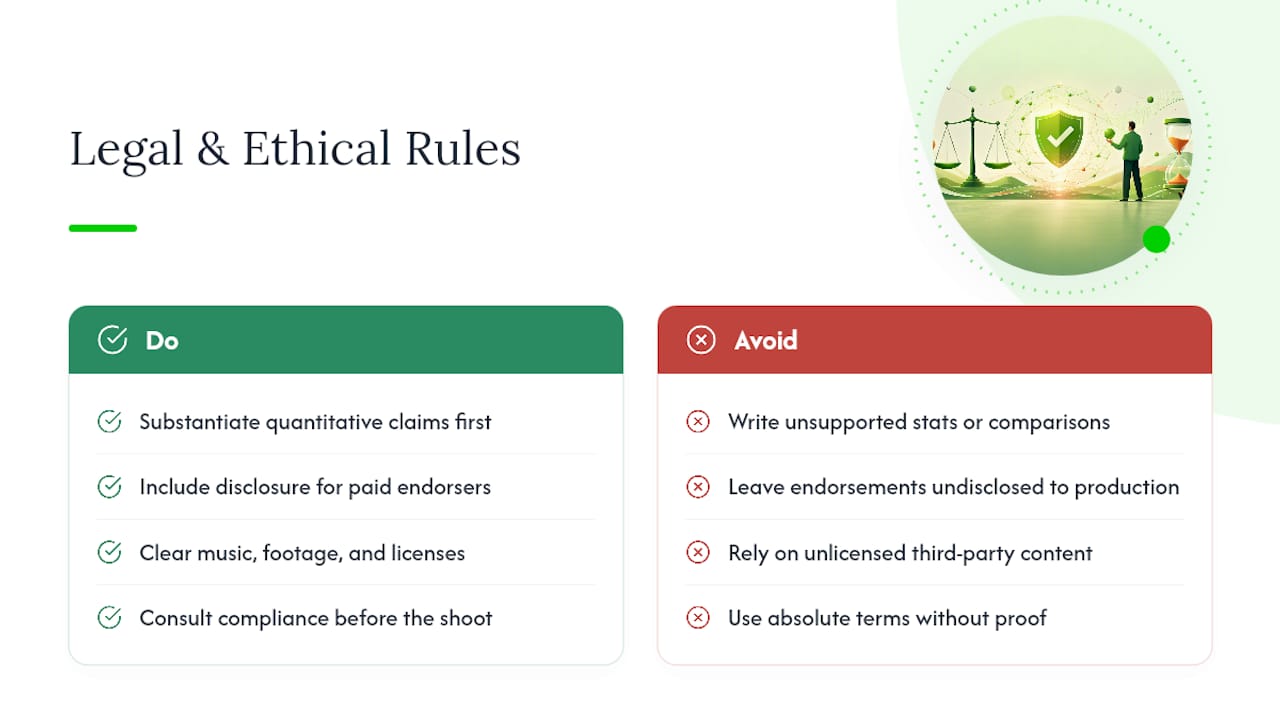
Every claim in a script needs a real basis before it goes to production, not after a viewer flags it. This applies to specific numbers ("40% faster"), comparative claims ("better than leading brands"), and testimonial language, all of which can trigger regulatory scrutiny if unsupported.
A few rules worth building into the drafting process itself:
Substantiate every quantitative claim before it's written into a script. If a stat can't be sourced to a real study, survey, or internal data set, either cut it or soften it to a qualitative claim ("customers tell us it's faster," not "40% faster").
Disclose material connections. If a script features a paid endorser, testimonial, or influencer-style delivery, disclosure language belongs in the script itself, not left to production to add later as an afterthought.
Clear music, footage, and any third-party content before locking a final cut. Stock footage licenses and needle-drop music rights vary by usage type (broadcast vs. social vs. paid media), and a script written around a specific song can become a legal liability if the license doesn't cover the intended placement.
Avoid absolute language your legal team can't defend: words like "guaranteed," "risk-free," or "proven" carry real regulatory weight in advertising and should only appear when the underlying claim genuinely supports them.
When in doubt on a specific claim, run it past whoever handles compliance before the shoot, not after the ad is already running and generating impressions you'd have to pull back.
How Does Storytelling Make an Ad Script More Persuasive?
A list of product features rarely moves anyone. A short, specific story almost always does, because it gives the viewer a person to root for instead of a spec sheet to evaluate.
The mechanism is simple: viewers process narrative more easily than argument, and they remember characters longer than claims. A 60-second spot that opens on a specific person's specific frustration, the exact moment their delivery was late, the exact sound of a printer jamming, does more work than a voiceover listing five product benefits in sequence.
You don't need a complex plot. The Before/After/Bridge framework is storytelling in miniature: establish a relatable "before" state, show the "after," then bridge the two with the product as the mechanism. Keep the "before" specific rather than generic. "Struggling with paperwork" is forgettable. "Staying at the office until 7pm just to finish invoices" is a scene a viewer can picture.
Dialogue beats narration when you can afford it. A customer saying "I almost didn't believe it worked this fast" carries more weight than a narrator claiming the same thing, because it reads as testimony rather than sales copy. If budget allows a real customer voice, even a short unscripted line, it usually outperforms a polished script read by an actor.
Resolution matters as much as setup. Don't let the story dangle while the CTA interrupts it. Close the narrative loop, however briefly, before you ask for the action. A story that ends mid-thought feels like an ad that ran out of time rather than one that made its point.

How Do You Collaborate Well With Creative Teams and Directors?
The script is a starting point for production, not a finished blueprint they have to follow line by line. Writers who understand that distinction get better final ads than writers who insist every word survives the shoot.
Share the one-line brief and the "why" behind key choices, not just the finished script. A director who understands the strategy behind a hook can protect its intent even while adapting the exact shot to what works on location. Without that context, deviations on set can accidentally undercut the whole point of the line.
Flag which lines are load-bearing and which are flexible. Mark the hook and the CTA as fixed, since those carry the most strategic weight, and note where visual direction or line delivery has room to breathe. This saves time in review, since the director isn't guessing what actually matters to you.
Build in a read-through with talent before the shoot day whenever the schedule allows it. A line that scans fine on paper sometimes trips on the tongue, and catching that in rehearsal is far cheaper than catching it in the edit bay.
Expect the script to change on set, and treat that as normal rather than a failure of the writing. Lighting, location, and talent chemistry all shift what works in the moment. Send the two-column AV script, not a prose paragraph, since it gives everyone on set a shared reference for timing and intent that's easy to scan between takes.
Crowd's Perspective: How We Brief, Write, and Test Scripts for Local Businesses
The pattern we see most often with local business owners isn't bad writing, it's skipping the one-line brief and jumping straight to a full script. That single step, forcing the message and CTA into one sentence before drafting anything, catches most of the wandering, unfocused scripts before they ever reach a camera. Using two-column AV scripts from day one also cuts reshoots dramatically, since the director and the client are looking at the same synced document instead of a paragraph open to interpretation. Speed matters more than polish in the first draft. A rough script with a clear hook beats a beautifully written one that buries the point in sentence four.
— E
Get Production-Ready Ad Scripts Without Learning the Craft Yourself
Writing a genuinely strong script, one with a tested hook, tight AV formatting, and a CTA built for your actual audience, takes real repetition to get right. Crowdcompany's digital PR and content scripting services skip that learning curve entirely: our team drafts production-ready AV scripts, generates multiple hook variants for testing, and hands off timing-accurate scripts your video team or a creator can shoot the same week.
What makes this different from hiring a freelance copywriter is the testing loop built in. We don't just deliver a script and disappear, we build variant sets designed for the kill-rule testing approach covered above, so you're not guessing which hook actually works before you commit media spend to it. For local businesses running paid campaigns across Meta, Google, and TikTok, that means fewer wasted production days and faster answers on what resonates with your specific customers.
If you're in South Florida, check out our digital PR and content scripting services built specifically for Boca Raton businesses. Reach out and we'll scope your first script batch this week.
Sources
- How to Write Video Ad Scripts That Convert With Templates
- Commercial video script template (Boords)
- Video Ad Script Timer | Estimate 15, 30 & 60 Second Ad Length
- Commercial script samples (Voice123)