
If you're running a local business or small ecommerce brand and you need a straight answer: start with Mailchimp if you want to send your first campaign this week, choose Klaviyo if email is already driving revenue and you need lifecycle data to grow it, and hire Crowdcompany if you'd rather spend that time running your business instead of learning a platform.
- Simple start, limited budget: Mailchimp's drag-and-drop editor and 500-contact free plan get you live fast. G2's 2026 testing confirms it wins on ease and speed.
- Revenue depends on email: Klaviyo's event-based data model and predictive analytics make it the stronger choice once lifecycle messaging drives real sales.
- No time, need ROI fast: Hire an agency. Crowdcompany handles migration, flows, and reporting so you skip the learning curve entirely.
Third-party reviewers at EmailToolTester and Zapier both land on the same split: ease-of-use versus data-first revenue control.
Table of Contents
- Mailchimp vs Klaviyo: what's the core difference?
- How do the features compare for local businesses?
- Which platform fits your business type?
- What does migration and setup actually look like?
- How does pricing work, and what will it actually cost you?
- Questions to ask before you commit to a platform or agency
- When should you stop DIY and hire a specialist?
- Contract terms, cancellation, and vendor lock-in risks
- Key Takeaways
- The platform debate misses the real question
- Crowdcompany runs your email program so you don't have to
- Useful sources and further reading
Mailchimp vs Klaviyo: what's the core difference?
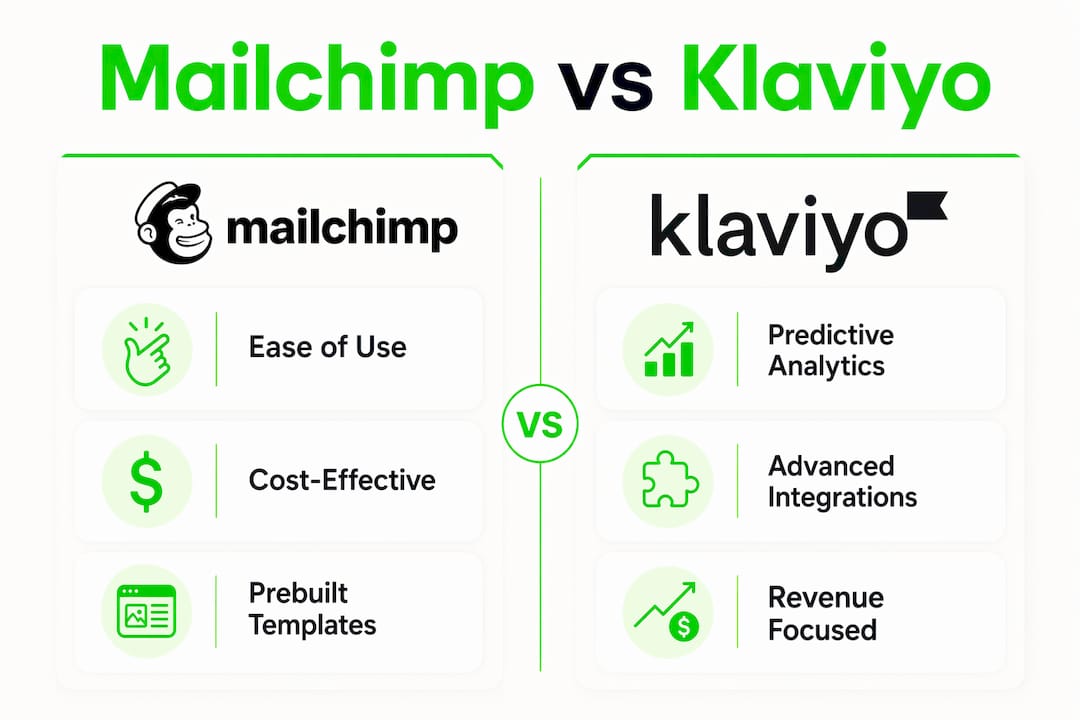
These two platforms are built around different assumptions about who you are and what you need. Mailchimp assumes you want to send a good-looking email quickly. Klaviyo assumes email is a revenue engine and you want to control every variable in it.
Three axes define the split:
- Design philosophy: Mailchimp prioritizes low friction. Klaviyo prioritizes data depth.
- Data model: Mailchimp uses an audience/list model. Klaviyo uses a unified profile and event model, meaning every click, purchase, and page view attaches to a single customer record.
- Expected outcome: Mailchimp gets you to "sent" faster. Klaviyo gets you to higher revenue per send over time.
Think of it this way: Mailchimp is the on-ramp; Klaviyo is the highway. Analyst consensus in 2026 places Mailchimp ahead on onboarding speed and all-in-one marketing features, while Klaviyo leads on predictive analytics and lifecycle automation depth.
Support windows reflect the same philosophy gap. Mailchimp provides email support for a limited initial period on its free plan; Klaviyo offers a longer initial email support window, giving new users more runway to get set up correctly.
How do the features compare for local businesses?
Ease of use and onboarding

Mailchimp wins here, clearly. Its drag-and-drop editor, Creative Assistant brand kit, and 300+ prebuilt integrations are available on all plans. You can pull your logo, fonts, and colors from your website automatically. Klaviyo requires manual brand setup, though once it's done, one-click application works well.
Ecommerce and predictive analytics
Klaviyo is purpose-built for this. Its predictive tools include expected next-order date, churn risk scoring, and customer lifetime value estimates, all usable as segmentation triggers. Mailchimp's higher-tier plans add CLV and purchase likelihood predictions, but they sit behind the Standard and Premium paywalls. For a DTC brand running abandoned-cart flows and win-back sequences, Klaviyo's depth is hard to match.
Automation and lifecycle flows
Both platforms offer no-code builders and prebuilt templates. Mailchimp's Customer Journey Builder includes 100+ automations on Standard and Premium plans. Klaviyo offers 80+ templates on all paid plans, with behavioral triggers tied to product views, order events, and form submissions. The key difference: Klaviyo's flows connect directly to event data, so a "viewed product three times but didn't buy" trigger is straightforward to build. On Mailchimp, that level of behavioral specificity requires more workarounds.
Integrations
Both platforms connect with Shopify, WooCommerce, and BigCommerce, plus Zapier for custom workflows. Klaviyo's Shopify integration syncs richer event and order-level data, including Shopify Markets features, while Mailchimp provides standard customer and order sync. Klaviyo offers 350+ integrations on paid plans; Mailchimp's 300+ are available on all plans, including native QuickBooks and Google Analytics connections that Klaviyo lacks.
AI features
By 2026, the AI split mirrors the platform philosophy. Mailchimp's AI tools focus on content generation speed: subject line suggestions, Creative Assistant, and send-time optimization. Klaviyo's AI is tuned for ecommerce ROI: predictive CLV, churn risk, and AI-powered segmentation that updates based on purchase behavior.
Deliverability and reporting
Klaviyo includes more sender health dashboards, bounce suppression tools, and IP warmup support than Mailchimp. For a business scaling from 2,000 to 20,000 contacts, that infrastructure matters. Mailchimp covers the basics well but offers fewer advanced deliverability controls.
Which platform fits your business type?
Simple rule: if your business runs on repeat purchases and customer lifetime value, Klaviyo pays for itself. If you're sending a monthly newsletter or promotional blast, Mailchimp is faster and cheaper.
| Business type | Recommended option | Why |
|---|---|---|
| Local service (salon, gym, clinic) | Mailchimp | Simple campaigns, low contact volume, speed matters more than data depth |
| Local retail shop | Mailchimp or Klaviyo | Klaviyo if you run loyalty or repeat-purchase flows; Mailchimp if volume is low |
| DTC ecommerce brand | Klaviyo | Predictive CLV, abandoned-cart flows, and event-based segmentation drive measurable revenue |
| Multi-location business | Klaviyo or agency | Complex segmentation by location requires event data or dedicated management |
| Any business with no time | Hire an agency | Platform expertise, migration, and ongoing optimization handled for you |
A local restaurant sending weekly specials to 800 subscribers? Mailchimp's Essentials plan at an affordable monthly rate is the right call. A DTC skincare brand with 15,000 contacts running post-purchase sequences and win-back flows? Klaviyo's profile-based model and predictive analytics justify the higher cost. When you're managing multiple locations or need cross-channel automation that includes SMS, paid retargeting, and CRM, the DIY path on either platform starts costing more in time than an agency engagement costs in dollars.
What does migration and setup actually look like?
A basic Mailchimp setup takes 1–2 weeks. A full Klaviyo ecommerce integration with custom flows, event mapping, and deliverability warm-up runs 4–8 weeks. Plan for that gap before you expect measurable ROI.
- Audit and clean your contact list before importing. Remove hard bounces, unsubscribes, and duplicates.
- Map your events (purchases, page views, form fills) to the new platform's data model.
- Recreate templates and brand kit in the new environment.
- Rebuild your core flows: welcome series, abandoned cart, post-purchase, and win-back.
- Run a deliverability warm-up by sending to your most engaged contacts first, then expanding volume over 2–4 weeks.
- QA every flow with test orders and form submissions before going live.
One hidden cost worth flagging: Mailchimp's audience model can count the same contact multiple times if they appear in more than one audience, inflating your billable contact count. Klaviyo's profile-based model avoids that problem entirely.
Pro Tip: Run your first A/B test on subject lines with at least 1,000 contacts per variant before drawing conclusions. Smaller samples produce noise, not signal. And note the support window difference: Mailchimp gives you 30 days of free email support at launch; Klaviyo gives you 60. Use that window aggressively.
How does pricing work, and what will it actually cost you?
Pricing shapes differently across these platforms, and that affects how predictable your costs are as you grow.
Mailchimp uses a tiered feature model: more expensive plans unlock advanced features, not just higher contact limits. Its Essentials plan starts at $13/month for up to 500 contacts and scales to $385/month for up to 50,000 contacts. Klaviyo charges based on contact count and feature add-ons. Its Email plan starts at $20/month for up to 500 contacts; the Marketing Analytics add-on costs an additional $100/month at that same contact volume.
| Contacts | Mailchimp Essentials | Klaviyo Email plan |
|---|---|---|
| 500 | $13/month | $20/month |
| 50,000 | $385/month | Higher (varies by add-ons) |
At mid-to-high contact volumes, Klaviyo can run significantly higher in monthly costs than Mailchimp for equivalent contact counts. Klaviyo's free plan allows access to many features up to a contact threshold; Mailchimp's free plan limits automations and AI tools to paid tiers.
Hidden costs to budget for: duplicate contact billing on list-based platforms, SMS credits (separate from email), migration labor (4–8 weeks of setup time), and human support access after the initial onboarding window closes.
A simple ROI model: if your average order value is $75, your list has 5,000 contacts, and a well-built abandoned-cart flow converts 5% of triggered sends, that's 250 recovered orders per campaign cycle. At $75 each, that's $18,750 in recovered revenue. Whether Klaviyo's higher monthly cost is justified depends entirely on whether you build and maintain those flows correctly.
Questions to ask before you commit to a platform or agency
Use this checklist on vendor calls and before you pay for migration.
Ask platform vendors:
- How does your platform count contacts? Can the same person appear in multiple segments and be billed twice?
- What deliverability tools are included at my plan level?
- Can I export all profile and event data if I switch platforms?
- What's the support SLA after the initial onboarding window?
- Is SMS included or a separate add-on?
Ask agencies:
- Can you show case studies with measurable revenue outcomes from email programs?
- Who owns the platform account and data if we part ways?
- What's your reporting cadence and what metrics do you track?
- Do you handle migration, or do we?
- How is your pricing structured, and what's included in the base engagement?
Red flags to walk away from:
- Any platform that can't clearly explain how contacts are counted and billed
- An agency that won't commit to data portability in writing
- Opaque pricing with no clear breakdown of add-on costs
- No deliverability warm-up plan for new senders
When should you stop DIY and hire a specialist?
Hire an agency when email is generating real revenue and you don't have time to optimize it, when a failed DIY setup has left flows broken or deliverability damaged, or when you need email connected to paid retargeting, SMS, and CRM in a single coherent system.
Crowdcompany's email and retargeting engagements start with a full audit of your current list health, flow architecture, and attribution setup. From there, the team builds or migrates your core lifecycle flows, connects your CRM, and runs deliverability warm-up. Clients typically see measurable lift within the first 60–90 days of a properly structured program.
Crowdcompany's services that map directly to what this checklist covers: retargeting and email management, CRM and lead automation, migration, deliverability optimization, and cross-channel reporting. The first consultation covers a list audit, a migration or launch plan, and a revenue forecast based on your current contact volume and average order value.
Contract terms, cancellation, and vendor lock-in risks
Both Mailchimp and Klaviyo operate on monthly subscription models with no long-term contracts required at standard tiers. You can cancel at any time, though neither platform proactively makes data export easy. Before you migrate away from either platform, export your full contact list, all event history, and any custom segments in CSV format. Klaviyo's profile-based model stores richer behavioral data, which means more to export but also more to lose if you don't plan the exit carefully.
The real lock-in risk isn't contractual. It's operational. If your flows, templates, and automation logic live entirely inside one platform and your team doesn't know how to rebuild them elsewhere, switching costs are high regardless of what the cancellation policy says. Practitioners consistently warn that starting on an easier platform and migrating later once email becomes a revenue driver is one of the most common and expensive mistakes in email marketing. Plan your platform choice with your 18-month growth trajectory in mind, not just your current contact count.
For agencies, always confirm in writing that the platform account is owned by your business, not the agency. Account ownership determines who controls the data if the relationship ends.
Key Takeaways
For US local businesses in 2026, Klaviyo wins on revenue-focused depth and Mailchimp wins on speed and cost, but neither choice matters if the flows aren't built and maintained correctly.
| Point | Details |
|---|---|
| Platform choice depends on revenue stage | Use Mailchimp for fast, low-cost starts; switch to Klaviyo when lifecycle email drives real sales. |
| Contact billing can inflate costs | Mailchimp's audience model may double-count contacts across lists; Klaviyo's profile model avoids this. |
| Migration takes 4–8 weeks for ecommerce | Budget time and labor for event mapping, flow rebuilds, and deliverability warm-up before expecting ROI. |
| Klaviyo costs more at scale | At 50,000 contacts, Mailchimp Essentials runs $385/month; Klaviyo's cost is higher with add-ons factored in. |
| Crowdcompany handles the full stack | Crowdcompany manages migration, lifecycle flows, CRM automation, and reporting for local businesses that need results without the DIY time investment. |
The platform debate misses the real question
The Mailchimp vs Klaviyo conversation almost always focuses on features. What it rarely addresses is execution. A perfectly configured Klaviyo account with abandoned-cart flows, CLV-based win-back sequences, and a clean deliverability warm-up will outperform a neglected Mailchimp setup every time. But the reverse is also true: a well-maintained Mailchimp program with consistent sends and clean segmentation beats an over-engineered Klaviyo build that nobody has time to manage.
The platform is not the strategy. The most common mistake local business owners make is spending weeks evaluating tools and then launching with a single welcome email and no follow-up sequence. Start with the flows that connect directly to revenue events: abandoned cart, post-purchase, and win-back. Those three alone, built correctly, typically generate more return than any platform feature comparison will predict.
If you're pairing email with social growth, tools like Sogrow can help build the audience that feeds your list, which makes the platform decision matter even more once that list starts converting.
Crowdcompany runs your email program so you don't have to
Most local businesses don't need a better platform. They need someone to build the flows, clean the list, and connect email to the rest of their marketing. That's exactly what Crowdcompany does for local businesses and ecommerce brands across the US.
Crowdcompany's email and retargeting service covers platform selection, migration, lifecycle flow builds, deliverability setup, and monthly reporting. If you also need CRM and lead automation or want to connect email to paid advertising and foot traffic campaigns, those services are available as part of a full growth engagement. Book a free consultation at crowdcompany.co and the first call covers a list audit, a platform recommendation, and a 90-day revenue forecast based on your actual numbers.
Useful sources and further reading
- Klaviyo vs. Mailchimp (Shopify Blog) — pricing tiers, automation depth, and integration comparisons
- Klaviyo vs. Mailchimp: G2 2026 Testing — ease-of-use vs. data-first trade-off analysis
- Klaviyo vs. Mailchimp (Zapier) — free plan feature access and AI feature breakdown
- Klaviyo vs. Mailchimp (EmailToolTester) — contact billing model, deliverability tools, and support windows
- Mailchimp vs. Klaviyo (EmailToolSpot) — migration cost warnings and practitioner advice
- Klaviyo vs. Mailchimp (StraightUpSoftware) — pricing comparison at scale
- Crowdcompany — Growth Agency in Boca Raton, FL — agency services, case studies, and consultation booking