
Guerrilla marketing is low-cost, high-impact activation that uses surprise and place-based creativity to drive awareness and shareable content instead of paid media reach. This article organizes proven guerrilla marketing ideas by tactic and budget, walks through how to match a tactic to a goal, and covers the permits, measurement, and cultural checks that separate a campaign that runs smoothly from one that ends up as a cautionary story.
TL;DR:
- Guerrilla tactics like projection mapping and mobile vehicles offer high visual impact with budgets ranging from $1,500 to $15,000 but require precise location and permits.
- Authentic user-generated content campaigns, such as amplifying real customer reviews, can generate over a billion impressions at minimal cost and build trust.
- Community-sensitive creative review and local involvement are essential to avoid missteps in culturally or geographically specific markets, especially during holidays or community events.
- Larger or multi-site campaigns benefit from professional agency support to manage permits, safety, measurement, and crisis response, especially when used with stunts or vehicle activations.
- Measuring success relies on tracking earned impressions, direct actions like scans or URL visits, social media mentions, and search interest, all integrated into the campaign design.
Table of Contents
- Guerrilla Marketing Ideas Organized by Tactic and Budget
- How to Pick the Right Tactic for Your Goal and Budget
- Permits, Safety, and Reputation Checks Before You Launch
- How to Measure a Guerrilla Marketing Campaign
- Real Examples Worth Studying
- Tailoring Guerrilla Campaigns to Local and Cultural Context
- When to Hire an Agency vs. Run It Yourself
- Get a Guerrilla Campaign Built for Your Market, Not Just an Idea List
- Sources
Guerrilla Marketing Ideas Organized by Tactic and Budget
The term itself comes from advertising veteran Jay Conrad Levinson, who coined "guerrilla marketing" in 1984 to describe scrappy, unconventional tactics smaller businesses could use to compete against advertisers with far bigger budgets. That's still the core promise four decades later: creativity substitutes for spend. The tactics below work because they lean on surprise, local relevance, and design that people actually want to photograph or film, a combination the American Marketing Association points to as the throughline across effective guerrilla work.
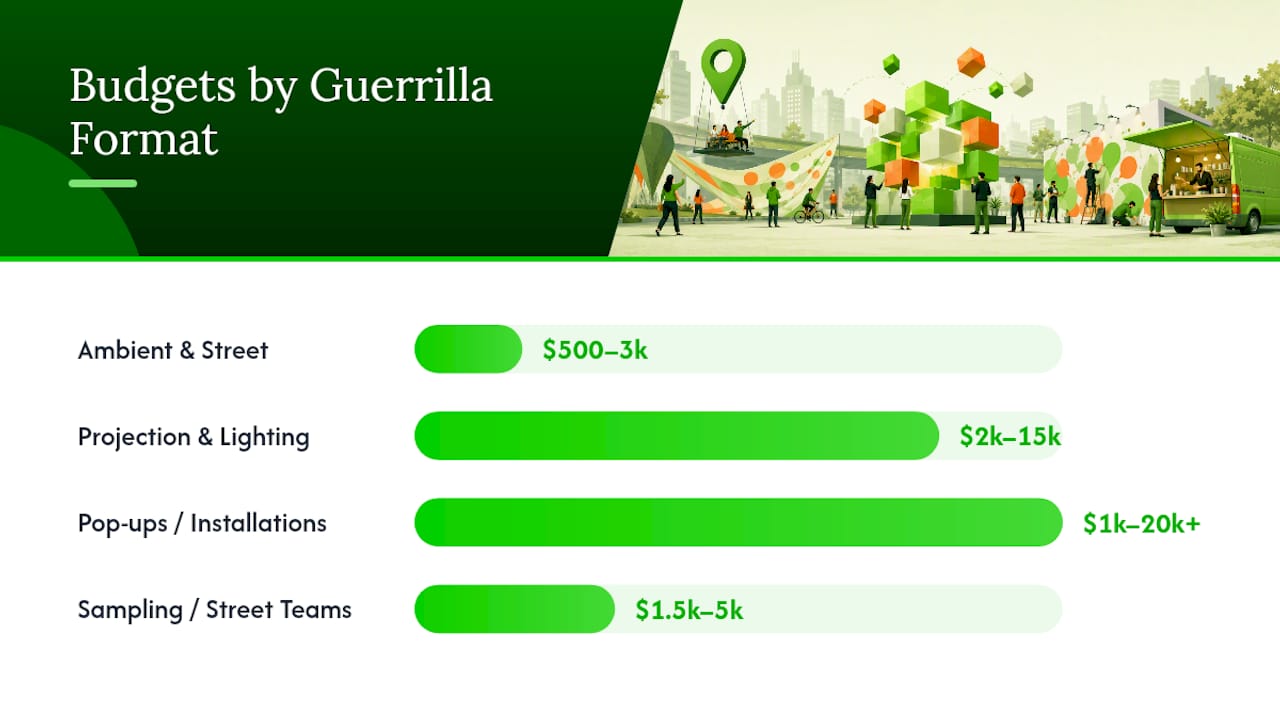
Ambient and street-level tactics. Reverse graffiti (cleaning a logo or message into a dirty sidewalk or wall with pressure washing) sidesteps most anti-graffiti ordinances since you're removing dirt, not adding paint. Budget: $500 to $3,000 depending on surface size and crew time. Chalk art on public sidewalks costs even less, often under $500 in materials and labor, and works well outside coffee shops, farmers markets, or transit stops. Neighborhood poster waves, coordinated flyer drops across a defined radius, cost little but need real design discipline so they read as intentional art rather than clutter.
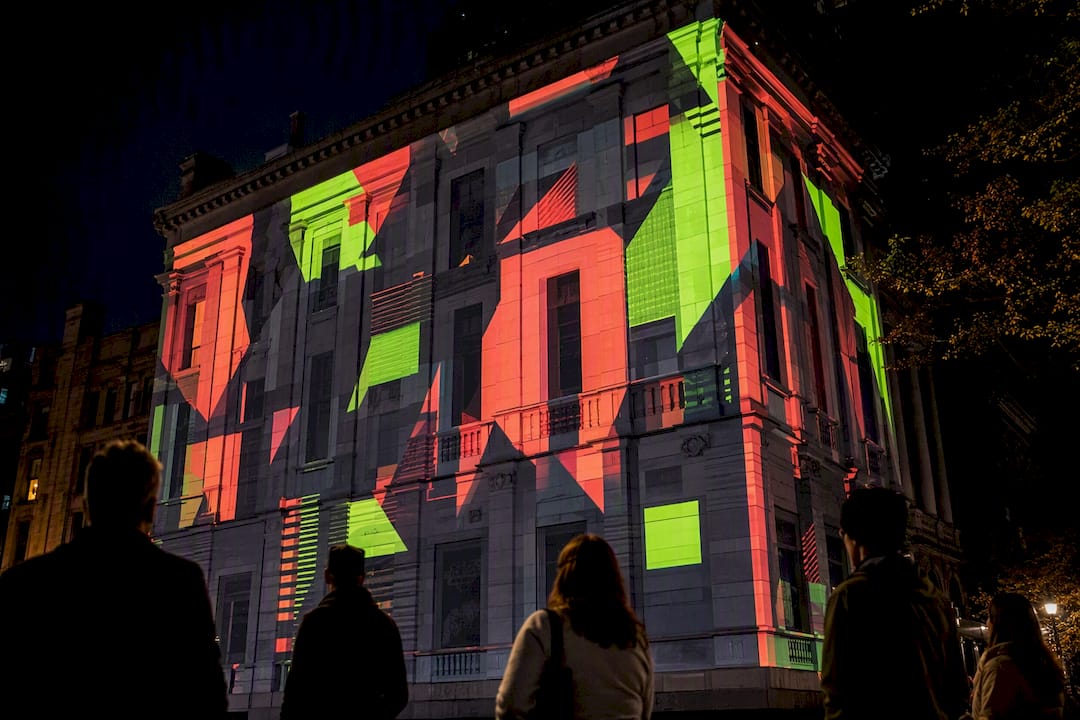
Projection and lighting. Projection mapping onto a building facade after dark turns a static wall into a moving billboard, typically running $2,000 to $15,000 depending on projector power and permitting. Adding a QR code to the projected image lets viewers act immediately, turning a passive light show into a trackable lead source. This tactic shines for nighttime events, product launches, or anniversary campaigns in dense downtown corridors.
Pop-ups and installations. A one-day or one-weekend micro pop-up, a branded kiosk in a parking lot or empty storefront, runs anywhere from $1,000 for a DIY tent setup to $20,000+ for a fully built installation with staff and signage. Branded seating or photo-op installations (an oversized chair, a mural with a cutout, a colorful bench) cost less and generate ongoing organic content because people keep sitting in them long after your team packs up. Partnering with a signage specialist for durable, weather-resistant builds, the kind covered in Arrowhead Sign Company's guide to engaging product displays, keeps a temporary installation from looking cheap in photos.
Sampling and street teams. Commuter sampling at transit stations or busy intersections during morning and evening rush hours costs $1,500 to $5,000 for a half-day team of five to eight brand ambassadors, plus product cost. Event-based street teams working outside a competitor's storefront, a festival gate, or a stadium entrance follow the same cost logic but need tighter choreography since foot traffic moves in bursts.
Mobile formats. LED trucks and wrapped branded vehicles let you bring the activation to the audience instead of waiting for foot traffic to find you. A single-day LED truck rental runs $1,500 to $4,000 in most metro markets; a fully wrapped vehicle used for weeks or months at events amortizes that cost fast. These work especially well for multi-location campaigns where you need the same message to hit several neighborhoods in one day.
Social-first and UGC tactics. This is where the biggest reach numbers show up. Dove's r/eal Reviews campaign took unedited, unfiltered consumer reviews from Reddit and blew them up onto physical billboards and social channels, generating more than 1 billion impressions. The lesson isn't the billboard, it's the source material: authentic, unpolished audience content amplified through paid and earned channels beats studio-produced ads for trust. A small business version of this might mean printing a genuine customer quote on a sandwich board outside the shop, or running a "worst review, best comeback" social series. Budget for the small-business version: typically under a few hundred dollars.
Stunts and experiential spectacles. Flash mobs, queue-turning activations (making a line for something ordinary suddenly feel like an event), and timed spectacles synced to a live event draw crowds and cameras fast, but they carry the highest execution risk and usually the highest cost, from $5,000 for a scrappy flash mob to six figures for a Red Bull style stunt-based activation with full production and safety crews. These need the most planning lead time and the tightest coordination with local authorities.
- Under $500: chalk art, sandwich-board UGC quotes, DIY photo props
- $500 to $5,000: reverse graffiti, commuter sampling, poster waves, LED truck rental
- $5,000 to $20,000: projection mapping, branded pop-ups, small flash mobs
- $20,000+: multi-city mobile tours, full-production stunts, large-scale installations
Pro Tip: Before you greenlight any idea on this list, ask whether it photographs well from a phone held at chest height. If the answer is no, redesign it. Most of the reach from guerrilla campaigns now comes from someone else's camera, not yours.
How to Pick the Right Tactic for Your Goal and Budget
Match the tactic to the objective first, the budget second. A projection mapping display looks spectacular but does almost nothing for lead capture if there's no clear next action built in. Work through this checklist before you commit to a format:
- Define the single goal. Awareness, sampling and lead capture, or foot traffic. Pick one primary goal; secondary benefits are fine, but a campaign trying to do all three usually does none of them well.
- Know your audience's rhythm. Guerrilla tactics work best when they intercept people during predictable pockets of time, like commute corridors or event queues, rather than hoping random passersby notice you.
- Confirm the location supports the tactic. A projection needs a flat, permission-cleared surface after dark. A pop-up needs foot traffic and either a lease, a permit, or a friendly landlord.
- Decide the measurement plan before production starts, not after the event wraps.
Three stacks that consistently work for common goals:
- Awareness stack: projection mapping + social-first UGC amplification + a poster wave in the surrounding blocks. Budget range: $3,000 to $18,000.
- Sampling and lead capture stack: commuter sampling + a dedicated landing page with a QR code + a follow-up email sequence. Budget range: $2,000 to $7,000.
- Foot traffic stack: branded pop-up + LED truck driving the surrounding neighborhood + a limited-time in-store offer tied to a coupon code. Budget range: $4,000 to $22,000.
Before production, answer these four questions in writing: Who exactly will be present to see this? Where precisely does it happen, down to the block or intersection? What's the single action you want a viewer to take next? How will you know it worked? Practitioner guides consistently find that operational realism, knowing the answers to those four questions cold, predicts success far better than the cleverness of the concept itself.
Pro Tip: If you can't answer the "next action" question in one sentence, the idea isn't ready for production. "People will see it and remember our brand" is not a next action.
Permits, Safety, and Reputation Checks Before You Launch
Most guerrilla marketing ideas need some level of permission, even the ones that feel spontaneous. Chalk art and reverse graffiti on public sidewalks often fall under municipal right-of-way or public art rules, so a quick call to your city's public works or arts office before you set up saves you from a shutdown mid-activation. Pop-ups and vehicle-based activations, including LED trucks, typically need a temporary vending permit or a special event permit, and private property installations need written landlord or business owner sign-off, not a verbal handshake.
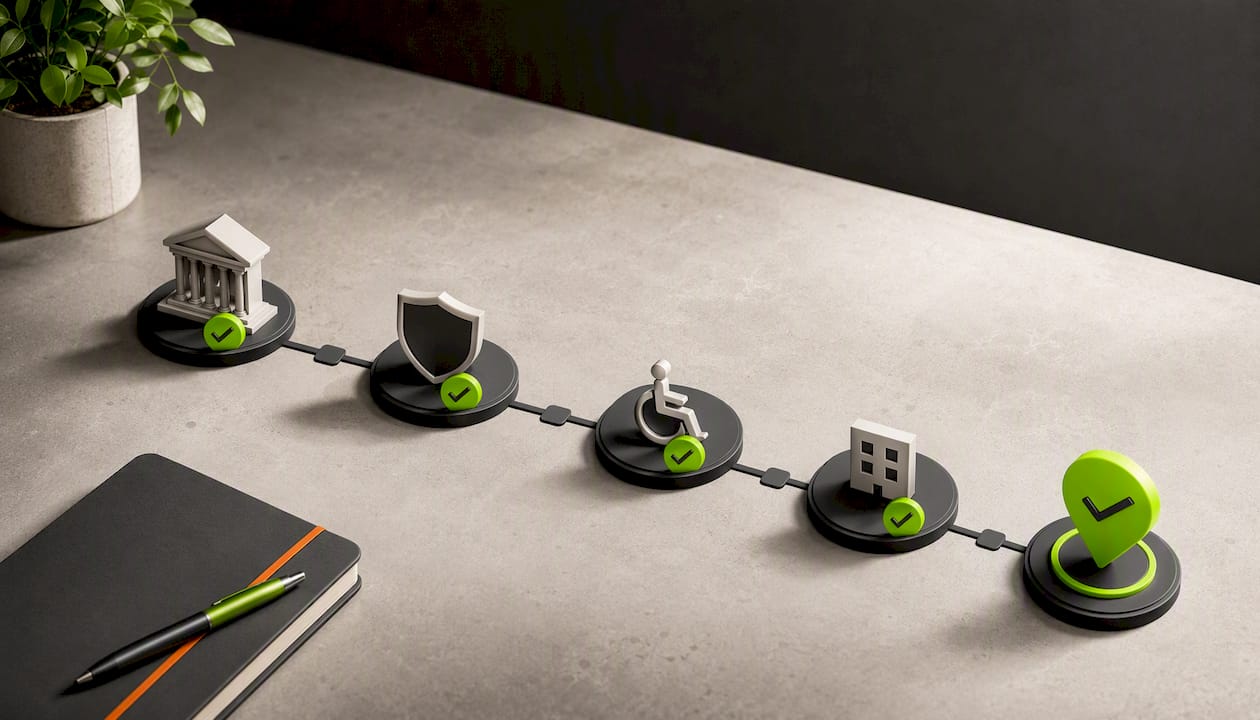
Carry general liability insurance for any activation involving crowds, staff, or vehicles. It's usually inexpensive relative to campaign cost and it's the first thing a city inspector or property manager will ask about. For crowd-drawing formats like flash mobs or queue-turning stunts, plan sightlines and exits the way an event producer would, and think through accessibility: can someone in a wheelchair or with a stroller move through the space you're activating?
Reputation risk deserves its own line of thinking. A stencil on private property without permission reads as vandalism, not creativity, no matter how good the design is. Favor tactics that are community-first by design, sanctioned reverse graffiti, commissioned murals, sampling that gives something of real value away, over anything that could be mistaken for defacement or a public nuisance. A campaign that goes viral for the wrong reason isn't a win.
How to Measure a Guerrilla Marketing Campaign
The metrics that matter are earned impressions, QR/link scans, user-generated content volume, foot traffic lift, and search demand uplift in the days following the event. Build measurement into the activation itself rather than trying to reconstruct it afterward. A dedicated landing page or shortlink with UTM parameters tells you exactly how many people acted on what they saw. Event-specific coupon codes tie foot traffic and sales directly back to the campaign.
Given how saturated mobile usage already is in the United States, assume most engagement will happen on a phone, and design your tracking accordingly: a QR code, a text-to-join number, or a short memorable URL rather than a long one people have to retype. To estimate earned media value, tally organic social mentions and impressions, then compare that reach against what an equivalent paid placement would have cost. Report both the raw numbers and that comparison to stakeholders, since the earned media multiple is usually the number that makes budget conversations easier next time.
Real Examples Worth Studying
Dove's r/eal Reviews campaign is the clearest recent proof that authenticity scales. By taking unfiltered Reddit reviews and blowing them up onto billboards and social feeds, Unilever generated more than 1 billion impressions without scripting a single line of ad copy. The creative wasn't the agency's voice, it was the audience's, amplified through paid and owned channels. That's a repeatable structure for a business of any size: find your best unfiltered customer language and give it a bigger stage.
Stunt-led brands like Red Bull operate at the opposite end of the spectrum, building large-scale, physically demanding activations (cliff dives, air races, sponsored extreme sports events) that take months of planning, dedicated safety crews, and PR teams ready the moment cameras start rolling. The lesson for smaller brands isn't to copy the scale, it's to copy the discipline: nothing gets filmed until permits, insurance, and a press plan are locked.
A few lessons from running local activations across South Florida markets:
- Multi-site campaigns need a single point of contact coordinating permits across each municipality, since requirements rarely match city to city.
- The strongest earned media usually comes from the activation's second life on social, not the day-of foot traffic.
- Local business partners are far more willing to say yes to a pop-up or sampling event when you bring your own insurance documentation upfront.
Tailoring Guerrilla Campaigns to Local and Cultural Context
A tactic that reads as playful in one neighborhood can read as tone-deaf or intrusive in another, and the businesses that get this wrong usually didn't ask a local resident to look at the creative before it went live. Sampling in a commuter corridor near a house of worship needs different timing than the same tactic outside a college campus. Chalk art referencing local slang or landmarks lands better than generic brand copy, but only if someone who actually lives there confirms the reference is accurate and welcome.
Language matters as much as imagery. If your market includes a significant population that speaks a language other than English at home, bilingual signage or bilingual street team staff isn't a nice extra, it's the difference between an activation that includes the neighborhood and one that talks past it. Religious holidays, local elections, and community events also shift what's appropriate; a stunt-style activation during a solemn civic moment can generate backlash instead of buzz.
The safest process is simple: involve someone from the community you're activating in during creative review, not after the concept is finalized. Ask specifically whether anything in the visual, the language, or the timing could be read as dismissive, appropriative, or out of step with the neighborhood's own tone. That one extra review step costs almost nothing and prevents the kind of reputational damage that no amount of earned media can undo.
When to Hire an Agency vs. Run It Yourself
A single chalk art moment or a sandwich-board UGC quote is a fine DIY project. The math changes once you're running multi-site activations, coordinating vehicles, or leaning on a stunt-style format where a permit mistake or a safety lapse becomes a headline for the wrong reason.
What a agency actually handles that's hard to replicate solo: simultaneous permitting across multiple jurisdictions, PR relationships ready to amplify the moment it happens, and measurement infrastructure built before day one instead of stitched together after. Mobile truck logistics alone, routing, fuel, driver scheduling, wrap production, eat up more coordination time than most in-house teams expect.
Before hiring, ask any agency three things: How do you handle permitting across multiple cities in one campaign? What does your measurement report actually look like, with a sample? Who handles crisis response if the activation draws the wrong kind of attention? The answers tell you more than the pitch deck does.
— E
Get a Guerrilla Campaign Built for Your Market, Not Just an Idea List
Crowdcompany is the alternative to piecing together permits, vendors, and measurement tools yourself. We run guerrilla marketing and mobile truck activations alongside digital PR so the earned media side of your campaign is built in from day one instead of bolted on afterward.
Our approach starts with an intake call to nail down your goal and budget bracket, moves into a pilot activation sized to test the concept before you scale it, and closes with a measurement plan agreed on before we build anything. If you're weighing us against other options, our agency comparison page breaks down where we differ. For businesses in South Florida specifically, our guerrilla marketing team in Miami Beach already knows the local permitting offices by name. Book an intake call to get a pilot scoped for your goal and budget.
Sources
The claims and figures in this article draw from a small set of primary sources worth reading directly. Unilever's own coverage of the Dove r/eal Reviews campaign details the billion-plus impression figure and the mechanics behind it. National University's overview of guerrilla marketing strategies traces the term back to Jay Conrad Levinson's 1984 coinage. For the operational discipline that separates working campaigns from expensive stunts, American Guerrilla Marketing's practitioner guide is worth a full read, not just the excerpt cited above.
- How Dove turned Reddit’s honesty into unmissable marketing | Unilever
- Guerrilla marketing strategies | National University blog
- Guerrilla marketing ideas that actually work for brands in 2026 | American Guerrilla Marketing